Author: FinTax
For the same ASIC mining rig, on financial statements, this cost may need to be depreciated over two to three years, but on the U.S. federal tax return, its eligible tax basis may be deducted entirely in the first year.
On July 4, 2025, H.R.1 became Public Law 119-21. Section 70301 amended IRC §168(k), permanently reinstating the 100% additional first-year depreciation deduction (commonly known as bonus depreciation) for qualified property. The IRS further clarified in Notice 2026-11 that this rule generally applies to qualified property acquired and placed in service after January 19, 2025.
However, 100% bonus depreciation does not mean that all mining rig costs can be fully deducted in the acquisition year. The actual tax treatment still depends on asset classification, acquisition timing, and when the asset is placed in service.
I. Characteristics of Depreciation for Mining Equipment
ASIC mining rigs used for self-operated mining and meeting the recognition criteria under IAS 16 are typically capitalized by listed mining companies as mining equipment under Property, Plant, and Equipment (PPE) and depreciated over their estimated useful lives.
IAS 16 requires that the depreciable amount of an asset be allocated systematically over its useful life. When determining the useful life, factors such as expected usage, physical wear and tear, technical or commercial obsolescence, and legal or similar limitations must be considered. The useful life of an asset is based on its expected utility to the enterprise, which may therefore be shorter than the asset's economic life. The depreciation method is reviewed at least at each financial year-end, and if there is a significant change in the expected pattern of consumption of future economic benefits, it is treated as a change in accounting estimate.
However, for mining rigs, the fact that equipment is still operational does not mean it is economically rational to continue its operation. When a new generation of ASICs increases computing power and energy efficiency, older machines require lower electricity prices to maintain marginal profitability; increases in total network hash rate and mining difficulty can also reduce the expected output per unit of computing power.
The actual useful life of a mining rig depends more on its ability to generate economically valuable computing power at a sustainable cost. A generation of equipment may technically run for 5 years, but if a company expects that after 3 years its energy efficiency will be insufficient to remain economically viable at its electricity cost level, a 3-year accounting life may better reflect the actual usage pattern. Conversely, if electricity costs are low, equipment maintenance is good, or the model remains competitive over a longer cycle, the estimated useful life may also be longer.
The accounting practices of listed mining companies also reflect the trend of shorter economic useful lives for mining rigs. Bitdeer Technologies Group disclosed in its 2025 Form 20-F that starting July 2025, the estimated useful life for the majority of its mining rigs was adjusted to 2 to 3 years, down from 2 to 5 years previously. Argo Blockchain plc disclosed in its 2025 Form 20-F that mining rigs are typically depreciated on a straight-line basis over an estimated useful life of 36 to 48 months.
The depreciation period for mining rigs is essentially an accounting estimate made by the enterprise based on the asset's expected economic usage period; there is no fixed period universally applicable to all mining rigs. Companies need to consider factors such as the rig model and generation, energy efficiency, changes in hash rate difficulty, equipment replacement plans, and estimated residual value to determine the period over which the asset can continue to generate economic benefits. As mining rig iterations accelerate, such estimates are more prone to change. Therefore, companies need to establish sufficient, reviewable bases and continuously assess whether estimates of useful life, residual value, and depreciation methods remain appropriate.
II. 100% Full Depreciation under U.S. Federal Tax Law
The core change on the U.S. federal tax side stems from Public Law 119-21. This policy applies to a broad range of qualified depreciable property, not just crypto mining rigs. The IRS lists qualified property as including depreciable property subject to MACRS with a recovery period of 20 years or less, covering both new and some used property that meets the conditions. For mining companies, whether a rig qualifies for 100% full depreciation first requires confirming the asset's tax classification, acquisition and in-service dates, user entity, and other applicable conditions. Merely signing a purchase order or completing payment does not equate to being placed in service; the IRS generally requires that the asset be ready and available for its specific use.
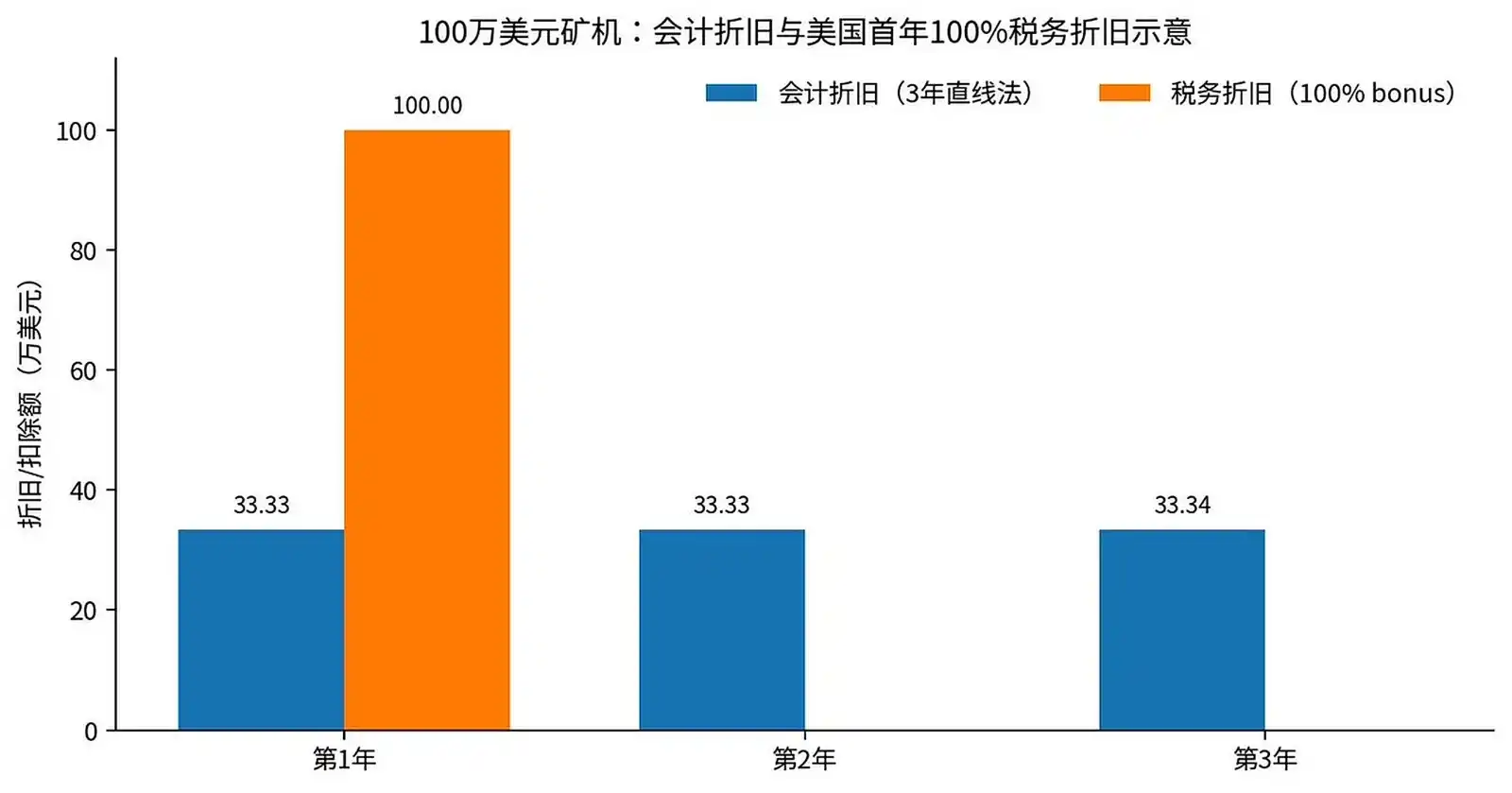
Once a mining rig meets the applicable conditions, it can generate significant tax timing advantages for the miner. Assume a mining company purchases $1 million worth of mining rigs. For accounting purposes, using a 3-year straight-line depreciation, it would recognize approximately $333,000 in depreciation expense annually. If it qualifies for 100% full depreciation under U.S. federal tax law, the entire $1 million eligible tax basis can be deducted in the first year. For companies with higher current profits, front-loading this deduction can reduce current taxable income and cash tax liability.
III. In Loss Years, Spreading Depreciation May Be More Valuable
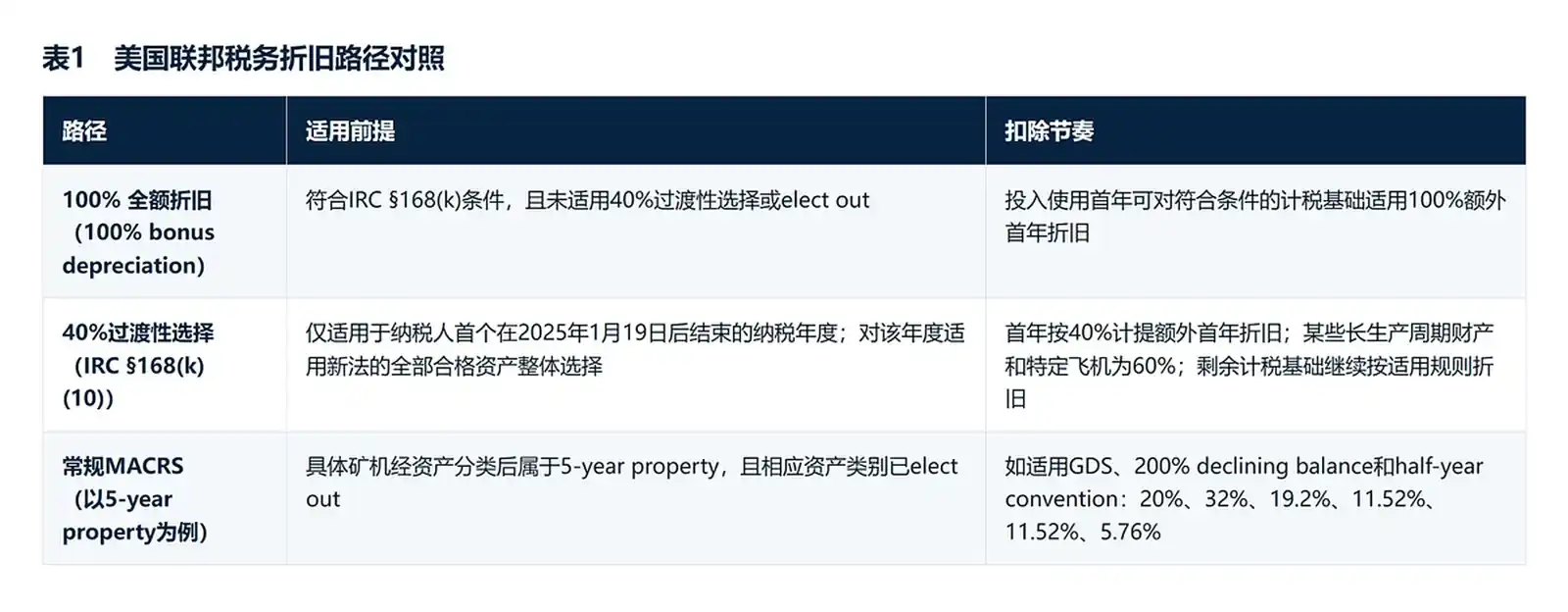
Pursuant to relevant provisions in IRC§168(k)(7), a taxpayer may elect out of the first-year full depreciation for a class of property. This election applies to all qualified property within that class placed in service during that tax year, not just selected individual pieces of equipment.
Besides electing out or simply forgoing 100% full depreciation, the new law also provides a transitional election. IRC§168(k)(10) states that for the first tax year beginning after January 19, 2025, a taxpayer may elect to claim a 40% additional first-year depreciation (60% for certain property with a longer production period and certain aircraft) for property qualified under the new law.
If a taxpayer elects out of 100% full depreciation for a class of property, cost recovery follows the regular MACRS rules. Whether a mining rig falls into the 5-year property class requires identifying its specific asset classification. If a mining rig is classified as 5-year property and uses the common GDS, double-declining balance method with a half-year convention, the standard rates from Publication 946 are 20%, 32%, 19.2%, 11.52%, 11.52%, and 5.76%. Actual cost recovery would span six tax years.
Whether a company elects 100% first-year full depreciation depends on the impact of the timing of the depreciation deduction on its overall tax liability and cash flow. For companies with higher current-year profits, accelerating depreciation deductions typically reduces taxable income and cash tax earlier. When already in a tax loss position, adding more depreciation may only increase net operating losses (NOL) without a corresponding immediate reduction in cash taxes. For regular C corporations (taxed as separate entities), NOLs generated after 2017 are generally subject to an 80% taxable income limitation when carried forward to future years. Furthermore, NOLs existing prior to an ownership change may face additional limitations on usability. Therefore, the decision to use 100% full depreciation should involve comprehensive modeling considering future profitability, NOL usability, time value of money, class property elections, and other tax law limitations.
IV. How Tax-Accounting Differences Are Reflected on the Books
When the book value of an asset exceeds its tax basis, a taxable temporary difference arises, typically leading to the recognition of a deferred tax liability.
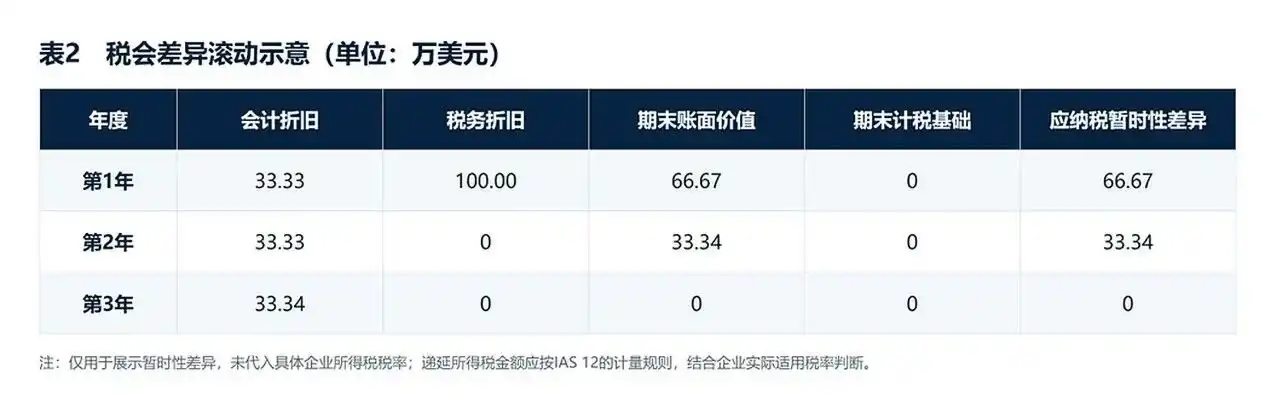
Using a batch of mining rigs costing $1 million with zero residual value as an example, assume straight-line depreciation over 3 years for accounting. At the end of the first year, accounting depreciation is approximately $333,333, leaving a book value of $666,667. If the rigs qualify for the U.S. 100% full depreciation and the entire $1 million tax basis was deducted in the year they were placed in service, their tax basis has been reduced to zero.
At this point, a taxable temporary difference of $666,667 exists between the $666,667 book value and the zero tax basis, leading to the recognition of a corresponding deferred tax liability. The specific amount of the deferred tax liability is calculated by applying the enacted or substantively enacted tax rate expected to apply when the temporary difference reverses to that temporary difference.
In the second and third years, accounting depreciation continues, but no corresponding tax depreciation is generated as the tax cost was fully deducted in year one. As the book value of the rigs declines each year, this taxable temporary difference and the related deferred tax liability will gradually reverse.
Therefore, 100% first-year tax depreciation does not simultaneously shorten the accounting life of the mining rig to one year. The financial statements still reflect the estimated pattern of consumption of the economic benefits of the equipment, while tax returns follow the cost recovery schedule permitted by tax law. In practice, the purchase cost, in-service date, accounting life, tax asset class, and deducted amount for the same piece of equipment must be traceable and correspond.
V. Regional Differences in Tax Treatment of Mining Rigs
The U.S. 100% full depreciation offers mining companies faster cost recovery and retains the option to elect out of accelerated deductions. However, in Ethiopia and Kazakhstan, mining rigs generally need to recover costs over time according to local asset classifications and statutory depreciation rules, with relatively less flexibility in tax treatment.
Ethiopia's *Federal Income Tax Proclamation* (Council of Ministers Regulation No. 410/2017) manages depreciation by category. For computers, software, and data storage equipment, it prescribes a straight-line rate of 20% or a diminishing balance rate of 25%. In a simplified example, if a company uses a 3-year straight-line method for financial reporting, and the local tax classification ultimately supports classification as computing equipment using the straight-line method, then for a $1 million asset, first-year accounting depreciation would be approximately $333,333, while tax depreciation would be approximately $200,000. The tax deduction is actually slower than accounting depreciation. The year-end tax basis would be approximately $800,000, higher than the approximately $666,667 book value, which in direction would create a deductible temporary difference. This outcome stands in stark contrast to the U.S.
Kazakhstan's new *Tax Code* (No. 214-VIII) was signed on July 18, 2025, and took effect from January 1, 2026. According to a tax summary updated in July 2026, tax depreciation primarily uses the diminishing balance method, generally dividing fixed assets into four groups: general machinery and equipment up to 25%, computers and information processing equipment up to 40%. If mining rigs are classified into different asset groups, the speed of tax cost recovery will also vary accordingly.

Conclusion
The treatment of mining rig depreciation first requires clarity on both accounting and tax bases. For accounting, a reasonable estimated useful life should be determined considering factors such as equipment generation, energy efficiency, and expected operating cycles. For tax, using U.S. federal tax law as an example, it's necessary to determine whether the relevant equipment qualifies under IRC§168(k) and accordingly decide whether to apply 100% full depreciation, the 40% transitional policy, or elect out. For mining rigs deployed in other jurisdictions, re-evaluation based on local asset classification and depreciation rules is also required.
In practice, the key is ensuring that accounting and tax treatments correspond. This requires companies to maintain information in their fixed asset registers such as equipment model, acquisition cost, in-service date, estimated useful life, and tax asset class, providing a consistent data foundation for related processes like deferred tax calculation. As mining rigs update quickly, useful lives, operational plans, and applicable tax rules may change frequently. Therefore, companies need to conduct periodic reviews and promptly update accounting estimates and tax judgments.