American Federation Of Teachers Opposes Crypto Market Structure Bill In New Letter

bitcoinistPublished on 2025-12-11Last updated on 2025-12-11

Abstract

The American Federation of Teachers (AFT) has formally opposed a proposed crypto market structure bill, urging the Senate Banking Committee to reconsider the legislation. In a letter, AFT President Randi Weingarten called the bill “irresponsible” and “reckless,” warning it could endanger pension funds and retirement plans like 401(k)s by exposing them to volatile and potentially fraudulent crypto assets. She highlighted a provision allowing non-crypto companies to issue stock on blockchain, bypassing existing securities regulations, which could lead to “disastrous outcomes.” The AFT’s opposition aligns with concerns from other groups, including the AFL-CIO and several Democratic senators, who fear the bill may weaken investor protections and potentially trigger another financial crisis. Progress on the bill has been delayed, but a new draft is expected for review soon.

The American Federation of Teachers (AFT) has formally added its voice to the growing opposition against the proposed crypto market structure bill, urging the Senate Banking Committee to reconsider the legislation.

In a letter obtained by CNBC, AFT President Randi Weingarten described the bill as “as irresponsible as it is reckless,” citing the alleged dangers it poses to working families’ pensions and the overall economy.

AFT Calls Out Loopholes In Crypto Legislation

In her correspondence with Senate Banking Committee Chairman Tim Scott and Ranking Member Elizabeth Warren, who is known for her consistent skepticism toward digital assets, Weingarten expressed significant concern about the implications of the proposed legislation.

She stated that the current draft gives the AFT “deep concern” over the risks posed to retirement plans, including the union’s own pensions. Weingarten argued that advancing the crypto legislation could open the door to “widespread fraud” and “unethical practices” within retirement schemes.

Weingarten alleged that the bill “misleadingly” portrays cryptocurrencies as stable and mainstream, despite their volatility. She argued that rather than providing necessary safeguards. “If passed, it will undercut the safety of many assets and cause problems across retirement investments,” she noted.

Among the specific concerns raised by the AFT was a provision allowing non-crypto companies to issue their stock on the blockchain, thus evading existing regulatory frameworks for securities.

Weingarten warned that this loophole and the corresponding erosion of traditional securities laws could have “disastrous outcomes.” She noted that pensions and 401(k) plans may end up invested in unsafe assets, even when they are nominally traditional securities.

Additionally, she criticized the legislation for inadequately addressing the fraud and illegal activities that Weingarten believes remain prevalent in crypto markets, labeling it “irresponsible” and “reckless.”

Delays And Heightened Concerns

In the letter, Weingarten also stressed that if the bill were to become law, it could potentially set the stage for the next financial crisis. The AFT’s stance aligns with concerns previously expressed by the AFL-CIO, the nation’s largest labor union, which also opposed a draft of the crypto bill in October.

In line with Weingarten’s opposition, Democratic senators, including Warren, have raised concerns regarding the balance of regulatory oversight between the Commodity Futures Trading Commission (CFTC) and the Securities and Exchange Commission (SEC).

Massachusetts Secretary of State William Galvin reiterated these concerns in a letter, highlighting that the proposed legislation could exclude significant portions of the financial industry from state oversight, creating risks for millions of savers.

Progress on the Senate’s version of the crypto market structure bill has faced delays, partly attributed to the recent lengthiest government shutdown in US history.

Senator Lummis recently provided insight into potential timelines, indicating that her goal is to share a new draft by the end of the week. She plans to allow both the crypto industry and lawmakers from both parties to review the draft before moving forward with markup next week.

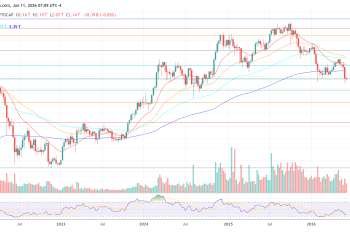
The daily chart shows the total crypto market cap valuation currently at $3.12 trillion. Source: TOTAL on TradingView.com

Featured image from DALL-E, chart from TradingView.com

Related Questions

QWhat is the main reason the American Federation of Teachers (AFT) opposes the crypto market structure bill?

AThe AFT opposes the bill because it believes the legislation is irresponsible and reckless, posing significant risks to working families' pensions and the overall economy by potentially opening the door to widespread fraud and unethical practices within retirement schemes.

QAccording to AFT President Randi Weingarten, what specific loophole in the bill could allow non-crypto companies to evade existing regulations?

AThe bill contains a provision that would allow non-crypto companies to issue their stock on the blockchain, thus evading existing regulatory frameworks for securities.

QWhich two major US regulatory agencies' balance of oversight is a point of concern for Democratic senators regarding this bill?

ADemocratic senators, including Elizabeth Warren, have raised concerns regarding the balance of regulatory oversight between the Commodity Futures Trading Commission (CFTC) and the Securities and Exchange Commission (SEC).

QWhat potential consequence does the AFT warn could occur if this crypto bill becomes law?

AThe AFT warns that if the bill becomes law, it could potentially set the stage for the next financial crisis.

QWhich other large labor union had previously expressed opposition to a draft of this crypto bill, as mentioned in the article?

AThe AFL-CIO, the nation's largest labor union, also opposed a draft of the crypto bill in October.

Related Reads

Can Generative Models Finally Be Trained End-to-End? The Core Is a For Loop

This article introduces a novel training paradigm for generative models called Explorative Modeling (XM), which enables true end-to-end training. Traditionally, powerful generative models like autoregressive and diffusion models are not trained end-to-end. They are trained to predict a single small step but require iterative multi-step sampling for inference. This "exposure bias" leads to error accumulation and limits performance. The core challenge XM addresses is "mode blurring." In generative tasks, a single input (e.g., "generate a dog") corresponds to many valid outputs (multiple modes). Standard training objectives like reconstruction loss force the model to average these modes, producing unrealistic, blurry outputs. To avoid this, existing models break generation into many small, almost deterministic steps, sacrificing end-to-end training. XM tackles this by restructuring the training loop itself. Its key insight is to amplify "generative expressivity." For each training input, instead of generating one sample, the model generates K candidate outputs. Only the candidate closest to the real data is used for computing the loss and updating the model via backpropagation. This simple "best-of-K" mechanism is implemented as a short for-loop. By exploring multiple possibilities, the model learns to distribute its guesses across different modes rather than collapsing to their uninformative average. The paper demonstrates that "exploration" acts as a new, powerful scaling axis. Gains from XM increase with model size, data scale, and compute. Experiments show improvements in FID scores for image generation and significant efficiency gains, sometimes outperforming larger models without exploration. When pushed to the limit, XM enables fully single-step, end-to-end generative models. In robotics tasks, an "Explorative Policy" matched the performance of a 100-step Diffusion Policy with a single forward pass, drastically improving inference speed. While the best-of-K concept is not entirely new, the authors' contribution lies in formally understanding it as a direct method to boost generative expressivity without fragmenting the generation process. This work suggests that as models scale, enhancing exploration during training may become crucial for overcoming fundamental performance bottlenecks.

marsbit10m ago

Can Generative Models Finally Be Trained End-to-End? The Core Is a For Loop

marsbit10m ago

Annual Salary of Millions Competing for Electricians, Meta Rushes to Open Its Own Technical School

The AI boom is facing an unexpected bottleneck: a severe shortage of skilled construction workers and electricians. As tech giants like Meta, OpenAI, and Alphabet race to build massive data centers—such as OpenAI's $16 billion "Stargate" project—they are hitting a critical labor wall. The U.S. needs an estimated 130,000 more electricians, 240,000 construction workers, and 150,000 supervisors by 2030 for AI infrastructure alone, but tens of thousands of electrician jobs go unfilled each year. While AI companies offer high premiums, with electricians earning up to $280,000 annually, worker scarcity still causes massive losses—delays on a single project can cost $14.2 million per month. The complexity of building AI data centers, which require immense power (equivalent to powering hundreds of thousands of homes), sophisticated electrical systems, and advanced liquid cooling solutions, demands highly skilled technicians who are in short supply. To combat this, companies are investing heavily in training. Meta has committed $115 million to a free training school offering tuition, housing, and stipends, targeting 5,000 new workers. OpenAI is partnering with unions to secure skilled labor. These efforts are paying off, with a significant rise in Gen Z interest in trade schools over college. However, the power demands are staggering. AI data centers are driving a rapid surge in electricity consumption, projected to account for up to 12% of U.S. power use by 2028 and raising costs for consumers. Furthermore, the construction boom is project-based, leading to a potential future glut of trained workers once building peaks, which could depress wages industry-wide. The race for AI supremacy now depends as much on skilled hands as on advanced chips.

marsbit1h ago

Annual Salary of Millions Competing for Electricians, Meta Rushes to Open Its Own Technical School

marsbit1h ago

Trading

Spot
活动图片