Allbridge exploit: Flash loans still haunt DeFi – $1.65M drained via USDC/USDT pool

ambcryptoPublished on 2026-07-20Last updated on 2026-07-20

Abstract

Allbridge, a decentralized cross-chain bridge, suffered a $1.65 million exploit after an attacker used a $1.12 million USDC flash loan to manipulate its USDC/USDT liquidity pool. By performing repeated swaps, the attacker distorted the pool's price ratio, allowing them to withdraw nearly $950,000 in USDT at a favorable rate. The stolen funds were then bridged from Solana to Ethereum. In response, Allbridge suspended its Core service and urged users to withdraw liquidity, causing its Total Value Locked (TVL) to drop sharply from $21.61 million to $12.78 million. The attack highlights ongoing vulnerabilities in DeFi pricing mechanisms and the need for enhanced security in cross-chain protocols as they attract significant capital.

Allbridge, a decentralized cross-chain bridge, suffered a $1.65 million exploit that forced the suspension of Allbridge Core. This is after the attacker secured a $1.12 million USD Coin [USDC] flash loan and later manipulated the USDC/USDT pool ratio.

That distortion let the attacker withdraw liquidity at favorable exchange rates before moving the stolen assets from Solana [SOL] to Ethereum [ETH]. Later on, the protocol quickly halted Allbridge Core and urged liquidity providers to withdraw funds from affected pools.
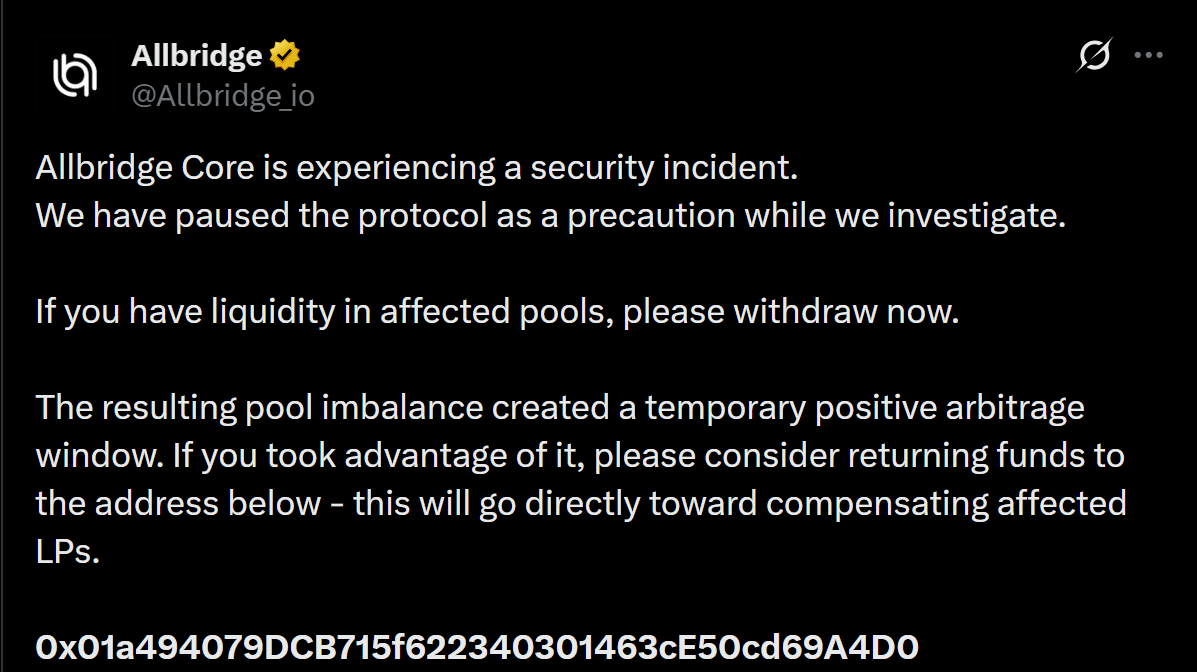
Source: X

Those measures aimed to limit further losses while developers investigated the cause of the breach. Instead of exploiting cross-chain transfers, the attacker targeted the bridge’s liquidity pricing mechanism.

This attack demonstrated that flash-loan-type exploits can still affect DeFi applications with robust security features.

Additionally, it highlighted the need for improved pricing resilience and protection of liquidity in cross-chain environments as they continue to grow and become increasingly attractive destinations for large amounts of capital.

Flash loan triggered the liquidity drain

The exploit unfolded after the attacker secured a $1.12 million USDC flash loan from Kamino. This enabled them to manipulate the Allbridge stable coin pool without risking their own capital.

Using the borrowed funds, the hacker then did repeated USDC to Tether [USDT] swaps. As a result, this caused distortion in the price of the stablecoin pool.
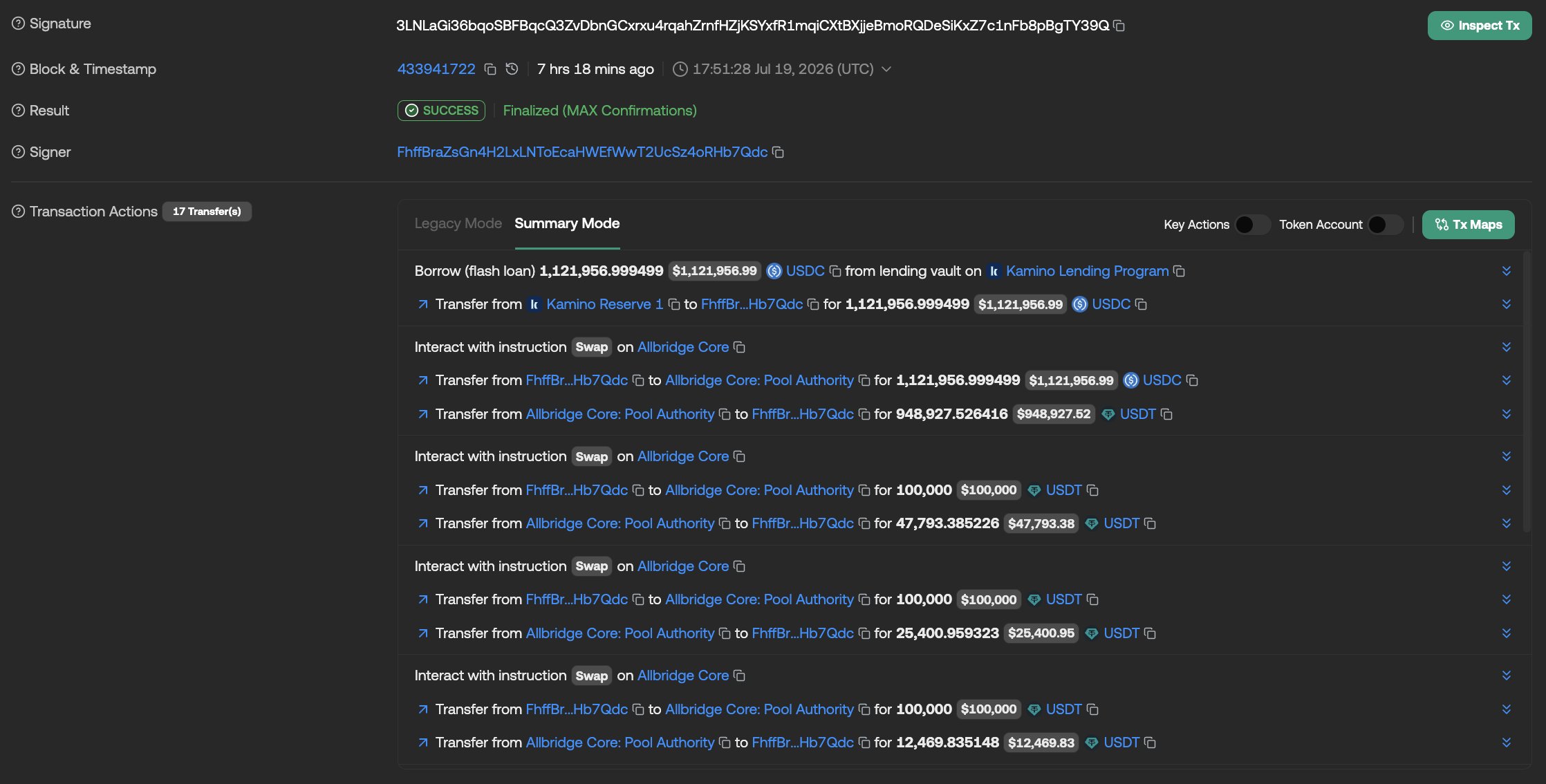
Source: X

As the imbalance widened, each swap increased the value available for withdrawal under the manipulated exchange ratio. The attacker capitalized on that window by extracting 948,927.53 USDT.

The transaction trail then recorded a $2.24 million USDC movement through the Allbridge bridge, illustrating how the manipulated liquidity quickly translated into one of the protocol’s largest single transfers before the funds moved beyond Solana.

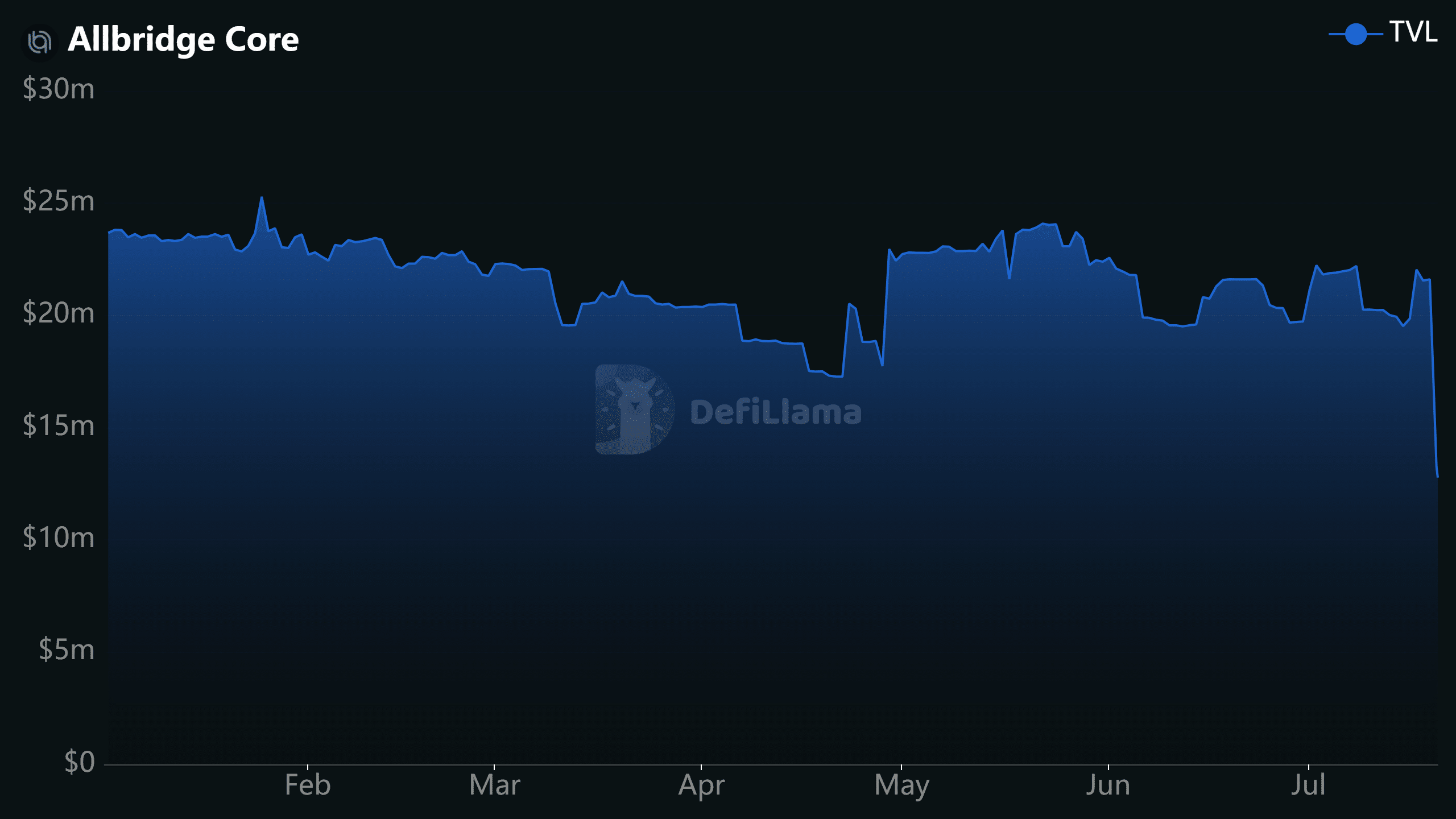
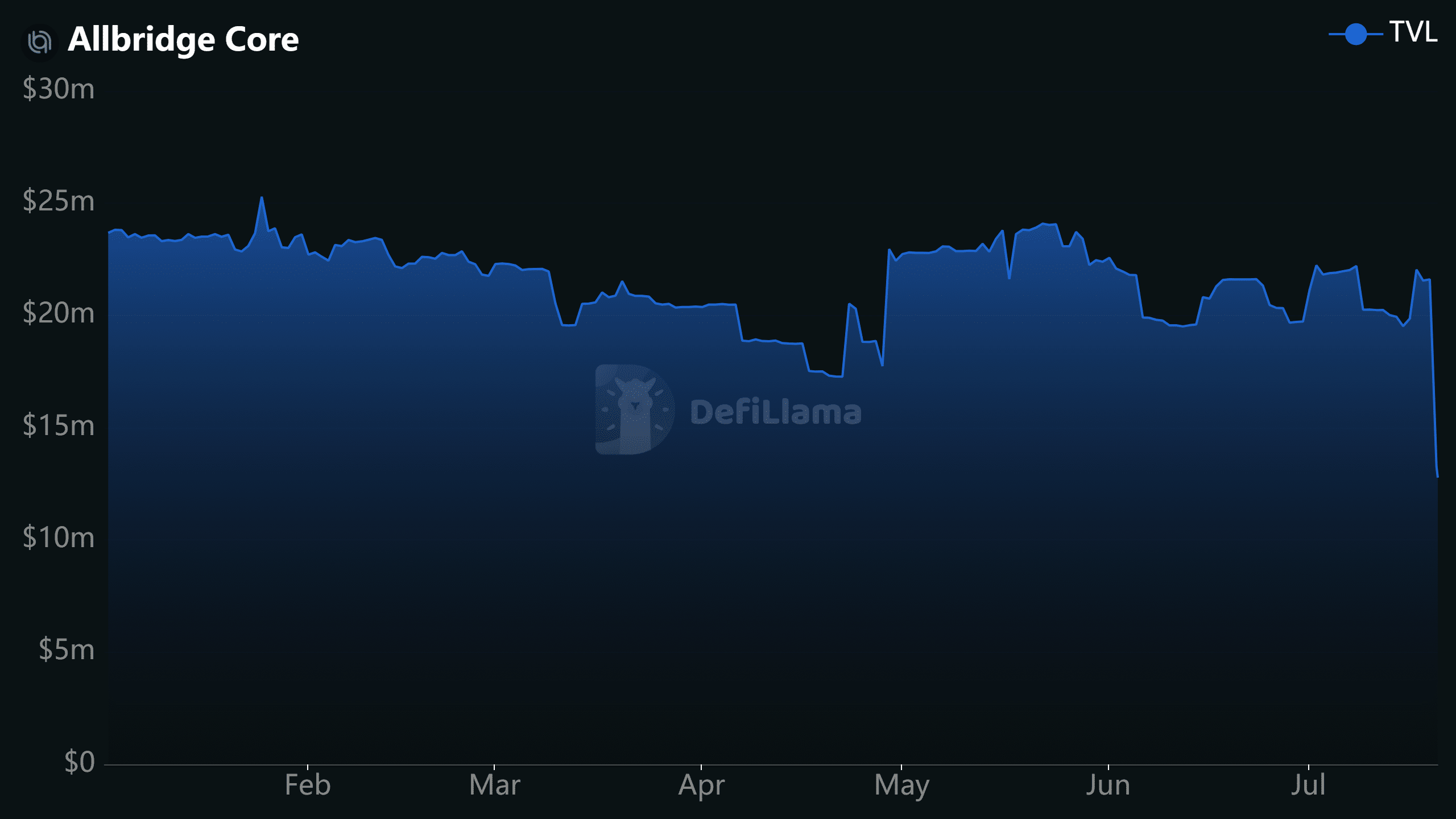
Allbridge Core’s TVL remained relatively stable near $21.61 million before the exploit disrupted liquidity conditions. However, the protocol’s suspension quickly accelerated withdrawals as liquidity providers responded to the heightened risk.
Source: DeFiLlama

That pressure pushed TVL sharply down to $12.78 million, marking one of its steepest single declines. The drop reflected more than lost funds because users also reduced capital exposure during the uncertainty.

Consequently, recovery now depends on restoring confidence through stronger security measures, transparent updates, and renewed liquidity participation. Sustained TVL growth will ultimately signal whether users trust the protocol again.


Final Summary

  • Allbridge’s $1.65 million exploit exposed how flash-loan attacks can manipulate bridge liquidity and pricing mechanisms.
  • Allbridge’s recovery now hinges on restoring TVL, strengthening security, and rebuilding user confidence.


Related Questions

QWhat type of financial attack was used to exploit Allbridge, and what was the initial method?

AThe exploit used a flash loan attack. The attacker initially secured a $1.12 million USDC flash loan from Kamino.

QWhat specific mechanism within Allbridge did the attacker target, and how did they manipulate it?

AThe attacker targeted the bridge's liquidity pricing mechanism. They used the borrowed funds to perform repeated USDC to USDT swaps, distorting the stablecoin pool's price ratio and creating an imbalance.

QWhat was the final amount drained from the protocol, and what specific asset was primarily withdrawn?

AThe attacker drained a total of $1.65 million from the protocol, primarily withdrawing 948,927.53 USDT by capitalizing on the manipulated exchange ratio.

QWhat was the immediate impact on Allbridge Core's Total Value Locked (TVL) following the exploit and protocol suspension?

AFollowing the exploit and suspension, Allbridge Core's TVL dropped sharply from approximately $21.61 million to $12.78 million, reflecting both lost funds and user withdrawals due to heightened risk.

QAccording to the article, what key factors are necessary for Allbridge's recovery after this exploit?

AAllbridge's recovery hinges on restoring TVL, implementing stronger security measures, providing transparent updates, and rebuilding user confidence to encourage renewed liquidity participation.

Related Reads

L2 'Recalibration': When L1 Becomes Its Own Rollup, What Is Ethereum's Endgame?

The article discusses the evolving relationship between Ethereum's Layer 1 (L1) and Layer 2 (L2) solutions, moving beyond the initial "L2 for scaling" model. As Ethereum L1 itself scales (increasing Gas Limit, statelessness, zkEVM), the unique value proposition of L2s shifts from merely providing cheap execution to offering differentiated features like application-specific optimization, privacy, and flexible governance. The piece explores three key themes: 1. **L2's New Role:** L2s are transitioning from a pure scaling technology to a spectrum of execution environments with varying degrees of security inheritance from Ethereum L1. 2. **Interoperability as State Trust:** Solving L2 fragmentation is less about cross-chain bridges and more about enabling faster, trust-minimized state verification between environments. This involves initiatives like faster L1 finality, intent-based architectures (Open Intents Framework), and native account abstraction. 3. **Blurring Layers:** With the potential integration of zk-proofs into L1 validation (making L1 akin to its own "Rollup") and the concept of "Native Rollups," the rigid boundary between L1 and L2 may fade. The future could be a unified system with multiple execution domains (for DeFi, gaming, privacy, etc.) sharing a common security, settlement, and state framework. In conclusion, Ethereum's goal is not to abandon L2s or re-centralize everything on L1, but to re-integrate the fragmented user experience—liquidity, accounts, applications—while preserving the scaling benefits of a multi-environment ecosystem. The endgame is a cohesive "one chain" feeling for users, powered by diverse but securely interconnected execution layers.

marsbit25m ago

L2 'Recalibration': When L1 Becomes Its Own Rollup, What Is Ethereum's Endgame?

marsbit25m ago

The Encryption Bill Clarity's Challenge: A Thorny Path of Bipartisan Compromise in the U.S.

U.S. lawmakers are attempting to advance the Clarity Act, a significant crypto market structure bill, but its path is fraught with partisan hurdles. The process has been rocky since January, when a prior bipartisan deal in the Senate Banking Committee was upended. A key compromise in May on "yield" issues allowed the bill to move forward in committee, but only with the conditional support of two Democratic senators, Angela Alsobrooks and Ruben Gallego. They emphasized that their final vote depends on reaching an agreement on ethics provisions for elected officials. Ultimately, the Senate Agriculture Committee passed its version along party lines without Democratic support. As Republicans push for a full Senate vote in July, the demand for strong ethics language has expanded beyond Democrats. Additional controversies surround provisions related to yields (aligning some Republicans with large banks) and developer protections (opposed by enforcement agencies). Core concerns about illicit finance and consumer protection remain central to the debate. Despite consensus on the need for legislation, achieving the necessary bipartisan compromise is proving difficult. While momentum exists—including recent meetings between senators and White House officials—a reconciled bill text faces skepticism. Senator Gallego has stated that without ethics terms acceptable to Democrats, they will not provide the needed votes. The immediate goals for the crypto community in Congress are unclear: a symbolic Senate vote before the August recess, eventual passage into law by 2026, or forging a final compromise framework. The arduous, vote-by-vote effort to build bipartisan support continues, mirroring the traditional legislative grind the industry must now navigate.

Foresight News1h ago

The Encryption Bill Clarity's Challenge: A Thorny Path of Bipartisan Compromise in the U.S.

Foresight News1h ago

Trading

Spot
活动图片