After the Tide Recedes, How Many Truly Resilient Crypto Projects Remain?

比推Published on 2026-02-05Last updated on 2026-02-05

Abstract

Title: After the Tide Recedes: How Many Truly Resilient Crypto Projects Remain? In a prolonged crypto market downturn, projects demonstrating pragmatic and realistic visions are proving most resilient. This analysis highlights three key examples: 1. **Hyperliquid** addresses immediate trading friction by offering a decentralized exchange (DEX) for perpetual contracts, combining CEX-like features (high leverage, fast execution) with on-chain transparency. Its sustained activity post-airdrop reflects genuine user adoption. 2. **Canton Network** targets institutional finance needs by providing a blockchain infrastructure with "selective privacy" for regulatory compliance and business confidentiality. Backed by partnerships like DTCC (handling ~$3.7 quadrillion annually), it enables seamless integration with traditional finance. 3. **Kite AI** builds infrastructure for a future AI-driven economy, developing tools like "Agent Passport" for identity verification and the x402 protocol for autonomous payments. While not yet widely deployed, its vision aligns with the anticipated rise of AI agents as economic entities. Key evaluation criteria for project viability include: - Solving a real, existing problem (not manufactured demand); - Structurally sound solutions (technically, legally, economically); - Team execution capability (resources, expertise, track record). Projects failing these tests may see short-term gains but likely collapse in downturns. The current market stress...

Source: Tiger Research

Author: Ekko & Ryan Yoon

Original Title: Realism Is the Only Answer in a Crypto Downturn

Compiled and Edited: BitpushNews


The cryptocurrency market continues to be in a prolonged downtrend. In such an environment, the projects that can survive are those that present pragmatic and realistic visions.

Core Points

<ul class="list-paddingleft-2" style="animation: 0s ease 0s 1 normal none running none; appearance: none; background-image: none; background-position: 0% 0%; background-size: auto; background-repeat: repeat; background-attachment: scroll; background-origin: padding-box; background-clip: border-box; border: 0px none rgb(31, 31, 31); inset: auto; clear: none; clip: auto; columns: auto; contain: none; container: none; content: normal; cursor: auto; cx: 0px; cy: 0px; d: none; direction: ltr; fill: rgb(0, 0, 0); filter: none; flex: 0 1 auto; float: none; gap: normal; hyphens: manual; interactivity: auto; isolation: auto; margin-bottom: 16px; marker: none; mask: none; offset: normal; opacity: 1; order: 极速执行以及通过 HLP 机制提供的稳定流动性——带入了链上环境。</p> <p>Early usage was partly driven by the demand for the $HYPE token airdrop. However, users remained highly active even after the airdrop ended, reflecting genuine recognition of the platform's performance. Ultimately, Hyperliquid's resilience stems from solving a persistent and real problem: user dissatisfaction with centralized exchanges.</p> <h3>Canton Network: Positioning for the Institutional Finance Era</h3> <p>Canton provides a solution targeting the near future. As interest in real-world assets (RWA) continues to grow, financial institutions have begun to view blockchain as a financial infrastructure, not just a public network. In this context, institutions need not complete data transparency, but a "selective privacy model" that supports regulatory compliance while protecting business confidentiality.
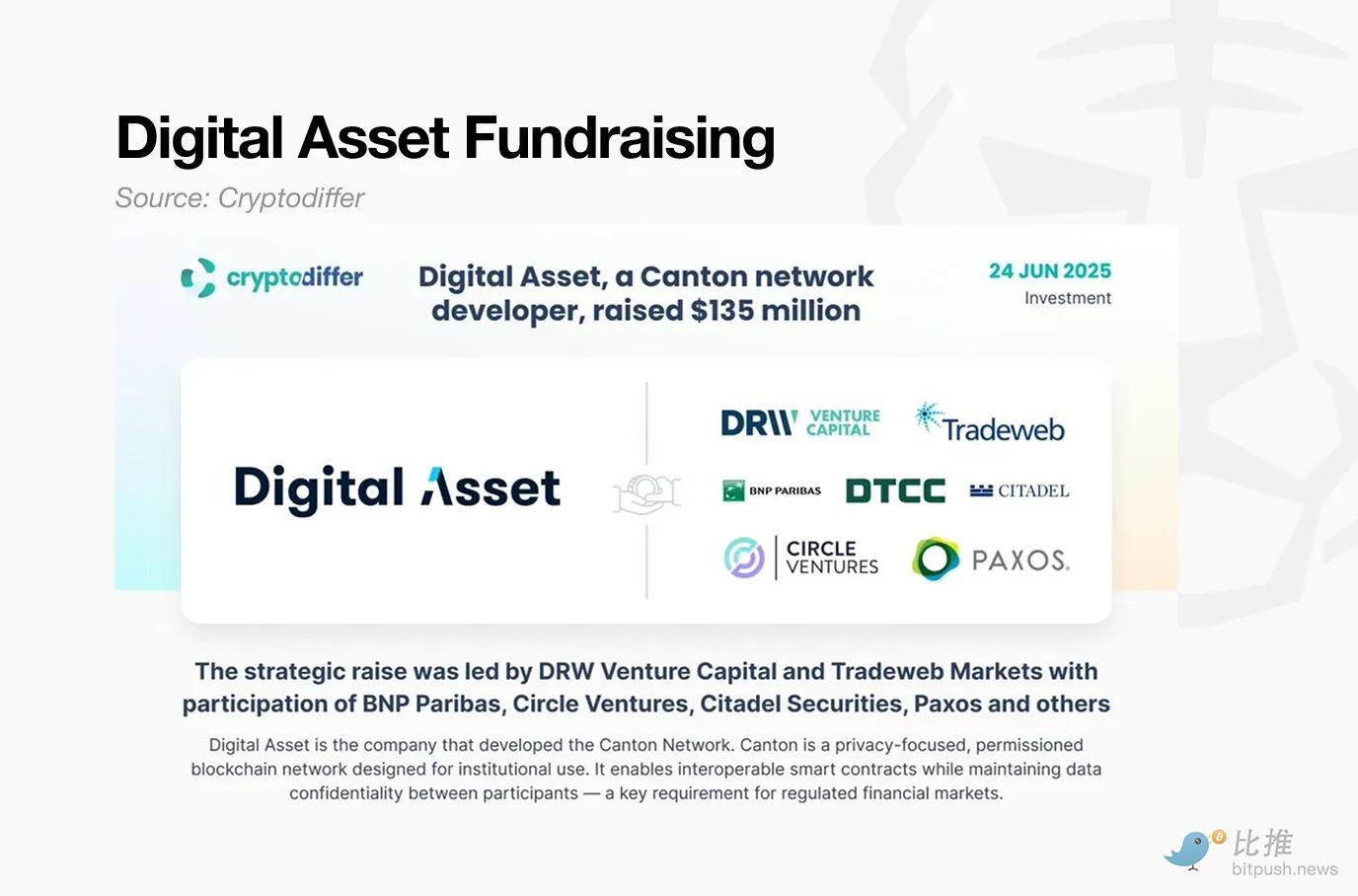
The Canton Network was born in response to these needs. Using the smart contract language DAML, Canton can provide customizable data disclosure schemes based on the needs of the participating parties.

This allows financial institutions to maintain transaction confidentiality while sharing information only to the necessary extent. Instead of强行推行 a technology-provider-led design, Canton has built infrastructure that highly aligns with institutional needs.

Another key factor is that Canton has aimed for "real-world deployment" from the start to expand its ecosystem, receiving early collaborative support from financial institutions. Most notably, its partnership with DTCC (The Depository Trust & Clearing Corporation) has established a channel for assets managed in the traditional financial system to enter the Canton environment. DTCC handles approximately $3.7 quadrillion in transactions annually, further validating the practical feasibility of the Canton Network's solution.

In the end, Canton provides a structured solution that simultaneously meets three major institutional requirements: privacy protection, regulatory compliance, and integration with the existing financial system.

Kite AI: Building the AI Economy That Has Yet to Arrive

Unlike the previous two examples, Kite AI currently has relatively limited application in the real world. However, viewed from the future perspective of "AI Agents operating as economic entities," its structural logic remains highly compelling.
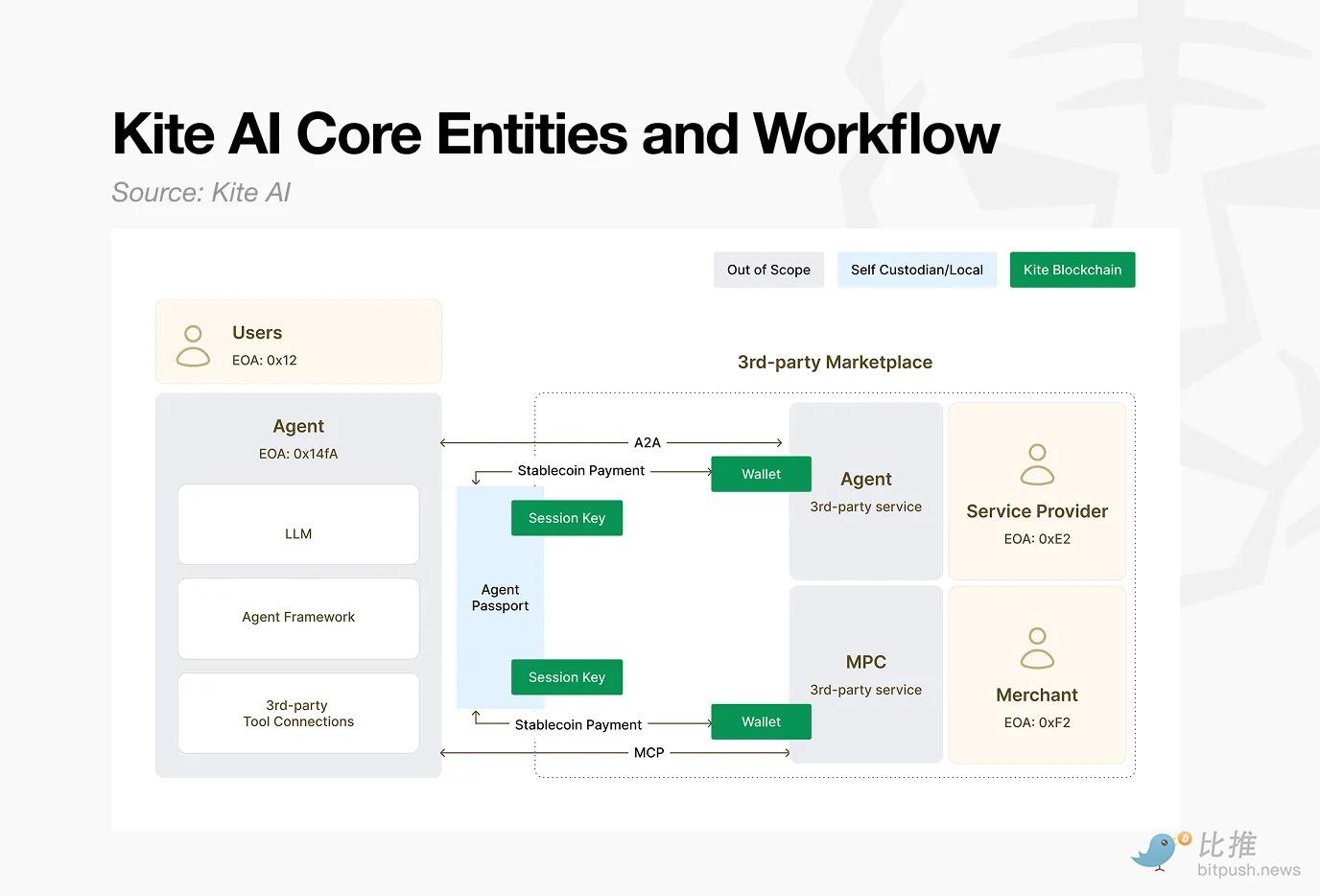
There is broad consensus, both in Web2 and Web3, on an "agent-driven future." Few would dispute that future AI Agents will handle tasks like booking hotels or ordering groceries on behalf of users.

However, realizing this future requires an infrastructure that allows AI Agents to independently initiate and execute payments. Existing transaction systems are designed around transfers between people and efficiency for human participants.

Therefore, for AI Agents to become autonomous economic entities, new mechanisms are needed, including identity verification and automated payment frameworks. Kite AI is building payment infrastructure specifically designed for this environment, with core components including the "Agent Passport" for identity verification and the x402 protocol for automated payments.

The vision presented by Kite AI is not yet ready for large-scale deployment, simply because the future it targets has not fully arrived. Nonetheless, the project's practical significance stems from a broader assumption: when this widely anticipated future arrives, the foundational technology it is developing will become a necessity. This alignment with macro trends gives the project structural credibility even with its current limited usage.

Three Key Questions for Assessing Practical Feasibility

Although these three projects operate on different timeframes, they share a common characteristic: real-world feasibility.

Evaluations of the same project often diverge: some believe it solves real problems, while others dismiss it as hype. To bridge this interpretative gap, we must ask at least three core questions:

  1. What specific problem is the project aiming to solve? (Is it a genuine pain point for users, or a need fabricated just to use the technology?)

  2. Is the proposed solution structurally feasible? (Does it hold up technically, in terms of compliance, and in its economic model?)

  3. Does the team have the capability to execute in reality? (Do they have relevant industry resources, technical expertise, and implementation experience?)

Since most projects promote optimistic future narratives, answering these questions correctly requires time and effort; filtering out misleading or incomplete information is not easy. Projects that cannot confidently answer these three questions might experience short-term price increases, but when the next downturn comes, they will likely perish with it.

The current state of the crypto market is clearly not optimistic. But this does not mean the industry is over. New experiments will continue, and our task is to assess what these efforts truly represent. Right now, keeping our feet on the ground is the only choice.


Twitter:https://twitter.com/BitpushNewsCN

Bitpush TG Discussion Group:https://t.me/BitPushCommunity

Bitpush TG Subscription: https://t.me/bitpush

Original link:https://www.bitpush.news/articles/7609260

Related Questions

QWhat is the core argument of the article regarding which crypto projects survive a market downturn?

AThe article argues that crypto projects which survive a downturn are those with a pragmatic and realistic vision, focusing on solving concrete, real-world problems rather than relying on abstract narratives or hype.

QAccording to the article, what are the three key questions to evaluate a project's practical viability?

AThe three key questions are: 1. What specific problem is the project trying to solve? (Is it a genuine user pain point or a manufactured need?) 2. Is the proposed solution structurally sound? (Is it technically, regulatorily, and economically viable?) 3. Does the team have the capability to execute in reality? (Do they have relevant industry resources, technical expertise, and implementation experience?)

QHow does Hyperliquid demonstrate resilience in the current market according to the analysis?

AHyperliquid demonstrates resilience by solving a persistent, real-world problem: user dissatisfaction with centralized exchanges. It brought key CEX features like high leverage, fast execution, and stable liquidity (via its HLP mechanism) on-chain with its perp DEX, and maintained high activity even after its token airdrop ended, showing genuine user认可 (recognition).

QWhat specific need of financial institutions does the Canton Network address?

ACanton Network addresses the institutional need for a 'selective privacy model' that supports regulatory compliance while protecting business confidentiality. It provides customizable data disclosure through its DAML smart contract language, allowing institutions to share information only as necessary, and is built with real-world deployment in mind, evidenced by its collaboration with major entities like the DTCC.

QWhat future scenario is Kite AI's infrastructure designed for, and why is it considered pragmatically credible despite limited current use?

AKite AI is designed for a future where AI Agents act as autonomous economic entities, requiring new infrastructure for identity verification (Agent Passport) and automated payments (x402 protocol). It is considered pragmatically credible because its vision aligns with the widely anticipated macro-trend of AI-driven economies, making its underlying technology a potential necessity when that future arrives.

Related Reads

From South Korea to the United States: Blue-Collar Jobs Are Becoming Increasingly Popular, Thanks to AI

AI is reshaping the labor market's value proposition. The traditional four-year college degree is losing its appeal as a guaranteed career path, while skilled blue-collar trades like electricians, welders, and plumbers are experiencing historic demand and wage premiums. This shift is driven by dual pressures: AI's displacement of certain white-collar roles and a booming need for physical infrastructure and data center construction. Data confirms the trend. In the U.S., vocational school revenue surged, and a significant portion of recent layoffs are AI-related. Surveys show a majority of Gen Z adults plan to pursue blue-collar work, citing better job security against AI automation. Vocational education interest has exploded recently. Experts cite a psychological shift as younger generations seek tangible, AI-resistant careers and avoid high student debt. In many cases, salaries for skilled trades now match or exceed those requiring a bachelor's degree. In South Korea, semiconductor vocational high schools boast near-total employment, with graduates securing high-paying roles at companies like Samsung. The shortage is structural, exacerbated by a retiring baby boomer workforce and massive infrastructure projects. Companies like JPMorgan Chase, Meta, and Lowe's are investing heavily in training programs. However, overcoming historical stigma and a "perception gap" around trade careers remains a key challenge to closing the talent gap.

marsbit47m ago

From South Korea to the United States: Blue-Collar Jobs Are Becoming Increasingly Popular, Thanks to AI

marsbit47m ago

Qualcomm: AI Hype Subsides, When Will Smartphones Emerge from the Gloom?

Qualcomm reported its Q3 FY2026 results (ending June 2026), with revenue of $9.95B, down 4% YoY but above expectations. Gross margin declined to 53.1%, pressured by rising costs across manufacturing and memory. Key business segments showed mixed performance: Handset revenue fell 19.6% YoY to $5.09B, dragged by an 11% decline in non-Apple Android shipments and weaker high-end mix. Conversely, Automotive revenue surged 61% to $1.59B, and IoT grew 9% to $1.83B. Core operating profit dropped 41% YoY due to margin compression and higher expenses. Management's Q4 FY2026 guidance projects revenue of $9.7B-$10.5B, in line with consensus, but Non-GAAP EPS guidance of $2.05-$2.25 fell short of expectations. Amidst persistent weakness in its core handset market, Qualcomm is pursuing growth in AI, focusing on Edge AI (smartphones, PCs, automotive) and Data Center AI. Its data center strategy includes four pillars: AI accelerators (e.g., AI200), commercial CPUs (Dragonfly C1000), custom silicon, and connectivity solutions. While these initiatives initially boosted its stock, concerns over AI capital expenditure sustainability have since erased those gains. The company targets $5B in data center revenue for FY2027 and $15B for FY2029. The report concludes that with the traditional handset business still under pressure, the data center opportunity is currently viewed as a longer-term option, and a more conservative valuation based on core operations may be warranted until AI contributions materialize.

marsbit51m ago

Qualcomm: AI Hype Subsides, When Will Smartphones Emerge from the Gloom?

marsbit51m ago

From TPU to Self-Evolving Agents: How Jeff Dean Predicts the Next Step in AI

At the 2026 YC Startup School, Jeff Dean outlined his vision for AI's next phase, shifting focus from simply scaling models to building intelligent, autonomous systems. He believes AI's progress is no longer just about creating smarter models, but about integrating them into systems capable of long-term, iterative work, automated experimentation, and continuous learning. This evolution moves the competition from "who has the bigger model" to "who can best organize intelligence." Dean suggests AI capabilities are now comparable to a junior engineer, enabling the automation of complex workflows. However, the true challenge and opportunity lie in managing these AI "workers" at scale. He emphasizes the importance of **context engineering**—structuring tools, memory, and feedback loops—over raw model power. For startups, this means building deep expertise in niche domains where general models currently fail (near 0-1% success rates), leveraging proprietary data, specialized tools, and domain-specific evaluators. A recurring theme is re-examining fundamental constraints. Dean's past work, like moving Google's search index to memory or creating the TPU, stemmed from questioning outdated assumptions about hardware and cost. He sees similar inflection points today, particularly in **specialized inference hardware** to drastically reduce latency and energy consumption for real-time Agent operation. Notably, he points out that in modern AI systems, the dominant cost is often not computation but **data movement**. Reliable, long-running Agents require robust system design, borrowing concepts from distributed computing like checkpointing, state management, and parallel exploration to handle failures and maintain progress over days or weeks. As AI automates execution, the scarcest human skills will shift to **defining clear specifications**, **judging what problems are worth solving** (taste), and designing effective feedback loops. Ultimately, Dean's framework prioritizes understanding the problem deeply, identifying the true bottlenecks, and systematically building closed-loop systems where AI can not only perform tasks but also improve AI itself.

marsbit52m ago

From TPU to Self-Evolving Agents: How Jeff Dean Predicts the Next Step in AI

marsbit52m ago

Trading

Spot
活动图片





