"Niu Lai" (Bull Coming), a phenomenal meme event that heated up in real life over the past weekend, has also become the brightest star in the meme coin market.
So this article will start with "Niu Lai." We will review the past weekend, and by combining the latest developments on various chains, we can also look ahead to this week and see some potential opportunities.
BSC, The Bull Has Arrived
BSC is undoubtedly the chain with the highest current popularity. Although CZ's tweet over the weekend was seen as "splitting" attention from MarsCoin, leading to controversy and sharp price volatility, overall, I believe the developments on BSC this time are genuinely positive.
Let's start with "Niu Lai." The price of this coin has dropped from a peak market cap of around $47 million to about $33 million, so from a risk-reward perspective, it might not seem as attractive now. The closest English equivalent for this coin might be $Jimothy on Solana a month ago, which reached a peak market cap of around $47 million.
A coin that can reach a market cap close to $50 million—is there a "conspiracy"? Definitely, but at least this conspiracy has a logical basis and can be considered a "benign conspiracy." Compared to recent projects with high control and purely driven by influencer shilling like $CATE, $TOAD, or even $ANSEM, a coin like Niu Lai did have some genuine market-driven momentum during its phase below a $1-3 million market cap.
When the Niu Lai movie first appeared, having a sharp enough sense of meme-awareness regarding this film and the event itself determined whether one could profit from Niu Lai's price action. Of course, before the coin truly took off, we might have been concerned about attention splits, the extent of the event's subsequent virality, and whether there would be a favorable liquidity environment to support it.
But if one didn't at least buy a bit, say $100 worth, to participate, then it might be time to sharpen one's meme senses. What we couldn't predict was the event escalating into a mass-participation performance art piece, or that capital would intervene to pump it to a height near a $50 million market cap. However, at the million to low multi-million dollar market cap range, it was within the realm of reasonable expectation and dream.
What's good about this coin? From a narrative-sense perspective, it was fair to every meme player. We all saw this absurd movie and could rely on our own senses to find the target coin. There also wasn't the usual endless arguing about attention splits. If one must find fault, $Jimothy was used by the White House for a tweet and only reached $50 million; Niu Lai didn't have such a high-profile dissemination chain. But this logic determining the ceiling often isn't the logic for us as individual players; it's simply the will of capital.
Compared to purely relying on tweets from the "Two Saints" for hype, Niu Lai was really quite good. It even had an objective, quantifiable observation metric—the WeChat Search Index:
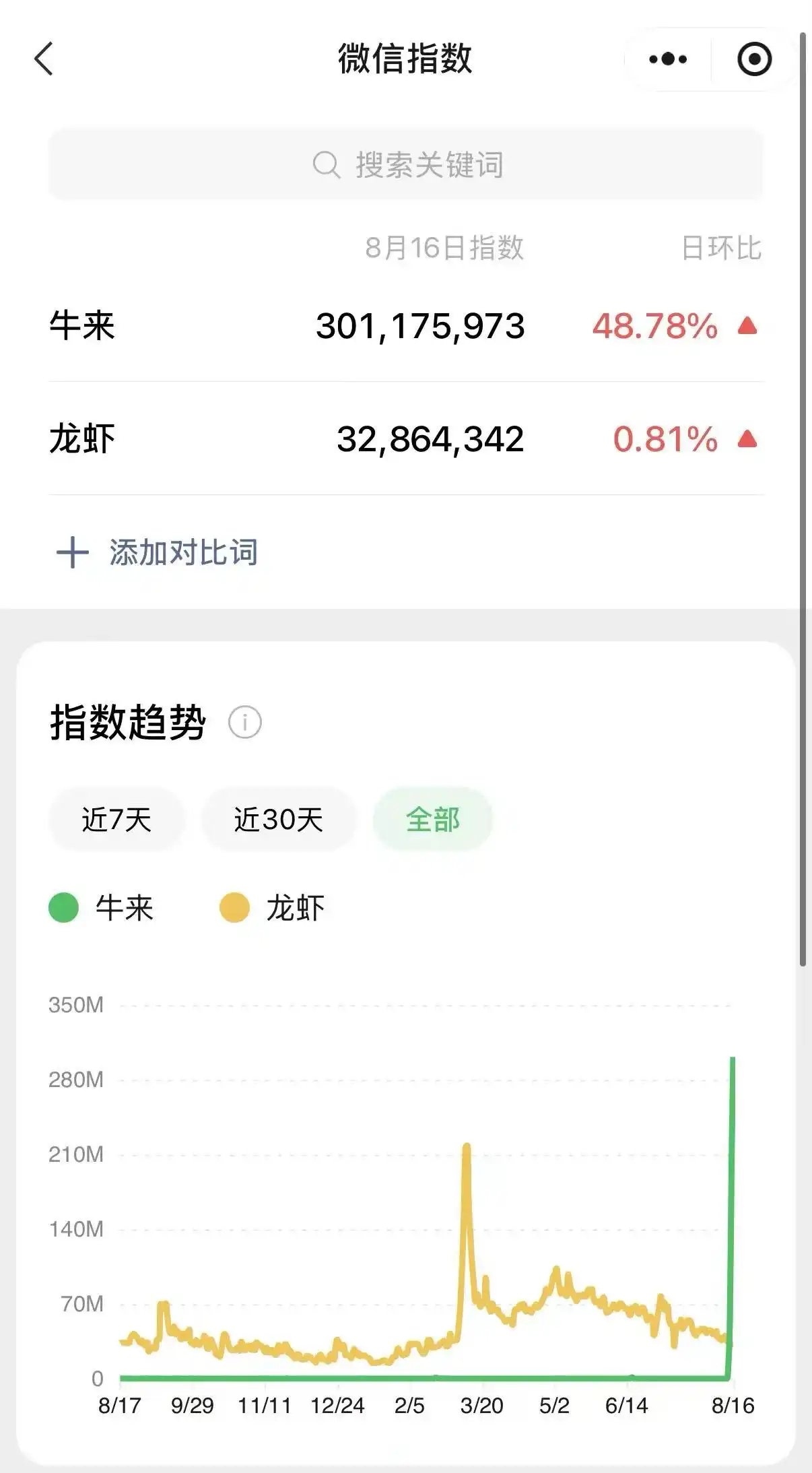
On August 15th, the WeChat Search Index for "Niu Lai" had already exceeded 200 million, and on August 16th, it broke through 300 million. Compared to the hugely popular "Lobster" from earlier this year, its search index peak was only about 220 million. Data-wise, this is undoubtedly a top-tier Chinese meme topic.
Another positive aspect is that Niu Lai reached this market cap height without any catalytic help from Binance Alpha. This is an organically grown bull, not an artificially force-fed one. After learning the story, most foreign investors also gave positive evaluations, considering it a good narrative. We can see this directly from holder statistics: Niu Lai has about 24,150 holding addresses, while fomo shows the number of Niu Lai holding users exceeds 9,200. The proportion of foreign holders in Niu Lai is not low. A good narrative is always one that transcends language barriers and is universally understandable.
If BSC can continue this trend—fewer attention splits, more good narratives that grow organically and attract capital intervention—then Niu Lai should be given deep credit. However, once capital is involved, it will inevitably lead to distribution. This is true from stocks with actual backing to meme coins driven by sentiment.
As for CZ burning MarsCoin and then saying he didn't actually know there were two MarsCoins, I think the issue isn't whether he knew about the two MarsCoins. It's more that, given Flap's MarsCoin was already listed on Binance Alpha, the market still interpreting this burn as some kind of statement is unhealthy.
Questioning whether his action was premeditated is an understandable emotional vent. Wanting to seize sudden events for profit is also human nature and a sharp skill. But the reaction was somewhat excessive—comparing the burn to the historical case of Neiro (case-sensitive) when one version was already on Binance Alpha isn't quite appropriate.
Fortunately, the MarsCoin on Binance Alpha wasn't drained too badly, and the suddenly burned one also quickly fell back after briefly approaching a $37 million market cap. The market has shown enough firmness and rationality this time.
Don't just listen to his words, watch his actions. CZ, the market has passed the ball back to you this time. If there are no further twists, I think this episode should be over.
It's been a while since Solana felt behind the meta
This isn't to say Solana is lagging in new narratives or gameplay recently, as since the stock meme phase, meme coins haven't seen any new gameplay. It's still about which side has more interesting narratives, which side's good projects successfully gather momentum, or which side's conspiracy group set up a play. The on-chain population is finite now, and multi-chain trading is convenient and mature. The active retail investors and capital are also limited, making it almost irrelevant which chain is draining which. Where it's lively, people just go and buy.
The reason Solana feels behind is simply because "Niu Lai" was too successful, making similar attention-grabbing projects on Solana like $Layooo seem a bit like "followers."
This dancing gorilla to the catchy BGM containing "Layoo" went viral on TikTok and was then used by crypto players on X for many absurd posts. Of course, many non-meme coin Web2 users also just imitated the gorilla's dance for fun, somewhat similar to when the "Big Expansion" song went viral and everyone danced.
However, compared to Niu Lai, the coin that emerged yesterday was a "conspiracy play," and its market cap only reached about $4.4 million at its peak. The coin supported by the original creator, $Layoo, also saw some action, peaking at around a $400k market cap. There are arguments for both: the successful one is called a "conspiracy play" due to lack of creator support, but its deployment was indeed earlier.
There's a foreign version of "Niu Lai" and also a foreign version of "Bei You." $App, a coin from alon, json, and other pump.fun official team members, started ending their tweets with the phrase "Sent from my Pumpfun App," giving the impression they want to make this watermark-style phrase pump.fun's slogan for social push.
After briefly reaching a $2 million market cap last week, this coin fell, at one point dropping below a $100k market cap. But alon kept adding this phrase to his tweets, leading to a notable price rebound yesterday, briefly breaking a $600k market cap before dying again. If pump.fun people keep playing this meme and even integrate this slogan into the App's sharing feature, it might revive again.
Of course, Solana isn't without highlights. $ANSEM rebounded from below a $200 million market cap, reaching $350 million at one point, giving the feeling a bottom is in place and a new high is targeted. The reason: Ansem launched a new platform, ANSEM.IO.
This isn't a true new launchpad; it essentially gives $ANSEM a "shovel attribute" while incidentally doing paid promotion business like Dexscreener. You can launch tokens through ANSEM.IO, but it actually routes through pump.fun, just repackaged, not competing with pump.fun's launchpad business. However, tokens launched through this front-end must at least voluntarily buy and airdrop 3% to $ANSEM holders at launch.
There's also a meme coin billboard, Z500, where any meme coin can pay $99 - $3999 for exposure.
Base's Counterattack, Arriving Belatedly
Base also saw a cat coin, $Basecat, peak at a $20 million market cap yesterday, which feels very reminiscent of $CASHCAT. The main catalyst was Cobie following the coin's X account, and then Base App's official Twitter also started explicitly promoting the coin:
So if Cobie follows Vlad's playbook next, giving likes and follows one after another, Base might experience another small rally. The reason Basecat isn't rising much now is probably because Base hurt investors too deeply before; people dare not be too optimistic that Cobie will consistently promote projects rather than act on a whim.
Besides Basecat, Base also seems to be copying the stock meme homework from other chains, but so far without much success. Yesterday, there was a stock meme, simply called $MEME, paired with Coinbase's stock, forming a $MEME/$COIN meme coin, which briefly surged to a $1 million market cap. Just as people found it interesting, it quickly crashed to near zero...
It's really hard to play.
Robinhood's Ebbing Tide
There's not much to say about the Robinhood chain. In recent articles, we have been repeating this core point:
The price action of $CASHCAT determines the overall market on the Robinhood chain.
After this coin listed on the main Robinhood platform, there is no bigger positive catalyst. No other stimulation matters; only this coin continuously rising upward works.
The current situation is: after forming a huge daily candlestick with over $100 million in volume on the day of its Robinhood main platform listing, it slowly rose to a peak of about $170 million market cap, then fell back to the current ~$100 million. The fact that it absorbed such massive selling pressure makes it hard to believe there isn't capital or market makers behind it.
Retail investors no longer determine this coin's trend; the market currently has little doubt it will eventually reach a $1 billion market cap or higher. However, the process might be very grinding, especially given the overly uniform expectations recently. Whether this $100 million market cap level holds or breaks can only depend on what the capital behind it thinks.
Conclusion
Based on the above, we present a current ranking at the start of this week: BSC > Solana > Base > Robinhood
- BSC: Has Niu Lai, situation is good. If the Two Saints provide more stimulation, the rally could continue.
- Solana: User inertia allows it to naturally stand out when others are lackluster. But now that others have stories, it becomes less attractive.
- Base: If Cobie consistently promotes projects, opportunities in the short term will definitely be more than Robinhood's, maybe even more than Solana's. But this chain has always been really hard to play; opportunities might be big, but there are countless pitfalls, and falling in means dying quickly.
- Robinhood: If $CASHCAT doesn't perform, it continues to lie flat.
Overall, the on-chain difficulty level remains hellish. It might seem like everyone is making money, but in reality, one's own operations could lead to being permanently trapped by holding on just a bit too long. In a situation like Niu Lai, if you truly bought a few thousand dollars below a $1 million market cap and held all the way to the tens of millions market cap level, either you are really rich and don't care at all, or you genuinely bet right...
It's still necessary to remain more cautious, trade less, observe more, and not be overly optimistic or carried away by get-rich-quick stories.