TL;DR
According to reports from AP and Axios, following the framework arrangement reached between the U.S. and Iran regarding the ceasefire extension and the passage of oil tankers through the Strait of Hormuz, U.S. stocks rose on June 18, with the Nasdaq gaining 1.9%. The semiconductor and AI hardware supply chain performed even stronger.
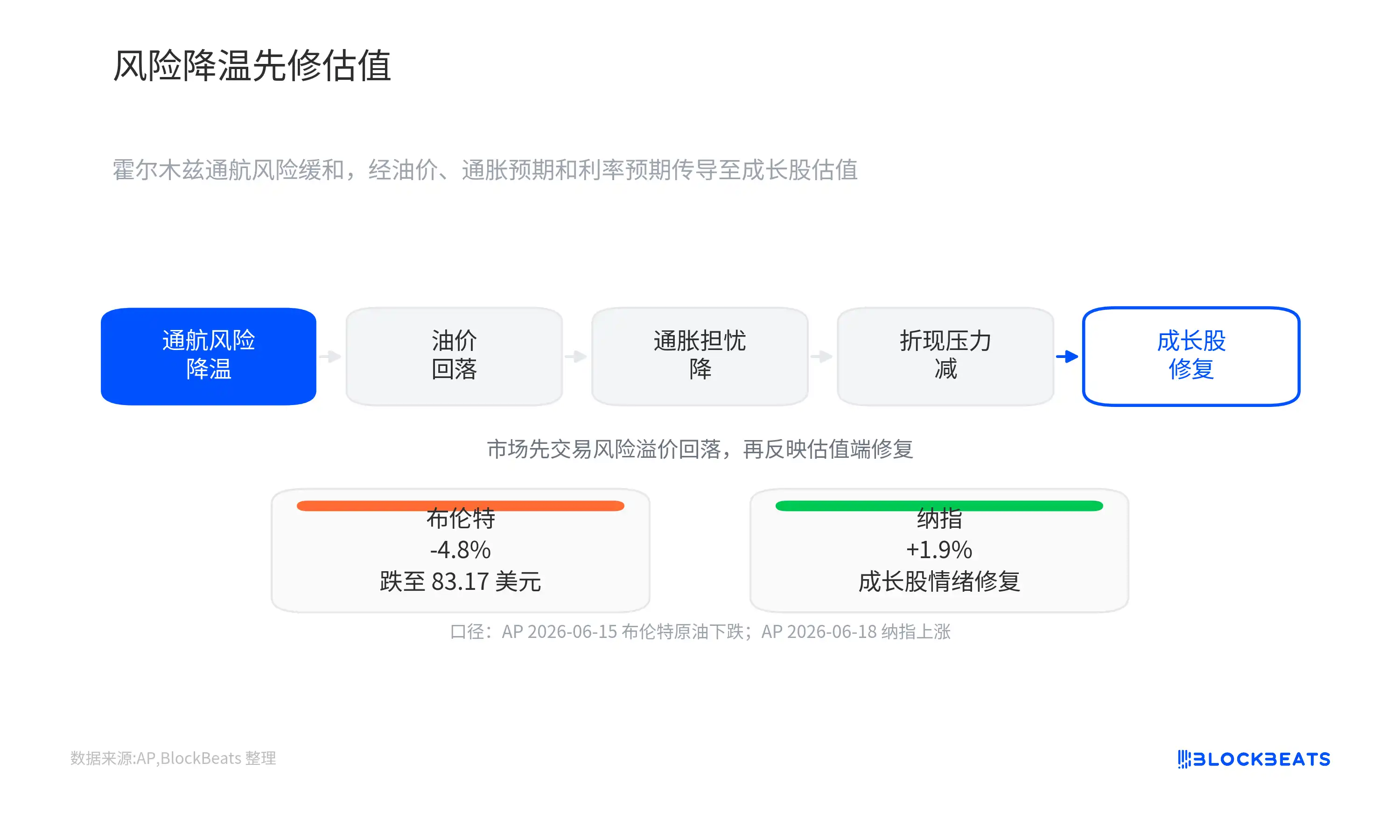
Such geopolitical news impacts technology stocks primarily through oil prices and interest rate expectations. The Strait of Hormuz is a crucial global artery for oil transportation; any disruption can quickly drive up oil prices and inflation expectations. Conversely, if the market trades on 'resumed passage and de-escalating conflict,' the discounting pressure on high-valuation growth stocks will ease.
Easing Middle East risks does not equate to a sudden improvement in AI fundamentals. What it opens up first is a window for valuation repair. What's truly worth watching is which directions funds choose after this window opens. The gains on June 18 were more concentrated not in broad technology stocks, but in chips, optical interconnects, memory, and some domestic manufacturing targets.
Intel was one of the most conspicuous trades that day. According to a Reuters report, Trump stated that Apple would collaborate with Intel to design and manufacture chips in the U.S. Influenced by this, Intel's stock price surged approximately 10%-11%. However, no formal disclosures regarding contract scale, product categories, or mass production timelines have been seen from Apple or Intel yet. This resembles more of an elasticity release driven by policy catalysts and the domestic manufacturing narrative.
Therefore, the core question of this rally is not 'whether tech stocks have rebounded,' but the nature of the rebound. Is the market buying back into AI infrastructure orders, or is it conducting a selective valuation repair by leveraging the de-escalation of geopolitical risks?
Declining Energy Risks First Repair Growth Stock Valuations
For general investors, the Strait of Hormuz can be understood as the 'chokepoint' for global oil transport. Any risk of blockade in this passage can drive up oil prices, pushing inflation expectations higher, and also affecting the Federal Reserve's path and corporate costs. High-valuation technology stocks are particularly sensitive to this chain because their valuations rely more heavily on cash flows many years into the future.
According to an AP report on June 15, Brent crude oil fell 4.8% to $83.17, returning to early March levels. Kiplinger mentioned the same day that WTI crude fell 4.9% to $80.75, its lowest settlement price since early March. Falling oil prices do not mean inflation pressure has been eliminated, but they are enough to reduce market tail-end concerns about energy shocks.
This explains why the Nasdaq and semiconductors gained greater elasticity after the news. They did not rise because of sudden profit changes at individual companies, but were prioritized for rebalancing by funds after the decline in risk premiums.
However, this chain cannot be simply described as 'Hormuz eases, therefore semiconductors rise.' A more accurate statement is that the de-escalation of geopolitical risks provided the external conditions for a rebound in growth assets. Which segments within the tech sector are favored by funds still depends on whether their fundamentals can be verified.
Ranking Within Tech Favors the Hardware Chain
This rally more resembles a re-ranking within technology stocks.
Semiconductors leading the gains indicate the market is not just buying a single leader, but is re-pricing the AI infrastructure chain. However, if one only sees 'chips are up,' it's easy to misjudge it as a full-fledged return of AI trading. More importantly, fund preferences are more concentrated in chip manufacturing, optical interconnects, memory, equipment, and domestic manufacturing.
The underlying change is that AI trading has moved from the early stage of 'the bigger the model, the better; the more GPUs, the better' to a more selective phase. Investors are now asking not whether AI has imagination space, but who can capture real revenue from data center construction.
The attention on optical interconnects and memory is also related to this stage. Large AI clusters cannot run on GPUs alone. Tens of thousands of chips require high-speed data transfer between them; optical interconnects (high-speed transmission in data centers) are akin to building highways for AI clusters. As training and inference demands expand, memory bandwidth, storage capacity, and data movement efficiency will also become bottlenecks.
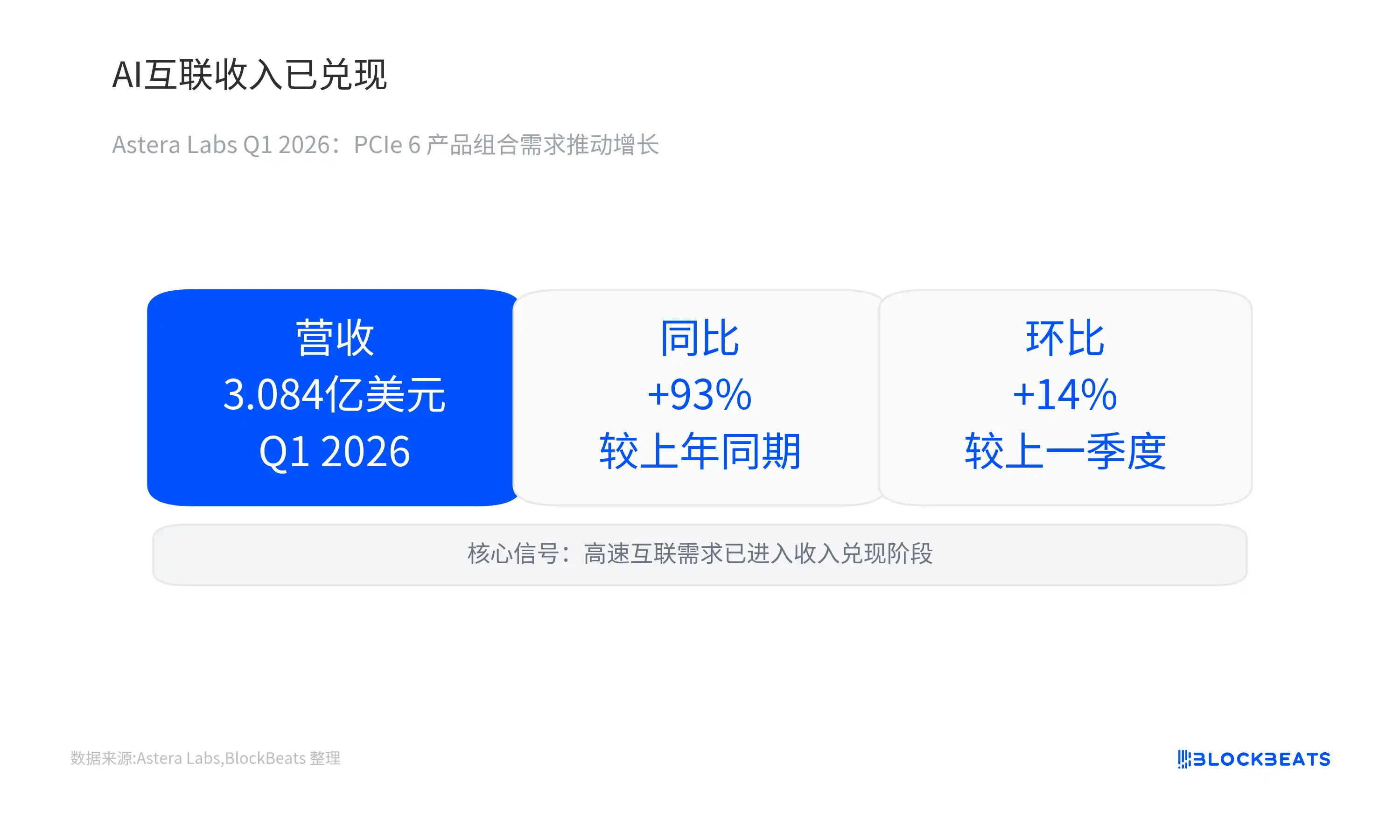
Astera Labs' earnings report provided the market with a more concrete anchor. The company's Q1 2026 revenue was $308.4 million, up 93% year-over-year and 14% quarter-over-quarter. The company stated that growth was driven by demand for its PCIe 6 product portfolio and AI interconnect-related products. Such data makes it easier for investors to believe that the AI hardware chain is not just about long-term narratives but is already translating into orders and revenue from data center construction.
This is also the difference between this round of trading and purely forward-looking tech stories. Public market performance can support chips and tech-related directions leading the gains, but 'which segments funds prioritize buying' remains a market generalization that requires a nuanced understanding. At least from the market action, the recovery in risk appetite has not turned into indiscriminate chasing of all high-valuation assets. Funds seem more inclined to first buy segments that can be verified by earnings reports and capital expenditure.
The Intel Trade Mixes Policy and Fundamental Imagination
Intel's surge is the most prone to misinterpretation.
According to Reuters, Trump stated that Apple would collaborate with Intel to design and manufacture chips in the U.S. This statement directly placed Intel into the narrative of domestic chip manufacturing. For the market, it is not an ordinary customer partnership news but a convergence point of supply chain security, manufacturing reshoring, and U.S. chip policy.
However, this does not mean Intel's fundamentals have already been turned around by the Apple partnership. A more prudent understanding currently is that Trump's remarks provided a policy catalyst which, combined with the recovery in semiconductor risk appetite, amplified the elasticity of Intel as a domestic manufacturing target. How much revenue this collaboration can bring, whether it enters advanced node mass production, the timeline, and gross margin improvements all require clearer information from Apple, Intel, or subsequent financial reports.
This precisely illustrates the divergence in this round of AI hardware revaluation. Policy catalysts can boost attention, orders and revenue can support valuation, and capital expenditure can verify cycle strength. When all three appear simultaneously, stock price elasticity is greatest. However, if there is only policy rhetoric without contract scale and financial contribution, the trade is more easily re-priced as short-term sentiment.
Intel, optical interconnects, and memory correspond to three verification paths respectively. Intel needs to see if policy and customer cooperation can translate into genuine foundry revenue. Optical interconnects depend on whether the scaling of AI clusters continues to push bandwidth demand higher. Memory and storage rely on whether AI server orders continue to drive prices and shipments.
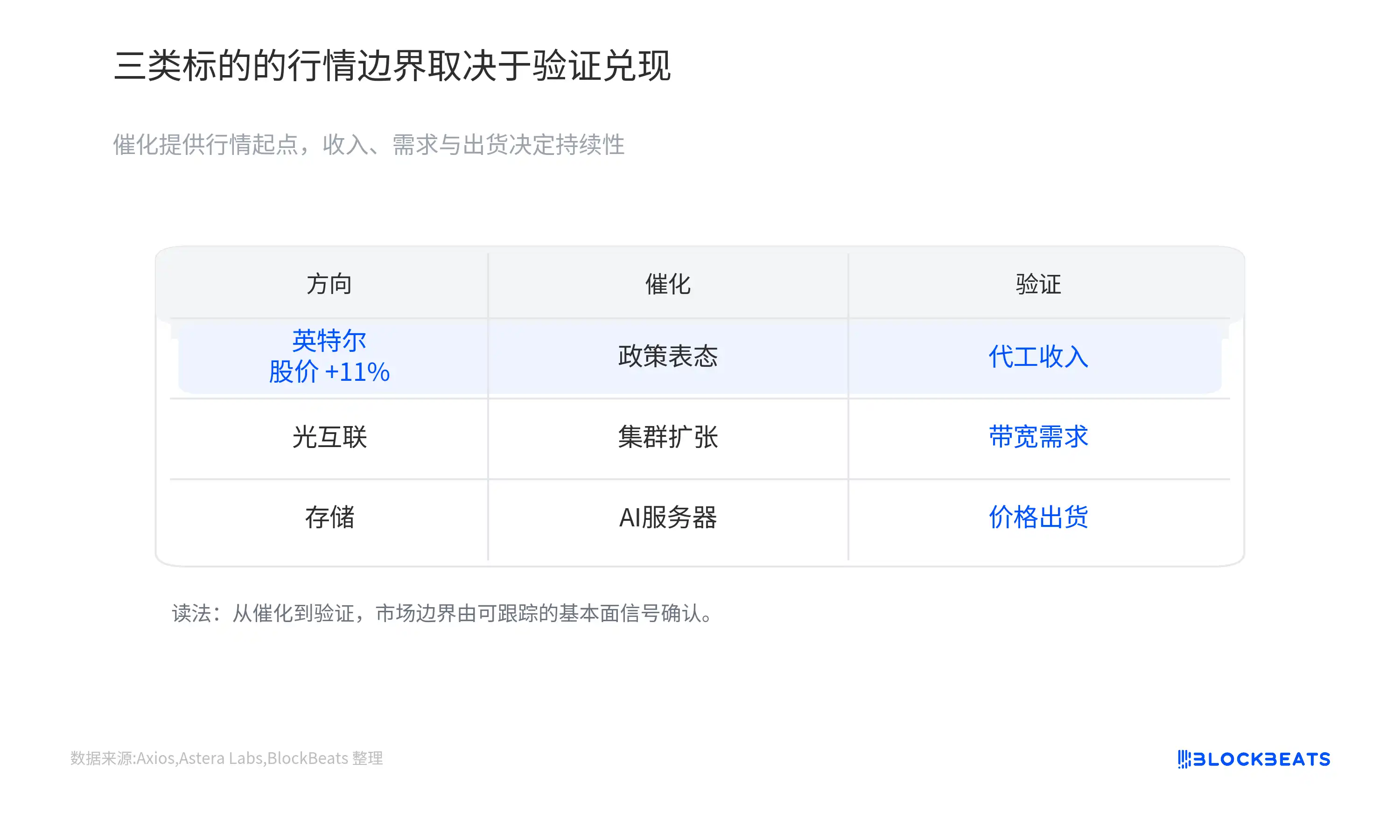
If Q2 earnings reports continue to show robust cloud provider capital expenditure, AI server orders remain high, and revenue guidance from optical interconnect and memory companies continues to grow, this rally will more closely resemble a continuation of the AI infrastructure cycle. If data falls short of expectations, the market may redefine it as a valuation repair following the easing of geopolitical risks.
Orders and Negotiation Progress Determine the Rally's Limits
The biggest misjudgment to avoid now is prematurely writing a short-term window as confirmation of a long-term trend.
The U.S.-Iran framework is still in the preliminary arrangement stage. According to Axios, both sides agreed to a 60-day ceasefire extension framework and may reopen the Strait of Hormuz. The market can trade on risk easing, but this does not mean the Hormuz risk has disappeared. Whether the ceasefire can be sustained, whether passage arrangements are stable, and whether sanctions and nuclear issues disrupt negotiations again will all impact oil prices and risk appetite.
The verification for the AI hardware chain is also straightforward. In the upcoming Q2 earnings reports, investors need to see whether large cloud providers continue to revise capital expenditure upwards, whether AI server order intensity is maintained, and whether revenue guidance from optical interconnect and memory companies continues to show growth. Once capital expenditure begins to be questioned, the elasticity of high-valuation hardware chains will conversely become a source of volatility.
Intel has an additional layer of verification. Trump's remarks are sufficient to trigger trading, but what truly affects valuation is contract scale, product categories, mass production timelines, and profit margins, not the 'Made in America' narrative itself. Policy can provide a pricing window but cannot substitute for financial realization.
This rally is better understood as a selective recovery in risk appetite: the easing of macro risks opened a window, and funds prioritized buying back the AI hardware chain. It weakens the extreme judgment that 'AI trading is over,' but it is not yet sufficient to prove that the AI infrastructure cycle is re-accelerating. The answer is not in a single day's gains but in whether capital expenditure, orders, and profit margins can continue to keep up.