After Privacy Coins Surge, Does It Mean a Bear Market Is Coming?

marsbitPublished on 2026-01-31Last updated on 2026-01-31

Abstract

The article explores the sharp rise in privacy coins like ZEC and XMR as a potential signal of an impending bear market in the crypto cycle. Historically, privacy tokens tend to surge when other narratives—such as DeFi or NFTs—lose momentum, often marking a final speculative push before a downturn. In 2017, coins like ZEC and XMR gained attention as "better Bitcoin" alternatives, fueled by technological appeal and hype. By late 2021 and early 2022, privacy projects like Aleo attracted massive investments, though they ultimately failed to deliver practical, mainstream adoption. The recent surge in late 2025, with ZEC rising 20x in three months, lacked clear catalysts but may reflect growing unease with increasing regulatory scrutiny and reduced financial privacy in crypto. While figures like Arthur Hayes and firms like a16z promoted "privacy-as-a-service," the author suggests this may have been a tactic to facilitate sell-offs rather than genuine growth. The piece argues that extreme privacy features—such as Monero’s fully anonymous transactions—often cater to illicit use cases rather than mainstream needs, making them a target for regulators and exchanges. Most users and regulators seek balanced privacy—protection without complete anonymity—which current privacy tokens fail to provide. Without addressing real-world utility and acceptable levels of privacy, these coins may remain the last resort in cyclical market pumps, often leaving investors at a loss.

Author: Eric, Foresight News

Every bull market has its signs of ending. Looking back, among these signs, the sudden explosion of privacy tokens has never been absent.

This recurring phenomenon has the same reason each time: there's nothing left to hype. After all concepts and narratives have been exhausted, the final dance of capital usually chooses "privacy," a topic that has persisted since 2014.

Hype around privacy at the end of a bull market has logical rationality. After experiencing the noise, many people often suddenly realize, in the void of the bull-to-bear transition, what the original intention of Web3 was, then shout about making privacy and decentralization great again—but the result is just another round of speculation.

Although the process is the same, the triggers each time are not entirely identical.

2017 was the heyday of privacy tokens because there were no impressive DApps, and the sector was still in a phase of finding direction. Back then, ZEC, XMR, and DASH were absolute "hot stars," with discussion levels even surpassing Bitcoin. ZEC and XMR were launched with the "technological innovations" of zero-knowledge proofs and ring signatures, respectively, while DASH combined PoW and PoS.
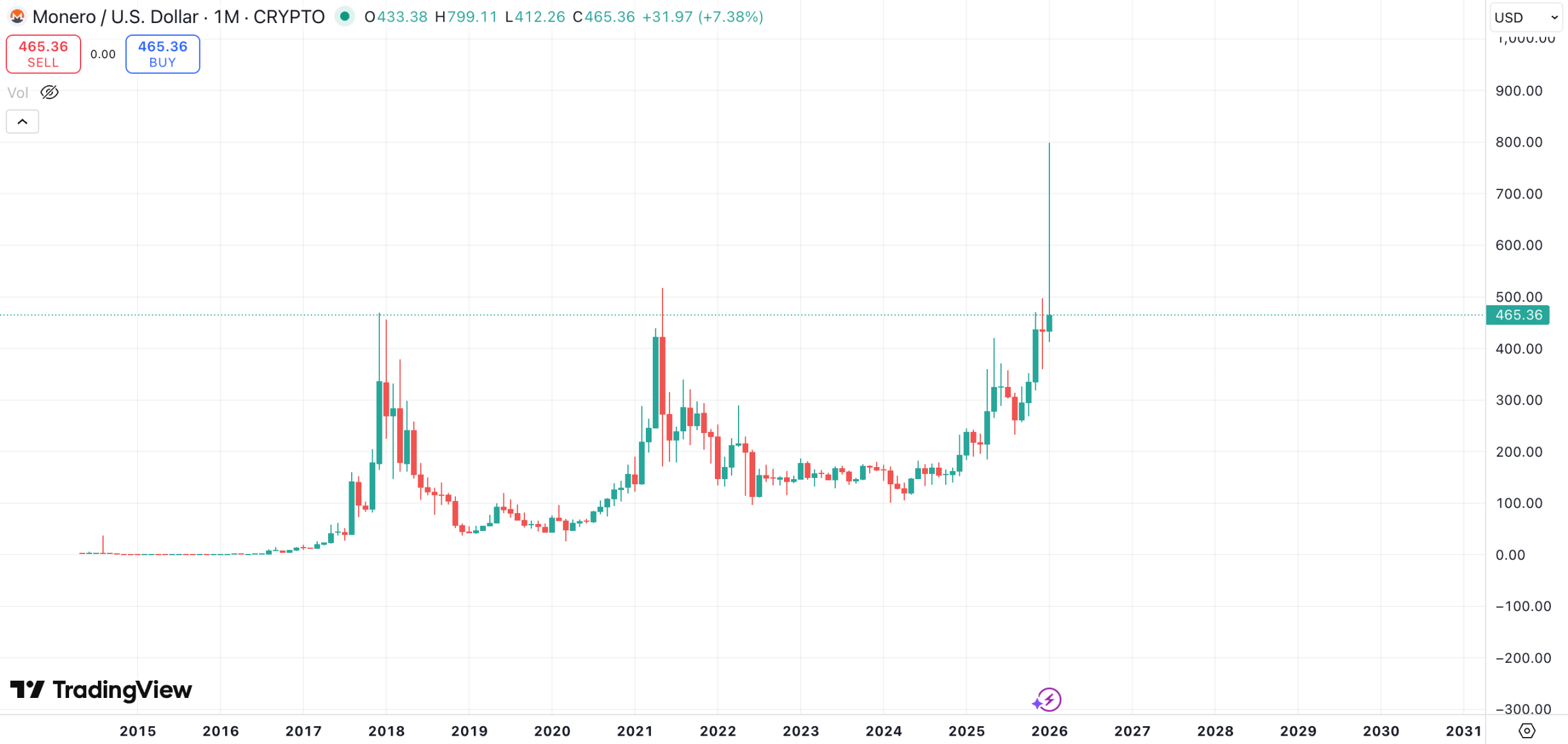
Readers who didn't experience that period might not understand the market's fervor for such tokens at the time. Back then, whether Bitcoin was the absolute core of cryptocurrency was controversial; many such tokens charged ahead under the banner of "better Bitcoin." ZEC's price once surged to $30,000 in early 2018, while Bitcoin's peak price in that cycle was less than $20,000.

Late 2021 and early 2022 were purely about forcing the privacy concept. After experiencing DeFi, NFT, and the metaverse, projects including Aleo received hundreds of millions in funding, with SoftBank, a16z, and Tiger Fund among the investors. The market at that time briefly believed that after the application explosion, privacy could finally move from concept to practical implementation.

Perhaps because everyone was making money and was euphoric, no one truly cared whether privacy was a mass need, or even if there was demand, whether demanders were willing to bear significant costs just to ensure privacy. The result was that it landed—but face-first.

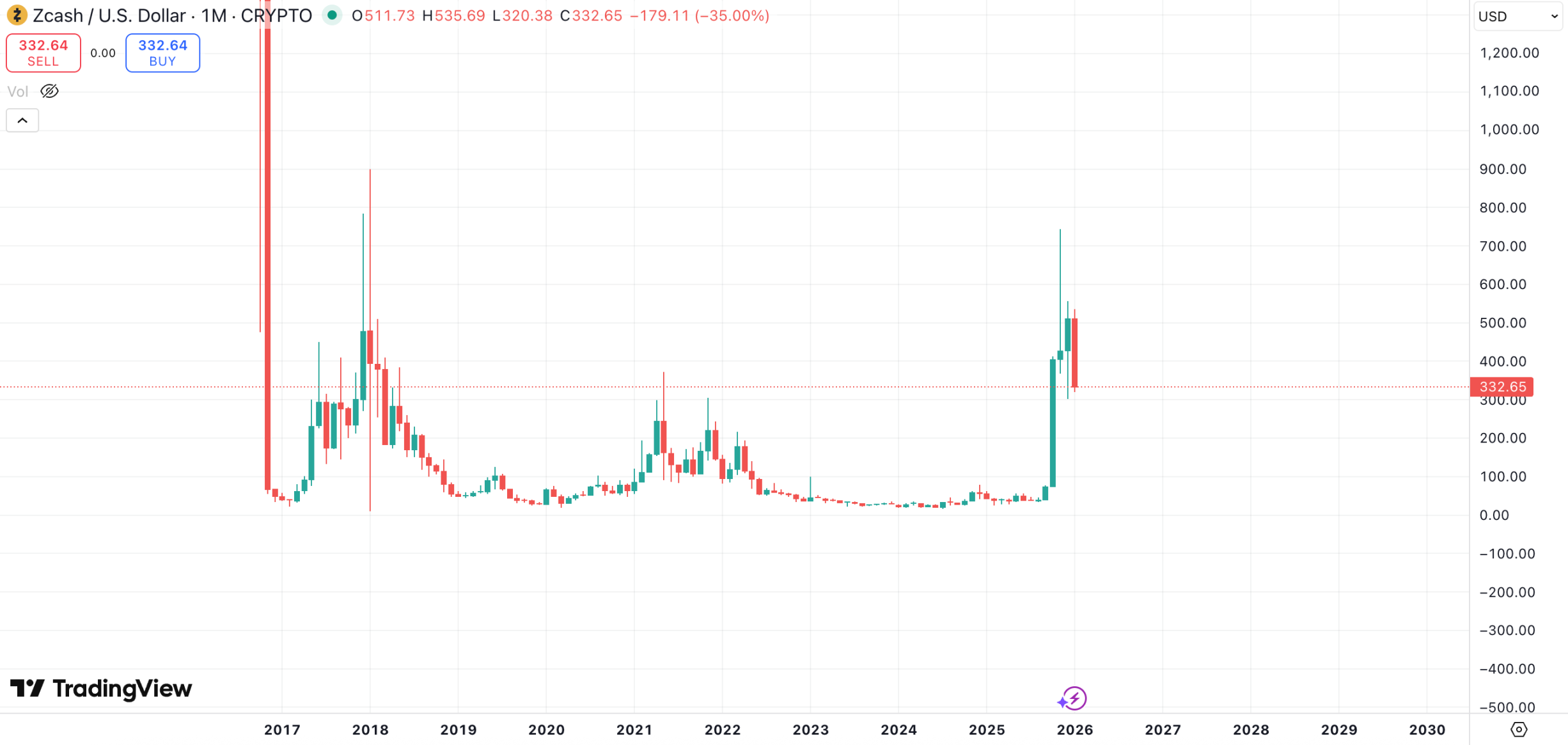
In this cycle, the rise of privacy tokens represented by ZEC began in September 2025. Looking back, it's hard to pinpoint any specific reason at that time to explain why it rose 20 times in three months. If we must find a reason, it might be because it was "not so compliant."
2025 can be said to be the year cryptocurrency was fully legitimized. Multiple countries in Europe and America successively introduced regulatory laws. Even supporting cryptocurrency development couldn't escape scrutiny under regulations like identity verification and anti-money laundering—DeFi was no exception. Thus, although cryptocurrency was no longer considered a security, it essentially wasn't much different from trading securities. Government scrutiny of individuals didn't relax at all; it only temporarily eased regulations on projects and institutions to avoid hindering innovation.

Additionally, the arrest of fraudster Qian Zhimin in the UK, and later the exposure of Chen Zhi whose Bitcoin was confiscated, revealed an open secret: although only you hold the private key, it's not difficult for law enforcement to make you hand it over. When this fact is laid bare again, it might trigger some investors to switch to privacy tokens.

But including BitMEX co-founder Arthur Hayes's shilling and a16z's mention of "privacy as a service" all happened after November. Judging from the price trend, this seems more like cover for dumping rather than driving the rise. XMR might have held on for two more months due to reasons like Iranian officials fleeing with funds or hackers who stole hundreds of millions in Bitcoin converting it to XMR, but it also peaked and fell rapidly.

Although we can't definitively say the bull market is over now, at least at the end of the last bull market, there were no shortage of well-known figures and institutions shilling privacy. The extremely similar plot should at least make us more vigilant.

The privacy concept has persisted from 2014 to today without dying out because it genuinely meets some gray demands, but it conflicts with actual "privacy" needs. In reality, what most people recognize as privacy protection isn't making data completely untraceable, but more about not being easily exposed. In financial transactions, dark pools exist to prevent large capital actions from affecting the market or being targeted by other funds, but this doesn't mean the transaction information itself can't be verified.

The privacy concept in Web3 is sometimes overly extreme. Zcash's privacy transactions are optional, while XMR is private by default—sender, receiver, and amount can't be verified on-chain, which is also the core reason XMR was delisted by over 70 global cryptocurrency exchanges in 2025. For most people, there seems to be insufficient reason to use XMR to hide traces. Moreover, the process of buying XMR itself is traceable; when you buy XMR, you might be suspected of engaging in illegal activities.

Simply put, most people just want their behavioral records protected and respected, not completely hidden; regulatory agencies especially cannot accept channels almost tailor-made for money laundering. With current technology, anonymous on-chain transfers of USDT are also achievable, so there's really not much reason to use a targeted asset just for privacy.

Web3 has been talking about privacy for over 10 years but seems to always avoid the question: "What level of privacy do we actually need?" Without finding real scenarios, privacy tokens may forever be the last bagholders in sector rotation.


Related Questions

QAccording to the article, what is a common sign that a bull market in cryptocurrency might be ending?

AThe article states that a sudden surge in privacy coins is a common sign that a bull market might be ending, as it often represents the 'last dance' for capital when other narratives have been exhausted.

QWhat was the primary reason given for the rise of privacy coins like ZEC in September 2025?

AThe article suggests the main reason was that privacy coins were 'less compliant' with the increasing regulatory scrutiny on mainstream cryptocurrencies, which led some investors to seek assets that offered more anonymity.

QWhy does the author believe the 'privacy' narrative in Web3 is problematic?

AThe author argues that the Web3 privacy narrative is often too extreme, focusing on complete anonymity which is at odds with what most people and regulators actually want—protection and respect for data, not complete untraceability, which is often associated with illicit activities.

QWhat historical example does the article use to show the market's past enthusiasm for privacy coins?

AThe article cites the 2017 bull market where ZEC's price briefly reached $30,000, surpassing Bitcoin's price at the time, due to intense market speculation and the belief that these coins were 'better versions of Bitcoin'.

QWhat fundamental question does the article claim the Web3 privacy space has avoided for over a decade?

AThe article states that the space has avoided the crucial question: 'What degree of privacy do we actually need?', leading to a lack of real-world use cases and making privacy coins the last resort in market cycles.

Related Reads

After 50x Storage Surge, Justin Sun Always Looks to the Next Decade

Sun Yuchen, known for his controversial stunts like a $30 million lunch with Warren Buffett (canceled due to a kidney stone) and eating a $6.2 million duct-taped banana, is often overshadowed by a significant fact: his decade-long track record of spotting major investment trends. In 2016, he famously advised young people to invest in Bitcoin, Nvidia, Tesla, and Tencent instead of buying property. A hypothetical $20,000 investment in Nvidia and Tesla from that list would now be worth over 50 million RMB. His latest major call was on November 6, 2025, predicting a "50x storage opportunity" tied to the AI boom, which materialized with Sandisk's stock surging nearly 50-fold by 2026. Looking ahead, Sun now focuses on the next frontier: Physical AI. He identifies four key areas: 1. **Embodied AI/Robotics**: He sees this reaching its "iPhone moment," with companies like UBTech and Galaxy General leading in commercialization. 2. **Drones**: Viewed as the first commercially viable form of Physical AI, revolutionizing sectors from warfare (e.g., AeroVironment's Switchblade) to logistics. 3. **Spatial Computing**: Beyond VR, it's about AI understanding physical space, a foundational technology for robotics and autonomous systems, exemplified by Apple's Vision Pro. 4. **Space Exploration**: After a 2025 suborbital flight with Blue Origin, Sun advocates for space as the ultimate frontier, discussing blockchain's potential role in space asset management and data transactions. His investment philosophy involves betting on entire, inevitable trends rather than single companies. For robotics, he sees Tesla (the body/manufacturer) and Nvidia (the brain/AI platform) as complementary plays. In defense drones, he highlights companies making tanks obsolete (AeroVironment) and those augmenting fighter jets (Kratos). For space, he participated in Blue Origin's flight and anticipates SpaceX's potential IPO to redefine the sector's valuation. Sun Yuchen's vision frames the next two decades not as a revolution in information flow (like the internet), but in the fundamental operation of the physical world through AI-powered robots, autonomous systems, and spatial intelligence, ultimately extending human and AI activity into space. While many still focus on conventional assets, he continues to look toward the next technological horizon.

marsbit29m ago

After 50x Storage Surge, Justin Sun Always Looks to the Next Decade

marsbit29m ago

The Billionaires Behind the Most Expensive Midterm Election in History

"The Most Expensive Midterm Elections and Their Billionaire Backers" This analysis details the unprecedented scale of spending in the 2026 midterm elections, highlighting the key billionaire donors shaping the political landscape. Jeff Yass, founder of Susquehanna International Group, has contributed over $81 million, ranking third among individual donors behind George Soros ($102.6M) and Elon Musk ($84.8M). Yass is a major donor to Trump's MAGA Inc. and supports school choice and various candidates. Overall, federal committees have raised over $4.7 billion this cycle, with political ad spending projected to reach $10.8 billion. Republican-aligned groups are significantly out-raising their Democratic counterparts. "Dark money" from undisclosed sources continues to grow. The core stakes involve control of Congress and policy direction for Trump's final term. Donors are also motivated by specific issues: Sergey Brin and Chris Larsen are funding opposition to a proposed California wealth tax and supporting crypto-friendly policies. Other top donors include OpenAI's Greg Brockman and his wife Anna ($50M total to MAGA Inc. and an AI-focused PAC), Richard Uihlein ($45.3M to conservative causes), venture capitalists Marc Andreessen and Ben Horowitz (each over $44M to crypto/AI PACs and MAGA Inc.), Miriam Adelson ($42.6M to GOP leadership PACs), Paul Singer ($33.9M), and Diane Hendricks ($25.8M to MAGA Inc.). The article notes that the peak fundraising period is still ahead, with major primaries approaching.

marsbit31m ago

The Billionaires Behind the Most Expensive Midterm Election in History

marsbit31m ago

The Largest IPO in History Is Approaching, Surpassing SpaceX, 28 Years of AI Self-Iteration, Countdown to Intelligence Explosion

"Anthropic Nears Trillion-Dollar IPO, Fueled by Explosive Growth and 2028 'Intelligence Explosion' Warning Anthropic is considering a deal valuing the AI company near $1 trillion, potentially leading to one of the largest IPOs ever and surpassing SpaceX. Its revenue has skyrocketed, with Annual Recurring Revenue (ARR) reaching $45 billion in May 2026—a 500% increase in just five months. This vertical growth curve is attributed to its key products, Claude Code and Cowork, dominating AI coding and enterprise collaboration. Beyond commercial success, co-founder Jack Clark issued a pivotal warning in an interview: there is a greater than 50% chance that by the end of 2028, AI systems will achieve recursive self-improvement—the ability to autonomously build a 'better version' of themselves, initiating an 'intelligence explosion.' This prophecy underpins the company's astronomical valuation, as the market prices in the potential for transformative and disruptive AI. Further signaling its ambition, Anthropic formed a $1.5 billion joint venture with Goldman Sachs and Blackstone, aiming to disrupt traditional consulting firms like McKinsey by deploying Claude AI for complex strategic work. This move tests AI's capacity to replace high-level cognitive labor, a precursor to its predicted autonomous evolution. The narrative presents a dual future: unprecedented economic opportunity alongside significant risks like economic restructuring and security threats. Anthropic's meteoric rise and Clark's 2028 prediction frame the coming years as a countdown to a potential technological singularity."

marsbit43m ago

The Largest IPO in History Is Approaching, Surpassing SpaceX, 28 Years of AI Self-Iteration, Countdown to Intelligence Explosion

marsbit43m ago

Trading

Spot
Futures
活动图片