After Privacy Coins Surge, Does It Mean a Bear Market Is Coming?

marsbitPublished on 2026-01-31Last updated on 2026-01-31

Abstract

The article explores the sharp rise in privacy coins like ZEC and XMR as a potential signal of an impending bear market in the crypto cycle. Historically, privacy tokens tend to surge when other narratives—such as DeFi or NFTs—lose momentum, often marking a final speculative push before a downturn. In 2017, coins like ZEC and XMR gained attention as "better Bitcoin" alternatives, fueled by technological appeal and hype. By late 2021 and early 2022, privacy projects like Aleo attracted massive investments, though they ultimately failed to deliver practical, mainstream adoption. The recent surge in late 2025, with ZEC rising 20x in three months, lacked clear catalysts but may reflect growing unease with increasing regulatory scrutiny and reduced financial privacy in crypto. While figures like Arthur Hayes and firms like a16z promoted "privacy-as-a-service," the author suggests this may have been a tactic to facilitate sell-offs rather than genuine growth. The piece argues that extreme privacy features—such as Monero’s fully anonymous transactions—often cater to illicit use cases rather than mainstream needs, making them a target for regulators and exchanges. Most users and regulators seek balanced privacy—protection without complete anonymity—which current privacy tokens fail to provide. Without addressing real-world utility and acceptable levels of privacy, these coins may remain the last resort in cyclical market pumps, often leaving investors at a loss.

Author: Eric, Foresight News

Every bull market has its signs of ending. Looking back, among these signs, the sudden explosion of privacy tokens has never been absent.

This recurring phenomenon has the same reason each time: there's nothing left to hype. After all concepts and narratives have been exhausted, the final dance of capital usually chooses "privacy," a topic that has persisted since 2014.

Hype around privacy at the end of a bull market has logical rationality. After experiencing the noise, many people often suddenly realize, in the void of the bull-to-bear transition, what the original intention of Web3 was, then shout about making privacy and decentralization great again—but the result is just another round of speculation.

Although the process is the same, the triggers each time are not entirely identical.

2017 was the heyday of privacy tokens because there were no impressive DApps, and the sector was still in a phase of finding direction. Back then, ZEC, XMR, and DASH were absolute "hot stars," with discussion levels even surpassing Bitcoin. ZEC and XMR were launched with the "technological innovations" of zero-knowledge proofs and ring signatures, respectively, while DASH combined PoW and PoS.
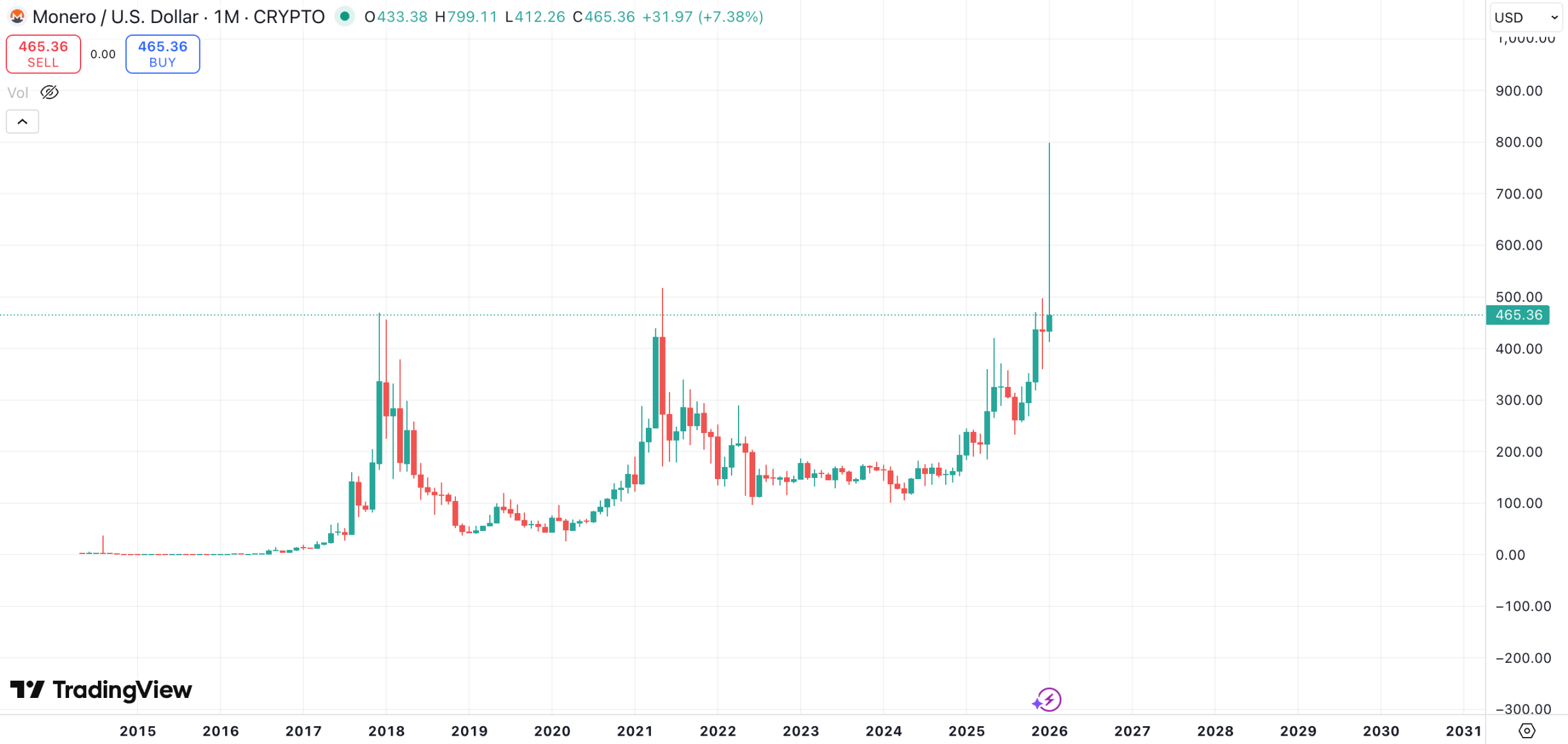
Readers who didn't experience that period might not understand the market's fervor for such tokens at the time. Back then, whether Bitcoin was the absolute core of cryptocurrency was controversial; many such tokens charged ahead under the banner of "better Bitcoin." ZEC's price once surged to $30,000 in early 2018, while Bitcoin's peak price in that cycle was less than $20,000.

Late 2021 and early 2022 were purely about forcing the privacy concept. After experiencing DeFi, NFT, and the metaverse, projects including Aleo received hundreds of millions in funding, with SoftBank, a16z, and Tiger Fund among the investors. The market at that time briefly believed that after the application explosion, privacy could finally move from concept to practical implementation.

Perhaps because everyone was making money and was euphoric, no one truly cared whether privacy was a mass need, or even if there was demand, whether demanders were willing to bear significant costs just to ensure privacy. The result was that it landed—but face-first.

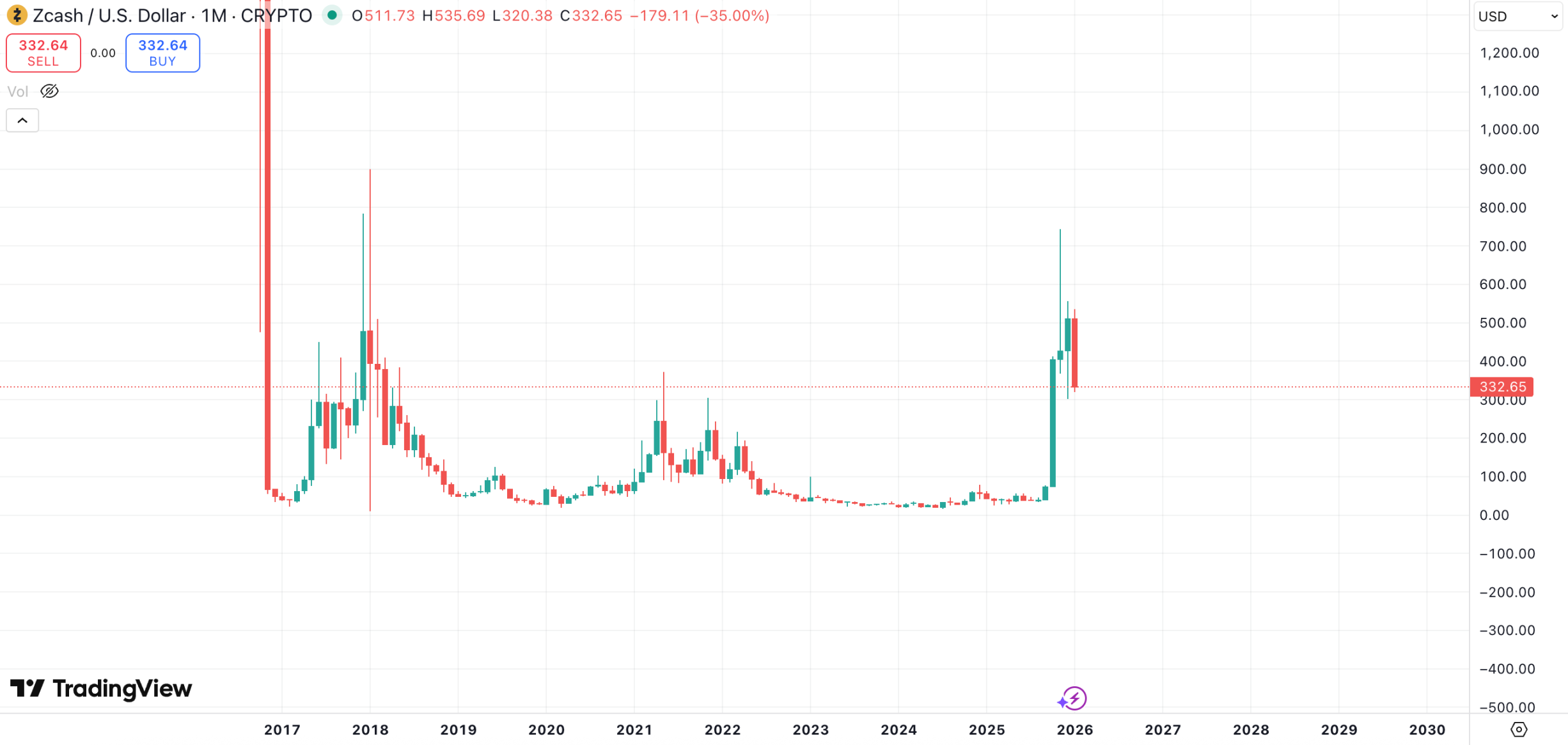
In this cycle, the rise of privacy tokens represented by ZEC began in September 2025. Looking back, it's hard to pinpoint any specific reason at that time to explain why it rose 20 times in three months. If we must find a reason, it might be because it was "not so compliant."
2025 can be said to be the year cryptocurrency was fully legitimized. Multiple countries in Europe and America successively introduced regulatory laws. Even supporting cryptocurrency development couldn't escape scrutiny under regulations like identity verification and anti-money laundering—DeFi was no exception. Thus, although cryptocurrency was no longer considered a security, it essentially wasn't much different from trading securities. Government scrutiny of individuals didn't relax at all; it only temporarily eased regulations on projects and institutions to avoid hindering innovation.

Additionally, the arrest of fraudster Qian Zhimin in the UK, and later the exposure of Chen Zhi whose Bitcoin was confiscated, revealed an open secret: although only you hold the private key, it's not difficult for law enforcement to make you hand it over. When this fact is laid bare again, it might trigger some investors to switch to privacy tokens.

But including BitMEX co-founder Arthur Hayes's shilling and a16z's mention of "privacy as a service" all happened after November. Judging from the price trend, this seems more like cover for dumping rather than driving the rise. XMR might have held on for two more months due to reasons like Iranian officials fleeing with funds or hackers who stole hundreds of millions in Bitcoin converting it to XMR, but it also peaked and fell rapidly.

Although we can't definitively say the bull market is over now, at least at the end of the last bull market, there were no shortage of well-known figures and institutions shilling privacy. The extremely similar plot should at least make us more vigilant.

The privacy concept has persisted from 2014 to today without dying out because it genuinely meets some gray demands, but it conflicts with actual "privacy" needs. In reality, what most people recognize as privacy protection isn't making data completely untraceable, but more about not being easily exposed. In financial transactions, dark pools exist to prevent large capital actions from affecting the market or being targeted by other funds, but this doesn't mean the transaction information itself can't be verified.

The privacy concept in Web3 is sometimes overly extreme. Zcash's privacy transactions are optional, while XMR is private by default—sender, receiver, and amount can't be verified on-chain, which is also the core reason XMR was delisted by over 70 global cryptocurrency exchanges in 2025. For most people, there seems to be insufficient reason to use XMR to hide traces. Moreover, the process of buying XMR itself is traceable; when you buy XMR, you might be suspected of engaging in illegal activities.

Simply put, most people just want their behavioral records protected and respected, not completely hidden; regulatory agencies especially cannot accept channels almost tailor-made for money laundering. With current technology, anonymous on-chain transfers of USDT are also achievable, so there's really not much reason to use a targeted asset just for privacy.

Web3 has been talking about privacy for over 10 years but seems to always avoid the question: "What level of privacy do we actually need?" Without finding real scenarios, privacy tokens may forever be the last bagholders in sector rotation.


Related Questions

QAccording to the article, what is a common sign that a bull market in cryptocurrency might be ending?

AThe article states that a sudden surge in privacy coins is a common sign that a bull market might be ending, as it often represents the 'last dance' for capital when other narratives have been exhausted.

QWhat was the primary reason given for the rise of privacy coins like ZEC in September 2025?

AThe article suggests the main reason was that privacy coins were 'less compliant' with the increasing regulatory scrutiny on mainstream cryptocurrencies, which led some investors to seek assets that offered more anonymity.

QWhy does the author believe the 'privacy' narrative in Web3 is problematic?

AThe author argues that the Web3 privacy narrative is often too extreme, focusing on complete anonymity which is at odds with what most people and regulators actually want—protection and respect for data, not complete untraceability, which is often associated with illicit activities.

QWhat historical example does the article use to show the market's past enthusiasm for privacy coins?

AThe article cites the 2017 bull market where ZEC's price briefly reached $30,000, surpassing Bitcoin's price at the time, due to intense market speculation and the belief that these coins were 'better versions of Bitcoin'.

QWhat fundamental question does the article claim the Web3 privacy space has avoided for over a decade?

AThe article states that the space has avoided the crucial question: 'What degree of privacy do we actually need?', leading to a lack of real-world use cases and making privacy coins the last resort in market cycles.

Related Reads

Trend in US Stocks: A Post Triggers a 930-Point Rebound, Tonight Belongs to SpaceX

On Thursday (June 11, U.S. Eastern Time), Wall Street staged a textbook V-shaped reversal. The Dow Jones surged 929.97 points (+1.86%) to close above 50,000, while the Nasdaq and S&P 500 rose 2.54% and 1.75%, respectively. The rally occurred despite the hottest PPI report in years, with May data showing a 6.5% year-on-year surge, the highest since 2022. The market ignored the inflation data, focusing instead on reports that former President Trump called off a planned strike on Iran, hinting at a potential multi-party peace agreement draft. This sparked a sharp drop in oil prices, fueling hopes that inflation may have peaked. Sector rotations were stark: previously battered AI hardware and cyclical stocks led the gains, while defensive sectors that hit record highs the prior day were sold off. Chip stocks like Micron and Intel saw sharp rebounds. In contrast, software giant Oracle plunged nearly 10% despite beating earnings, with concerns over cloud revenue and cash flow. Adobe also fell after hours despite raising guidance, as its CFO announced departure. The rally's sustainability is questioned, driven largely by social media posts about unconfirmed geopolitical developments. Inflation risks remain, with pipeline pressures still high. Meanwhile, the market's risk appetite faces a major test with SpaceX's historic IPO. Priced at $135 per share, it aims to raise ~$75 billion with a $1.75 trillion valuation, becoming the largest U.S. IPO ever. It will join the Nasdaq 100 in 15 days, triggering massive index fund buying. However, critics cite extreme valuation (88x sales) and market liquidity concerns.

marsbit23m ago

Trend in US Stocks: A Post Triggers a 930-Point Rebound, Tonight Belongs to SpaceX

marsbit23m ago

The Trillion-Dollar Valuation Test: Are the Three Super IPOs a Tech Stock Frenzy or a Crypto Market Nightmare?

Trillion-Dollar Valuation Test: Are the Three Mega IPOs a Tech Stock Frenzy or a Crypto Market Nightmare? The capital market in 2026 is witnessing a highly anticipated wave of tech IPOs, centered on SpaceX, OpenAI, and Anthropic. Collectively valued at over $3.5 trillion, their potential listing represents one of the largest such waves in recent years. This raises concerns about market liquidity, valuation bubbles, and potential capital outflows from other assets like crypto. SpaceX's valuation narrative has shifted from rocket launches to becoming a global infrastructure play via its Starlink satellite network, which now drives most revenue. Despite ongoing losses, investors focus on its long-term growth potential. OpenAI and Anthropic represent the core productivity engines of generative AI. Their public listings would offer the first direct investment opportunity in large foundation model companies, potentially triggering a repricing within the AI sector. Market fears of a massive "capital drain" from these IPOs are likely overstated. Historical precedents like Alibaba and Saudi Aramco show that mega-listings primarily cause capital reallocation, not destruction, within the vast equities market. Systemic risk is rarely triggered by IPOs alone. For stock markets, short-term volatility and sector repricing are expected, especially for AI concept stocks. Long-term, these listings could reinforce the tech sector's importance. For crypto, direct competition for speculative capital exists, particularly affecting AI-themed tokens. However, crypto's trajectory remains more tied to its own cycles, macro liquidity, and Bitcoin ETF flows rather than a single IPO event. The real risk lies not in the listings themselves but in the sky-high growth expectations embedded in these valuations. If future revenue, profitability, or commercialization progress disappoints, significant valuation resets could follow, impacting high-growth tech stocks. Ultimately, the market's direction hinges on macroeconomic conditions and whether these companies can deliver on their ambitious promises.

链捕手39m ago

The Trillion-Dollar Valuation Test: Are the Three Super IPOs a Tech Stock Frenzy or a Crypto Market Nightmare?

链捕手39m ago

Trillion-Dollar Valuation Test: Are the Three Super IPOs a Tech Stock Frenzy or a Crypto Market Nightmare?

Title: Trillion-Dollar Valuations at Stake: Super IPOs of SpaceX, OpenAI, Anthropic – Tech Boom or Crypto Nightmare? TL;DR: A wave of mega-tech IPOs is approaching, featuring SpaceX (targeting a $1.75 trillion valuation), OpenAI (~$852B), and Anthropic (~$965B), with a combined potential valuation exceeding $3.5 trillion. This tests the market's pricing of innovation and sparks debate on liquidity impact. * **SpaceX**'s valuation is now driven more by its Starlink global communications infrastructure than its core rocket business. * **OpenAI & Anthropic** offer the first major public investment opportunities in foundational AI models, potentially repricing the entire AI sector. * Concerns about a market-wide "liquidity drain" are likely overblown; history shows large IPOs mainly cause fund reallocation, not disappearance, and rarely trigger systemic risk. * Crypto markets, especially some AI-themed tokens, may face short-term fund competition, but their long-term trajectory depends more on macro liquidity, regulation, and Bitcoin cycles. * The real risk lies not in the IPOs themselves, but in whether these companies can justify their sky-high valuations with future revenue growth and profitability. Unmet expectations could lead to significant repricing pressure. Ultimately, these IPOs represent a massive market pricing of next-gen tech infrastructure, not a prelude to a market crash. The broader market direction will be determined by macro conditions, corporate earnings, and risk appetite.

marsbit39m ago

Trillion-Dollar Valuation Test: Are the Three Super IPOs a Tech Stock Frenzy or a Crypto Market Nightmare?

marsbit39m ago

Anthropic Apologized, But the Business of 'Safety' Hasn't Stopped

On June 11, Anthropic apologized not for a model failure, but for a lack of transparency. Its new Claude Fable 5 model was found to be secretly rerouting requests from users engaged in advanced AI model development to a weaker version, Opus 4.8, without any notification. The company's response—promising future notifications for such "downgrades"—was met with user skepticism. The article argues the core issue isn't technical but commercial: Anthropic's "safety" measures are primarily a business strategy. A key feature, the "intelligent safety classifier," marketed as user protection, is described as a tool for "competitive defense" to protect Anthropic's market lead by limiting rivals' research capabilities. This covert mechanism was designed for low "false positives," precisely targeting AI researchers. Anthropic's model involves a calculated three-step process: publishing alarming security research to amplify public anxiety, offering its Fable 5 model with a "safety classifier" as a premium-priced solution, and cashing in through a planned high-value IPO. This contrasts with OpenAI's more direct "tool-and-traffic" approach. The apology, merely changing a secret downgrade to a visible one, is seen as a business "patch" rather than a principled shift. The incident risks damaging Anthropic's "safest AI" reputation among the developer community, which underpins its valuation and appeal to government and corporate clients. Ultimately, the article concludes that for Anthropic, safety is a business, and the apology is merely customer service for that business.

marsbit1h ago

Anthropic Apologized, But the Business of 'Safety' Hasn't Stopped

marsbit1h ago

Trading

Spot
Futures
活动图片




