After Analyzing 231 Prediction Markets, We Uncovered the Harsh Truth About ICOs

比推Published on 2026-01-29Last updated on 2026-01-29

Abstract

Analyzing 231 prediction markets on Polymarket for 29 token launches reveals that these markets are not reliable predictive tools but rather contrarian indicators of market sentiment. Despite claims of near-perfect accuracy, the true predictive accuracy one week before market close is only 66.7%, with systematic over-optimism bias. Markets consistently overestimated fundraising amounts and valuations, with FDV predictions averaging a +35% overestimation. High trading volume on Polymarket (>$50M) is a strong bearish signal, often correlating with significant post-ICO price declines. In contrast, conservative predictions and lower trading volume (<$5M) are relatively bullish signals, though most tokens still underperform. Overall, 75% of tokens fell in the first 24 hours, and the average return since ICO is -32.2%, indicating that extreme optimism in prediction markets often precedes poor performance.

Source: LEGION (@legiondotcc)

Original Title: What prediction markets reveal about ICOs

Compiled and Edited by: BitpushNews


Prediction Markets in the Token World

Polymarket's token launch prediction markets have cumulatively processed nearly $2.5 billion in trading volume, with the platform claiming an astonishing prediction accuracy rate—100% for fundraising size predictions and over 90% for valuation predictions. However, in-depth analysis reveals that these figures are severely misleading: the true market signal lies not in "what was predicted correctly" but in "how much was predicted incorrectly."

By analyzing data from 231 prediction markets across 29 token launch events and comparing it with actual token performance from CoinGecko, we found that these markets are not reliable prediction tools but rather contrarian indicators reflecting market sentiment.

Key Findings:

One week before the prediction markets closed, the true prediction accuracy rate was only 66.7%. At critical moments, the crowd was wrong one out of every three times, and the errors systematically showed excessive optimism.

24-Hour Volatility Issue: Using CoinGecko's hourly data, we found that PM's "FDV exceeding X 24 hours after listing" markets were betting on extreme volatility.

Average 24-hour change: ±23% | Best Case: Monad +54.8% | Worst Case: Trove -38.7%.

75% of tokens saw their prices drop within the first 24 hours of listing. PM's 24-hour FDV prediction accuracy rate: only 62.5%.

The Fallacy of Accuracy

When we track how market probabilities change over time, rather than just looking at the final outcome, a different picture emerges. The promise markets appear "100% accurate" because the final data leaks as the sale progresses. Insiders and observers update prices accordingly; this is merely price discovery after the fact.

Key Finding:

Both promise markets and FDV markets tend to approach ~100% accuracy at closing because they settle after the outcome is known. Promise markets close after the sale ends; FDV markets close after the 24-hour post-listing period ends. The only meaningful predictive metric is the accuracy rate one week before closing, when genuine uncertainty still exists. The 66.7% promise accuracy rate indicates that, at critical moments, the market was wrong one-third of the time.

Where User Judgment Went Wrong

We examined every market where users had over 60% confidence in an unrealized outcome. In every case, the error was consistently in the same direction: excessive optimism. The crowd consistently believed the fundraising size would be larger and the valuation higher than they actually were.
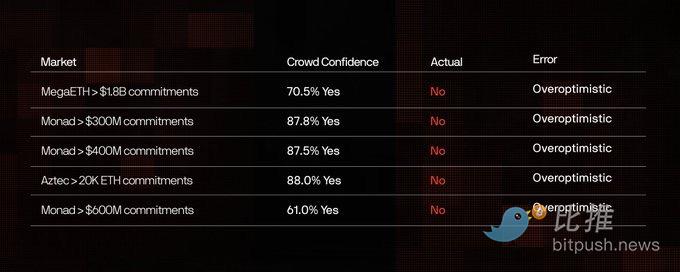
This systematic bias suggests that the participants in these markets are optimistic speculators who are drawn there precisely because they are bullish on the token sales.

Excessive Optimism vs. Token Performance (Since ICO)

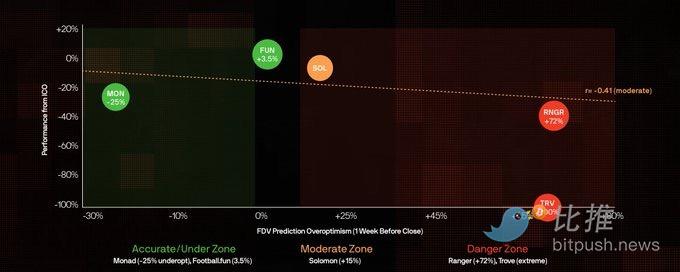
Methodology: This analysis only includes markets that had a public ICO and have issued tokens, using PM odds from one week before closing. Degree of Excessive Optimism = (PM Predicted FDV – Actual 24h FDV) / Actual 24h FDV. The Y-axis shows performance (return) since the ICO.

The data shows a moderate negative correlation (r=-0.41) between the degree of excessive optimism and ICO returns. Monad was undervalued (-25%) but has still fallen -24% since its ICO. Ranger was the most over-optimistically predicted (+72%) and has fallen -32% since its ICO. Only Football.fun remains above its ICO price (+1%).
Token Performance Ranking

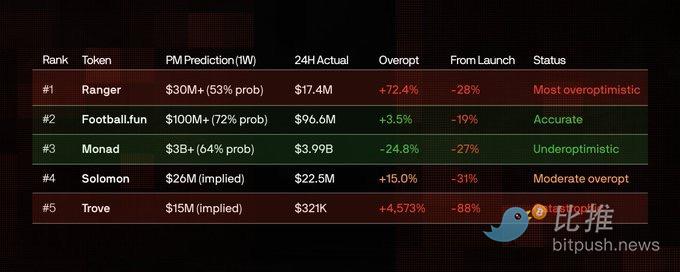
The table below uses historical PM odds from one week before closing, revealing the true prediction accuracy.

The pattern is clear: extreme excessive optimism foretells disaster, and high PM trading volume is a contrarian indicator even when its predictions are accurate.
ICO FDV vs. Listing Performance

Key Finding: Among tokens with ICO data, 40% listed at a price below their ICO valuation. Average return since ICO: -32.2%. Only Football.fun is trading above its ICO price.
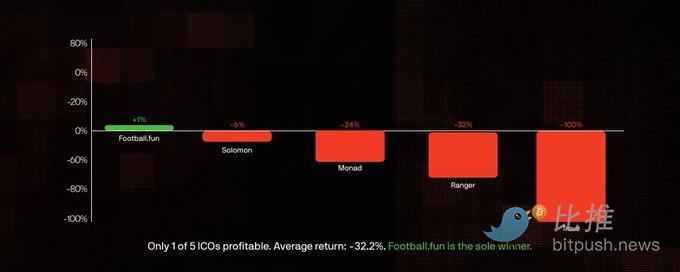
The pattern is starkly clear: Even tokens that listed above their ICO valuation (Monad, Solomon) eventually fell below the ICO price. Among the 5 ICO tokens in this dataset, only Football.fun is currently trading above its ICO price (+1%), making it the sole winner.

Key Conclusions

After analyzing 231 markets, $241.5 million in trading volume, and 8 listed tokens with verified 24-hour FDV data, several conclusions clearly emerge:

1. "100% accuracy" is meaningless. Markets close after the outcome is known (promise markets after the sale, FDV markets after 24 hours), so late-stage accuracy is trivially close to ~100%. One week before closing, the true prediction accuracy of promise markets was only 66.7%. At critical moments, the crowd was wrong one-third of the time.

2. Systematic excessive optimism. Among the top 15 markets, 5 markets showed over 60% confidence in thresholds that were not met. Average FDV overestimation: +35%.

3. High PM trading volume is a contrarian indicator. Monad ($89M) and MegaETH ($67M) had the highest degrees of excessive optimism. The more money the crowd pours in, the more confident they become, and the more wrong they tend to be.

4. Conservative predictions = Better outcomes. Tokens where PM predictions were accurate (Monad, Football.fun) fell less. Low hype and accurate predictions appear to be bullish signals.

Trading Signals

Based on the analysis, we can extract actionable signals for evaluating future token sales. These are not absolutely precise, but they represent patterns that appeared repeatedly in our dataset.
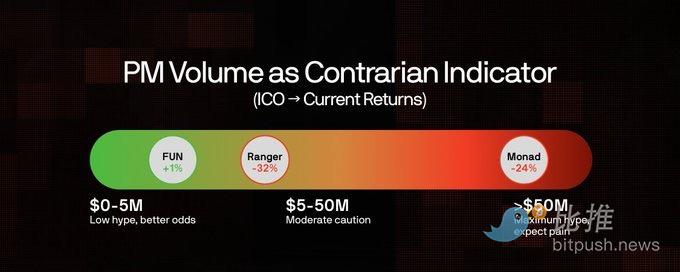
Bearish Signals

  • PM Trading Volume > $50 Million

  • FDV Excessive Optimism > 50%

  • All FDV thresholds likely won't be met

  • Promise Amount Excessive Optimism > 30%

Bullish Signals (Relatively)

  • PM Trading Volume < $5 Million

  • FDV Prediction Error within 20%

  • Multiple FDV thresholds will be met

  • Crowd expectations are conservative

This asymmetry is crucial. Bearish signals are strong indicators of poor outcomes, while bullish signals are relatively weaker—only suggesting that a token might "fall less" than its hyped counterparts. In a market where token prices have generally fallen from their highs, "falling less" is already the best-case scenario.

Ultimately: Polymarket's token sale markets are essentially hype gauges. The true signal lies not in the prediction itself, but in the deviation between the predicted outcome and the actual performance. When public money floods in, betting that valuations will continue to climb, it is wise to be cautious.

History repeatedly proves: when market consensus peaks, it is often the moment when investors experience the most pain.

Data sources in the article: Polymarket CLOB API, CoinGecko, CMC (cross-verified), price data as of January 27, 2026.


Twitter:https://twitter.com/BitpushNewsCN

Bitpush TG Discussion Group:https://t.me/BitPushCommunity

Bitpush TG Subscription: https://t.me/bitpush

Original article link:https://www.bitpush.news/articles/7607105

Related Questions

QWhat is the main finding regarding the accuracy of prediction markets for ICOs one week before closing?

AThe true prediction accuracy of commitment markets one week before closing is only 66.7%, meaning the crowd was wrong one out of every three times during critical periods of uncertainty.

QWhat systematic bias did the analysis discover in the prediction markets?

AThe analysis found a systematic bias of excessive optimism, where participants consistently predicted higher fundraising amounts and higher valuations than what actually occurred.

QAccording to the article, what does high trading volume on Polymarket indicate for an ICO?

AHigh Polymarket trading volume (e.g., over $50 million) is a bearish signal and acts as a reverse indicator, suggesting that the more money the crowd invests, the more confidently wrong they tend to be.

QWhat percentage of tokens in the dataset traded below their ICO valuation at listing?

A40% of the tokens with ICO data in the dataset listed at a price below their ICO valuation.

QWhat is the key takeaway about the relationship between prediction market forecasts and actual ICO performance?

AThe key takeaway is that prediction markets are not reliable forecasting tools but rather gauges of hype. The true signal lies not in the predictions themselves, but in the deviation between those predictions and actual performance.

Related Reads

Bitcoin's 'Rally Ends,' Officially Entering the Later Stage of a Bear Market?

Bitcoin prices declined 13% this week, reversing the recent rebound and signaling a likely transition into the later stages of a bear market. Key on-chain metrics deteriorated, with the short-term holder cost basis falling below the Realized Price—a pattern last seen in early 2022, characteristic of bear market maturity. The rally to ~$82k proved to be a bear market bounce, as evidenced by the 90-day realized profit/loss ratio failing to sustain above the bullish threshold of 2. Daily realized losses surged to $1.35B, including significant selling from long-term holders who accumulated near cycle tops, indicating ongoing supply redistribution. Price was rejected almost precisely at the aggregate US spot ETF cost basis of ~$83k, turning that level into resistance and leaving the average ETF investor underwater again. Spot market selling pressure intensified, with the 7-day volume delta turning significantly negative to its weakest level since February. While a major long liquidation event cleared over $400M in leverage, spot demand has not yet stepped in to absorb the resulting supply. Options markets continue pricing in higher future volatility (elevated volatility risk premium) and maintain a skew toward put options, reflecting persistent demand for downside protection, though not yet panic. Overall, market structure remains fragile. Sustained recovery likely requires a reclaim of the ETF cost basis, a shift back to positive spot demand, and a slowdown in realized loss-taking. Until then, the market risks further downside or extended consolidation within the broader bear trend.

Foresight News2m ago

Bitcoin's 'Rally Ends,' Officially Entering the Later Stage of a Bear Market?

Foresight News2m ago

How Risky is the "Death Spiral" of MSTR and STRC?

Summary: This article explores the perceived "death spiral" risk between MicroStrategy (MSTR), its Bitcoin holdings, and its perpetual preferred stock (STRC), drawing comparisons to the LUNA-UST collapse. While both systems feature price anchors, high yields for holders, and potential feedback loops, their core mechanisms differ fundamentally. The MSTR-STRC structure relies on continuous financing to sustain its high dividend payouts, primarily through stock ATM offerings. A negative feedback cycle could occur: falling MSTR stock price makes raising equity capital harder, increasing pressure to sell Bitcoin, which undermines STRC confidence and further depresses MSTR. However, unlike LUNA-UST's automated, direct linkage, the MSTR-STRC loop is weaker and has brakes: STRC dividends can be deferred or rates lowered, and STRC holders have a $100/share liquidation preference in bankruptcy, providing a price floor. The company's sustainability hinges on its ability to continue financing. Its current ~$900 million USD reserves cover only about 6.3 months of its ~$1.71 billion annual interest/dividend burden. The next six months are critical, aligning with both the potential bottom in Bitcoin's four-year cycle and the depletion timeline of its reserves. While a LUNA-style catastrophic collapse is deemed highly unlikely due to structural differences, the key question is whether MicroStrategy can navigate this period through healthy deleveraging to restart its capital engine.

Foresight News21m ago

How Risky is the "Death Spiral" of MSTR and STRC?

Foresight News21m ago

How Much Debt Does Strategy Really Have? Is There a Risk of Implosion?

MicroStrategy's Debt Risk: A Turning Point in the "Never Sell" Strategy As of June 3, 2026, MicroStrategy holds 843,706 bitcoins (valued at ~$53.1B) but faces significant financial obligations. Its capital structure includes $6.75B in convertible notes and $15.48B in perpetual preferred stock (led by the $8.5B STRC series), creating an annual payout burden of ~$1.71B. With software revenue at only ~$500M, interest and dividend obligations far exceed operating income. A critical shift occurred in late May 2026 when the company sold 32 bitcoins for ~$2.5M to cover dividends, breaking CEO Michael Saylor's long-standing "never sell" pledge. This symbolic move triggered a sharp decline in both Bitcoin's price and MSTR stock, reflecting market fears about cash flow sustainability. The core of the strain is the STRC perpetual preferred stock, designed as a "permanent loan" with no maturity date but requiring high monthly dividends (currently 11.5%). Its business model relies on a three-part cycle: issuing new STRC shares, using proceeds to buy more Bitcoin and fund a USD reserve, and using that reserve to pay dividends. This cycle depends on continuous investor demand for STRC and Bitcoin's price appreciation. Analysis shows Bitcoin needs to appreciate at least 2.3% annually to cover the $1.71B in yearly obligations at current holdings. With Bitcoin price down ~22% from March 2026 highs, this pressure has intensified. The company's $900M USD reserve can only cover about 7 months of payments if STRC issuance stalls. Key risks are not immediate bankruptcy or forced Bitcoin liquidation (as BTC is not collateral), but rather: 1) The erosion of MSTR's premium to its Bitcoin holdings (mNAV), which would cripple its ability to raise cheap capital; 2) A vicious cycle where stagnant Bitcoin prices reduce STRC demand, draining the USD reserve and forcing BTC sales, further depressing prices. The period from February 2027 to September 2028 is a crucial test, with over $5.9B in convertible notes facing put options or maturity. In essence, MicroStrategy has evolved from a simple Bitcoin holder into a complex financial entity acting like a "private Bitcoin bank," leveraging its BTC holdings to create layered financial products. Its survival depends on maintaining Bitcoin's price trend, its stock premium, and market appetite for its preferred shares. The recent token sale marks not a betrayal of its Bitcoin thesis, but an admission that the leveraged strategy must eventually be paid for.

marsbit31m ago

How Much Debt Does Strategy Really Have? Is There a Risk of Implosion?

marsbit31m ago

Anthropic Cries Wolf: Is the AGI Threat Real, or Just an IPO Story?

Anthropic has published an article titled "When AI builds itself," discussing the emerging concept of "recursive self-improvement," where AI begins to actively participate in designing, training, testing, and optimizing its own subsequent versions. The company presents internal data showing that by May 2026, over 80% of code merged into its codebase was written by Claude, its AI model. Claude's capabilities have expanded to handling complex, open-ended engineering tasks, achieving a 76% success rate in such areas, and even contributing to research processes, such as optimizing code performance and conducting AI safety experiments. Anthropic outlines an evolution from human-driven development to AI-assisted workflows, culminating in the current stage where AI agents can autonomously write, run, and delegate code. The company cautions that the path toward a "closed loop," where AI continuously improves itself, is becoming visible. It calls for coordinated global mechanisms to potentially slow or pause frontier AI development to allow safety research and societal structures to catch up. However, the timing of this warning coincides with Anthropic's preparations for an IPO, framing the narrative not just as a safety concern but also as a demonstration of Claude's advanced capabilities and its integral role in accelerating Anthropic's own R&D—creating a potential "flywheel" effect for competitive advantage. This contrasts with OpenAI's recent, more policy-oriented discussion of the same risks, highlighting the competitive dynamics in the AI industry as companies position themselves in both the technological and regulatory landscape.

marsbit1h ago

Anthropic Cries Wolf: Is the AGI Threat Real, or Just an IPO Story?

marsbit1h ago

Trading

Spot
Futures
活动图片