‘Adapt or die’- SEC approves Nasdaq plan to trade tokenized securities

ambcryptoPublished on 2026-03-19Last updated on 2026-03-19

Abstract

The SEC has approved Nasdaq's pilot program to trade tokenized securities, allowing the exchange to test blockchain-based versions of stocks and ETFs on a unified platform. The program will initially include high-volume assets like those in the Russell 1000 Index and major ETFs. Unlike many existing tokenized products, Nasdaq’s tokens will grant holders the same legal rights as traditional shareholders, including the same CUSIP numbers and trading symbols. This move is seen as a major disruptive force in asset management, with experts comparing its potential impact to that of ETFs on mutual funds. The approval accelerates Nasdaq’s partnership with Kraken and aims to enable 24/7 trading and attract offshore investors. The tokenized securities market has already surpassed $1 billion, with significant growth in early 2026.

New York-based Nasdaq Exchange has gotten the green light to proceed with its pilot program for trading tokenized securities.

The SEC approval would allow the traditional exchange to test trading of the blockchain-based version of stocks under its Depository Trust Company (DTC) pilot program.

Both traditional stocks and these tokenized variants will trade on the same unified platform. The program will initially target high-volume ETFs and stocks.

This would include the constituents of the Russell 1000 Index (Apple, Microsoft, Nvidia, Amazon, etc.). Additionally, ETFs such as the S&P 500 and the Nasdaq-100 will fall within the early asset scope.

Community reactions

For ETF analyst Nate Geraci, the SEC approval would set the stage for a massive disruption by the tokenization boom.

For him, the writing is on the wall: the top regulator, the SEC, major exchanges (Nasdaq, NYSE), and the world’s largest asset managers (BlackRock and Fidelity) are all in on tokenization.

He added,

Tokenization will be as disruptive to asset management as ETFs were to mutual funds...Will basically be adapt or die a slow death.

Nasdaq initially sought SEC approval for tokenized stocks in September 2025. But its proposal was wholly different from the current tokenized securities on the market, such as xStocks offered by Kraken and Backed Finance.

Unlike most current offerings, including leveraged derivatives that grant holders no legal rights, Nasdaq pushed for its tokenized securities to have rights similar to those of investors holding traditional shares. And the SEC acknowledged this.

A tokenized share of a DTC Eligible Security must be fungible with, share the same CUSIP number and trading symbol with, and afford its shareholders the same rights and privileges as a share of an equivalent class of the traditional security for it to trade on Nasdaq.

Nasdaq’s tokenization plans

That said, the SEC’s green light will accelerate Nasdaq’s recent partnership with Kraken to distribute tokenized securities by xStocks.

This integration may likely be tied to the DTC pilot and eventually accord xStock holders similar legal rights as traditional shareholders.

The end goal? Ensure 24/7 trading and target large offshore users to gain access to the U.S. equity market.

And the appetite for these products is incredible. So far, the tokenized segment has crossed $1B, and over $300 million of the market cap was added in Q1 2026 alone.
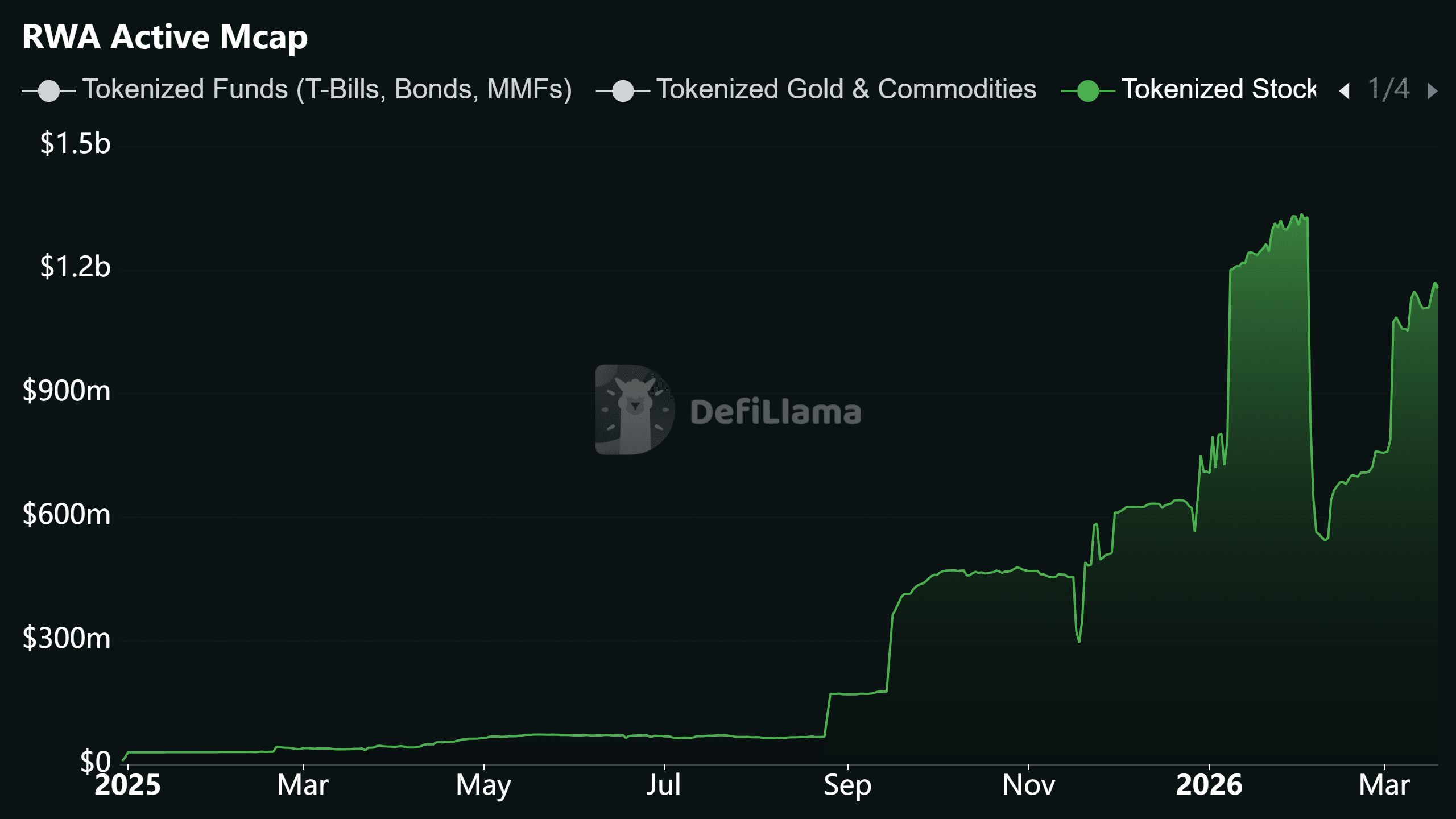
Source: DeFiLlama

Final Summary

  • The approval of Nasdaq’s tokenized securities trading is a major unfolding disruption that would force other traditional players to pivot, per an ETF expert.
  • SEC clarified that Nasdaq’s tokenized stocks and ETFs will offer similar rights as traditional securities.


Related Questions

QWhat is the significance of the SEC's approval for Nasdaq's pilot program?

AThe SEC's approval allows Nasdaq to proceed with its pilot program for trading tokenized securities, which are blockchain-based versions of stocks. This program will enable both traditional stocks and their tokenized variants to trade on the same unified platform, initially targeting high-volume ETFs and stocks like those in the Russell 1000 Index and major ETFs such as the S&P 500 and Nasdaq-100.

QAccording to ETF analyst Nate Geraci, how disruptive will tokenization be to asset management?

ANate Geraci believes tokenization will be as disruptive to asset management as ETFs were to mutual funds. He stated that it will force traditional players to 'adapt or die a slow death,' indicating a significant transformation in the industry.

QHow do Nasdaq's tokenized securities differ from current offerings like xStocks from Kraken and Backed Finance?

AUnlike current offerings such as leveraged derivatives that grant holders no legal rights, Nasdaq's tokenized securities are designed to have rights similar to those of investors holding traditional shares. The SEC requires that tokenized shares must be fungible, share the same CUSIP number and trading symbol, and afford shareholders the same rights and privileges as traditional securities.

QWhat is the end goal of Nasdaq's tokenization plans, as mentioned in the article?

AThe end goal of Nasdaq's tokenization plans is to ensure 24/7 trading and target large offshore users to gain access to the U.S. equity market. This initiative aims to expand market accessibility and provide continuous trading opportunities.

QWhat is the current market size of the tokenized segment, and how much growth was seen in Q1 2026?

AThe tokenized segment has crossed $1 billion in market size. In Q1 2026 alone, over $300 million in market capitalization was added, indicating significant growth and appetite for these products.

Related Reads

Agents Take Over Traffic Distribution Power: What Are Tencent, ByteDance, and Alibaba Competing For?

In the race to dominate the AI era's entry point, China's tech giants—Tencent, ByteDance, and Alibaba—are aggressively deploying AI Agents to control the future of traffic distribution. Alibaba is pursuing a dual-track "closed loop + openness" strategy. Its Qianwen app is evolving into a super-Agent integrated across its ecosystem (Taobao, Alipay, etc.) to handle complex tasks like travel planning. Concurrently, it is opening its platform to external brands (Luckin Coffee, KFC) and has launched a B2B Agent platform, "Wukong," targeting enterprise automation. Its other flagship, Quark, aims to be an "AI super search box" for information and tasks. ByteDance is executing an omnipresent "sprawl strategy." Its Doubao app boasts over 300 million monthly active users and is evolving into a default AI entry point for daily life, with plans for paid versions and e-commerce integration. Its core weapon is the Kouzi platform, a visual "AI assembly factory" for developers to build custom Agents. ByteDance is also pushing hardware integration, collaborating on AI phones and developing smart glasses to embed Doubao everywhere. Tencent is playing its long-held "ultimate card" by quietly embedding an AI Agent directly into WeChat. This Agent, accessible via a swipe, can understand user commands and automatically execute tasks by calling upon WeChat's millions of mini-programs (e.g., finding and ordering coffee). This leverages WeChat's unparalleled 1.4-billion-user ecosystem to position the app as an AI-powered "service operating system," a move that could dramatically reshape the competitive landscape. The core battleground is shifting from competing for "user screen time" to competing to be the "default execution layer" for user intent. The business model is evolving from an "attention economy" to an "intent economy," where the Agent that can most efficiently fulfill a user's need gains control over service access and token flow. This represents a fundamental change in how users connect with digital services, making the fight for the Agent入口 (entry point) a pivotal moment for redefining industry leadership in the AI age.

marsbit52m ago

Agents Take Over Traffic Distribution Power: What Are Tencent, ByteDance, and Alibaba Competing For?

marsbit52m ago

From Banning Doubao to Embracing Honor: Why Did WeChat Suddenly 'Change Its Face'?

The article explores the sudden shift in WeChat's strategy towards AI assistants from mobile phone manufacturers, transitioning from strict opposition to active collaboration. For over a year, WeChat fiercely resisted attempts by phone AI assistants (like ByteDance's Doubao in late 2025) to control its features via GUI automation ("simulated clicking"), citing security and data control concerns. This stance created a significant barrier for system-level AI integration. Now, Tencent has initiated A2A (Agent-to-Agent) partnerships with major phone brands like Honor, Xiaomi, OPPO, and vivo. This model allows a phone's system AI (e.g., Honor's YOYO) to parse a user's voice command and send a structured request directly to WeChat's own internal AI agent via secure APIs. WeChat then executes the action (e.g., sending a message) and returns the result. The article attributes Tencent's "change of face" to strategic pressure. While leading in social app usage, Tencent trails rivals like ByteDance and Alibaba in standalone AI app popularity. WeChat, with its vast mini-program ecosystem, is Tencent's key asset for an AI comeback. The upcoming WeChat AI agent aims to handle tasks like booking and payments within the app. However, phone system assistants remain the primary AI entry point for most users. The A2A collaboration allows Tencent to extend WeChat's AI reach to this crucial system layer while maintaining control over its core functions and data. For phone manufacturers, embracing A2A is a pragmatic move. The GUI route proved unviable due to WeChat's blocks. A2A offers a compliant path to integrate a vital service, enhancing their AI assistants' usefulness. It allows them to focus on developing their own AI ecosystems for other services while cooperating on WeChat access. The collaboration is framed as a mutual, strategic necessity: Tencent gains a distribution channel, and manufacturers gain a key functionality. The partnership relies on a "dual authorization" mechanism for security, requiring both user and app consent for each action. While questions about long-term data privacy practices remain, experts note A2A is more secure and compliant than GUI automation. Ultimately, this cooperation is seen as a tentative, calculated truce. Tencent's long-term goal is to make WeChat an AI-powered "service OS." Phone manufacturers aim to make their system AI the central user interface. Their paths may converge or clash in the future, but for now, the A2A deal represents the opening chapter in the battle for the AI-era user入口, driven by necessity and strategic calculus on both sides.

marsbit2h ago

From Banning Doubao to Embracing Honor: Why Did WeChat Suddenly 'Change Its Face'?

marsbit2h ago

Trading

Spot
Futures
活动图片




