Above the Seats: A Covert Power Struggle Deciding the Fate of Encryption

marsbitPublished on 2026-03-19Last updated on 2026-03-19

Abstract

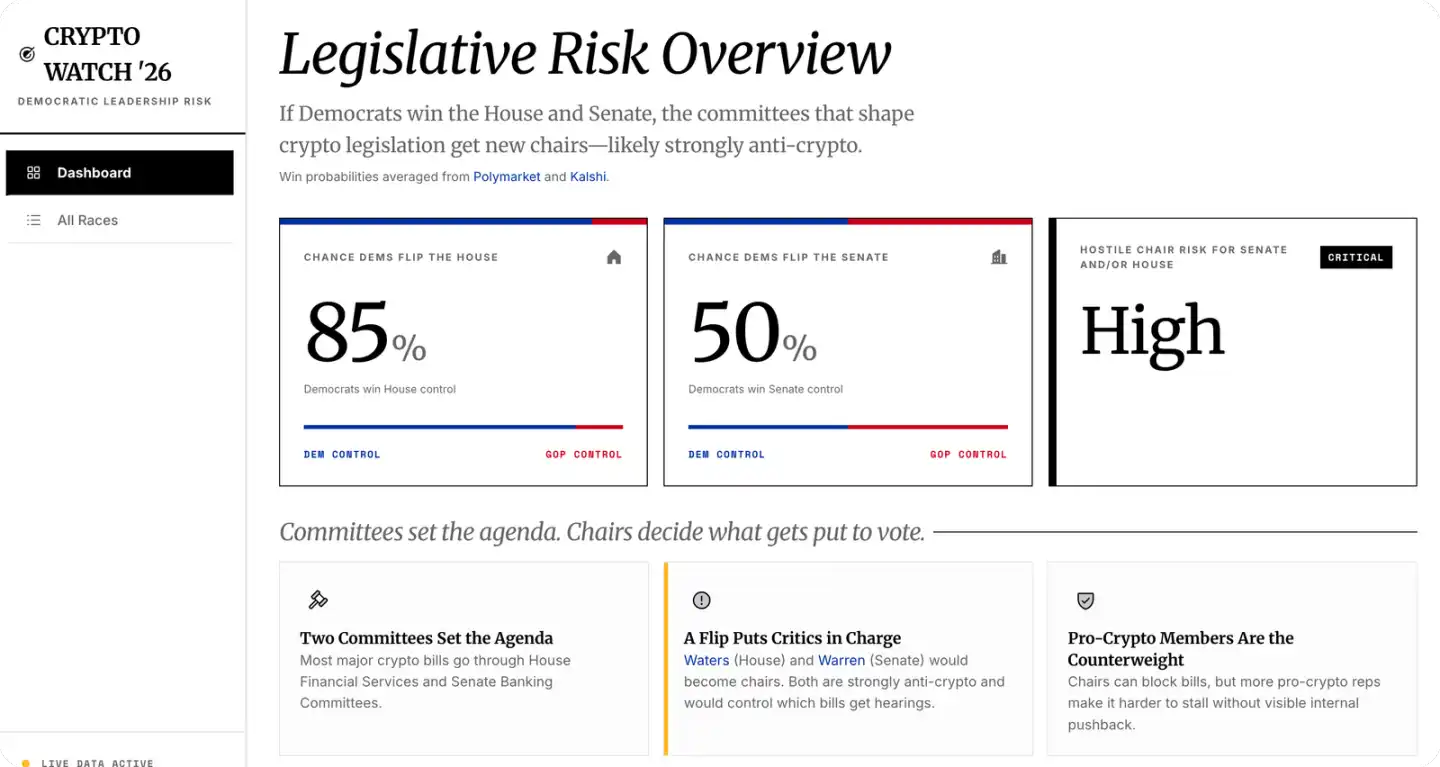
The 2026 US midterm elections pose significant risks to the crypto industry, with Democrats having an 85% chance of taking the House. This would place Maxine Waters, a vocal crypto critic, as Chair of the House Financial Services Committee (HFSC), giving her absolute power to block crypto legislation by controlling the agenda. In the Senate, Elizabeth Warren, another staunch opponent, would likely chair the Banking Committee. While nearly half of Democratic lawmakers voted for the pro-crypto GENIUS Act, this support is superficial. Bills never go to a full floor vote without first passing through committee, where chairs hold unilateral power to kill them. The current pro-crypto Republican chairs, who advanced bills like FIT21 and CLARITY, would be replaced. The analysis highlights that even though pro-crypto Democrats exist, they lack influence in the powerful committees that control legislative progress. Key elections that could shift committee dynamics are limited. The conclusion is that a Democratic sweep would create a severe structural headwind, stalling major crypto legislation in Congress despite bipartisan voter support.

Written by: David Christopher

Compiled by: Saoirse, Foresight News

What level of risk does this midterm election truly conceal for the encryption industry? As the possibility of a Democratic sweep of both the Senate and the House of Representatives in the midterm elections continues to rise, I aim to conduct an in-depth analysis of its potential impact on the future trajectory of the encryption industry, based on current polls.

To this end, I have consulted prediction markets on one hand, and resources like Stand with Crypto (SWC) on the other—a platform that records the policy stances of various candidates towards the encryption industry. I have integrated this information and built an analytical dashboard accordingly.

Although the data is still being supplemented and refined, I have established a core database tracking key districts where Democratic candidates are leading, and correlating their encryption policy positions with potential influence in Congressional committees. This analysis preliminarily reveals the policy landscape for the coming months: superficially, there appears to be room for cooperation, but a deeper look uncovers profound structural issues.
A Surprising Reality

First, it must be clarified that Democratic support for the encryption industry is actually higher than commonly perceived—at least on certain bills.

In the House of Representatives, 101 Democratic lawmakers (approximately 48% of the caucus) voted in favor of the GENIUS Act; in the Senate, 18 Democrats (40%) voted to advance the bill to a floor vote. This seems to form a tangible bipartisan support coalition. However, this support is confined to that specific bill. Once it enters the core stage that truly determines legislative direction—the committee process—this support vanishes entirely.

This is precisely the crux of the issue.

The Core Source of Influence

Encryption-related legislation is never brought directly to a full floor vote.

Whether it's stablecoin regulation, market structure rules, or defining the authority of the U.S. Securities and Exchange Commission (SEC), all issues must first undergo committee review. The House Financial Services Committee (HFSC) and the Senate Banking Committee are the two core bodies that determine the life or death of encryption bills (market structure bills also require input from the Agriculture Committee regarding the relevant authority of the Commodity Futures Trading Commission (CFTC)).

Committee chairs hold absolute agenda control: they decide which bills get hearings, which move to the deliberation stage, and which die quietly in procedural deadlock. A chair opposed to a bill does not need to vote it down; they can simply kill it by refusing to schedule it.

Republican chairs in recent years have fully demonstrated the influence of this power:

  • Senate Banking Committee Chair Tim Scott pushed the GENIUS Act through committee review and helped it pass the Senate vote;
  • Former House Financial Services Committee Chair Patrick McHenry strongly advocated for the FIT21 Act, making it the first major encryption market structure bill to pass the House;
  • Current House Financial Services Committee Chair French Hill has continued this momentum, pushing related bills like the CLARITY Act through the House (although this bill remains stalled in the Senate), and consistently holding hearings on digital assets and capital markets modernization.

So, what changes if Democrats achieve a full victory?

The majority party will control all committee chair positions in Congress, without exception. If Democrats recapture the House, they will chair all House committees; if they take the Senate, they will fully control all Senate committees. The selection of chairs within the majority party is typically based on seniority.

  • House Financial Services Committee: The most senior Democrat is Maxine Waters;
  • Senate Banking Committee: The highest-ranking Democrat is Elizabeth Warren.

It is well-known that both have voted against all major encryption bills. Warren led the opposition during the GENIUS Act deliberations, calling it "a threat to national security"; Waters directly condemned the bill as "a complete and total crypto scam."

The key point of contention in the House is this—once party control changes, the subcommittees will be completely reorganized. The majority party will dictate the allocation and proportional adjustment of seats for new members. Waters will have significant influence over personnel arrangements within the House Financial Services Committee and its subcommittees, including deciding who will oversee "digital asset" related matters. Admittedly, she cannot unilaterally decide all members (the party leadership and caucus have a say), but it is enough to steer the committee towards her preferred anti-encryption stance.

The Democratic contingent in the current House Financial Services Committee is already clearly leaning anti-encryption: Brad Sherman, Stephen Lynch, Emanuel Cleaver, and Sylvia Garcia all hold strong opposing views. Even with pro-encryption members like Jim Himes, Bill Foster, Ritchie Torres, Josh Gottheimer, and Vicente Gonzalez, they cannot control the agenda under Waters' chairmanship.
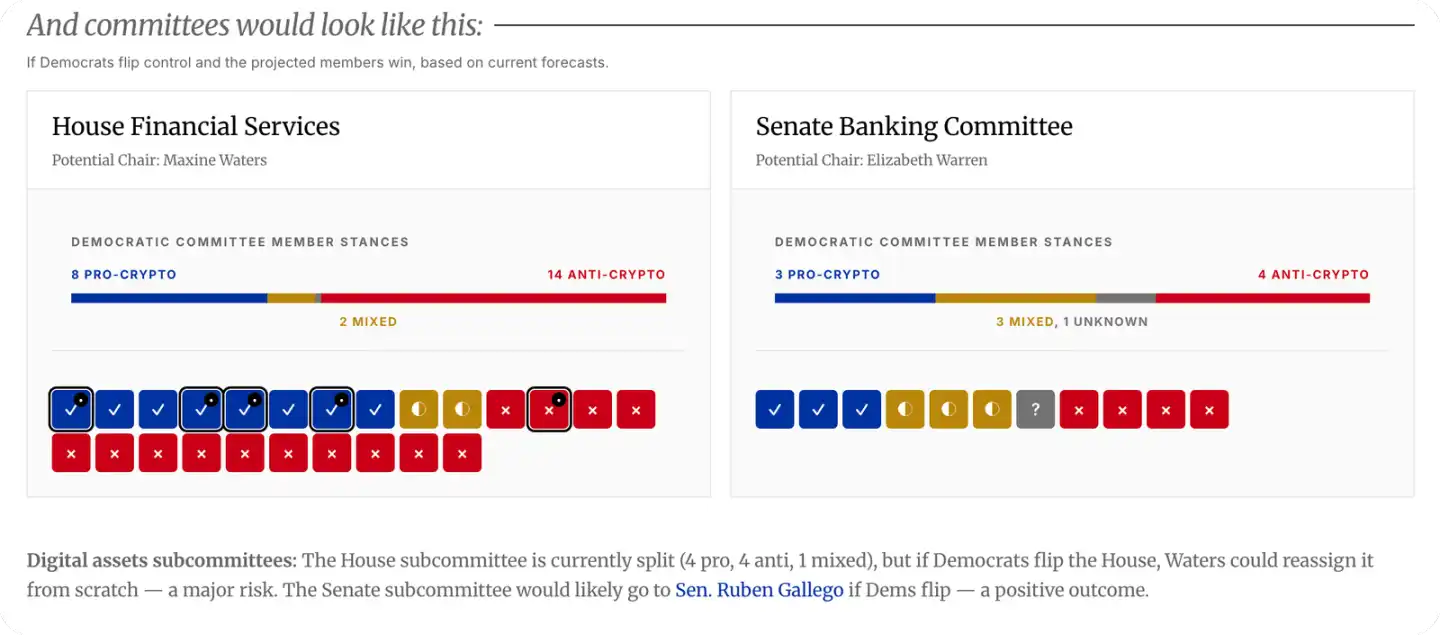
This chart shows the distribution of encryption stances in the two core committees if Democrats regain control of Congress in the 2026 midterm elections, visually reflecting the regulatory landscape the encryption industry will face.

The situation in the Senate Banking Committee is slightly better. Although Warren would become chair, the committee's composition is more diverse: it includes pro-encryption senators (e.g., Mark Warner, Ruben Gallego, Angela Alsobrooks), opponents (e.g., Tina Smith), and swing-vote moderates. A slight positive is that if Democrats control the Senate, Senator Gallego, rated favorably on the SWC platform, is highly likely to chair the digital assets subcommittee. Although Warren would still control the full committee's agenda, Gallego could potentially carve out some space for pro-encryption voices at the subcommittee level.

The Key Elections That Truly Impact the Landscape

Most existing pro-encryption Democratic lawmakers are not on the House Financial Services Committee or the Senate Banking Committee. They can certainly vote in favor of relevant bills in full floor votes, and they can pressure party leadership (though, given the high degree of partisanship on this issue, most are reluctant to speak out for the encryption industry), but they cannot force committee chairs to advance legislation.

Only a handful of elections can truly change the power composition within these committees.
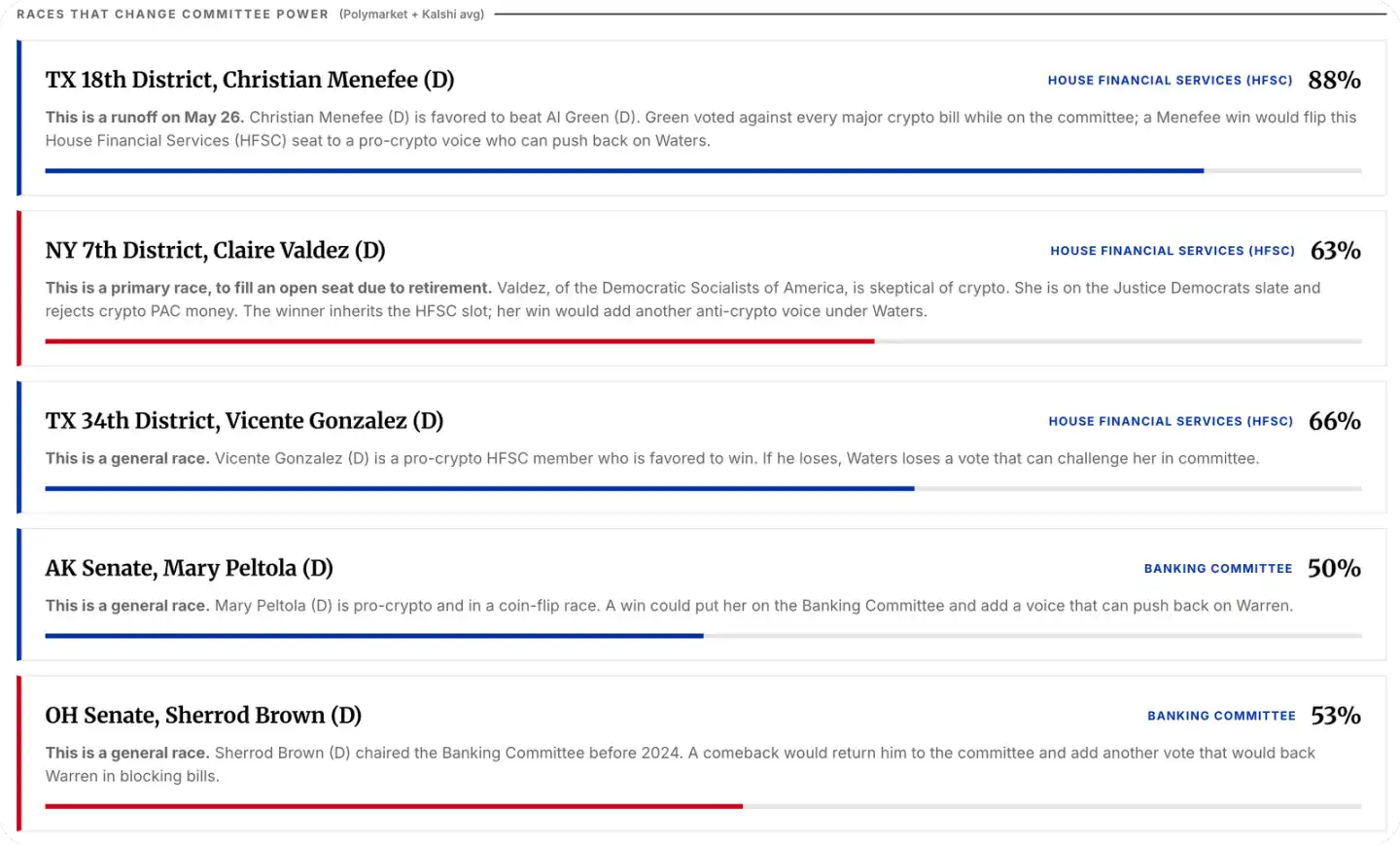
This chart is an analysis of key district races affecting U.S. Congressional encryption legislative power. Data is averaged from Polymarket and Kalshi prediction markets. It corely shows which election results would directly change the encryption stance of the House Financial Services Committee (HFSC) and the Senate Banking Committee.

The Final Conclusion of the Midterm Elections

The prospects in the House are extremely grim.

The probability of Democrats retaking the House is as high as 85%, meaning Waters is highly likely to chair the House Financial Services Committee, wielding absolute power to reorganize subcommittees and control the legislative agenda. The remaining bright spots are extremely limited: Menefee has a chance to defeat Green for a seat, and Gonzalez is highly likely to retain his current seat. These scenarios might create some checks and balances, but they cannot change the core of power—the ownership of the chairmanship.

The Senate is the encryption industry's last remaining stronghold, and the situation worsened last night: Juliana Stratton defeated Raja Krishnamoorthi in the Illinois primary. Based on SWC platform records, combined with the fact that Fairshake (a U.S. Super PAC with ties to the encryption industry, and currently one of the most influential political lobbying organizations in the crypto space) spent $7 million opposing her, it is clear that Stratton is a staunch anti-encryption politician.

Even more frustrating is the overall picture: approximately 47% of Democratic lawmakers in both chambers supported the GENIUS Act, and 37% of House Democrats supported the CLARITY Act—pro-encryption Democrats do exist. But the life or death of bills is never decided by full floor votes; it depends on the committees. Committee votes on market structure bills strictly follow party lines. The existing support base simply cannot transmit to the core环节 that truly determines legislative direction.

The encryption industry should not have become so partisan. Pro-encryption Democrats do exist; they just happen not to be in the key positions that hold real legislative power.


Related Questions

QWhat is the main concern for the crypto industry regarding the upcoming midterm elections according to the article?

AThe main concern is that if Democrats sweep both the House and Senate, key congressional committees like the House Financial Services Committee (HFSC) and Senate Banking Committee will be chaired by strong crypto opponents like Maxine Waters and Elizabeth Warren, who can block crypto-related bills by controlling the agenda and refusing to advance them to a full vote.

QWhich two congressional committees are identified as the most critical for the fate of crypto legislation?

AThe House Financial Services Committee (HFSC) and the Senate Banking Committee are the two core committees that determine the survival or death of crypto bills, as all related legislation must pass through them first before reaching a full floor vote.

QWho are the likely Democratic chairs of the HFSC and Senate Banking Committee if their party gains control, and what are their stances on crypto?

AMaxine Waters would likely chair the House Financial Services Committee (HFSC), and Elizabeth Warren would likely chair the Senate Banking Committee. Both are strong opponents of crypto; Warren called the GENIUS Act a 'threat to national security,' and Waters denounced it as a 'total crypto scam.'

QWhat specific power does a committee chair hold over crypto legislation, as explained in the article?

AA committee chair has absolute agenda control: they decide which bills get hearings, which move to markup, and which die in procedural gridlock. They can kill a bill they oppose simply by refusing to schedule it for consideration, without needing to vote it down.

QDespite significant Democratic support for some crypto bills in full votes, why does the article argue this support is ineffective?

AThe support is ineffective because crypto bills never go directly to a full vote; they must first pass through committees. The chairs of these key committees, who are staunch crypto opponents, can block the bills from ever reaching a full vote, rendering the broader support meaningless.

Related Reads

KOL's Perspective: Why Is SOL Set to Rise from This Point?

**Summary: Why SOL is Positioned for Growth at This Level** The article argues that SOL is poised for an upward move from its current price point, citing several key factors. Primarily, SOL has just broken out of a 4-month consolidation phase. This breakout signals a return of risk appetite to the broader crypto market, as SOL is seen as a key indicator of overall crypto health. The token's ownership has reportedly shifted from short-term traders and tourists to long-term accumulators, leading to low volume. Any meaningful increase in trading activity could thus trigger significant upward momentum. Fundamental strengths include strong institutional adoption, integration with DeFi and RWAs (Real-World Assets), and the potential benefits from the Clarity Act. Despite its high volatility—having dropped 70% from its all-time high but still up 12x from its bear market low—SOL is highlighted as one of the few tokens from the last cycle to reach new highs. It boasts a robust ecosystem of applications, users, and protocols. Future catalysts include the expected influx of AI developers following the Miami Accelerate conference, which focused on AI on Solana. Furthermore, Solana is positioned as the premier chain for memecoin activity, a trend expected to continue and drive network usage and fees. The article concludes that recent price action reflects a healthy transfer to long-term holders, setting the stage for growth.

marsbit6m ago

KOL's Perspective: Why Is SOL Set to Rise from This Point?

marsbit6m ago

Those Pre-Bitcoin PoW Protocols Have Recently Been Reimplemented

This article details a recent surge in replicating pre-Bitcoin Proof-of-Work (PoW) protocols, specifically focusing on Hal Finney's 2004 RPOW (Reusable Proofs of Work). Within five days in May 2026, multiple independent builders in the Bitcoin/cypherpunk community launched projects inspired by this early electronic cash proposal. The initiative began with Fred Krueger's `rpow2.com`, a centralized but auditable system that replaced RPOW's original IBM 4758 hardware with Ed25519 signatures. Initially a faithful replica, it later adopted Bitcoin-like features (21M supply cap, difficulty adjustment) and a controversial 5.24% founder allocation. This sparked rapid forks, including `rpow4.com` which incorporated full Bitcoin parameters, a prediction market (`rpowmarket.com`), and a DEX (`rpow2swap.com`). Concurrently, Mike In Space created a prototype of Wei Dai's 1998 b-money proposal (`b-money.replit.app`), pushing the historical exploration even further back. The article contrasts these centralized, server-dependent experiments with Bitcoin's core innovation of decentralized, trustless consensus. It also highlights a parallel development: the `HASH` project on Ethereum, which uses smart contract hooks to enable a purely fair-launch, browser-mineable PoW token with 0% allocations to team or VCs. The collective activity is framed as a meme-driven, educational exploration of cypherpunk history rather than a serious financial movement, with all projects heavily disclaiming any investment value.

marsbit11m ago

Those Pre-Bitcoin PoW Protocols Have Recently Been Reimplemented

marsbit11m ago

South Korean Exchanges 'Battle' Regulators, Challenging the Boundaries of Enforcement and Legislation

South Korea's cryptocurrency industry is engaged in a rare, direct confrontation with regulators. The Financial Intelligence Unit (FIU), the primary anti-money laundering (AML) watchdog, has recently imposed heavy penalties on major exchanges like Upbit and Bithumb for alleged violations involving unregistered overseas VASPs and AML procedures. However, exchanges are now actively challenging these actions in court and through industry associations. In a significant shift, the Seoul Administrative Court ruled in favor of Upbit's operator, Dunamu, overturning part of an FIU-ordered business suspension. The court found the FIU's penalty criteria and justification insufficiently clear. Similarly, the court suspended the enforcement of a six-month business suspension against Bithumb pending a final ruling, citing potential irreversible harm to the exchange. Beyond legal battles, the industry is contesting proposed legislative amendments. The Digital Asset eXchange Alliance (DAXA) strongly opposes a draft rule that would mandate Suspicious Transaction Reports (STRs) for all crypto transfers over 10 million KRW (~$6,800). DAXA argues this "poison pill" clause violates legal principles and would overwhelm the STR system, increasing reports from 63,000 to an estimated 5.45 million annually for major exchanges, thereby crippling effective AML monitoring. This conflict highlights a structural tension in South Korea's crypto governance: comprehensive digital asset laws are still developing, while regulators rely heavily on AML enforcement. The industry's move from passive compliance to active legal and legislative challenges signifies a new phase, pressing for clearer rules and more proportionate enforcement. While short-term disputes may intensify, this clash could ultimately lead to a more mature and sustainable regulatory framework for South Korea's vibrant crypto market.

marsbit1h ago

South Korean Exchanges 'Battle' Regulators, Challenging the Boundaries of Enforcement and Legislation

marsbit1h ago

After 50x Storage Surge, Justin Sun Always Looks to the Next Decade

Sun Yuchen, known for his controversial stunts like a $30 million lunch with Warren Buffett (canceled due to a kidney stone) and eating a $6.2 million duct-taped banana, is often overshadowed by a significant fact: his decade-long track record of spotting major investment trends. In 2016, he famously advised young people to invest in Bitcoin, Nvidia, Tesla, and Tencent instead of buying property. A hypothetical $20,000 investment in Nvidia and Tesla from that list would now be worth over 50 million RMB. His latest major call was on November 6, 2025, predicting a "50x storage opportunity" tied to the AI boom, which materialized with Sandisk's stock surging nearly 50-fold by 2026. Looking ahead, Sun now focuses on the next frontier: Physical AI. He identifies four key areas: 1. **Embodied AI/Robotics**: He sees this reaching its "iPhone moment," with companies like UBTech and Galaxy General leading in commercialization. 2. **Drones**: Viewed as the first commercially viable form of Physical AI, revolutionizing sectors from warfare (e.g., AeroVironment's Switchblade) to logistics. 3. **Spatial Computing**: Beyond VR, it's about AI understanding physical space, a foundational technology for robotics and autonomous systems, exemplified by Apple's Vision Pro. 4. **Space Exploration**: After a 2025 suborbital flight with Blue Origin, Sun advocates for space as the ultimate frontier, discussing blockchain's potential role in space asset management and data transactions. His investment philosophy involves betting on entire, inevitable trends rather than single companies. For robotics, he sees Tesla (the body/manufacturer) and Nvidia (the brain/AI platform) as complementary plays. In defense drones, he highlights companies making tanks obsolete (AeroVironment) and those augmenting fighter jets (Kratos). For space, he participated in Blue Origin's flight and anticipates SpaceX's potential IPO to redefine the sector's valuation. Sun Yuchen's vision frames the next two decades not as a revolution in information flow (like the internet), but in the fundamental operation of the physical world through AI-powered robots, autonomous systems, and spatial intelligence, ultimately extending human and AI activity into space. While many still focus on conventional assets, he continues to look toward the next technological horizon.

marsbit2h ago

After 50x Storage Surge, Justin Sun Always Looks to the Next Decade

marsbit2h ago

Trading

Spot
Futures
活动图片




