Abandoning Token Issuance, Abolishing veBAL: Can Balancer's 'All-or-Nothing Gamble' Bring Renewal?

marsbitPublished on 2026-03-24Last updated on 2026-03-24

Abstract

Balancer, a veteran DeFi protocol, is undergoing a radical transformation following a major $120M security breach in November 2025 that accelerated its existing financial decline. With annual revenue of just $290K against a $2.87M operational budget, its DAO treasury was on track to be depleted within four years. TVL plummeted from a peak of $3B to under $160M. On March 23, 2026, the core team proposed two major overhauls: a tokenomics reform and an operational restructuring. The key strategy shifts from token emission-driven growth to a sustainable, fee-based model. Operational changes include dissolving Balancer Labs, reducing the team from 25 to 12.5 full-time equivalents, and cutting the annual budget by 34% to $1.9M. The protocol will focus solely on its core products: Boosted Pools, a revamped reCLAMM, and LBPs, while maintaining deployments only on Ethereum, Gnosis, Arbitrum, and Base. Tokenomics reforms are more drastic: BAL token emissions will stop immediately, and the veBAL governance system will be abolished. All protocol fees will now go entirely to the DAO treasury, and V3 protocol fees are reduced from 50% to 25% to attract LPs. A $500K compensation fund is allocated for veBAL holders. A crucial exit mechanism is proposed: a 12-week window, opening one year after the vote, allowing BAL holders to burn their tokens for stablecoins at a Net Asset Value (NAV) of $0.16 per BAL. If fully utilized, this could burn 35% of the circulating supply. The team projects...

Original Author: KarenZ, Foresight News

On November 3, 2025, a security incident resulting in losses exceeding $120 million largely shattered the growth illusion of the veteran DeFi protocol, Balancer.

This was the largest security incident in Balancer's history. But the deeper wound lies not in that astronomical figure.

Looking at the financial data attached to Balancer's latest proposal, its fundamentals are already grim: the protocol's annualized fees are approximately $1.65 million, while the DAO's estimated annualized revenue is only $290,000, accounting for 17.5%.

The remaining funds flow to veBAL holders, core pools, the Balancer Alliance plan, and other parties. The entire system appears to be a continuously running "money printer," but it's actually "leaking" on both sides: on one hand, fees are split and lost through multiple layers; on the other hand, the BAL token has an annual inflationary release of approximately 3.78 million tokens, creating continuous selling pressure of about $580,000 at current prices — note that BAL's current fully diluted valuation (FDV) is only $11 million.

The annual operating budget is as high as $2.87 million, while the annualized revenue is only $290,000, resulting in a deficit of $2.58 million.

The DAO treasury (excluding BAL) holds only $10.3 million. At this rate, the treasury has less than 4 years left.

After the security incident, Balancer's TVL took a further hit. It dropped from $800 million to approximately $300 million, and then continued to decrease. The current TVL is less than $160 million. Recall that at its peak in 2021, Balancer's TVL had reached over $3 billion.
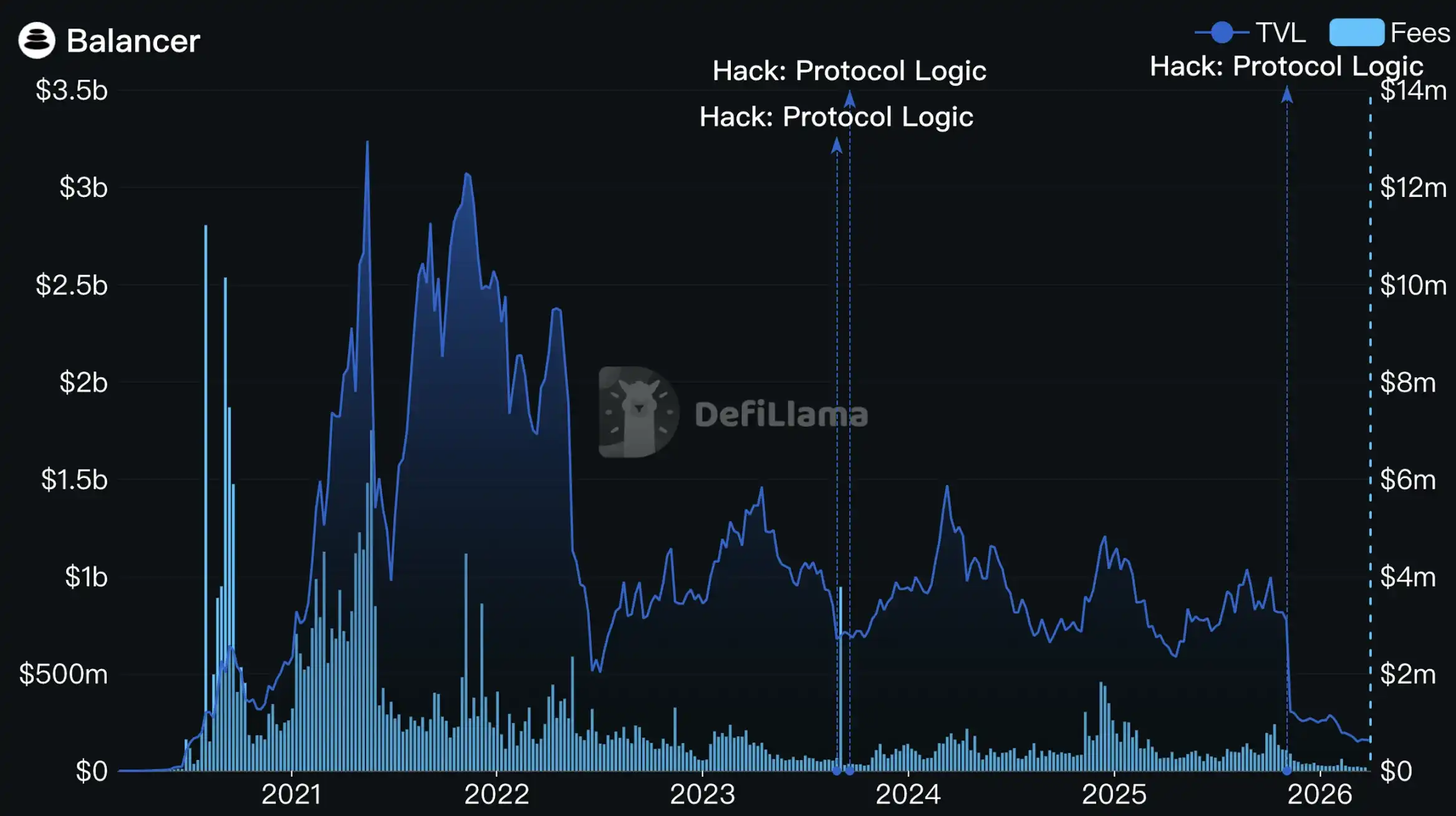
Source: DefiLlama

Balancer has officially reached a crossroads. On March 23, 2026, the Balancer core team simultaneously released two important governance proposals: a comprehensive overhaul of BAL tokenomics and an operational restructuring.

The core logic of these two documents combined can be summarized in one sentence: Abandon the growth model driven by token releases and shift towards sustainable operation driven by revenue.

Operational Restructuring: Team "Slimming Down," Annual Budget Reduced by 34%

The proposal suggests formally dissolving Balancer Labs, with its core technical personnel transitioning to contractor roles and merging into Balancer OpCo Limited, which will continue to operate as the DAO's legal proxy entity.

The team size will be compressed from about 25 people to 12.5 full-time equivalents (including dedicated service providers like Beets, MAXYZ, etc.), and the annual operating budget will be reduced from $2.87 million to $1.9 million, a 34% cut.
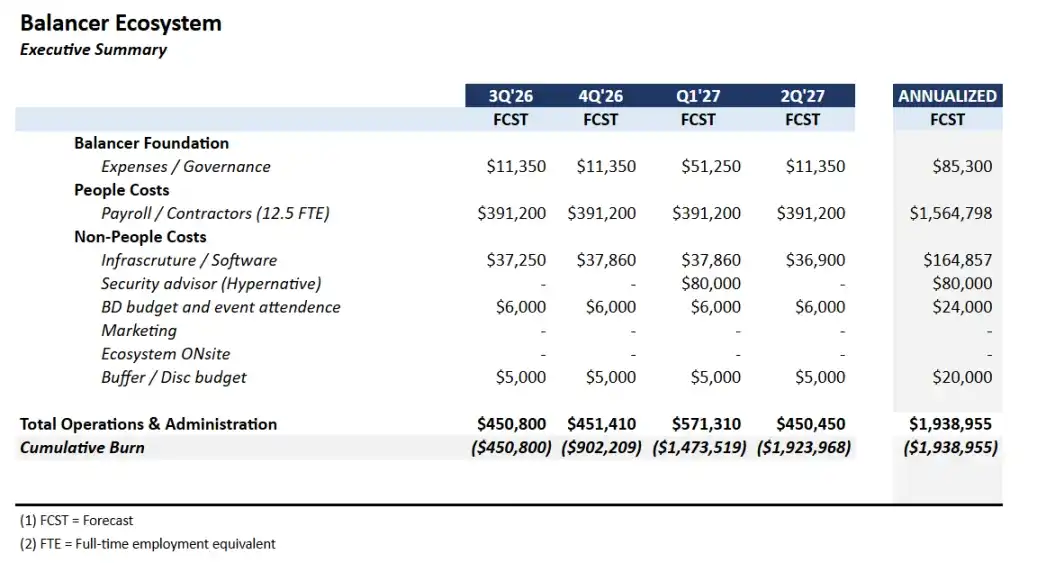
The product lines are also being drastically narrowed. The team will focus resources on three products with validated commercial viability: Boosted Pools (flagship product), reCLAMM (to be relaunched after fixing vulnerabilities, possibly renamed), and LBP (token launch pools, operated opportunistically).

Other exploratory directions, such as ETF structured products, yield optimizers, and AI-driven liquidity tools, will only proceed subject to meeting "core KPIs".

On-chain deployments are also being scaled back. The current model of maintaining V2 and V3 on over 9 chains is unsustainable. The team explicitly retains four core chains: Ethereum, Gnosis, Arbitrum, and Base. Other deployments will be reviewed individually based on fee revenue and operational costs, and terminated if they do not meet standards.

Tokenomics Reform: A Complete Overhaul, Not Minor Tweaks

Stop BAL Emissions, Abolish veBAL

If the proposal passes, Balancer will terminate BAL token incentive emissions, with no transition period.

Simultaneously, the veBAL governance mechanism will be formally abolished. Holders will stop receiving any economic rewards after the final bi-weekly fee distribution. Their locked veBAL will become purely governance credentials, waiting to expire at the end of the lock-up period.

This is a painful decision, but the logic behind it is clear: the veBAL mechanism had a structural flaw from the start, being prone to oligopolistic control. Currently, Aura Finance (a veBAL meta-governance protocol) and whales hold significant voting power, making genuine community voices increasingly faint in governance. This mechanism not only failed to promote the protocol's healthy development but became a vehicle for circular economic games — protocol money flows to middlemen via incentives, and the middlemen's votes direct more incentives towards themselves.

If veBAL was once an experiment by Balancer borrowing from Curve's design, the team now frankly admits: the experiment is over, and the results did not meet expectations.

Regarding the termination of veBAL economic rights, Balancer stated it will provide a $500,000 compensation activity, distributed directly to veBAL holders as pure cash compensation.

All Fees Go to DAO Treasury, Reduce V3 Protocol Take Rate

All protocol fees — V2 swap fees, V3 swap fees, Yield fees, LBP fees — will thereafter flow 100% to the DAO treasury, abandoning the previous multi-party split mechanism.

Simultaneously, the V3 protocol fee take rate will be reduced from 50% to 25%. This means for the same transaction, liquidity providers (LPs) previously received 50%, but will now receive 75%.

These two moves seem opposite in direction but share the same underlying logic: the former eliminates the circular economy, allowing the treasury to obtain real usable funds; the latter increases LP attractiveness, trading lower platform fees for more organic liquidity and real trading volume.

The proposal estimates that post-reform, the DAO's annualized revenue could reach approximately $1.22 million, more than 4 times the current $290,000.

Exit Option: Burn BAL for Stablecoins at $0.16 per Token

The treasury will also allocate 35% of its assets (currently about $3.6 million) to a dedicated pool. This is not for actively buying BAL on the secondary market, but to open a "burn for stablecoins" channel: BAL holders can voluntarily send their tokens to a contract to be burned, receiving stablecoins of equivalent value at the NAV price (Net Asset Value, approximately $0.16 per token).

The window will open 12 months after the proposal passes and last for 12 weeks. Any unused stablecoins after the window closes will return to the treasury. The 12-month waiting period is designed specifically to allow holders whose veBAL unlocks gradually to participate.

At the time of writing, the BAL price is $0.1548, below the NAV price. Offering an exit at the NAV price provides a more dignified option for those wanting to leave than a secondary market stampede.

If this channel is fully utilized, it would burn approximately 22.7 million BAL tokens, about 35% of the circulating supply, which is 6 times the current annual inflation emission.

9-Year "Runway": Is It Enough?

If both proposals pass, the team's projected financial model is as follows:

DAO annualized revenue ~$1.22 million (assuming TVL recovers somewhat after V3 fee reduction), annual operating expenses $1.9 million, buyback expenditure ~$3.6 million, plus the $500,000 veBAL compensation.

After completing the buyback and compensation, the treasury would still have approximately $6.2 million remaining. The annual funding gap would narrow from about $2.6 million to $700,000, giving a theoretical survival period of nearly 9 years.

For a DeFi protocol, 9 years is enough to span a full industry cycle.

But this model is built on optimistic assumptions: that reducing the V3 protocol take rate will indeed attract more organic TVL; that the slimmed-down team can truly support daily protocol operations, security maintenance, etc.; and that core products (especially reCLAMM) can successfully attract the market again after repairs.

If any link underperforms expectations, the 9-year survival period will shorten rapidly. The team itself explicitly states that if DAO monthly revenue falls below $60,000 for 3 consecutive months, a revised plan must be submitted to the community.

For Balancer, this is a nearly all-or-nothing reform. Abandoning the once-proud veBAL mechanism, abandoning the complex multi-party split structure, and returning to an extremely simplified origin: let real transaction fees drive protocol survival, not newly minted tokens maintaining false prosperity.

Whether this desperate reform will work ultimately depends on the market and time, awaiting long-term observation.


Related Questions

QWhat were the main reasons behind Balancer's decision to abandon the veBAL mechanism and stop BAL token emissions?

ABalancer decided to abandon veBAL and stop BAL emissions because the veBAL mechanism was structurally flawed, leading to oligopolistic control by entities like Aura Finance and large holders, which stifled genuine community governance. The token-based growth model created a circular economy where incentives flowed to middlemen instead of supporting protocol health. Additionally, the annual inflation of 3.78 million BAL tokens created significant sell pressure, exacerbating financial unsustainability.

QHow does Balancer plan to address its financial sustainability issues after the proposed changes?

ABalancer aims to achieve financial sustainability by shifting to a revenue-driven model. Key measures include redirecting 100% of protocol fees to the DAO treasury, reducing operational budget by 34% to $1.9 million annually, and lowering the V3 protocol fee take rate to 25% to attract more organic liquidity. These changes are projected to increase DAO annualized revenue to approximately $1.22 million, extending the treasury's runway to nearly 9 years.

QWhat compensation is Balancer offering to veBAL holders, and how will it be funded?

ABalancer is offering a $500,000 compensation package to veBAL holders, funded directly from the DAO treasury. This is a cash compensation for the termination of their economic rights, as veBAL will become a governance-only credential with no further financial benefits after the final fee allocation.

QWhat is the purpose of the 'burn-for-stablecoin' mechanism, and how does it work?

AThe 'burn-for-stablecoin' mechanism allows BAL holders to voluntarily burn their tokens in exchange for stablecoins at a fixed Net Asset Value (NAV) price of $0.16 per BAL. It is designed to provide an orderly exit for holders wishing to leave, reducing sell pressure on the secondary market. The DAO will allocate 35% of its treasury (about $3.6 million) for this purpose, with the window opening 12 months after proposal approval and lasting for 12 weeks.

QWhich product lines and chains will Balancer focus on after the operational restructuring?

APost-restructuring, Balancer will concentrate resources on three commercially validated product lines: Boosted Pools (flagship product), reCLAMM (to be relaunched after bug fixes and possible rebranding), and LBPs (opportunistic operation). Deployment will be limited to core chains: Ethereum, Gnosis, Arbitrum, and Base, with other chains subject to review based on fee revenue and operational costs.

Related Reads

In Conversation with Ray Dalio: We Are Currently in an AI Bubble, with 1% of My Portfolio in Bitcoin

Ray Dalio, founder of Bridgewater Associates, warns in an interview that the current AI boom shows classic bubble characteristics, which could lead to significant economic downturns as seen in past cycles like 1929 or 2000. He explains that speculative enthusiasm, fueled by debt and overvaluation, often precedes a crash when rising rates or taxation force asset sales, causing widespread losses and recession. Dalio also outlines his "Big Cycle" theory, describing an approximate 80-year pattern where widening wealth gaps, massive government deficits, and shifting geopolitical power (like China's rise) create internal conflict and global instability. He emphasizes that we are in a late-cycle, transitional phase where traditional powers like the US and UK face decline. For personal wealth protection, Dalio advises diversification beyond cash into assets like stocks, bonds, real estate, and particularly gold, which he prefers over Bitcoin. While he holds about 1% of his portfolio in Bitcoin as a non-printable hard asset, he views gold as more secure from technological or governmental threats. Regarding AI's impact, Dalio believes it will disproportionately benefit capital owners, worsening inequality by replacing both physical and cognitive labor. He suggests that human intuition and emotional intelligence, combined with AI, will be key for future workers. On taxation, Dalio argues that wealth taxes are impractical and risk triggering asset sell-offs, reducing productive investment. He points to the UK as a cautionary example of debt, low productivity, and political strife. Geopolitically, Dalio foresees a more regionalized world, with the US showing weakness in prolonged conflicts like with Iran, akin to past imperial declines. The ideal outcome, he suggests, is coexisting powerful blocs (e.g., Americas, China-Asia Pacific) without major war.

marsbit3h ago

In Conversation with Ray Dalio: We Are Currently in an AI Bubble, with 1% of My Portfolio in Bitcoin

marsbit3h ago

Daily 7.2 Trillion KRW: Foreign Capital's Record Net Buying on Friday! Wall Street Says Headwinds for Korean Stock Fund Flows Have Subsided

South Korean stock market sees a dramatic shift in fund flows. On July 31, foreign investors made a record net purchase of approximately KRW 7.2 trillion in KOSPI stocks, marking a fundamental reversal from the persistent large-scale net outflows seen in previous months. This contributed to a significant narrowing of foreign net selling in July to KRW 9.8 trillion, down sharply from KRW 48.4 trillion in June and KRW 44.5 trillion in May. Simultaneously, domestic institutional pressure eased. South Korean pension funds and asset managers turned to a net buying position in July, purchasing KRW 1.0 trillion worth of KOSPI shares, contrasting with net sales in May and June. Market volatility is expected to be dampened by new financial regulations. Effective July 31, the Financial Services Commission tightened access for retail investors to single-stock leveraged ETFs by raising the minimum cash deposit requirement. Trading volumes for these products subsequently dropped to about 50% of their monthly average. Citigroup Research maintains its year-end KOSPI target of 10,000 points. The firm cites several supportive factors: the substantial easing of headwinds from capital outflows, a robust fundamental outlook for the semiconductor sector, historically low market valuations, strong economic fundamentals, and the potential for policy support from financial authorities if needed.

marsbit3h ago

Daily 7.2 Trillion KRW: Foreign Capital's Record Net Buying on Friday! Wall Street Says Headwinds for Korean Stock Fund Flows Have Subsided

marsbit3h ago

Thanks to Dice Rolls, Bitcoin Keys Are Stored Offline, But Not Everyone Will Do It

The article discusses using dice rolls to generate secure Bitcoin wallet seeds, providing entropy independent of potentially flawed hardware random number generators. It explains that each fair dice roll offers about 2.585 bits of entropy, with around 50 rolls needed for a standard 12-word seed phrase and 99+ recommended for higher security. This method gained attention after a vulnerability was revealed in some Coldcard hardware wallets, where a faulty firmware RNG (dating back to 2021) compromised generated keys. The analysis notes that while a dice-generated main seed was safe from this specific flaw, other Coldcard functions (like creating paper wallets, backup keys, or passwords) could still be vulnerable if they used the defective RNG. The piece argues that while dice-based entropy is technically robust, the manual process is error-prone, tedious, and unrealistic for most new users, who might make mistakes in recording or inputting rolls. It concludes that while manual entropy generation should remain an option for advanced users, the long-term goal is to develop reliable, user-friendly hardware and software that securely generates randomness without requiring specialized knowledge. Coldcard users are advised to check their firmware version and replace any secondary secrets (like paper wallet keys) created with vulnerable devices, while also considering multi-signature setups with devices from different manufacturers for added security.

cryptonews.ru9h ago

Thanks to Dice Rolls, Bitcoin Keys Are Stored Offline, But Not Everyone Will Do It

cryptonews.ru9h ago

Trading

Spot
活动图片




