Abandoning Mining for the Cloud: Bitcoin Miners Reshape Business Models in the AI Era

比推Published on 2025-12-16Last updated on 2025-12-16

Abstract

Bitcoin miners are facing a survival crisis due to declining Bitcoin prices and rising operational costs, with the average cost to mine one Bitcoin now exceeding its market value. In response, many are pivoting to leasing data center space to major tech companies for AI computational needs. This shift leverages their existing infrastructure—including power capacity, cooling systems, and high-performance hardware—to meet the explosive demand for AI data processing. Companies like Core Scientific have successfully transitioned, turning losses into profits by repurposing their facilities. This move not only provides stable revenue streams but also enhances the industry’s overall resilience, signaling a broader evolution from pure cryptocurrency mining toward diversified digital asset technology services.

Original Title: Bitcoin Miners, Abandoning "Mining" for the "Cloud"


Written by: Tiger Research

Compiled by: AididiaoJP, Foresight News

As Bitcoin prices continue to fall, many miners are facing a survival crisis. In the face of increasingly fierce core mining competition, how can these companies save themselves? Leasing artificial intelligence (AI) data centers has become a highly regarded path for transformation.

Core Conclusions

  • Bitcoin mining revenue is unstable, while costs continue to rise, making the core business model unsustainable.

  • Mining companies are beginning to leverage their existing sites and infrastructure to rent out data center space to large tech companies.

  • This transformation alleviates vicious competition and helps improve the health and stability of the entire industry.

I. Core Operational Risks Faced by Mining Companies

The business model structure of Bitcoin mining companies is relatively singular, which constitutes a fundamental vulnerability. Their revenue is almost entirely tied to the highly volatile Bitcoin price, full of unpredictability; while on the cost side, factors such as increasing mining difficulty, rising electricity prices, and hardware iteration show a rigid upward trend.

When the coin price falls, the problem is particularly acute: revenue plummets, costs remain high, creating a "squeeze from both ends" dilemma. In addition, regulatory risks loom large, such as the proposal in New York State, USA, to increase the mining consumption tax. Although it has limited impact on mining companies currently concentrated in more lenient regions like Texas, it signals the possibility of broader compliance pressures in the future.

All this forces mining companies to ponder a fundamental question: Can the singular mining business model survive in the long term?

II. Cost Inversion: The Increasingly Fragile Profit Structure

According to data from CoinShares, the average cost to mine one Bitcoin has now risen to approximately $74,600. If costs such as equipment depreciation are included, the total production cost is close to $130,000 per coin.
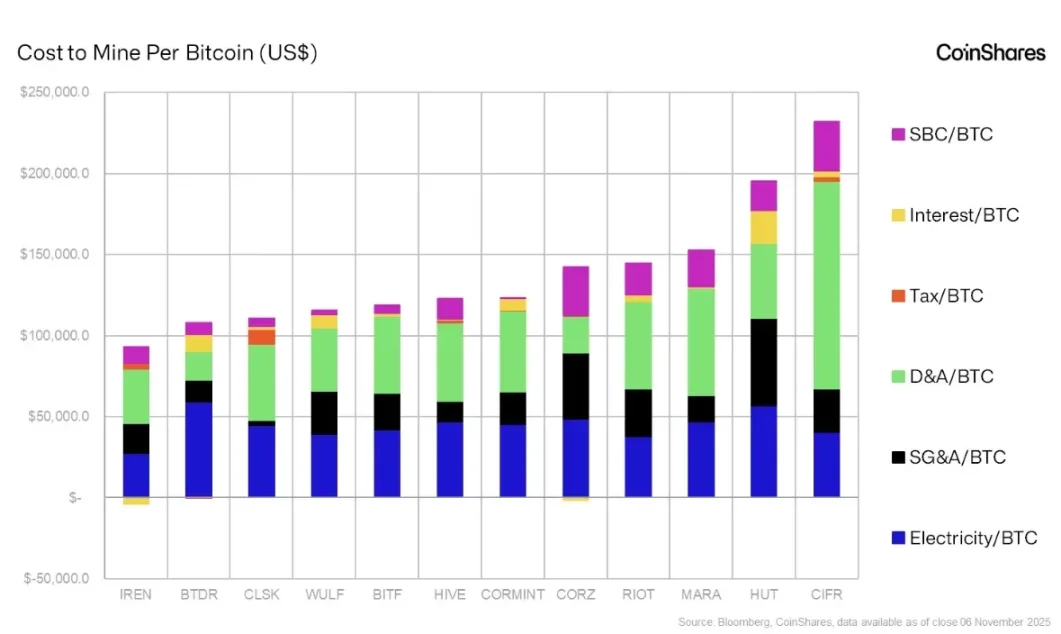
However, the current Bitcoin price is around $91,000. This means that for every Bitcoin produced, mining companies face a paper loss of about $46,000. Increasing mining difficulty and tightening energy policies further worsen the cost structure, leading to an increasingly fragile overall profit foundation for the industry.

III. The Path to Transformation: Why AI Data Centers?

The AI race is intensifying, creating explosive demand for data centers from tech giants. Building data centers from scratch is time-consuming, and market opportunities are fleeting, so leasing ready-made, quickly adaptable facilities becomes the preferred option.
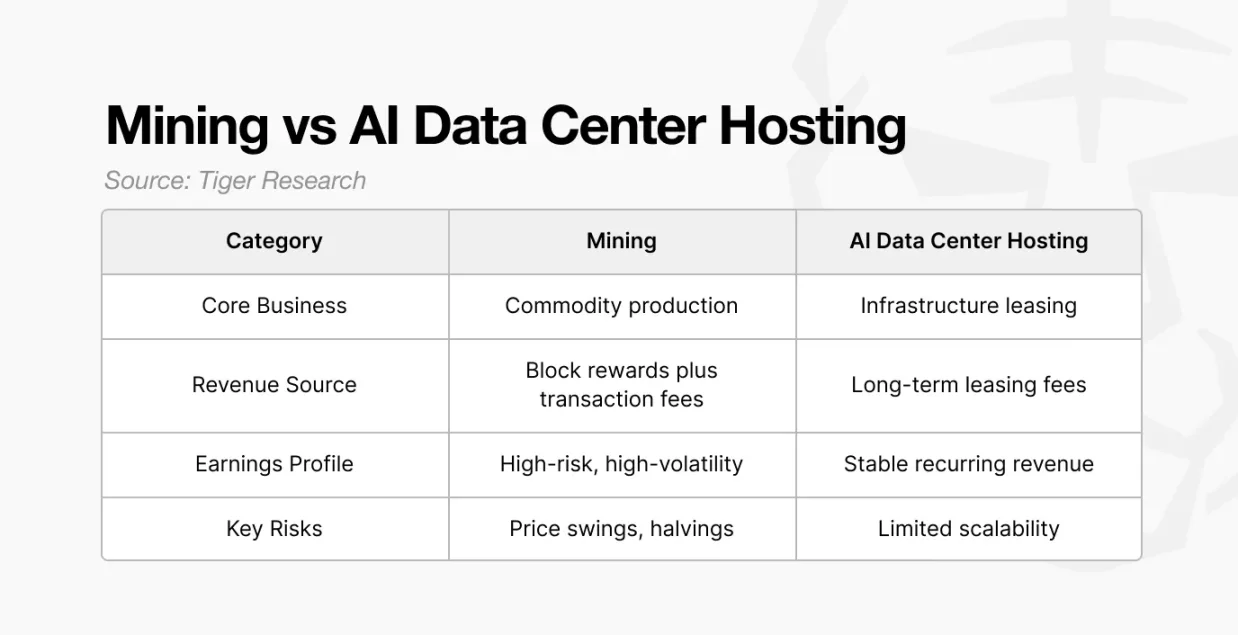
The existing assets of mining companies恰好 match this demand:

  • Computing Hardware: Possess large quantities of high-performance GPUs (such as NVIDIA chips) that can be repurposed for AI computing.

  • Power Resources: Already approved grid access at the hundreds of megawatts level is a scarce resource in today's energy market.

  • Cooling Capacity: Experience in heat dissipation accumulated from operating high-power mining rigs can be directly applied to managing AI servers like H100/H200.
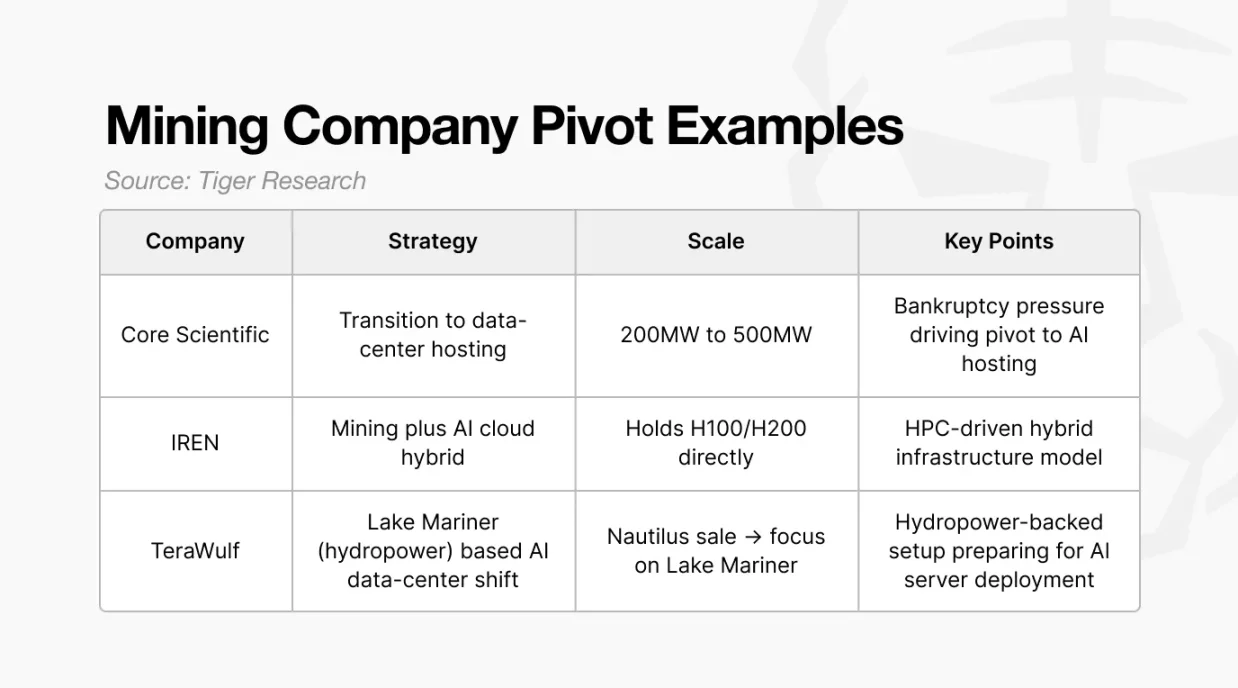
A typical case is Core Scientific, which was once on the verge of bankruptcy. By transforming into AI data center leasing, it now operates approximately 200 megawatts of capacity and plans to expand to 500 megawatts, successfully turning losses into profits. Companies like IREN and TeraWulf are also exploring similar paths of business diversification. This is not just about pursuing growth, but a necessity for survival.

IV. Diversified Evolution: More Than Just Data Centers

The transition to AI data center leasing is a mainstream trend, but it is not the only way out. This is essentially a rational choice for mining companies to reallocate capital to more efficient areas. Stable data center revenue can provide mining companies with a cash flow buffer, allowing them to more strategically hold Bitcoin assets and avoid forced sales during market downturns.

Meanwhile, some mining companies, such as Bitmine and Cathedra Bitcoin, are exploring expansion into broader Digital Asset Technology (DAT) business models. These diversification attempts collectively point to a trend: weak pure miners are being eliminated or transformed, while leading companies are evolving into comprehensive service providers. The entire cryptocurrency mining industry is moving towards a new, more mature, and resilient phase.


Twitter:https://twitter.com/BitpushNewsCN

Bitpush TG Discussion Group:https://t.me/BitPushCommunity

Bitpush TG Subscription: https://t.me/bitpush

Original article link:https://www.bitpush.news/articles/7596120

Related Questions

QWhat are the main reasons Bitcoin miners are facing a survival crisis?

ABitcoin miners are facing a survival crisis due to the instability of mining income, which is tied to the volatile price of Bitcoin, and the rising costs of operations, including increasing mining difficulty, higher electricity prices, and the need for hardware upgrades. This creates a 'two-way squeeze' on profitability.

QWhat is the average cost to mine one Bitcoin according to CoinShares data, and how does it compare to the current price?

AAccording to CoinShares data, the average cost to mine one Bitcoin has risen to approximately $74,600. When including costs like equipment depreciation, the total production cost is close to $130,000 per Bitcoin. With the current price around $91,000, this results in a significant loss per coin mined.

QWhy are AI data centers a viable转型 (transformation) path for Bitcoin mining companies?

AAI data centers are a viable转型 path because Bitcoin mining companies possess the necessary infrastructure, including high-performance GPUs (like NVIDIA chips), pre-approved access to massive power grids (a scarce resource), and expertise in cooling high-power equipment. These assets are in high demand by tech giants who need to scale their AI operations quickly without building new facilities from scratch.

QCan you name a specific Bitcoin mining company that successfully转型 (transformed) by leasing AI data center space?

AYes, Core Scientific is a prime example. After nearly facing bankruptcy, it successfully转型 by leasing AI data center space. It currently operates about 200 megawatts of capacity, with plans to expand to 500 megawatts, and has returned to profitability.

QBesides AI data center leasing, what other diversification strategies are some mining companies exploring?

ABeyond AI data center leasing, some mining companies like Bitmine and Cathedra Bitcoin are exploring a broader Digital Asset Technology (DAT) business model. This overall trend involves weak, pure-play miners being淘汰 (eliminated) or forced to转型 (transform), while leading companies evolve into comprehensive service providers, making the entire crypto mining industry more mature and resilient.

Related Reads

First Batch of Keynote Speakers and Partners Announced! Web2+3 Summit: Defining the Next Generation of Digital Economy

Web2+3 Summit: Defining the Next Generation of Digital Economy The 6th BEYOND International Technology Innovation Expo (BEYOND Expo 2026), Asia's largest tech and ecosystem exhibition, is launching a dedicated Web2+3 stage for the first time. Co-hosted by BEYOND Expo and ChainNeXT Group, the Web3 Summit will take place from May 28–30, 2026. Against the backdrop of accelerating global tech integration, the boundaries between Web2 and Web3 are rapidly blurring. With clearer global regulations for blockchain-driven internet (Web3) and the special issuance of a Hong Kong dollar stable币 license by the Hong Kong SAR government on April 10, 2026, Web3's decentralized principles are quickly merging with traditional industries (Web2) such as e-commerce, finance, and artificial intelligence. Focused on blockchain-driven digital economy elements, the summit will center on three core principles—implementability, commercial viability, and compliance. It will bring together top Web3 experts to discuss key integration areas like stablecoin payment finance (PayFi), real-world asset tokenization (RWA), and decentralized AI (DeAI), unveiling new opportunities for industrial innovation. The first wave of confirmed speakers includes Jack Kong (Director of Hong Kong Cyberport, Chairman of Nano Labs), Yat Siu (Chairman of Animoca Brands), Michael Wu (Co-founder & CEO of Amber Group), Michael Heinrich (Co-founder & CEO of 0G), and Art Abal (Co-founder of Vana). More Web3 ecosystem pioneers, AI, and fintech experts will be announced soon. Core forum topics include: - Web2+DeAI: New AI Paradigms Driven by Decentralized Infrastructure - Web2+RWA: Real-World Asset Tokenization and Global Liquidity - Web2+PayFi: Cross-Border Payments and Financial Innovation Powered by Crypto Infrastructure - Web2+3 AI: Autonomous Agents and the Crypto Economy - Web2+3 Wealth: On-Chain and Off-Chain Integrated Investment Ecosystems - Web2+3 Commerce: A New Landscape for Global Trade Driven by Stablecoins Additional agenda details will be released in the near future.

marsbit23m ago

First Batch of Keynote Speakers and Partners Announced! Web2+3 Summit: Defining the Next Generation of Digital Economy

marsbit23m ago

Trading

Spot
Futures

Hot Articles

What is $BITCOIN

DIGITAL GOLD ($BITCOIN): A Comprehensive Analysis Introduction to DIGITAL GOLD ($BITCOIN) DIGITAL GOLD ($BITCOIN) is a blockchain-based project operating on the Solana network, which aims to combine the characteristics of traditional precious metals with the innovation of decentralized technologies. While it shares a name with Bitcoin, often referred to as “digital gold” due to its perception as a store of value, DIGITAL GOLD is a separate token designed to create a unique ecosystem within the Web3 landscape. Its goal is to position itself as a viable alternative digital asset, although specifics regarding its applications and functionalities are still developing. What is DIGITAL GOLD ($BITCOIN)? DIGITAL GOLD ($BITCOIN) is a cryptocurrency token explicitly designed for use on the Solana blockchain. In contrast to Bitcoin, which provides a widely recognized value storage role, this token appears to focus on broader applications and characteristics. Notable aspects include: Blockchain Infrastructure: The token is built on the Solana blockchain, known for its capacity to handle high-speed and low-cost transactions. Supply Dynamics: DIGITAL GOLD has a maximum supply capped at 100 quadrillion tokens (100P $BITCOIN), although details regarding its circulating supply are currently undisclosed. Utility: While precise functionalities are not explicitly outlined, there are indications that the token could be utilized for various applications, potentially involving decentralized applications (dApps) or asset tokenization strategies. Who is the Creator of DIGITAL GOLD ($BITCOIN)? At present, the identity of the creators and development team behind DIGITAL GOLD ($BITCOIN) remains unknown. This situation is typical among many innovative projects within the blockchain space, particularly those aligning with decentralized finance and meme coin phenomena. While such anonymity may foster a community-driven culture, it intensifies concerns about governance and accountability. Who are the Investors of DIGITAL GOLD ($BITCOIN)? The available information indicates that DIGITAL GOLD ($BITCOIN) does not have any known institutional backers or prominent venture capital investments. The project seems to operate on a peer-to-peer model focused on community support and adoption rather than traditional funding routes. Its activity and liquidity are primarily situated on decentralized exchanges (DEXs), such as PumpSwap, rather than established centralized trading platforms, further highlighting its grassroots approach. How DIGITAL GOLD ($BITCOIN) Works The operational mechanics of DIGITAL GOLD ($BITCOIN) can be elaborated on based on its blockchain design and network attributes: Consensus Mechanism: By leveraging Solana’s unique proof-of-history (PoH) combined with a proof-of-stake (PoS) model, the project ensures efficient transaction validation contributing to the network's high performance. Tokenomics: While specific deflationary mechanisms have not been extensively detailed, the vast maximum token supply implies that it may cater to microtransactions or niche use cases that are still to be defined. Interoperability: There exists the potential for integration with Solana’s broader ecosystem, including various decentralized finance (DeFi) platforms. However, the details regarding specific integrations remain unspecified. Timeline of Key Events Here is a timeline that highlights significant milestones concerning DIGITAL GOLD ($BITCOIN): 2023: The initial deployment of the token occurs on the Solana blockchain, marked by its contract address. 2024: DIGITAL GOLD gains visibility as it becomes available for trading on decentralized exchanges like PumpSwap, allowing users to trade it against SOL. 2025: The project witnesses sporadic trading activity and potential interest in community-led engagements, although no noteworthy partnerships or technical advancements have been documented as of yet. Critical Analysis Strengths Scalability: The underlying Solana infrastructure supports high transaction volumes, which could enhance the utility of $BITCOIN in various transaction scenarios. Accessibility: The potential low trading price per token could attract retail investors, facilitating wider participation due to fractional ownership opportunities. Risks Lack of Transparency: The absence of publicly known backers, developers, or an audit process may yield skepticism regarding the project's sustainability and trustworthiness. Market Volatility: The trading activity is heavily reliant on speculative behavior, which can result in significant price volatility and uncertainty for investors. Conclusion DIGITAL GOLD ($BITCOIN) emerges as an intriguing yet ambiguous project within the rapidly evolving Solana ecosystem. While it attempts to leverage the “digital gold” narrative, its departure from Bitcoin's established role as a store of value underscores the need for a clearer differentiation of its intended utility and governance structure. Future acceptance and adoption will likely depend on addressing the current opacity and defining its operational and economic strategies more explicitly. Note: This report encompasses synthesised information available as of October 2023, and developments may have transpired beyond the research period.

363 Total ViewsPublished 2025.05.13Updated 2025.05.13

What is $BITCOIN

Discussions

Welcome to the HTX Community. Here, you can stay informed about the latest platform developments and gain access to professional market insights. Users' opinions on the price of BTC (BTC) are presented below.

活动图片