LayerZero Breaks Silence On $290 Million KelpDAO Crypto Exploit

bitcoinistPublished on 2026-04-20Last updated on 2026-04-20

Abstract

LayerZero has addressed the $290 million exploit affecting KelpDAO's rsETH, asserting it was not a protocol failure but a result of KelpDAO's decision to use a single-DVN (Decentralized Verifier Network) configuration. The company claims the attack was isolated to this specific setup and confirms no contagion risk to other assets or applications. Preliminary analysis suggests the attack was executed by a sophisticated state actor, likely North Korea's Lazarus Group. The method involved poisoning RPC infrastructure used by the LayerZero Labs DVN, swapping binaries on compromised nodes, and using DDoS attacks to force traffic to the malicious infrastructure. However, LayerZero states its least-privilege principles prevented a direct compromise. The exploit was only possible due to KelpDAO's 1-of-1 verifier setup, which contradicts LayerZero's recommended multi-DVN redundancy model. A properly configured system with multiple independent DVNs would have prevented the attack. LayerZero has deprecated affected nodes, restored its DVN, and will no longer support 1/1 configurations. Aave has frozen rsETH and WETH reserves on its platforms as a precaution while confirming rsETH on Ethereum mainnet remains fully backed.

KelpDAO’s $290 million rsETH exploit has moved into a new phase, with LayerZero and Aave now publicly outlining how the incident unfolded, why the damage appears contained, and what it could mean for crypto cross-chain security standards going forward.

The central claim from LayerZero is that the exploit was not a failure of the protocol itself, but the result of KelpDAO’s decision to run rsETH with a single-DVN configuration. That matters because the latest statements shift the market narrative away from generalized contagion risk across LayerZero-integrated assets and toward a narrower question: how much risk was concentrated in one application’s security design.

LayerZero Links KelpDAO Crypto Exploit To RPC Attack

In an incident statement from April 20, LayerZero said the April 18 attack targeted KelpDAO’s rsETH setup and was “isolated entirely to KelpDAO’s rsETH configuration as a direct consequence of their single-DVN setup.” The company added that it had conducted “a comprehensive review of active integrations” and could confirm “with confidence that there is zero contagion to any other asset or application.”

LayerZero framed the episode as a state-linked crypto infrastructure attack rather than a protocol exploit. According to the statement, “preliminary indicators suggest attribution to a highly-sophisticated state actor, likely DPRK’s Lazarus Group, more specifically TraderTraitor.”

It said the attack did not compromise the protocol, key management, or the DVN instances directly. Instead, the attacker allegedly poisoned downstream RPC infrastructure used by the LayerZero Labs DVN, swapped binaries on compromised op-geth nodes, and then used DDoS pressure on uncompromised RPCs to force failover toward the poisoned infrastructure.

That sequence is central to LayerZero’s argument. “Because of our least-privilege principles, they were unable to compromise the actual DVN instances,” the company wrote. “However, they used this pivot point to execute an RPC-spoofing attack.

Their malicious node used a custom payload designed explicitly to forge a message to the DVN with minimal warnings.” LayerZero said the manipulated node presented false data only to the DVN while returning truthful responses to other IPs, including its own monitoring infrastructure, in what it described as a deliberately stealthy effort to avoid detection.

Even so, LayerZero argues the exploit should have been stopped at the application layer had rsETH not relied on a 1-of-1 verifier setup. “The affected application was rsETH, issued by KelpDAO,” the statement said. “Their OApp configuration at the time of this incident relied on a 1-of-1 DVN setup, with LayerZero Labs as the sole verifier — a configuration that directly contradicts the multi-DVN redundancy model that LayerZero has consistently recommended to all integration partners.”

It added that “a properly hardened configuration would have required consensus across multiple independent DVNs, rendering this attack ineffective even in the event of any single DVN being compromised.”

The company said its DVN is live again, that affected RPC nodes have been deprecated and replaced, and that it will no longer sign or attest messages for applications using a 1/1 configuration. It also said it is working with law enforcement and industry partners, including Seal911, to track funds.

Aave said in an X update on late The protocol said its analysis shows “rsETH on Ethereum mainnet is fully backed,” but added that “out of an abundance of caution, rsETH remains frozen across Aave V3 and V4 and exposure to the incident is capped.” WETH reserves also remain frozen across the affected markets on Ethereum, Arbitrum, Base, Mantle, and Linea while the team continues to validate information and assess possible resolutions.

At press time, the total crypto market cap stood at $2.5 trillion.
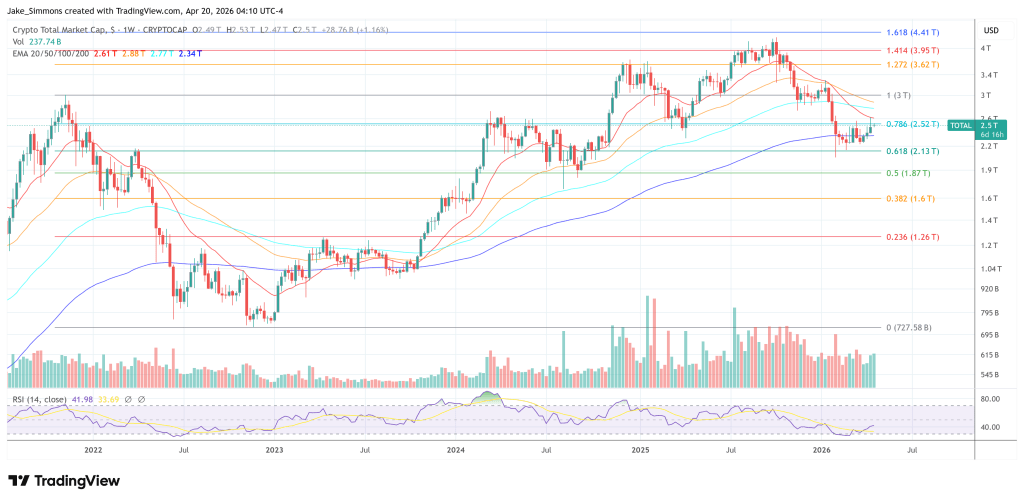
Total crypto market cap must overcome the 0.786 Fib, 1-week chart | Source: TOTAL on TradingView.com

Related Questions

QWhat was the main reason for the $290 million KelpDAO crypto exploit according to LayerZero?

ALayerZero stated that the exploit was not a failure of its protocol but was the result of KelpDAO's decision to run its rsETH with a single-DVN (Decentralized Verifier Network) configuration, which contradicted LayerZero's recommended multi-DVN redundancy model.

QWhich sophisticated state actor is LayerZero preliminarily attributing the attack to?

ALayerZero's preliminary indicators suggest the attack is attributed to a highly-sophisticated state actor, likely the Lazarus Group from the Democratic People's Republic of Korea (DPRK), and more specifically, the subgroup known as TraderTraitor.

QHow did the attacker execute the RPC-spoofing attack without compromising the DVN instances directly?

AThe attacker poisoned downstream RPC infrastructure used by the LayerZero Labs DVN, swapped binaries on compromised op-geth nodes, and then used DDoS pressure on uncompromised RPCs to force failover toward the poisoned infrastructure, allowing them to forge a message to the DVN.

QWhat action has LayerZero taken regarding applications using a 1-of-1 DVN configuration after the incident?

ALayerZero announced that it will no longer sign or attest messages for any applications using a 1-of-1 DVN configuration, reinforcing its stance that a multi-DVN setup is necessary for security.

QWhat is the current status of rsETH on Aave V3 and V4 markets following the exploit?

AAave has stated that, out of an abundance of caution, rsETH remains frozen across its Aave V3 and V4 markets, and exposure to the incident is capped, although their analysis shows that rsETH on Ethereum mainnet is fully backed.

Related Reads

Dalio Warns: AI Boom Shows Signs of a Bubble, Day of Reckoning Will Be the Time of Burst

Ray Dalio, founder of Bridgewater Associates, warns that the current artificial intelligence investment boom shows classic signs of a bubble, which he expects will eventually burst. In a Bloomberg Television interview, he noted that great technological revolutions often lead to capital inflows that create bubbles, making it difficult for investors and companies to calibrate their spending accurately—either overspending to capture market share or underspending and losing their competitive position. This caution comes amid significant rallies in AI-related assets, particularly chipmakers, driven by soaring demand for data centers and high-bandwidth chips, raising debates about overheating valuations. In contrast, Nvidia CEO Jensen Huang recently asserted that investors embracing the AI wave would see "crazy" returns and dismissed concerns over return on investment for data center spending as outdated. Dalio, however, focuses on the risks in the profit realization phase. He argues that bubbles tend to show signs of破裂 when markets transition from investment to the need for tangible returns, describing the burst as a process of converting paper wealth into cash. While acknowledging AI's intrinsic value, he expressed concern over the future profitability of some AI companies, suggesting the market is repeating a familiar pattern. The 76-year-old billionaire, who fully exited Bridgewater in 2025, has a net worth estimated at $21.5 billion according to the Bloomberg Billionaires Index.

marsbit9m ago

Dalio Warns: AI Boom Shows Signs of a Bubble, Day of Reckoning Will Be the Time of Burst

marsbit9m ago

Privacy Coin Crisis of Confidence! ZEC Plunges Over 56% in a Single Day

Zcash (ZEC), a leading privacy-focused cryptocurrency, experienced a severe crash on June 5th, plummeting over 56% in a single day and erasing nearly two months of gains. The flash crash was triggered by the disclosure of a critical zero-knowledge proof vulnerability within Zcash's Orchard privacy pool, which had existed since the pool's launch in May 2022. The flaw theoretically allowed an attacker to forge unlimited ZEC undetectably due to the pool's privacy features. The vulnerability was discovered on May 29th by independent security researcher Taylor Hornby during a proactive audit commissioned by Shielded Labs, utilizing AI-assisted analysis. The Zcash development team responded swiftly, implementing an emergency soft fork to disable Orchard transactions on June 2nd and executing a permanent hard fork fix (NU6.2) on June 3rd. Despite the technical fix, a major crisis of confidence emerged. The core issue is that Orchard's privacy design makes it cryptographically impossible to prove whether the vulnerability was exploited over the past four years, casting permanent doubt on the historical supply integrity of ZEC. While Shielded Labs argues exploitation was unlikely, the inability to provide definitive proof has severely damaged market trust. This sentiment was exacerbated when BitMEX co-founder Arthur Hayes, a prominent ZEC supporter, announced he was selling his entire position. He stated that privacy assets require "perfect security" rather than "probable safety." The combined effect of the disclosure and Hayes's exit ignited widespread panic selling, leading to massive liquidations and significant price decline. Analysts note the event highlights a fundamental tension within privacy coins: the conflict between verifiable supply and cryptographic privacy.

链捕手12m ago

Privacy Coin Crisis of Confidence! ZEC Plunges Over 56% in a Single Day

链捕手12m ago

Trading

Spot
Futures
活动图片

