Aave Scraps Avara and Family Wallet as SUBBD Momentum Builds

bitcoinistPublished on 2026-02-04Last updated on 2026-02-04

Abstract

Aave has retired its Avara brand and shut down the Family Wallet, signaling a strategic retreat from consumer-facing products to refocus on its core lending protocol and Lens ecosystem. This move reflects a broader market shift away from generalist "super-apps" toward specialized platforms that solve specific industry problems. In this context, SUBBD Token is gaining momentum by targeting the $85 billion creator economy. It combines AI and Web3 to disrupt high-fee structures and platform dependency faced by content creators. The project offers AI-driven tools like personal assistants, voice cloning, and influencer creation to automate and monetize content. SUBBD has raised over $4.5 million in its presale, with tokens priced at $0.05749. It also offers a 20% APY staking incentive to encourage long-term holding. The platform emphasizes creator sovereignty, reduced fees, and direct audience monetization—addressing key pain points that mainstream platforms like OnlyFans and Patreon fail to resolve. This utility-focused approach contrasts with Aave’s abandoned broader strategy, highlighting a market trend where crypto is valued for solving real-world problems rather than offering generalized interfaces.

Trusted Editorial content, reviewed by leading industry experts and seasoned editors. Ad Disclosure

Quick Facts:

  • ➡️ Aave has retired the Avara brand and shuttered the Family Wallet to refocus on its core lending protocol and Lens ecosystem.
  • ➡️ The market trend is shifting away from generalist “super-apps” toward specialized platforms that solve specific industry pain points.
  • ➡️ SUBBD Token is capitalizing on this shift by using AI and Web3 to disrupt the high-fee structures of the $85B creator economy.
  • ➡️ Early data shows strong demand for SUBBD’s model, with over $4.5 million raised during its presale phase.

The ‘crypto super-app’ dream took a hit this week. Aave, one of decentralized finance’s largest lending protocols, announced a strategic retreat from its consumer-facing wallet ambitions.

Stani Kulechov, Aave’s founder, confirmed the organization is retiring the ‘Avara’ parent brand and shutting down the Family Wallet, a product acquired just last year to bridge the gap between DeFi and everyday users.
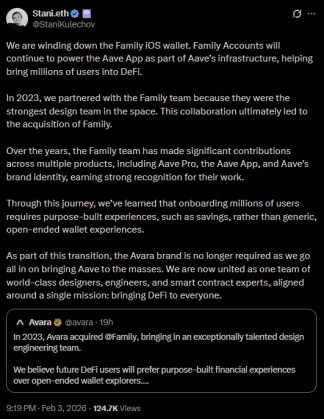

It’s a sharp pivot back to basics. For the past two years, the narrative was all about expansion—building social graphs (Lens Protocol), stablecoins (GHO), and wallets under one massive umbrella. But that era appears over.

The reversal suggests the market frankly no longer rewards broad, open-ended ecosystems that lack immediate stickiness. Instead, liquidity is flowing toward purpose-built protocols that solve specific, high-friction problems rather than general utility.

This restructuring comes as the broader crypto market hunts for the next major narrative beyond simple asset speculation. While infrastructure giants like Aave consolidate to defend their moats, capital is rotating into sectors offering tangible utility for non-crypto natives.

Specifically, the intersection of AI and the creator economy is seeing aggressive growth. It’s within this vacuum of consumer utility that projects like SUBBD Token ($SUBBD) are finding traction, using the exact kind of specialized focus that the ‘Family’ wallet missed.

Buy your $SUBBD here.

AI Tools Replace Generic Interfaces

The failure of the Family Wallet highlights a brutal truth in crypto: users don’t need another place to store private keys; they need a reason to use them.

While Aave retreats to infrastructure, SUBBD Token ($SUBBD) is capitalizing on the $85 billion content creation industry by attacking the inefficiencies of Web2 incumbents. The current landscape for creators is defined by exploitation, platforms routinely extract up to 70% of earnings in fees, while arbitrary bans restrict audience reach.

SUBBD addresses this not by building a generic wallet, but by deploying an EVM-compatible ecosystem designed specifically for creator sovereignty. By merging Web3 payments with proprietary AI models, the platform offers tools that were previously fragmented across a dozen subscriptions.

Features like the AI Personal Assistant allow creators to automate interactions, while AI Voice Cloning and AI Influencer Creation open new revenue streams that don’t require the creator to be physically present 24/7.
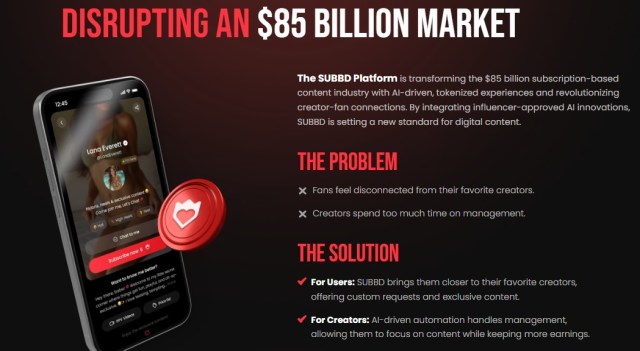
This utility-first approach differs fundamentally from the strategy Aave just abandoned. Where Avara attempted to capture users through a generalist interface, SUBBD captures them through essential service provision. The platform’s decentralized architecture ensures creators maintain ownership of their content and earnings, removing the middleman risk that plagues platforms like OnlyFans or Patreon.

For the market, this represents a shift from ‘crypto as a wallet’ to ‘crypto as a business backend.’

Check out the SUBBD ecosystem.

SUBBD Presale Draws Capital Seeking Utility

The market’s appetite for this specific utility is quantifiable. While legacy DeFi tokens struggle with governance restructuring, SUBBD Token has maintained steady inflows during its presale phase.

According to current data, the project has successfully raised $1.4M, signaling strong confidence from early adopters who view the convergence of AI and content monetization as the next logical step for retail crypto adoption.

Investors are currently entering at a price point of $0.05749, positioning themselves before the platform’s full public rollout. Beyond the speculative aspect, the protocol’s staking mechanics are designed to encourage long-term ecosystem stability.

The project offers a fixed 20% APY for the first year to participants who lock their tokens. This incentive structure does two things: it reduces circulating supply volatility during the critical early growth phase, and it aligns incentives between the platform’s developers and its community.

Smart money monitors these metrics closely because they suggest a departure from ‘vaporware.’ The token serves a dual purpose: governance rights over platform features, such as voting on AI creator curation, and utility within the ecosystem for tipping, subscriptions, and accessing token-gated content.

As Aave refocuses on the backend of DeFi, projects like SUBBD are building the front-end utility that actually drives mass adoption.

You can buy $SUBBD here.

The content provided in this article is for informational purposes only and does not constitute financial advice. Cryptocurrency investments carry inherent risks, including high volatility and potential loss of capital. Always conduct your own due diligence before investing.

Editorial Process for bitcoinist is centered on delivering thoroughly researched, accurate, and unbiased content. We uphold strict sourcing standards, and each page undergoes diligent review by our team of top technology experts and seasoned editors. This process ensures the integrity, relevance, and value of our content for our readers.

patrubogdan

Follow

Full Profile

Related Posts

Crypto Market Structure Bill Nears Key Moment As CFTC Chair Signals Progress Within Months

Dubai’s $280M Diamond Tokenization Sets RWA Precedent as Bitcoin Hyper Secures $31.2M

Bitcoin Dominance Shifts: Crypto Usage Spreads Beyond Bitcoin as $HYPER Keeps Gaining

Binance Crushes Competition With $155B Asset Surge; $HYPER Emerging as Bitcoin L2 Leader

Criptomoneda prometedora para invertir ante el cambio de sentimiento: el auge de la infraestructura Bitcoin

Criptomoneda prometedora para invertir mientras cambia el sentimiento del mercado: Bitcoin Hyper redefine la Capa 2

Related Questions

QWhat strategic changes did Aave announce regarding its consumer-facing products?

AAave announced it is retiring the 'Avara' parent brand and shutting down the Family Wallet, a product it acquired last year, to refocus on its core lending protocol and the Lens ecosystem.

QAccording to the article, what market trend is causing a shift away from 'super-apps'?

AThe market trend is shifting away from generalist 'super-apps' toward specialized platforms that solve specific, high-friction industry pain points and offer tangible utility.

QWhat specific industry is SUBBD Token targeting, and what is its total market size?

ASUBBD Token is targeting the content creator economy, which the article states is an $85 billion industry.

QWhat are two specific AI-powered tools the SUBBD platform offers to creators?

AThe SUBBD platform offers an AI Personal Assistant to automate interactions and AI Voice Cloning and AI Influencer Creation to open new revenue streams.

QHow much capital has the SUBBD Token presale raised, according to the data in the article?

AAccording to the article, the SUBBD Token presale has raised $1.4 million.

Related Reads

The Most Advanced Large Models Are Now Subject to Export Controls Like Enriched Uranium

In an unprecedented move mirroring the control of enriched uranium, the US Commerce Department has imposed an export control ban on Anthropic's advanced AI models, Fable 5 and Mythos 5, forcing their global shutdown. This marks the first time a purely digital entity—a set of neural network weights—has been subjected to such hardware-like strategic export restrictions, based not on physical scarcity but on its concentrated "capability density." The article draws a direct parallel to the historical control of nuclear technology, arguing that just as uranium ore becomes a controlled substance only when enriched to a critical threshold, AI capabilities become subject to regulation when compressed into a single, potent, and easily accessible interface. This "enriched AI" is seen as crossing a threshold where its aggregated power poses a potential threat. The author predicts three major consequences over the next decade. First, capability auditing will become institutionalized, with governments setting compliance checklists and thresholds for model power, triggering automatic export controls. Second, jurisdictional boundaries will blur as US export controls extend their reach globally, governing any user of American AI services regardless of location, forcing non-US entities to reconsider their AI supply chain dependencies. Third, a technological bifurcation will occur, splitting the AI landscape into a restricted, high-risk track of advanced US proprietary models and a more reliable track of open-source or locally developed alternatives, where guaranteed access may outweigh raw performance. The core crisis exposed is the lack of a legal property rights framework for AI "intelligence." While companies invest heavily in integrating these models into their production systems, legally they only purchase a service that can be revoked at any time, leaving them with no recourse for their sunk investments. The conclusion warns of a permanently fractured digital world where the most capable models may not be the most usable, and clear, unassailable ownership of technology will become paramount.

marsbit13m ago

The Most Advanced Large Models Are Now Subject to Export Controls Like Enriched Uranium

marsbit13m ago

From a $300 Million Valuation to a 'Fire Sale' at Tens of Millions: What Happened to Messari?

On June 12, leading crypto data and capital markets platform Blockworks announced its acquisition of competitor Messari for over $10 million. This price represents a significant discount from Messari's 2022 valuation peak of approximately $300 million, highlighting the survival pressures faced by high-valuation startups during the bear market and a consolidation wave in data infrastructure. Blockworks, founded in 2018, began as a media and events company but has pivoted to focus on institutional-grade data, investor relations, and compliance tools. Its recent Series A extension round, valuing the company at $192 million, aimed to fund this shift and strategic acquisitions like this one. Messari, also founded in 2018, grew as a go-to platform for professional crypto research and data, raising a $35 million Series B at its $300 million valuation in late 2022. However, the prolonged bear market and subsequent internal changes, including founder Ryan Selkis's departure in 2024, increased operational pressures. The acquisition integrates Messari's extensive data platform and API capabilities with Blockworks's strengths in issuer-side disclosure, investor relations, and compliance workflows. The combined entity aims to build a unified "system of record" for the on-chain market. This reflects a broader industry trend where high-quality, structured data is becoming critical for institutional adoption, AI agents, and creating data moats akin to traditional financial platforms like Bloomberg. The deal exemplifies how market consolidation is reshaping the fragmented crypto data landscape.

marsbit41m ago

From a $300 Million Valuation to a 'Fire Sale' at Tens of Millions: What Happened to Messari?

marsbit41m ago

If the AI Bubble Is Already Bursting, Who Will Truly Survive?

If the AI Bubble is Bursting, Who Will Remain? The debate over an AI bubble is intensifying, with figures like Ray Dalio warning of high levels and Jensen Huang seeing immense, early-stage opportunity. Both views hold truth: a speculative bubble in capital markets likely exists, mirroring the dot-com era, but the underlying technological shift is real and transformative. History shows that while bubbles burst—wiping out overvalued companies and speculative capital—they often leave behind critical physical and digital infrastructure. The dot-com bust, for instance, eliminated many firms but left the global fiber optic networks and data centers that enabled the rise of Amazon, Netflix, and cloud computing. Today's massive AI infrastructure investments (projected at trillions by 2030) in data centers, power, cooling, and GPUs may follow a similar path, creating the foundation for future applications. A key divergence from past bubbles is the "Jevons Paradox" effect in AI. As the cost of AI inference has plummeted by over 99.7% since 2023, enterprise spending on AI has skyrocketed. Cheap "tokens" have unlocked vast, previously uneconomical use cases, moving AI from simple chatbots into core business workflows—code generation, legal document review, scientific simulation, and financial analysis. The market is now in a phase of self-correction, weeding out superficial "API-wrapper" startups, but this cleansing process strengthens the ecosystem. The long-term trajectory is clear. The value is gradually shifting from capital expenditure (CapEx) on hardware to operational expenditure (OpEx) on transformative applications. As AI becomes a utility, the winners will be firms that deeply integrate it to solve vertical industry problems in law, healthcare, finance, and manufacturing. The泡沫 will recede, but the foundational shift towards an AI-powered era across all sectors is irreversible. The underlying productive force of AI contains no bubble.

marsbit1h ago

If the AI Bubble Is Already Bursting, Who Will Truly Survive?

marsbit1h ago

Trading

Spot
Futures
活动图片





