US Stock Market Trend (Aug 25): Besant's Trillion-Dollar Bond Buy Pushes Down Long-Term Rates, Nasdaq Falls, Dow Rises Amid Extreme Divergence

marsbitPublished on 2026-08-25Last updated on 2026-08-25

Abstract

August 26, US Stock Market: Nasdaq Drops as S&P 500 Sees Mixed Close Amid Treasury Moves, Geopolitical Concerns. The US stock market was sharply divided on Monday. The Dow Jones rose 0.26% to 53,417.16, extending gains, while the S&P 500 slipped 0.28% to 7,652.82, and the Nasdaq Composite fell 0.76% to 25,869.14. The Philadelphia Semiconductor Index tumbled nearly 4%. Treasury Secretary Bessenter took center stage, announcing dual actions: deploying nearly a trillion dollars from the Treasury General Account (TGA) to repurchase long-term bonds to pressure yields, while simultaneously imposing new sanctions on Iran. Long-term Treasury yields edged lower, with the 10-year yield falling about 3 basis points to 4.70%. However, markets focused on the geopolitical risks from the sanctions, prompting a risk-off shift into gold and Bitcoin, weighing heavily on tech and AI-hardware stocks. Nvidia informed major cloud clients of plans to raise AI server prices by over 15% starting next year. The company also reportedly plans to invest in AI search firm Perplexity. Despite this pricing power signal, its stock and the broader chip sector were dragged down by macro and geopolitical worries. All eyes are on Nvidia's earnings report scheduled for release after Wednesday's market close, with focus on Blackwell shipment details and data center revenue guidance. Samsung Electronics disappointed markets with a shareholder return plan seen as insufficient, raising concerns about capital expen...

Author: Chaoxiang Research

US stocks exhibited extreme divergence on Monday. The Dow rose 0.26% to 53,417.16 points, marking two consecutive gains. The S&P 500 fell 0.28% to 7,652.82 points, while the Nasdaq declined 0.76% to 25,869.14 points, and the Philadelphia Semiconductor Index dropped nearly 4%. US Treasury Secretary Besant deployed nearly a trillion dollars from the TGA account to repurchase long-term bonds and announced new sanctions against Iran. Long-term interest rates retreated, but capital flowed into safe havens like gold and Bitcoin, leading the Nasdaq lower. Nvidia notified customers of price increases exceeding 15% next year, with earnings scheduled for release after Wednesday's market close. Tonight, the focus will be on the US August Conference Board Consumer Confidence Index.

Besant's Dual-Pronged Approach: Trillion-Dollar Bond Buy Pressures Rates, Iran Sanctions Spur Risk-Off Sentiment

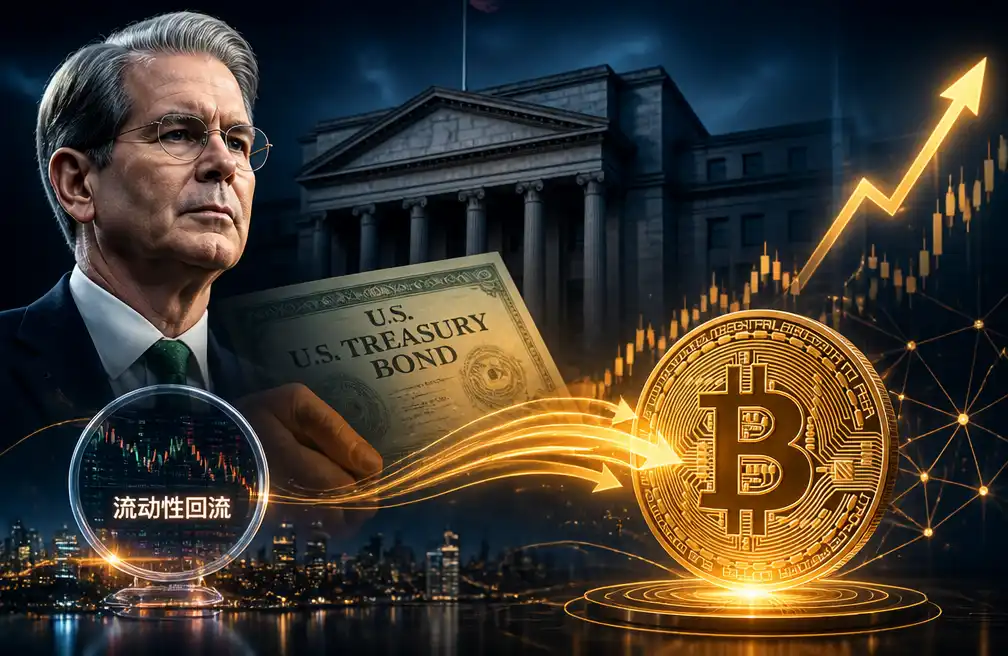
The biggest macroeconomic variable on Monday came from US Treasury Secretary Besant. He announced the use of nearly a trillion dollars from the TGA account to repurchase long-term bonds, while also unveiling several new economic sanctions targeting Iran.

The directions of these two policies are contradictory. Buying bonds to pressure long-term rates is favorable for the stock market, but sanctioning Iran pushes up geopolitical risk premiums, dampening risk appetite. The market ultimately chose the latter. Capital flowed out of AI hardware and tech sectors and poured into gold and Bitcoin.

The 10-year Treasury yield fell approximately 3 basis points to 4.70%, the 30-year yield declined about 2 basis points to 5.25%, and the 2-year yield dipped roughly 1 basis point to 4.22%. Although long-term rates retreated somewhat, tech stocks did not benefit. The Nasdaq fell 0.76% and the Philadelphia Semiconductor Index dropped nearly 4%. The traditional logic of lower rates benefiting tech failed on Monday, as the weight of geopolitical risk outweighed that of interest rates.

WTI crude oil fell 2.35% to $85.01/barrel, while Brent crude dropped 2.35% to $92.17/barrel. The decline in oil prices was primarily suppressed by demand outlook concerns, not a reduction in geopolitical risk.

Nvidia Notifies Customers of Over 15% Price Hikes Next Year, Plans Perplexity Investment

Macro uncertainty weighed on tech stocks, with Nvidia being one of the individual stocks affected on Monday. Two pieces of news emerged: the company had informed hyperscale customers like Microsoft and Google of price increases exceeding 15% for AI servers starting next year; simultaneously, Nvidia plans to invest in the AI search company Perplexity.

The price hike news continues the previous logic—soaring memory chip costs are driving up server prices, and Nvidia is passing these costs onto cloud providers. However, Monday's trading action showed the market did not react positively to the price hike news. The Philadelphia Semiconductor Index falling nearly 4% indicates that investor concerns about the AI hardware supply chain have moved beyond the question of "whether price hikes can be sustained," with more trading focused on geopolitical risk and macro uncertainty.

Nvidia is scheduled to report earnings after the market close this Wednesday. Price hikes are a positive signal, but the market is more concerned about Blackwell shipments, data center revenue guidance, and whether AI capital expenditures can continue to support orders.

Samsung Buyback Falls Short of Expectations, Shifting the Memory Sector's Narrative

Samsung Electronics' shareholder return plan fell short of market expectations, raising analyst concerns about the memory chip sector's capital expenditure outlook. Samsung shares fell 8.7% in the Korean market on Monday.

Following previous large-scale shareholder return plans by SK Hynix and Samsung, the market's pricing logic for the memory sector had included dual support from "price hikes + buybacks." Samsung's disappointing buyback has broken this narrative, with the sector's capital expenditure outlook re-emerging as a market concern. The Philadelphia Semiconductor Index dropping nearly 4% was significantly dragged down by the underperformance of this memory giant.

US-Canada Tariff Conflict Escalates, Trump Announces Auto and Steel Tariffs to Increase to 50%

Donald Trump announced that starting next year, tariffs on Canadian automobiles, auto parts, and steel will be raised to 50%. This is a further escalation of tariff conflicts following the breakdown of US-Canada negotiations last week.

Automobiles, parts, and steel are core components of the North American supply chain. An increase in tariffs from current levels directly to 50% will have a material impact on Canadian manufacturing and cross-border supply chains. Previously, market judgments on trade friction suggested "room for negotiation remains." Trump's latest statement indicates that tariff escalation has become the established policy direction.

Spot Gold Breaks Above $4,650, Bitcoin Nears $80,000

Capital chose the risk-off direction in response to Besant's policy mix. Spot gold rose 1.05% to $4,651.24 per ounce, hitting an intraday high of $4,681, its highest level in nearly three months. Bitcoin gained 1.59% to $78,966, briefly approaching $80,000 intraday for the first time since mid-May. The US Dollar Index rose 0.20% to 98.93.

The logic behind the simultaneous rise of gold and Bitcoin differs. Gold trades on geopolitical risk and fiscal concerns, while Bitcoin trades more on liquidity expectations and risk appetite recovery. However, they share one commonality: capital flowed not into AI hardware, but rather into "dollar credit alternative" assets.

Today's Focus

US August Conference Board Consumer Confidence Index. PMI data has already signaled strong services sector activity. Whether consumer confidence can similarly validate the resilience of consumption will influence market confidence in a soft economic landing.

Continued reaction to Nvidia's earnings expectations. Monday's two pieces of news have added new variables to the earnings report. The market will continue to speculate ahead of the release; any signals regarding Blackwell shipments, data center revenue guidance, or capital expenditures could trigger volatility.

The direction of Tuesday's market will unfold amidst the interplay of consumer confidence data and Nvidia's earnings expectations.

Related Questions

QWhat specific actions did US Treasury Secretary Besant announce that impacted the markets on August 25th?

AUS Treasury Secretary Besant announced two key actions: 1) Deploying nearly one trillion dollars from the TGA account to repurchase long-term bonds, aiming to lower long-end interest rates. 2) Imposing new economic sanctions on Iran, which elevated geopolitical risk premiums.

QHow did major US stock indices perform on Monday, and what was the primary reason for the Nasdaq's decline despite falling long-term yields?

AOn Monday, the Dow Jones Industrial Average rose 0.26%, the S&P 500 fell 0.28%, and the Nasdaq Composite fell 0.76% significantly. The Philadelphia Semiconductor Index dropped nearly 4%. Despite a drop in long-term Treasury yields (10-year down ~3 bps), the Nasdaq fell primarily because the market prioritized the risk-off sentiment driven by heightened geopolitical tensions from the Iran sanctions over the traditional positive impact of lower rates on tech stocks.

QWhat two company-specific news items were reported about Nvidia, and how did the market react to them?

ATwo news items about Nvidia were reported: 1) It notified major clients like Microsoft and Google that AI server prices would increase by over 15% starting next year. 2) It plans to invest in the AI search company Perplexity. The market reaction was negative, with the Philadelphia Semiconductor Index falling nearly 4%. This indicates that broader concerns about geopolitical risk and macroeconomic uncertainty overshadowed the potentially positive news of price increases.

QWhy did the stocks of memory chip companies like Samsung come under pressure?

AMemory chip stocks, particularly Samsung Electronics (which fell 8.7% in Seoul), faced pressure because Samsung's shareholder return plan fell short of market expectations. This disrupted the previous market narrative that supported the sector based on 'price increases + share buybacks.' It refocused investor concern on the capital expenditure outlook for the memory chip sector.

QWhat was the price movement of key 'safe-haven' or 'dollar-alternative' assets like gold and Bitcoin, and what was the implied market sentiment?

ASpot gold rose 1.05% to $4,651.24 per ounce, hitting a near three-month high, and Bitcoin rose 1.59% to $78,966, approaching $80,000 for the first time since mid-May. The simultaneous rise in these assets, alongside a decline in tech/AI hardware stocks, indicated a strong risk-off sentiment. Investors sought assets perceived as hedges against geopolitical risk (gold) and potential dollar alternatives (Bitcoin), rather than riskier growth-oriented equities.

Related Reads

NVIDIA Stuns with First Vera Rubin Test, DeepSeek Throughput Skyrockets 30x

NVIDIA has unveiled the first on-silicon test results for its next-generation flagship cabinet, the Vera Rubin NVL72, using DeepSeek-V4-Pro on real "agent coding" workloads. The results are staggering: compared to the current leading GB300 NVL72, Vera Rubin delivers up to a 30x increase in throughput per megawatt and reduces token generation cost by up to 35x. The benchmark used was the AgentX test from SemiAnalysis, which captures full AI agent workflows with growing context, tool calls, and sub-agent generation, moving beyond traditional LLM benchmarks. This highlights a shift from the LLM era to the Agent era. Key innovations behind Vera Rubin's performance include extreme co-design, separation of services, distributed KV cache, KV-aware routing, MegaMoE architecture, 4-bit NVFP4 quantization, and 6th-gen NVLink for efficient MoE model execution. Simultaneously, NVIDIA announced the full-scale production of two new chips: 1. **Groq 3 LPX:** A low-latency inference accelerator designed for the Vera Rubin platform. When paired with Rubin GPUs for context processing, it achieves record-breaking output speeds—e.g., running Gemma 4 31B at 3,400 tokens/sec—drastically reducing multi-step agent task times. 2. **Vera CPU:** A processor specifically built for agentic AI, featuring 88 custom Olympus cores and 1.2TB/s memory bandwidth to handle the complex orchestration of agent tasks. SpaceXAI is already deploying it, with plans for space-based Vera Rubin systems by 2028. NVIDIA's strategy has evolved from selling GPUs to providing a complete, optimized "AI factory" stack—encompassing GPU, CPU, and specialized accelerators—to power the emerging Agent AI economy.

marsbit39m ago

NVIDIA Stuns with First Vera Rubin Test, DeepSeek Throughput Skyrockets 30x

marsbit39m ago

Bessent Repurchases U.S. Treasury Bonds, So Why Is Bitcoin Rising?

On August 19, U.S. Treasury Secretary Scott Bessent significantly increased the limits for buying back long-term Treasury bonds (10, 20, and 30-year maturities), calling it a "Treasury Twist Operation." The goal was to lower soaring long-term yields, which had recently hit multi-decade highs, by boosting demand for these bonds. However, the effect on yields was brief and limited. The article explains that the Treasury's bond buybacks, funded by issuing more short-term debt or using its cash reserves, do not create new money but merely restructure government debt. Major factors pushing yields higher—such as large budget deficits, corporate borrowing for AI investments, inflation driven by rising oil prices, and Federal Reserve policy uncertainty—remained unaddressed, limiting the operation's impact. Instead of taming bond yields, the intervention was interpreted by markets as a sign of official concern over debt sustainability and potential future currency depreciation. This triggered a rally in assets perceived as hedges against such risks: Bitcoin surged toward $80,000, gold rose, and the U.S. dollar weakened. Further context includes Bessent's unusual suggestion for corporations to issue more medium-term ("belly") debt and the potential long-term role of dollar-pegged stablecoins (backed heavily by Treasuries) in influencing government borrowing costs. The move broke with the Treasury's traditional "regular and predictable" debt management approach. Analysts warn that such unexpected interventions could ultimately increase long-term borrowing costs if they erode investor confidence, creating a potential "Bessent put" similar to the "Greenspan put" for equities. Ultimately, the operation twisted markets for currencies and alternative assets more than the Treasury yield curve itself.

marsbit45m ago

Bessent Repurchases U.S. Treasury Bonds, So Why Is Bitcoin Rising?

marsbit45m ago

DeFi Sector Bounces Back Strongest: Which High-Revenue Projects Offer Entry Opportunities?

DeFi Sector Leads Recovery: Which High-Revenue Projects Are Worth Watching? DeFi has been one of the most active sectors during the recent market rebound. Beyond chasing price action, a key fundamental metric for evaluating DeFi protocols is sustainable revenue, which indicates real user demand. This analysis highlights high-revenue projects across key categories, using protocol fee data (net of supplier payouts). **DEX** * **Uniswap (UNI)**: Leads with $7.18M in 30-day revenue. Protocol fees from v2 and select v3 pools are used for UNI token burns. * **Solana DEXs**: Jupiter (JUP, $4.69M 30-day revenue) uses 50% of revenue for JUP buybacks. Meteora (MET, $1.67M) and Raydium (RAY, $1.13M) also allocate portions of fees to token buybacks. * **PancakeSwap (CAKE)**: Earned $5.16M in 30 days, with part of its fees used for CAKE burns, maintaining a net deflationary supply. * **Aerodrome (AERO)**: On Base, it generated $4.11M in 30 days. Revenue is directly distributed to veAERO holders rather than used for buybacks. **Lending** * **World Liberty Financial (WLFI)**: Top earner with $10.47M in 30-day revenue. A proposal passed to use 100% of fees from its Protocol-Owned Liquidity (POL) for WLFI buybacks, but holder net income remains zero. * **Aave (AAVE)**: Generated $4.12M in 30 days. Its buyback program was paused in April 2026 following the rsETH bridge attack. **ETH Staking** * **ether.fi (ETHFI)**: Earned $3.03M in 30 days. Revenue from eETH withdrawals is used for ETHFI buybacks, which are then distributed to sETHFI stakers. * **Lido (LDO)**: Generated $2.31M. Its new NEST mechanism automatically uses 50% of annual revenue exceeding $40M for LDO buybacks. In summary, several DeFi protocols are generating significant revenue, with many employing token buyback or direct distribution mechanisms. This revenue provides a fundamental basis for evaluation amid market volatility.

marsbit48m ago

DeFi Sector Bounces Back Strongest: Which High-Revenue Projects Offer Entry Opportunities?

marsbit48m ago

Trading

Spot
活动图片