The Blockchain Association has urged the U.S. Supreme Court to consider Custodia Bank's lawsuit against the Federal Reserve over its refusal to approve a master account application, which would grant the crypto-focused bank direct access to the Fed's payment system.
In an amicus curiae brief filed on Wednesday, the industry group stated that federal law requires the central bank to provide payment services to eligible non-member banks. The association believes the Fed should not have broad discretion to deny access.
The association argued that the appellate court's decision effectively gives the Fed a veto over state-chartered banks, allowing it to withhold services essential for their independent operation. It also linked the Custodia case to the alleged de-banking of crypto companies under 'Operation Choke Point 2.0,' claiming federal regulators have discouraged banks from serving the digital asset industry.
Custodia, a state-chartered bank in Wyoming specializing in digital assets, applied for a Fed master account in 2020. The bank sought direct access to the central bank's payment services without relying on an intermediary financial institution.
The Federal Reserve Bank of Kansas City denied Custodia's application in 2023. Later, the Tenth Circuit Court of Appeals ruled that the regional Fed branch had the authority to deny the request. In March, the appeals court voted 7-3 against rehearing the case, leaving the Supreme Court as Custodia's only avenue for appeal.
The Blockchain Association stated that the Tenth Circuit Court of Appeals interpreted the Fed's authority too broadly, essentially permitting it to deny payment system access to eligible state-chartered banks serving the crypto industry.
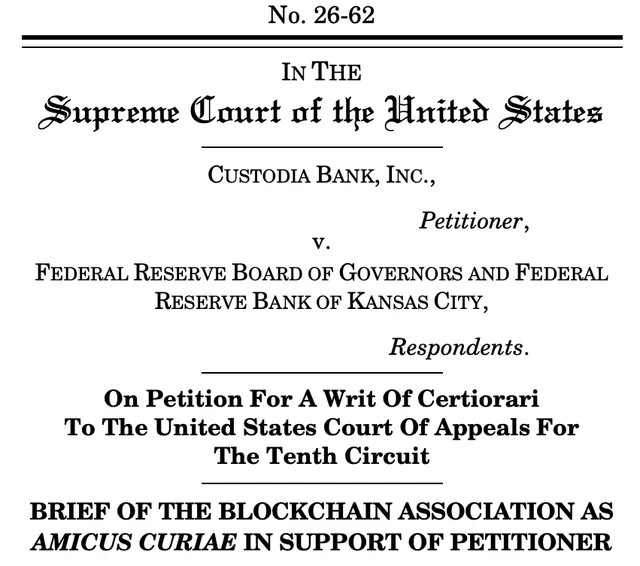
Blockchain Association supports Custodia's Supreme Court petition. Source: U.S. Supreme Court petition
Related: Goldman Sachs CEO backs 'imperfect' CLARITY law ahead of expected vote
Crypto Companies Gain Broader Access to U.S. Banking System
Custodia's lawsuit unfolds against a backdrop of other crypto companies securing wider access to the U.S. banking system. This includes federal licenses and, in one case, direct access to Fed payment infrastructure.
In March, Kraken Financial became the first crypto banking unit to obtain a limited-purpose master account from the Federal Reserve Bank of Kansas City, giving it direct access to Fedwire. This approval contrasts with Custodia's rejection by the same regional Fed bank in 2023.
In April, Coinbase received conditional approval from the Office of the Comptroller of the Currency (OCC) to form a national trust company, moving its custodial business under federal oversight but without the ability to take retail deposits or operate as a commercial bank.
In July, Circle received final OCC approval to create a national trust bank, and the following month, Kraken's parent company Payward filed for its own national trust company license. In December, the OCC also conditionally approved applications for national trust banks from Ripple, BitGo, Fidelity Digital Assets, and Paxos.
This trend has faced resistance from traditional banking groups. The Independent Community Bankers of America opposed Coinbase's approval in April, arguing that crypto companies seek the benefits of banking charters without being subject to the full regulatory framework applied to traditional banks.
Magazine: Bitcoin will never fall below $60K again: Nansen founder