Editor's Note: Google AI Studio is bringing AI programming to a more intuitive stage: users are no longer just having models 'write code', but can directly generate an Android application using natural language and install it on a real phone within minutes. From entering a prompt in the browser, to Gemini automatically generating code, designing interfaces, fixing bugs, to the app appearing on the device, the barrier to software development is being lowered even further.
The Verge author Sean Hollister recently experienced the 'prompt to phone' capability of Google AI Studio. He created three apps in one afternoon, including a text adventure game, a calorie calculator, and a Mario-like mini-game, with almost no need to write code himself, and some bugs could be quickly fixed by continuing the conversation. This experience shows that AI programming tools are moving from development environments closer to consumer-facing scenarios for ordinary users.
This is also the most imaginative aspect of the 'personal software revolution.' In the past, ordinary users could only wait for developers to create general products; now, they might be able to generate a fitness tracker, calorie calculator, or even a simple game on the fly according to their specific needs. For Google, this isn't just a demonstration of AI programming capability; it could also be a new entry point for Gemini into the mobile ecosystem, developer community, and subscription revenue.
However, this experience also illustrates that AI-generated applications still have a significant gap to truly mature. It can quickly produce a 'working' program but not necessarily a reliable, accurate, or user-friendly product: game narratives are crude, mechanics are thin, calorie data can be severely miscalculated, and the Mario-like mini-game even crashes repeatedly. More complex issues also include copyright boundaries, data sources, product judgment, and long-term maintenance capabilities.
What's truly worth paying attention to is not whether AI can already replace developers, but that the starting point of software production is changing. Google has proven that it's becoming a reality for ordinary people to create mobile apps using prompts; but from 'generating an app' to 'making a good app,' human professional experience, aesthetic judgment, and continuous iteration are still required in between. AI can significantly accelerate development speed, but the final mile of software quality can't be handed off—at least not yet.
Here is the original article:
Yesterday, I made my first Android app. Then, I made two more—three apps in one afternoon.
For one of the apps, I essentially just typed 148 English words into a web browser and then walked away. Ten minutes later, a brand new, complete app had appeared on my real Android phone. Of course, I did need to prepare the phone beforehand: enable USB debugging mode and connect it to my computer. But aside from that, as Google advertised, AI Studio did almost all the work for me.
I typed, clicked install, and then—voilà—a fully functioning program appeared. At that moment, I was almost ready to agree with David, Allison, and Jen's assessment: the personal software revolution has arrived, and it's entering your phone. In the future, even without programming skills, ordinary people might be able to get complex smart home device systems truly up and running.
Then, I started actually using these three apps: a calorie counter and two games. It turned out, they didn't perform very well. And just as I was beginning to enjoy iterating and trying to improve them, AI Studio reminded me that I had reached my daily usage limit. Next, I would either have to pay or wait for the quota to reset.
So, friction still exists. But there's no denying what an individual can accomplish nowadays is quite astonishing. That same morning, my colleague Stevie Bonifield also made a personal fitness tracker app, and he thought it was good enough to actually use. Faced with Gemini's pop-up prompt to upgrade to a paid plan, my first instinct was actually: 'Should I pay for a few months first?' That's not a reaction I would have expected myself to have towards a Google product.
How Google's AI Studio Builds an Android App
On Tuesday, when Google showed off using AI to write a game similar to Doom, we joked that I should make a game called MOOD. It would be a text adventure game like Doom, with MOOD standing for 'Modern Online Oratory Dungeon.'
Just this information was enough for Google to get to work. After I typed into AI Studio: 'Help me make a Doom-style text adventure game called MOOD, with MOOD standing for Modern Online Oratory Dungeon,' Gemini started automatically supplementing more ideas, trying to expand on my concept. It first typed a sentence: 'The game should feature procedurally generated levels and challenging turn-based combat.'
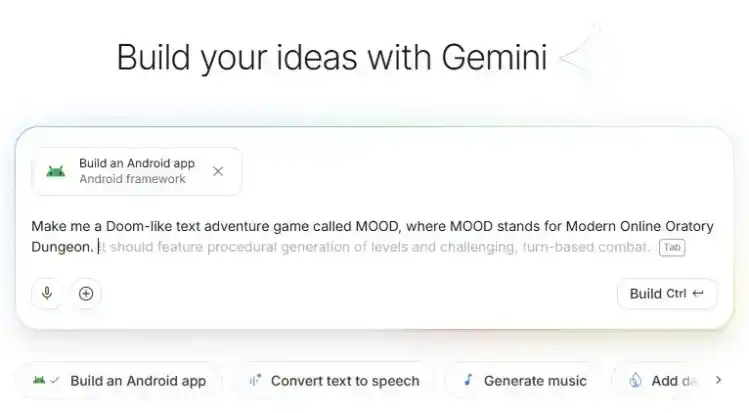
I didn't want randomly generated levels that were completely different each time—I wanted a classic text adventure where players explore a designed, real map structure. Turn-based combat, though, was acceptable. Maybe the game could also have AI help me auto-generate the map?
Then, Gemini suggested more settings like 'secrets hidden in rooms' and 'a satisfying progression system.' Most of the time, I just nodded along with its ideas.
Before I let it start writing code, the final prompt was this:
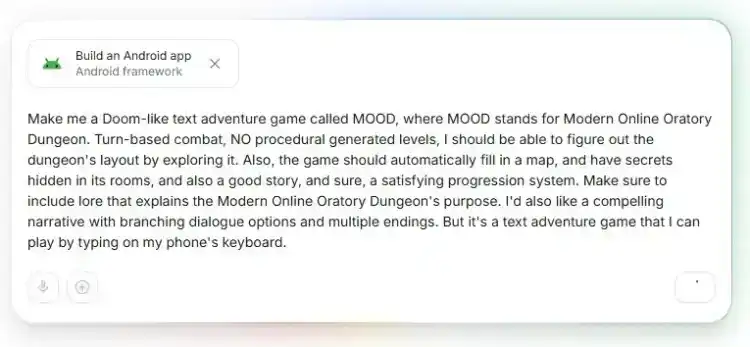
Next, it officially went on a full sprint. My colleague Jake pointed out that unlike Claude Code, Gemini doesn't make a plan first and then ask if you want to proceed. It automatically pushes forward—though you can check the code it writes at any time if you want.
One minute later, it had already generated five design prototypes for me:
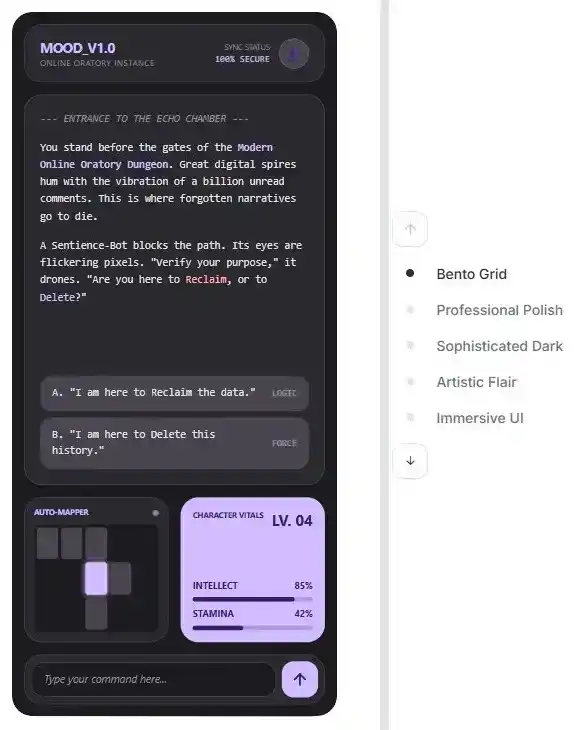
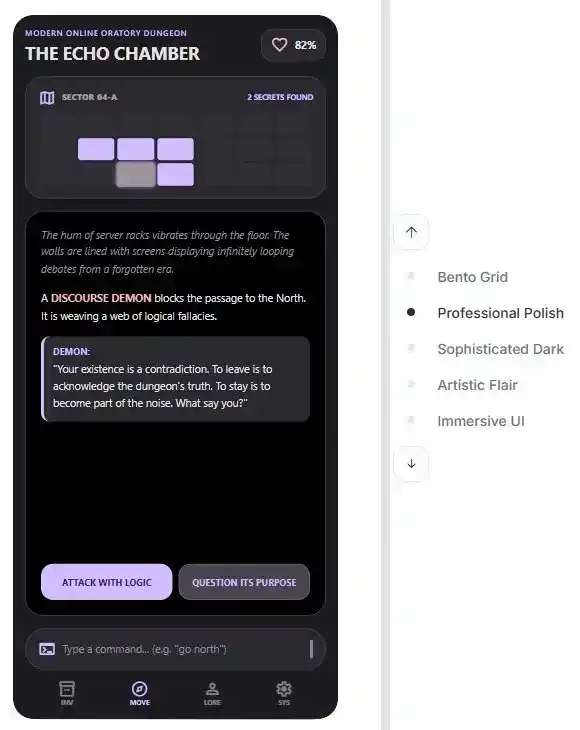
Twenty minutes later, I pressed the 'Install' button, transferring the game to a Pixel 9 phone.
Unsurprisingly, the writing was terrible. There were also no demons to be seen anywhere. The entire dungeon had only 11 rooms, and players could 'beat' it just by repeatedly mashing the attack button—in under a minute if played seriously. At least now it could; before that, Gemini had to help me fix two critical bugs that made the game unplayable.
Here's MOOD in action:
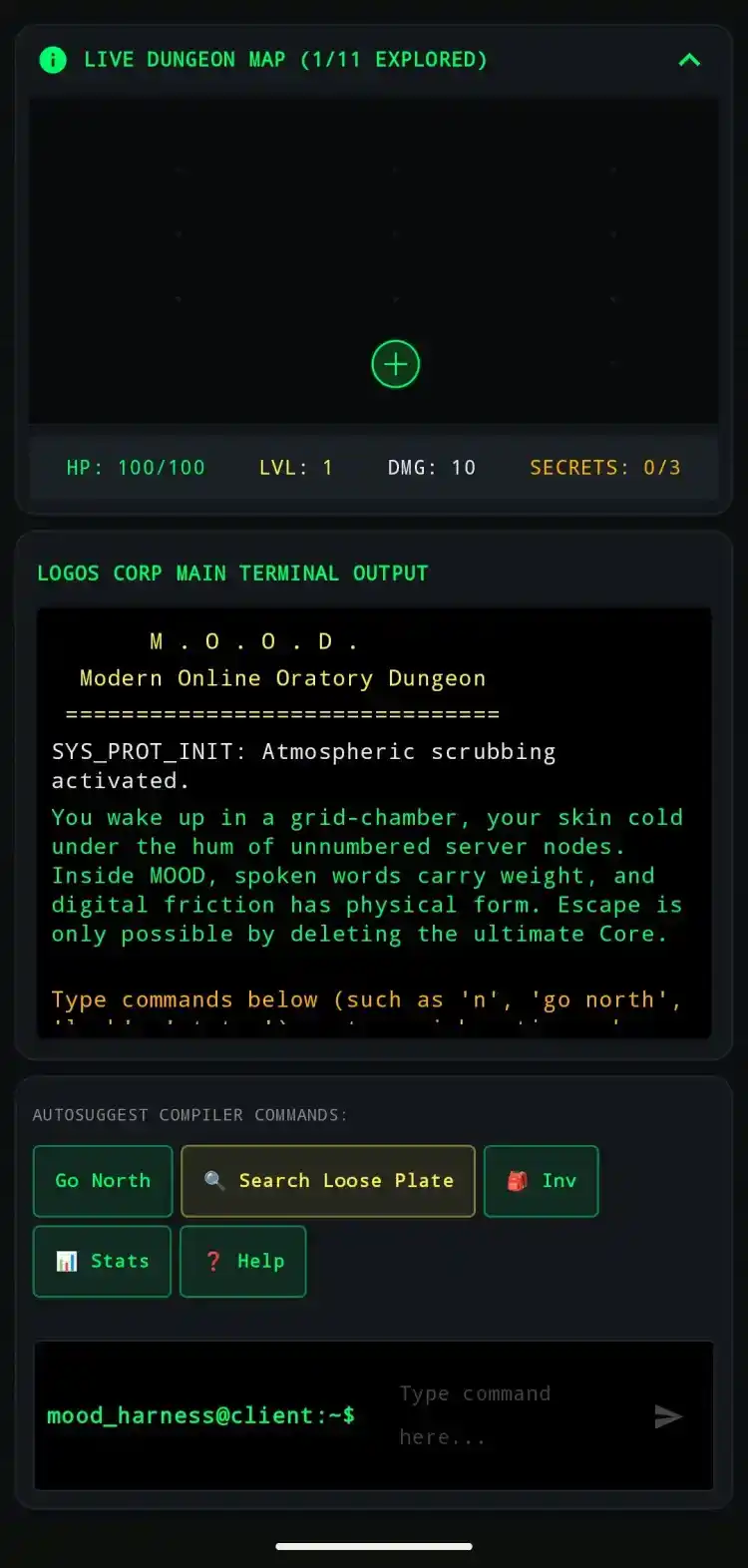
It wasn't a huge surprise to discover that Gemini's promised 'engaging narrative with branching dialogue options and multiple endings' eventually condensed into a simple branch at the very end of the game: I could defeat the 'Core Orator'—an AI that somehow turns internet anger into corporate profits—by attacking it, fusing with it, or entering a backdoor password.
Furthermore, the game actively exposed all the promised 'secrets' directly to the player: it made them into glowing buttons, and players didn't even need to type any text. When you encounter a glowing treasure chest, the game tries incredibly hard to remind you it's actually a Mimic—the classic Dungeons & Dragons monster that disguises itself as a treasure chest.
It not only explicitly warns you to 'check the chest at your own risk,' but even labels it as an enemy and doesn't let me leave, because the system prompts: 'A hostile ‘Clickbait Mimic’ is blocking the path!'
Speaking of which, MOOD will even tell you the backdoor password needed to unlock the hidden ending when you need it.
However, the bug-fixing process could be surprisingly smooth, provided it was a bug Gemini could correctly identify. When I told it the game got stuck when talking to 'The Whistleblower' because the button to end the conversation was missing, it immediately generated a new version of the app. I pressed 'Install,' the app on my phone restarted automatically, and upon re-entering the game, I found myself right where I left off—only this time, the button I needed was there.
My other apps probably needed more polishing. The calorie counter's best method for determining a food's calories turned out to be calling the paid Gemini API, which I don't have a key for. When I asked it to search for information from other databases instead, I discovered that its estimates for many foods were severely low.
However, when I told Gemini that a 16-ounce boba milk tea couldn't possibly be only 190 calories, it did seem to find that basic mistake in its own code. It previously thought 'milk' was enough to match 'boba milk tea,' and worse, it chose low-calorie 1% milk as the basis for the estimate. Gemini claimed it would now perform more reliable matching.
But even so, my 3-ounce serving of Taiwanese popcorn chicken was just calculated as 140 calories, and I'm pretty sure the real number is at least double that. So, this app clearly needed more work.
Finally, and least importantly, I felt I needed to test: whether Google still allows users to make those terrible Nintendo knock-off games, like my colleague Jay Peters did earlier this year with Project Genie; or whether Google had learned its lesson.
With deep shame, I present to you—Super Peach Rescue:
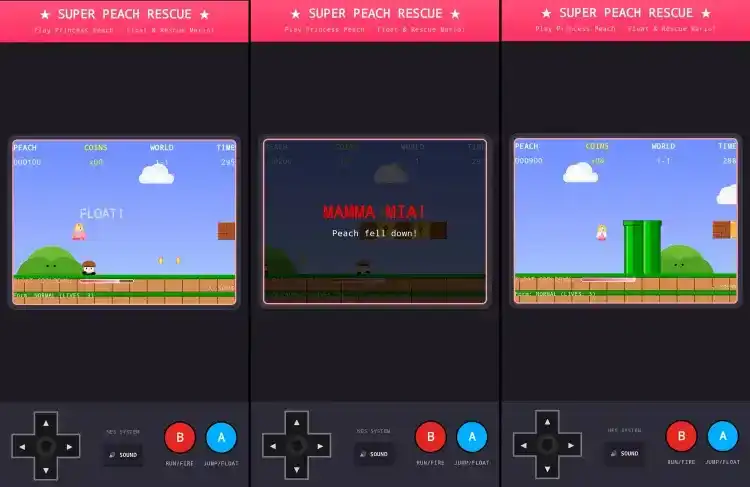
This is an utterly terrible program. Princess Peach was rendered as some kind of terrifying, one-eyed floating alien, and the game would instantly crash—every single time—if she dared touch any of the power-up blocks. So far, Gemini hasn't been able to figure out why.
Also, the second pipe in the game is completely impassable because Princess Peach simply can't jump that high.
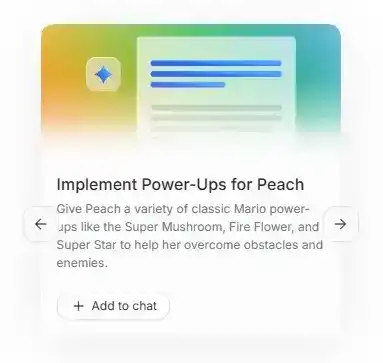
Nevertheless, Gemini didn't hesitate when generating such a game. My request was: 'Make a working Super Mario game where I play as Princess Peach rescuing Mario, with all the elements of a traditional Mario side-scroller.' In a sense, it did.
It even proactively suggested that I could 'give Peach a series of classic Mario power-ups like Super Mushroom, Fire Flower, and Starman.' It also labeled the control scheme as 'NES System.' I think I'll delete this game.
At least, among the two games I made via vibe coding, one was playable from the start and required almost no effort on my part—unless you count the psychological trauma of thinking about how many game developers are now unemployed.
To be clear: I'm actually glad the games I vibe-coded turned out so poor. For a completely free, personally-tailored calorie counter, I might still be able to defend myself: after all, no one would make such a tool just for me. But when it comes to games, I'd rather spend my time supporting actual human creators.