By Lan Meihui, Author: Ye Er, Editor: Wei Xiao
Qianwen's biggest rival has arrived.
On June 8th, WeChat officially opened up its AI ecosystem access capabilities to developers, allowing them to authorize and connect to WeChat AI from the Mini Program backend.
This means that the highly anticipated WeChat AI Agent is about to become a reality.
According to AI Lan Meihui, users can swipe right on the WeChat main interface to access the Agent's chat window and use natural language commands to automatically invoke Mini Programs to complete tasks such as hailing rides, ordering food, booking tickets, shopping, and making payments.
This enables "one-sentence ride-hailing, food ordering, shopping," and more within WeChat.
Those familiar with the current AI-native application industry know that this aligns directly with the Agent service and transaction closed-loop capabilities that Qianwen has been deeply cultivating.
One fact is that this year, in the battle for the AI super-entry point, Qianwen's core strategy has been to continuously integrate services like Taobao Flash Sales, Gaode Taxi, Fliggy, and Taobao Shopping by leveraging the Alibaba ecosystem. This not only makes Qianwen a unified AI entry point for users to access Alibaba's full range of services but also transforms Qianwen from a ChatBot into a life services assistant with the ability to serve the real, physical world.
For a long time, this kind of Agent service and transaction closed-loop has been seen as Qianwen's core moat, perhaps even a capability unique to Qianwen.
But now, with WeChat personally entering the fray, the situation looks very different.
Targeting Qianwen's Core Territory
Many have already experienced the service capabilities of Agents through Qianwen, perhaps for the very first time.
Ordering milk tea with a sentence, hailing a taxi with a sentence, or even completing e-commerce shopping directly through conversation with an AI—this interactive logic of AI Agents is quietly changing user habits and penetrating user minds.
Data shows that during Qianwen's "Spring Festival Hosting" campaign alone, orders exceeded 10 million within 9 hours of launch, reaching 15 million actual orders on the first day, with AI completing nearly 200 million order placements.
This is regarded by the industry as the world's first large-scale commercialization verification of AI Agents, also making Qianwen a key window for the public to perceive the capabilities of AI Agents.
Why? The reason is quite understandable—Qianwen is uniquely positioned.
On one hand, the Alibaba ecosystem it relies on inherently possesses closed-loop service scenarios across e-commerce, mobility, local life, travel, and more. On the other hand, under Alibaba's AI strategy, Alibaba is fully supporting Qianwen, facing virtually no barriers and acting swiftly in integrating with various business units.
Having a rich ecosystem is one thing, but also needing sufficient willingness to cooperate from all parties—until now, only Qianwen met both conditions.
But now, WeChat must be added to the list.
Firstly, with WeChat taking the initiative this time, its ecosystem of millions of Mini Programs inherently covers daily life scenarios such as ride-hailing, food delivery, ticket booking, grocery shopping, and retail. This provides an ecological foundation comparable to Alibaba's.
According to the WeChat Open Class PRO disclosure in January 2026, the WeChat ecosystem has a stable monthly active user base of 1.07 billion, with Mini Programs covering 108 verticals. Although WeChat hasn't announced the exact number of Mini Programs, the market generally estimates that the number of active Mini Program principals is in the millions.
Even in the e-commerce field, the number of merchants on WeChat Shops is growing rapidly.
Data from 2025 shows that the monthly number of active merchants on WeChat Shops reached 1.7 times that of the same period last year, and the overall GPM (Gross Merchandise Volume per 1000 Impressions) also increased to 1.5 times. The scale of cross-platform sales via WeChat more than doubled compared to the previous year.
This is enough to show that in terms of AI Agents, WeChat's Mini Program ecosystem can indeed rival Alibaba's.
Secondly, Mini Program principals are willing to actively cooperate with WeChat AI.
Even though service providers of Mini Programs may risk being commoditized in the Agent service business model, none can resist the super traffic advantage of WeChat.
As of now, including JD.com, Meituan, Ctrip, and others have all taken the lead in expressing their embrace of WeChat AI, seemingly determined to secure their place on WeChat's massive ship in the AI era. It's worth noting that the current WeChat has indicated its intent to join the battle for the AI super-entry point. Under this opportunity, cooperation between Mini Program principals and WeChat naturally presents a viable shortcut.
Furthermore, compared to Qianwen, WeChat has another advantage: as a national-level infrastructure, it inherently possesses three underlying high-frequency scenarios—social interaction, life services, and Mini Programs—naturally offering user stickiness difficult for other products to replicate.
Other manufacturers need to continuously invest marketing costs to educate users to actively open AI software to cultivate AI usage habits. WeChat, however, can embed the AI Agent into the native paths of daily chatting, searching, and service invocation, completing the landing of AI through users' subtle, habitual use.
In comparison, QuestMobile data shows that as of March 2026, Qianwen's monthly active user scale was 166 million, with an average active rate of 17.1%. User stickiness is rapidly improving, but it's clearly not on the same scale as WeChat, which boasts over 1 billion monthly active users.
This means that once WeChat makes its move, it could directly breach Qianwen's moat, rush into its core territory, and compete with Qianwen for the Agent To Agent business.
Recruiting Allies to Their Circles
Of course, Qianwen is also reinforcing its moat.
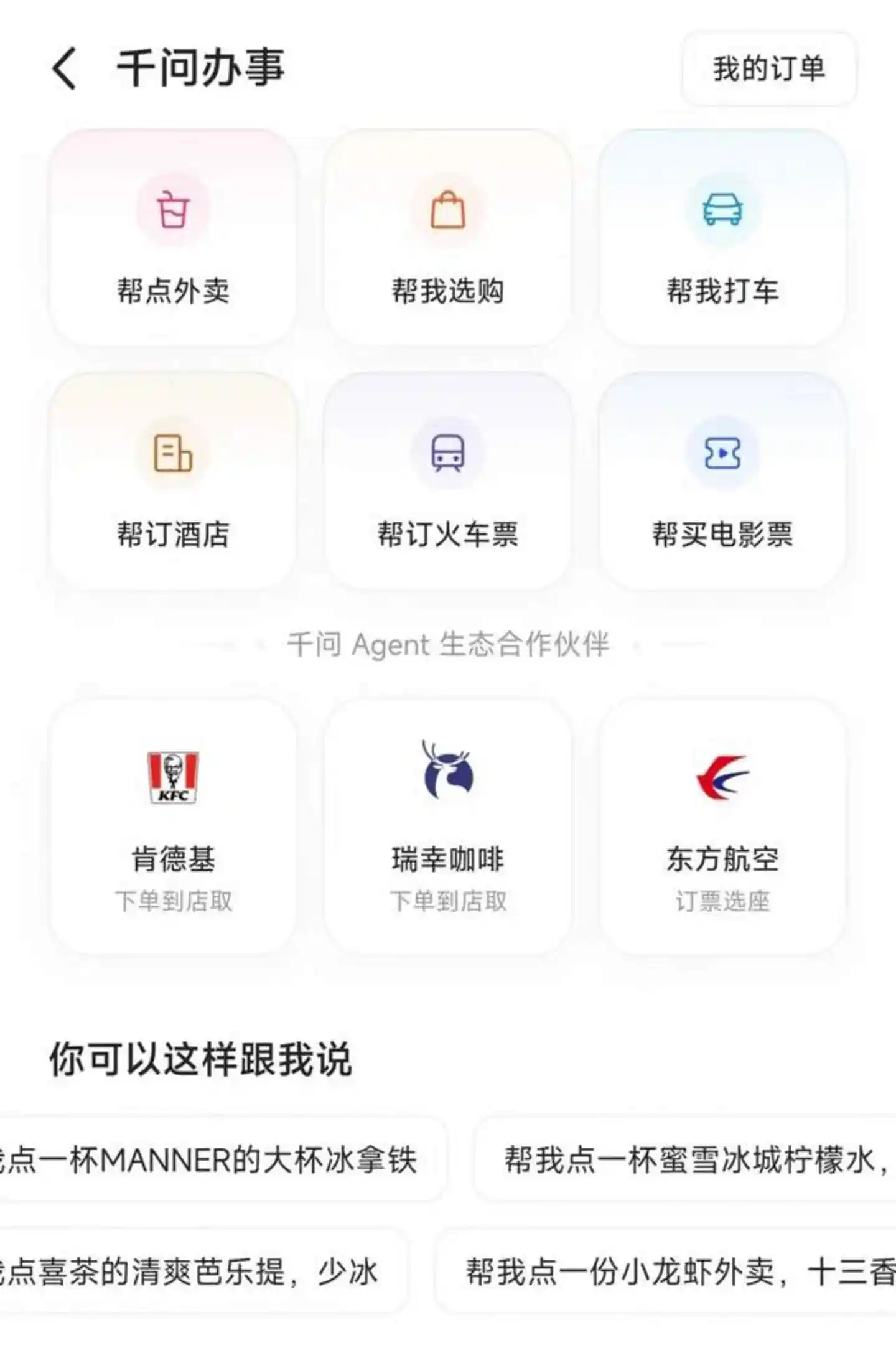
On June 3rd, Qianwen announced the full opening of its platform to third-party Agents and Skill modules. All enterprises can operate their own branded Agents on the platform, with Luckin Coffee, KFC, Mixue Bingcheng, China Eastern Airlines, and others among the first batch of companies conducting service tests.
The purpose of this move is clear: to leverage the scenario capabilities of brand partners to complement Qianwen's service portfolio, further widen the industry gap, and solidify its competitive barriers.
More importantly, through this, Qianwen aims to signal openness and cooperation to the market.
The timing, just one day after WeChat's AI Agent was publicly revealed on June 2nd, clearly indicates that Qianwen sensed the threat posed by WeChat and reacted quickly.
In building the Agent To Agent closed-loop system, where the technical capabilities of major players are largely on par, the richness of the scenario landscape becomes the key area for intensified focus.
Qianwen's opening up is precisely a preemptive judgment against WeChat's powerful appeal.
And the facts bear this out.
Within just seven days, the commercial ecosystem of WeChat's AI Agent has begun to take shape. Smartphone manufacturers, local life giants, e-commerce platforms, and millions of Mini Program merchants have all been incorporated into the same map, showing very positive willingness to embrace WeChat's AI Agent.
They are even broadcasting it widely. As of now, platforms like Meituan, JD.com, Dewu, and Ctrip have all intensively and prominently announced their alliances with WeChat.
A vigorous campaign of recruitment and alignment is in full swing.
In the mobile internet era, Tencent, JD.com, and Meituan competed directly with Alibaba by exchanging 'half their lives.' Now, this story is playing out again in the AI era.