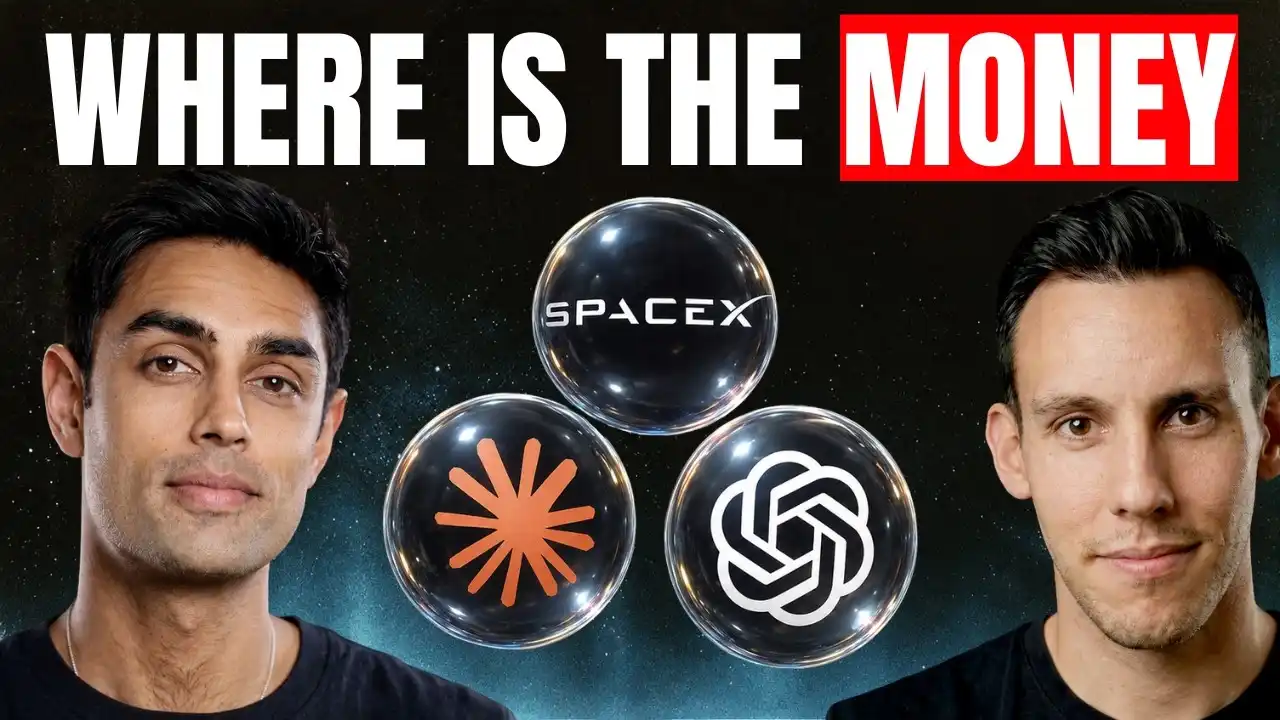
Hosts: Josh Kale; Ejaaz Ahamadeen
Podcast Source: Limitless Podcast
Original Title: Money is Running Out for the Biggest IPOs in History
Broadcast Date: June 3, 2026
Key Takeaways
This episode revolves around SpaceX, OpenAI, and Anthropic racing for IPO almost simultaneously, discussing how AI infrastructure construction is pushing private capital and tech giants' balance sheets to their limits. The two hosts believe this is not a single company's fundraising story but an unprecedented concentration of capital: companies need more computing power, data centers, electricity, and chips, while public markets, index funds, and pension funds are also being drawn in.
The episode also compares SpaceX's unproven space data center business model, Anthropic's already demonstrated enterprise revenue growth rate, Google's urgency in continuing to bet on AI through external financing, and OpenAI's capital needs to continue expanding data centers for training and serving models. Ultimately, both remain cautious about bubble risks but lean optimistic overall: as long as computing power supply still lags behind demand, AI infrastructure spending is more like building the next-generation technology foundation, not just an empty financial bubble.
Highlights Summary
Mega IPOs Densely Arriving: Is AI Construction Exhausting Capital?
- "The total expected funding from the IPOs of OpenAI, Anthropic, and SpaceX is projected to reach $180 billion, a figure that even exceeds the total funding of the entire dot-com bubble era, $164 billion. And that figure was the total over three years, while here it's just three companies."
- "Why now? Why the rush? In my view, the answer is simple: AI capital expenditure is becoming more expensive than these companies originally anticipated, and they are choosing to double down. Their free cash flow is no longer sufficient to support current demand."
- "Whether it's through debt instruments for leverage or other financing methods, we have already jumped into the abyss. If we don't go all in now, we'll end up with nothing."
SpaceX Rewrites IPO and Index Rules, Pension Funds Forced to Buy
- "Through its IPO, SpaceX is essentially redefining market rules to meet its massive funding needs."
- "Over $30 trillion in passive 401k funds, meaning retirement funds, will be forced to buy SpaceX stock, and at the IPO valuation level. Rough estimates suggest that about 24% of the shares issued in SpaceX's IPO will be absorbed by these passive funds. This scale of passive buying is unprecedented in history."
- "Some indices only require an observation period of 5 to 15 days; as long as the post-IPO stock price can be maintained at a certain level for a few days, the company can be included in the index. In other words, Elon Musk just needs to ensure the stock price stays at a certain level for a short time to easily meet the criteria."
- "It (SpaceX) has not truly proven its revenue model. It claims 'we will put AI data centers in space...'. However, this business model has not been validated... It's more of a 'trust me' promise."
Anthropic's Revenue Leap and IPO Motivation
- "They (Anthropic) reached that number ($20 billion) in the first month and a half of 2026. Recently, their annualized recurring revenue (ARR) has reached $45 billion. This is mainly due to the success of Claude Code, Claude Co-Work, and a series of enterprise contracts they have signed."
- "Anthropic is projected to achieve about $550 million in profit by the end of this month. Of course, this is just a drop in the bucket compared to the trillions in capital expenditure, but it will become the first major AI lab to achieve this."
- "Anthropic's coverage in the Fortune 10, meaning 9 out of the top 10 global companies are using Anthropic, especially Claude Code. Their net dollar retention rate... has grown 500%. In other words, these companies plan to spend 5 times more."
Google's $80 Billion Fundraising: An IPO That's Not an IPO
- "About a year and a half ago, Google's founders Larry and Sergey Brin were very clear: they would rather risk losing everything than lose the AI race. So they will keep spending until they find enough breakthroughs. They have returned to founder mode."
- "Google is a public company, yet it raised $80 billion.... But about $30 billion of that $80 billion might be used to cover tax obligations for employees cashing out stock in the coming months. That is, a significant portion of the fundraising won't actually be used for AI capital expenditure expansion.... This has a bit of a desperate flavor."
- "They (Google) lack focus. They are working on agents, they want to build better coding models; they want to build better general-purpose large models, while also building TPU infrastructure; they even sell TPUs to competitors, and then don't have enough compute to train Gemini themselves, so Gemini falls behind.... The recent Gemini 3.5 Flash, despite all this spending, still lags behind frontier models."
OpenAI and AI Infrastructure: The Money Isn't Even Spent Yet, Bottlenecks Are Already in the Physical World
- "I (Ejaaz) might have a slightly controversial view: the money that is about to be raised and spent will ultimately be a good thing. I think it fundamentally won't be a bubble but will build the necessary infrastructure."
- "We are now constrained by the physical world.... No matter how much leverage you want to use, how much money you want to raise, you might not actually be able to spend it, because you are constrained by the speed of regulation, the speed of physical data center construction, the speed of silicon chip production capacity. There's only one ASML, only one Nvidia, only one TSMC. The physical infrastructure side of AI is difficult to scale. Until I see this bottleneck relieved, I don't think we are in a bubble."
- "GPUs from four or five years ago are now renting for even higher prices than four or five years ago. They are more valuable.... What we are seeing now is the opposite situation: buyer demand is too strong, we simply don't have enough silicon and compute to meet the demand."
- "We are at a very unique moment in history. There has never been such a concentration of capital and value, betting on a single idea, in US history or in the history of capitalism.... The US is reindustrializing in a significant way."
Mega IPOs Densely Arriving: Is AI Construction Exhausting Capital?
Josh:
The three largest IPOs in history might file within weeks of each other: SpaceX, OpenAI, and Anthropic. On the same day, Google also raised $80 billion from external sources to support its own AI buildout.
Interestingly, the financial relationships between these companies have become quite complex, and they are, in a way, using each other's money to support each other's balance sheets. Over the past few weeks, markets have even started modifying rules designed to protect passive investors to allow them to participate in IPOs earlier.
Right now, the largest construction boom in the history of capitalism is underway, so we have to ask a question: Is there really enough money? These companies choosing to go public almost simultaneously is clearly not a coincidence. The chart we have on screen is staggering: The total expected funding from the IPOs of OpenAI, Anthropic, and SpaceX is projected to reach $180 billion, a figure that even exceeds the total funding of the entire dot-com bubble era, $164 billion. And that figure was the total over three years, while here it's just three companies.
So, the scale is incredible. We need to answer a few key questions: Is this a circular economy moment? Are these companies almost out of money? Have they grown too big for private capital to continue supporting them? There's a lot to unpack here. Ejaaz, let's start with SpaceX.
Ejaaz:
SpaceX, OpenAI, and Anthropic are all preparing for super IPOs, but the real story isn't any single company's individual fundraising, but that they might go public in a concentrated manner within weeks. Their target is to complete their IPOs by Q4 at the latest, and the combined fundraising scale is enormous. This situation is unprecedented in history.
Looking at them separately, SpaceX supposedly filed its S-1 on April 1st, which basically signals its intent to go public. Market rumors say it could go public this month or by early July at the latest. About 10 days ago, OpenAI was also said to have confidentially submitted its own S-1, preparing for an IPO. And just yesterday, Anthropic filed a confidential version of its S-1. So, these three companies are all sprinting for super IPOs within the same time window.
This raises the question: Why now? Why the rush? In my view, the answer is simple: AI capital expenditure is becoming more expensive than these companies originally anticipated, and they are choosing to double down. Their free cash flow is no longer sufficient to support current demand.
So far, these companies have been spending primarily private money, either raised from investors or from their own revenue. Now, they are turning to public markets, making a request to investors: "We need more money to build more data centers, buy more GPUs, train more models to meet growing demand."
If you ask these companies, none will admit they lack demand. In fact, Google, and I recall Amazon, Microsoft, and Meta, have all reported profitable quarters despite massive AI capital expenditures. These four companies combined are planning to deploy close to a trillion dollars this year, but even that is not enough. Therefore, they need more funds to fuel this buildout.
What I'm really concerned about is whether we've reached a point of no return. We discussed this before recording: once you get to this stage, there's no turning back. Whether it's through debt instruments for leverage or other financing methods, we have already jumped into the abyss. If we don't go all in now, we'll end up with nothing.
SpaceX Rewrites IPO and Index Rules, Pension Funds Forced to Buy
Josh:
What surprises me the most is that not only are these companies going all out, but institutional investors, the general public, and even major Wall Street fund companies are participating in betting on these IPOs, and they are modifying rules to accommodate them.
A recent prime example is the SpaceX IPO. To get its stock included in indices faster, index providers relaxed the original profitability requirements and shortened the typical 90-day observation period to just 5 days. Under traditional rules, a company first had to prove it could operate normally and have sustainable profitability before index funds would be required to buy its stock. But now, these index funds can buy earlier. Even if some people don't want to actively invest in SpaceX, their retirement accounts, 401ks, and portfolios holding these index funds will be forced to passively buy SpaceX stock sooner than before.
Ejaaz:
This situation has never happened before in history. Through its IPO, SpaceX is essentially redefining market rules to meet its massive funding needs.
A few data points are particularly noteworthy. First, over $30 trillion in passive 401k funds, meaning retirement funds, will be forced to buy SpaceX stock, and at the IPO valuation level. Rough estimates suggest that about 24% of the shares issued in SpaceX's IPO will be absorbed by these passive funds. This scale of passive buying is unprecedented in history.
Second, under traditional rules, to be included in key indices like the NASDAQ 100 or Fortune 500, companies usually needed to demonstrate large-scale revenue and stable performance for one or two consecutive quarters, typically taking 3 to 6 months. However, the rules have now been significantly relaxed. Some indices only require an observation period of 5 to 15 days; as long as the post-IPO stock price can be maintained at a certain level for a few days, the company can be included in the index. In other words, Elon Musk just needs to ensure the stock price stays at a certain level for a short time to easily meet the criteria.
Josh:
This change is indeed concerning. For decades, major indices have followed two core rules designed to protect ordinary investors, especially those participating through retirement or general investment accounts. Rule one was that a company must be profitable for four consecutive quarters. Rule two was a minimum free float percentage between 5% and 10%.
These rules were established after the 1999-2000 dot-com bubble burst. At that time, many indices included a batch of high-growth but consistently unprofitable companies at the peak of the bubble, causing 401k holders and retirement investors to passively hold these stocks and ultimately suffer huge financial losses when the bubble burst. Hence, these rules were introduced to protect ordinary investors.
Now, it seems history is repeating itself. The rules are being adjusted in reverse. Companies no longer need four consecutive quarters of GAAP profitability; they just need to look good for 15 days. Compared to the past, the bar has been significantly lowered. This makes me wary. While this rule relaxation could provide strong support for SpaceX's stock price because massive passive buying will push it up, if things don't go as expected, it could hurt those ordinary investors passively holding SpaceX stock.
Ejaaz:
Josh, I think much of the external criticism of the SpaceX IPO is valid: It has not truly proven its revenue model. It claims 'we will put AI data centers in space, using rockets to achieve this.' However, this business model has not been validated, not even at the proof-of-concept stage. While it certainly is launching rockets, we haven't seen GPUs in space actually training frontier AI models. So, in a sense, it's more of a 'trust me' promise.
However, one company is different. It has proven its revenue-generating ability, and its growth rate is staggering. That's Anthropic. Just yesterday, Anthropic filed a draft S-1 registration statement with the SEC, indicating it plans to go public in the coming months.
Anthropic's Revenue Leap and IPO Motivation
Ejaaz:
Anthropic's story differs from SpaceX's in a few ways. Anthropic's CFO Krishna Rao previously said the company had no immediate IPO plans and would take it slow. At that time, they had already reached $9 billion in annualized recurring revenue and projected about $20 billion for all of 2026, but they reached that number in the first month and a half of 2026. Recently, their annualized recurring revenue has reached $45 billion. This is mainly due to the success of Claude Code, Claude Co-Work, and a series of enterprise contracts they have signed. They are also involved in many joint ventures, raising money from Blackstone, and advancing many different things.
So, compared to SpaceX, Anthropic is indeed making a lot of money. Therefore, it makes sense for it to want to go further now. They are acquiring as much computing power as possible and are primarily competing with OpenAI: they want to train frontier models, serve frontier models, and make these models available to as many people as possible. That's why I think they are pushing forward with the IPO.
It should be noted, however, that this time no details were disclosed, right? It's more like a statement that had to be issued. OpenAI apparently didn't need to do this, but Anthropic decided to disclose for transparency. Josh, what's your take?
Josh:
It's interesting, it's like a "confidential disclosure about a confidential filing," quite ironic. But I think it did catch many by surprise. Almost no one expected the pace to be this fast. When I looked at Polymarket, everyone originally expected OpenAI to IPO before Anthropic. Then this news came out, and the odds completely flipped.
The data I saw from The Information might already be outdated because the recent rumors I've heard suggest Anthropic's growth is even faster than previously expected. It shows an unbelievable growth trajectory, primarily driven by real value creation on the enterprise side and very strong model capabilities.
Think about Mythos. They just announced that model two months ago, which means its training was completed even earlier. These models are really powerful. I feel Anthropic is very confident about going public.
This topic also raises another question: How much money does the market actually have to absorb this fundraising?
We know SpaceX will go public first. Rumors suggest it could be around June 12th, in the next two weeks. That could suck up $100 billion in capital. Although its target is to raise $75 billion, I believe it will exceed that. So how much money can Anthropic still get from the market? And if OpenAI goes public after that, how much is left for OpenAI? We are making very large capital demands on the public markets. The private market might already be drained, or maybe not. But we will soon see how quickly the public market's capital reserves are depleted because the amount each company wants to raise is staggering.
Ejaaz:
Here's how I think about it: There will be a class of investors buying these companies' stocks because their core logic is simply being bullish on AI. Then there will be a large group of retail investors who will say, "I use Claude every day, it's very helpful for me, so of course I'll buy this company's stock." Or they use ChatGPT daily and will think similarly.
These two groups will ultimately lead to the same result: buying these companies' stocks. From the companies' perspective, their purpose for going public to raise funds is also clear. Anthropic's CFO Krishna Rao has said it, OpenAI's CFO Sarah Friar has said it, Elon Musk has said it: We need more compute. More compute leads to better AI, better AI leads to better products, better products serve more customers, and ultimately lead to more revenue.
Specifically for Anthropic, rumors about their AGI model Mythos seem very real. There was also breaking news today that they are advancing Project Glasswing, a batched, sandboxed release method for Claude Mythos, covering an additional 150 organizations globally. They also mentioned in a recent statement that it will be released to the public in the coming weeks. So, all this happening now seems very coincidental, or perhaps an intentionally arranged coincidence.
Another difference with Anthropic is that it is projected to achieve about $550 million in profit by the end of this month. Of course, this is just a drop in the bucket compared to the trillions in capital expenditure, but it will become the first major AI lab to achieve this. Its growth rate is truly astonishing. Out of all these IPOs, I might be most bullish on Anthropic, but each company has its own path.
Google's $80 Billion Fundraising: An IPO That's Not an IPO
Josh:
We previously had a hypothesis that big tech companies like Google might start spending beyond what their revenue can bear. In other words, they would start using debt to support this buildout.
Now we are seeing some signs the market is slowly entering this territory. The revenue on Google's balance sheet is no longer enough to cover their needs, so they are seeking external capital. This isn't an IPO, because Google has been a public company for a long time, but it still needs more money. So what did it do? It raised $80 billion to support AI buildout, which is a massive amount of capital.
I don't remember the exact total capital expenditure they committed to, but I estimate this amount is close to 30% to 40% of their annual planned capital expenditure. Notably, Berkshire Hathaway, Warren Buffett's old company, wrote a $10 billion check to participate. This is a big deal: $30 billion from an underwritten public offering, $40 billion from a market follow-on offering plan starting in Q3 this year, and $100 billion from Berkshire's private placement.
We previously dug deep into Google's balance sheet, looked at how much they earn and spend. At that time, they were still positive. Now it seems, are they planning to move into losses, or are they just buffering ahead, giving themselves enough safety cushion?
Ejaaz:
I think they are going all in, and the books might eventually turn red. About a year and a half ago, Google's founders Larry and Sergey Brin were very clear: they would rather risk losing everything than lose the AI race. So they will keep spending until they find enough breakthroughs. That's founder mode; they've returned to founder mode. Sergey Brin came back to Google to get the company back into this state.
This is my favorite IPO story of the week, but it's not even an IPO. Google is a public company, yet it raised $80 billion. The question is, what is this $80 billion actually for? The headline, of course, is: We will use this $80 billion to build more AI capital expenditure, make more TPUs, provide more compute, etc.
But many people miss one story: about $30 billion of that $80 billion might be used to cover tax obligations for employees cashing out stock in the coming months. That is, a significant portion of the fundraising won't actually be used for AI capital expenditure expansion.
Setting that aside, I don't think Google is a bad actor. They have been as transparent as possible about how much they are spending on AI and how they plan to do it. They are genuinely trying their best. But this reminds me of the state we discussed OpenAI being in late last year: at that time we said OpenAI was a bit distracted, working on many random AI products, missing the whole coding AI focus, and then they called a Code Red and refocused.
I feel Google is now drifting into this overly broad state. They lack focus. They are working on agents, they want to build better coding models; they want to build better general-purpose large models, while also building TPU infrastructure; they even sell TPUs to competitors, and then don't have enough compute to train Gemini themselves, so Gemini falls behind. The recent Gemini 3.5 Flash, despite all this spending, still lags behind frontier models. Now they need to raise this much money to train better models. It seems they need to really lock in on a target, focus.
Looking at the funding structure, $80 billion is a lot, almost like Google doing its own IPO to support its buildout. I'm not entirely convinced using $30 billion of it to cover tax obligations is the best use. It does have a bit of a desperate flavor. But I'm still optimistic because historically, when large companies did similar public fundraises, companies for which Berkshire Hathaway wrote a $10 billion check later performed well. So I hope Google will be the same. But it's an interesting story indeed.
Josh:
Trust in Berkshire brings eternal life, right? Their past judgments have been accurate, and they've been very disciplined. We hope this continues. Another point to note: Google holds large stakes in many soon-to-be-public companies. It is one of the large private shareholders in both SpaceX and Anthropic, so when those companies' stock prices rise, Google will also benefit significantly.
But these numbers are getting larger and a bit frightening. We seem to have become numb to the scale of hundreds of billions. Google's capital expenditure of $180 to $190 billion this year would have been unimaginable just a few years ago. So when they say all in, they mean all in at a scale we've never seen before.
I think this is also one of the themes of this episode: We are at a very unique moment in history. There has never been such a concentration of capital and value, betting on a single idea, in US history or in the history of capitalism. The consequences will be significant. Whether it's a bubble or not, we are building real value. Real intelligence is being built. As the results of this spending enter the market, a real civilization-level shift will begin to be felt.
It's easy to get lost in these huge numbers, but it will ultimately lead to truly valuable tools. We often joke about Google, saying they haven't released a new frontier model in a while. But I also use their tools and services now, and I can clearly feel these products getting smarter. We'll cover WWDC next week as well, and see how Apple plans to launch these tools to make them smarter. We'll see where this capital expenditure is actually going.
But there's another IPO we haven't expanded on, and that's OpenAI.
OpenAI and AI Infrastructure: The Money Isn't Even Spent Yet, Bottlenecks Are Already in the Physical World
Ejaaz:
We mentioned earlier that 10 days before Anthropic filed its potential IPO paperwork, OpenAI did the same, also confidentially. But confidentiality eventually leaks; since it will leak anyway, might as well announce it themselves.
Josh:
Interestingly, before the Bloomberg and Financial Times reports came out, the market for an OpenAI IPO on Polymarket had already moved up, so there must have been some insider information flowing.
Ejaaz:
Basically, Goldman Sachs and Morgan Stanley have reportedly been working behind the scenes to help OpenAI prepare for an IPO. If you ask why they are doing this, the reason is the same: they want to raise more money to build more data centers. They just broke ground on a new data center a few days ago, I think. So it's all in now.
I might have a slightly controversial view: The money that is about to be raised and spent will ultimately be a good thing. I think it fundamentally won't be a bubble but will build the necessary infrastructure. This infrastructure will be built in the West, especially on US soil, becoming the foundational base for next-generation technological innovation.
You need compute power, you need transmission lines, you need all the basic materials to make GPUs and silicon chips actually run and serve customer needs. We are now constrained by the physical world. This might sound abstract, but I mean it literally. I'm in the Gavin Baker camp of thinking: No matter how much leverage you want to use, how much money you want to raise, you might not actually be able to spend it, because you are constrained by the speed of regulation, the speed of physical data center construction, the speed of silicon chip production capacity. There's only one ASML, only one Nvidia, only one TSMC. The physical infrastructure side of AI is difficult to scale.
So, even if you want to add leverage, design all sorts of complex debt structures, it's useless because there's nowhere to spend it. You are constrained by the physical world. Until I see this bottleneck relieved, I don't think we are in a bubble.
Josh:
Talking about Gavin Baker's view, he often draws an analogy to the dark fiber of the internet bubble era. Back then, a lot of fiber was laid, but the internet didn't have enough use cases to utilize that fiber. A lot of the build wasn't used, didn't generate revenue, and eventually everything collapsed.
But this time, we've been saying, GPUs from four or five years ago are now renting for even higher prices than four or five years ago; they are more valuable. Interestingly, Michael Burry, the guy from *The Big Short*, keeps saying, "No, this is wrong, everything will collapse." But so far, he's been completely wrong.
So, so far, all the guidance and signals we've seen are green, positive. Everything looks good. Capital expenditure seems to be bringing real value. The rumor you mentioned earlier about Anthropic potentially becoming profitable soon is very important. Because if it can absorb all the fundraising money and spend it with sufficient capital efficiency, eventually turning it into revenue, that would be incredible. OpenAI, I recall, doesn't plan to achieve that at least until the end of this year.
These signals are positive. One thing I personally will watch for is if any company starts cutting AI spending. I saw some news about unexpected Amazon $500 billion bills appearing, but I don't know how real those details are.
Ejaaz:
As long as companies can still extract value from AI systems, they will keep spending because it improves the revenue and margins of their own businesses. So far, so good. Hopefully, this trend continues.
Did you see that crazy data point Christian mentioned on the *Invest Like the Best* podcast? Anthropic's coverage in the Fortune 10, meaning 9 out of the top 10 global companies are using Anthropic, especially Claude Code. Their net dollar retention rate, meaning the budget clients had on January 1st compared to projected spending by year-end, has grown 500%. In other words, these companies plan to spend 5 times more.
But they aren't doing it because they are forced to; they are doing it willingly. The reason is they are getting very high ROI on the backend. So the issue is, if the trend continues in the right direction, the definition of a bubble usually involves excessive leverage and insufficient buyer demand. What we are seeing now is the opposite situation: buyer demand is too strong, we simply don't have enough silicon and compute to meet the demand. That's why Google is raising $80 billion, why these companies are going public at huge valuations. They need to serve this demand. Maybe I'm drinking my own Kool-Aid, but that's my call.
Which Company Is Worth Participating In? The Long-Term Bets Behind the Three IPOs
Josh:
You also have to think about its downstream impact, which will be enormous. Right now, we are building all this infrastructure in the US, and we have the capability to build it. Next, the focus will gradually expand beyond software. Software is still important, of course, but I just saw a piece of news about OpenAI: they are hiring for a robotics division and are going to start building robots. The Elon ecosystem is also advancing Optimus robots. I suspect around the IPO time, they might do a demo to attract more attention.
I think we are seeing a very massive shift: The US is reindustrializing in a significant way. We will put satellites into space, put data centers into orbit. This requires huge capital. But think about the value it can create: it's like replicating the internet and putting it in low Earth orbit. Then it's less susceptible to nation-state-level interference, won't go offline, won't have outages. This is incredible technology, driven by this capital expenditure and massive spending. And now the public also has a chance to participate.
Ejaaz, a question for you: Out of these three companies, if any, which one are you most excited about and would be most likely to invest in at the IPO?
Ejaaz:
Honestly, I'm excited about all of them. If I had to rank them, I'd go Anthropic, SpaceX, OpenAI, but the gaps between them are very small. It's a tough choice. They are all building incredible things, and I genuinely believe the products and services these three companies create will become the foundation for all future business and construction.
The question is, how do you value such a company? We've never seen this before. We've never seen a technological disruption that penetrates every single industry you can think of, even including the hardware side. Think about what will happen when robotics scale. You'll need robotics models, and you'll need data to do that, which is exactly what these AI labs will do. You'll also need potentially infinite compute deployed in space. You'll need very smart models, perhaps from Anthropic or OpenAI, trained with reinforcement learning, to perform these tasks.
These three companies are the clearest bets. So if I take a long-term view, which is how I usually invest, I would buy at the IPO and see what happens. How long have you been following SpaceX?
Josh:
Over a decade, since the Falcon 9 project. I remember watching every livestream. In fact, my YouTube channel is probably 14, 15 years old now. The first video I ever posted was filming a Falcon 9 launch on a screen with a handheld camera.
It's really incredible. Watching them go from Falcon 1, with a single rocket engine, to Starship with about 39 to 40 engines combined in the first and second stages, the progress is mind-blowing. It shows an awe-inspiring opportunity. Being able to invest in this company, to participate in it, is very exciting to me.
I know some people are unhappy about its relatively high valuation. But if you consider the future picture if it succeeds, and then consider the team requirements needed to achieve this, it's hard to find a better opportunity. You can't assemble a better team, you can't assemble a better company to take the shot. So at the very least, it deserves excitement and deserves support for this attempt: civilization is doing something we've never done before, in a cool, exciting way, and it ultimately has the chance to benefit everyone.
That's why I'm excited about SpaceX. I will try to participate. I hope when it goes public, it's not at a $4 trillion valuation; I hope it stays as close to the offer price as possible. I think another thing to watch is how high the premium will be once it starts trading, because we know the market will be incredibly hot.
Ejaaz:
Finally, I want to remind our listeners, Josh and I do approach these things with a near-exaggerated optimism. We occasionally try to ground ourselves, but overall, we take an optimistic stance on AI and frontier technology. So, none of this is investment advice.