Apple, a Company with a $4 Trillion Market Cap, Why Can't It Create a Smart Siri?

marsbitPublished on 2026-06-10Last updated on 2026-06-10

Abstract

On the eve of Tim Cook's final WWDC as CEO, Apple unveiled its long-awaited AI strategy, centering on a revamped "Siri AI." Facing years of criticism for Siri's stagnation and pressure from competitors like ChatGPT, Apple's answer involves partnering with Google, utilizing Gemini model technology to build its "Apple Foundation Models." The new Siri aims to be an operational hub, understanding on-screen content and coordinating across apps. However, its demonstrated capabilities largely mirror existing AI assistants, leading to a lukewarm market response and a drop in Apple's stock. The article details Apple's historical "AI debt" under Cook's risk-averse management, including missed opportunities with Siri, the cancelled car project, and the slow adoption of Vision Pro. Analysts suggest Apple's primary goal is not having the strongest model but defending the iPhone's AI entry point, keeping user data and system permissions within its ecosystem to potentially unlock new subscription revenue. The challenge for Cook's successor will be adapting Apple's traditionally deliberate product cycle to the faster-paced demands of the AI era.

Author丨Hu Shixin Editor丨Ye Jinyan

Produced by丨Shenwang·Tencent News Xiaoman Studio

At 1:00 AM Beijing time on June 9, Apple's WWDC 2026 kicked off in Cupertino. Tim Cook took the stage as usual with a "Good morning," but this time it felt more like a farewell: it was his 15th and final time hosting WWDC as CEO. On September 1st, John Ternus, Senior Vice President of Hardware Engineering, will take the helm of Apple.

This year marks Apple's 50th anniversary, with its market capitalization reaching a high of $4 trillion. However, this 78-minute keynote speech featured no new hardware products, almost entirely betting on AI. Over the past two years, Apple Intelligence has been delayed multiple times, the Siri overhaul has failed to materialize, and Apple paid a $250 million settlement in North America due to AI advertising controversies.

ChatGPT has already reshaped the industry for two and a half years. Can the Siri that Apple users once disliked become the gateway to the iPhone again?

Apple's answer is to remake Siri, build underlying capabilities with the help of Google's model technology, and embed AI into native apps like Safari, Photos, Passwords, and Shortcuts. However, the capital market did not seem immediately convinced. On the day of the launch, Apple's stock price closed down 1.89%, falling another approximately 1.92% after hours, wiping out over $75 billion in market value.

An Apple AI that the world has waited two years for has finally come to the fore. The question is, has it truly addressed its shortcomings, or is it merely packaging its lateness as a new beginning?

Siri AI, Lending Its "Soul" to Google

About 30 minutes into the launch event, Apple Intelligence and Siri AI took the stage.

It is reported that the new generation of Apple Intelligence will be advanced through collaboration with Google, building the next generation of Apple Foundation Models based on the technology behind the Gemini series of models. Part of this model suite runs on the device, handling tasks with lower latency and more personal data relevance; another part is handled by private cloud computing servers for heavier requests like image generation and complex reasoning.

Apple also introduced a system orchestrator to schedule capabilities such as personal context understanding, world knowledge, app operations, and screen awareness. In other words, Apple wants AI not just to answer questions, but to understand what the user is looking at, what's on the device, and which apps can be invoked.

Apple also continued to emphasize its consistent privacy narrative: data only serves the current request, is not stored, and cannot be accessed by Apple or third parties.

After the launch, Apple executives added that this is not simply integrating Gemini. The Apple Foundation Model consists of multiple groups of models on-device and in the cloud, customized for Apple Silicon, trained using Gemini's distillation techniques, but ultimately the models running for users are Apple's own.

The remade Siri is renamed Siri AI, has its own app for the first time, and conversation history can sync across iCloud. It is placed in the Dynamic Island, supports screen content understanding, and can invoke apps through App Actions to complete tasks: such as generating a party menu based on a schedule, extracting information from text messages to complete an invitation, identifying bills for splitting costs, and determining if a backpack is allowed on a flight based on flight details. Native apps like Safari, Passwords, Phone, and Photos also have AI capabilities embedded.

Apple's intent is clear: Siri is no longer just a voice gateway, but an operational hub embedded between the system and applications.

However, post-launch feedback wasn't entirely optimistic. External controversy mainly focused on one point: Siri AI did address shortcomings like context understanding, screen awareness, and cross-app invocation, but the capabilities it demonstrated are largely directions that other large model products have repeatedly proven over the past two years. It makes Siri more of a system-level assistant than before, but has yet to show a truly unexpected new gateway.

Additionally, due to regulatory requirements, Siri AI and the full Apple Intelligence features are not available in the EU and mainland China. For users of domestic models, the core AI updates from the launch remain visible but not immediately usable.

Cook's AI Debt

Apple's current passivity in AI has accumulated bit by bit over the past decade or so.

Since taking over Apple, Tim Cook has brought the company to what could be considered the peak in commercial terms. Over the past 15 years, Apple's market capitalization has risen from about $350 billion to $4 trillion. But on the other hand, the certainty-driven management that characterizes the "Cook era" has also made Apple slow in the generative AI race.

Senior analyst Ming-Chi Kuo previously commented that Cook built a profit fortress with extreme supply chain management, but also saddled Apple with a heavy AI debt.

Siri is the most typical example of this debt. In 2010, Steve Jobs acquired Siri for $200 million. In 2011, with the launch of the iPhone 4S, Siri debuted. It was originally Apple's early bet on an intelligent assistant gateway, but over the next decade, it repeatedly missed upgrade windows. Siri's leadership changed hands multiple times, from Scott Forstall, Eddy Cue, to Craig Federighi, John Giannandrea. Each reshuffle was hoped to be a restart, but ultimately failed to make Siri truly intelligent.

In 2018, Cook poached Giannandrea from Google to bolster AI capabilities. At the time, Craig Federighi, Apple's Senior Vice President of Software Engineering, told the team that this was the AI talent Apple needed. But seven years later, Siri remains stuck in the awkward position of being "able to wake up, able to answer, but not easy to use." What laid the problem bare was the emergence of ChatGPT. An Apple executive later admitted to Bloomberg that before that, Apple Intelligence wasn't even a clear plan.

Apple also tried to remedy the situation. At WWDC 2024, Apple Intelligence was announced. The demo showed Siri could understand personal data, operate across apps on the phone, and the iPhone 16 was marketed as "born for Apple Intelligence." But after the new phone went on sale, the core version of Siri did not launch as promised. Bloomberg later reported that Federighi found during internal testing that some demo functions were not stable, and those impressive scenes were more like pre-recorded prototype videos. After repeated delays, Apple pulled related advertisements, and users who purchased the iPhone 16 filed lawsuits.

Apple then reorganized its AI team. It is reported that in March 2025, Siri was stripped from Giannandrea's purview and transferred to Mike Rockwell, head of Vision Pro. Rockwell brought in core Vision Pro team members, replaced part of the original Siri team, and worked with Federighi and others to advance collaboration with Google, using Gemini and Google Cloud to strengthen the underlying capabilities of the new Siri. The Information disclosed that the key reason behind the collaboration was that Apple's in-house models were not yet ready, particularly struggling to run stably on-device.

Organizational turmoil followed. Core members like the head of the foundation model team, Ruoming Pang, left for Meta one after another. At the end of 2025, Giannandrea announced his retirement. Former Google executive Amar Subramanya took over as Vice President of AI, reporting to Federighi. Apple's traditionally stable product system appeared rushed for the first time in the face of AI.

This is not the only time the Cook era missed a window. Shenwang previously outlined several of his regrets: the decade-long, nearly $10 billion "Project Titan" car project was ultimately scrapped; Vision Pro is technologically impressive, but its $3,499 price tag and limited use cases led to a lukewarm market response, with about 390,000 units shipped in 2024. In comparison, Siri makes the outside world even more anxious.

Bloomberg reported that after the Apple Intelligence setback, Cook rarely intervened deeply in the AI roadmap, participating in key decisions. In an all-hands meeting in August 2025, he stated this was "somewhat our opportunity" and that Apple would invest unlimited resources. A senior executive's judgment was: Apple's past playbook of coming from behind, relying on over a billion users to overtake competitors, might not work this time.
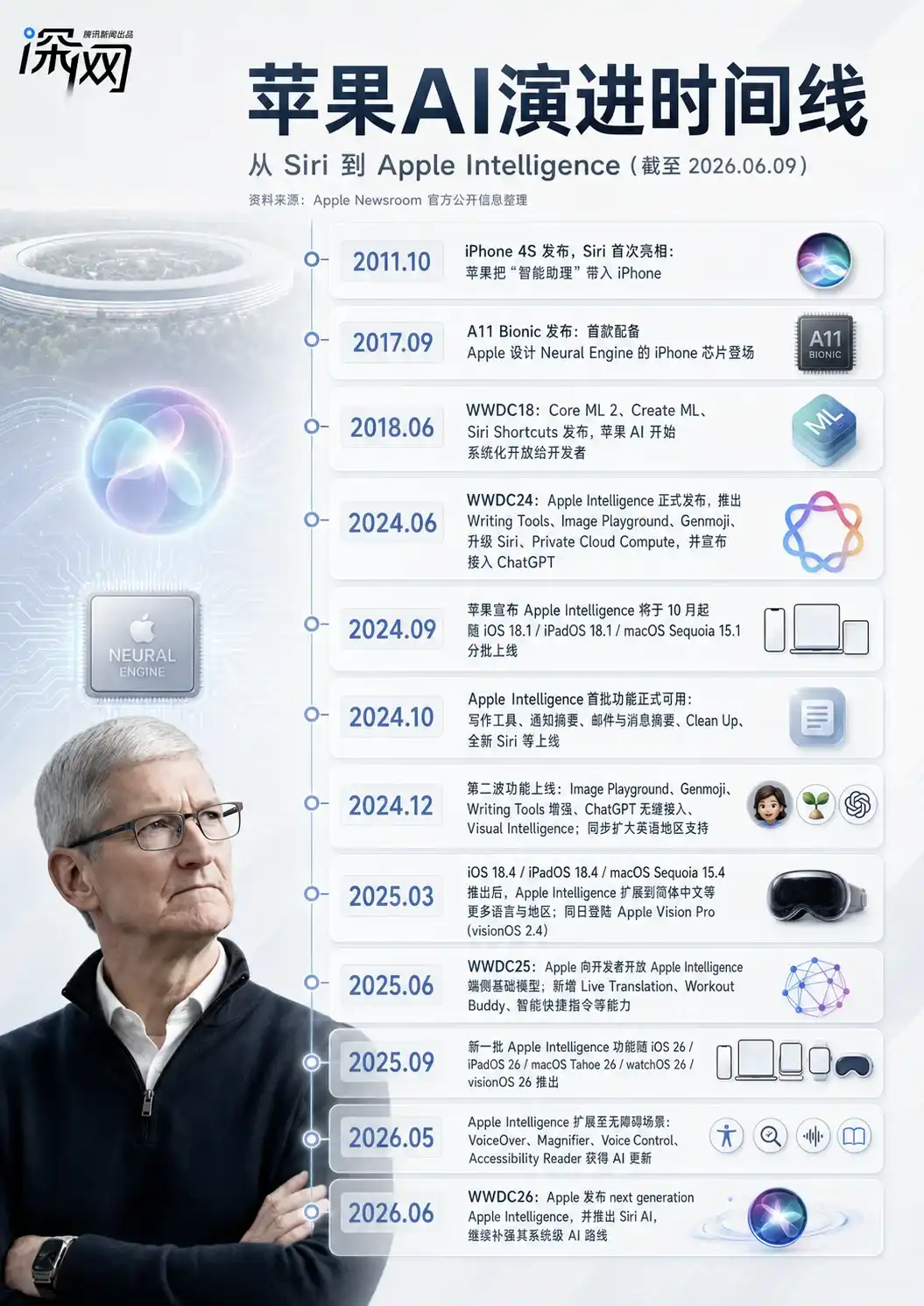
(AI-generated image)

Not Building the Strongest Model, But Cannot Lose the Gateway

In the view of several analysts, what Apple most wants to protect with this AI push is not the label of "strongest model," but the primary gateway on the iPhone.

A developer long focused on the Apple ecosystem believes Apple can accept that model capabilities come from external partnerships, can offload some computing costs to model vendors, but cannot accept users bypassing Siri and system services, directly using ChatGPT, Gemini, or Claude as the default gateway on their phones. What Apple wants to protect is that layer of system permission where users make requests, access data, and complete tasks.

This is also why Apple Intelligence repeatedly emphasizes on-device computing, private cloud computing, and personal context. Compared to simple Q&A, Apple cares more about whether AI can understand the screen the user is viewing, the information already on the device, and which apps can be invoked. The above-mentioned person judges that third-party large models can become increasingly powerful, but they cannot naturally access the deepest personal context within a user's phone, a part Apple is unwilling to give up.

Private cloud computing is therefore not just a technical solution but also related to commercialization. Federighi mentioned that some functions relying on server models would have daily usage limits, with iCloud+ users getting higher quotas. Several analysts thus speculate that Apple may tie high-cost AI features to subscription systems in the future, but the premise remains making users believe: data is not given to external model companies, and Apple has not sacrificed its privacy promises.

The gateway battle could also change App Store rules. Bank of America analyst Wamsi Mohan proposed that if Siri evolves into an AI agent, future app competition might focus less on downloads and usage time, and more on which service becomes invoked by Siri. Mohan estimates that if Siri successfully transforms into an AI agent, it could bring Apple $15 to $30 billion in incremental revenue by fiscal year 2030.

The concerns of the cautious camp are also clear. MoffettNathanson analyst Craig Moffett believes the market has already priced Apple Intelligence as a catalyst, not a potential risk. Apple's current valuation is above its five-year average. To support this valuation, it must prove that AI can drive a larger-scale device replacement cycle or translate into new service revenue. The capital market wants to see not just Siri becoming more useful, but whether AI can reignite Apple's growth curve.

Hardware gateways were originally seen as another undercurrent for Apple's AI. Multiple sources previously indicated that Apple had been advancing a series of wearable devices centered around Siri and visual perception, including smart glasses, pendant devices, and AirPods with cameras. They point in the same direction: if the AI gateway shifts from screens to vision, voice, and spatial perception, Apple cannot rely solely on the iPhone.

But progress on this path has not been smooth. According to multiple reports, Apple has adjusted part of its Vision hardware roadmap, shifting resources to lighter smart glasses; the AirPods with camera project, once thought to be near late-stage testing, later faced news of being shelved due to EU privacy compliance and supply chain adjustments.

An industry insider long tracking Apple believes what Cook leaves for the next CEO is a system logic that needs rewriting in the AI era. In the past, Apple could wait for technology to mature, then rely on integrated hardware and software to create a better experience. But the AI window doesn't entirely follow this rhythm; it requires continuous iteration, user habits, and faster organizational reactions.

Siri's original co-founder, Dag Kittlaus, remains optimistic. He told Bloomberg that as long as Siri gets a "brain transplant," Apple still has a chance to make it the user's first choice again. This sounds simple but points to Apple's core problem over the past decade-plus: Siri never lacked a gateway; what it lacked was being smart enough.


Related Questions

QAccording to the article, what are the main reasons for Apple's struggles in developing a smarter Siri?

AAccording to the article, Apple's struggles stem from a combination of factors: the company's history of 'deterministic management' which slowed its response to the generative AI race, internal instability with multiple leadership changes for the Siri team, technical difficulties where its own models weren't ready and couldn't run stably on devices, and a product culture that prioritized polish and reliability over rapid, iterative development demanded by AI advancement.

QWhat is Apple's new strategy for Siri AI, and which company's technology is it leveraging for the underlying foundation models?

AApple's new strategy involves a complete re-engineering of Siri into 'Siri AI', positioning it as an operational hub between the system and apps. It features screen awareness and the ability to perform tasks across applications. For the underlying foundation models (Apple Foundation Models), Apple is leveraging technology from Google, specifically the Gemini series models, to build its own models that run partly on-device and partly on private cloud servers.

QWhat major setback did Apple face with its initial AI push in 2024, as reported by the article?

AThe major setback was the delay and eventual non-release of the core Siri AI features that were initially demonstrated at WWDC 2024. The features, announced for the iPhone 16, were not delivered as promised. Internal tests reportedly showed the features were unstable, and the demos were largely pre-recorded prototypes. This led to Apple pulling related advertisements and facing lawsuits from disappointed customers.

QWhat is the article's perspective on the fundamental strategic priority for Apple in the AI era, beyond just having the best model?

AThe article argues that Apple's fundamental strategic priority is to defend the iPhone's 'first entrance' or the primary user interface. Apple is less concerned about having the most powerful model and more concerned about ensuring users do not bypass Siri and Apple's system services for third-party AI assistants like ChatGPT. Apple aims to retain the system-level permission to handle user requests, access personal data, and interact with apps, which is tied to its ecosystem control and potential future revenue.

QWhat challenges does Apple face in releasing its full AI features globally, specifically in the EU and China?

ADue to regulatory requirements, Apple's full suite of AI features, including Siri AI and the complete Apple Intelligence system, will not be immediately available to users in the European Union (EU) and Mainland China. Users in these regions will not be able to access the core AI updates announced at the time of the article's publication.

Related Reads

Y Combinator Co-founder: How to Make a Billion Dollars?

The Y Combinator co-founder argues that becoming a billionaire by founding a successful startup is not only possible but demonstrably achievable without unfair or unethical practices. He disputes a politician's claim to the contrary, using the example of a founder whose company grew at 93% monthly solely through creating a product users loved and recommended. The core mechanism is exponential growth. A conservative 15% monthly growth rate compounds to a 4384x increase over five years, which can easily lead to billion-dollar valuations and founder wealth. The process depends on two key variables: the growth rate and the duration it can be sustained. A high growth rate stems from a great product that users naturally promote, while a long duration requires a large enough market. For aspiring founders, especially young ones, the simplest path is to build something they and their friends genuinely need. Young people's current needs often predict future mass-market trends. He advises against actively "searching" for ideas, as this tends to filter out unconventional but promising ones. Instead, inspiration should come from working on interesting projects with friends, as many iconic companies (e.g., Apple, Facebook) started this way. Ultimately, building a massively valuable startup is not about exploitation but empathy: deeply understanding a user group and building a product that significantly improves their lives. This, powered by exponential growth in a large market, is the legitimate path to immense wealth creation.

Foresight News5m ago

Y Combinator Co-founder: How to Make a Billion Dollars?

Foresight News5m ago

The 800V Voltage Standard Championed by Nvidia: Which Infrastructure Providers Stand to Benefit?

NVIDIA is actively promoting the 800VDC architecture as a key direction for its next-generation AI factories and high-power racks, particularly for the upcoming Rubin and Kyber platforms. The primary driver is the rapidly increasing power density of AI racks, with designs like GB200/GB300 NVL72 reaching 120-140kW and future systems potentially hitting 180-220kW. At such high power levels, traditional low-voltage power delivery becomes inefficient due to massive current, leading to significant copper use, cable bulk, heat, and power loss. The 800VDC standard aims to increase efficiency by transmitting power at higher voltage and lower current to the rack before stepping it down locally for GPUs. NVIDIA claims this can improve efficiency by up to 5%, reduce total cost of ownership (TCO) by up to 30%, and cut copper usage by approximately 45%. This shift redefines infrastructure roles, pushing power engineering to the forefront alongside GPU performance. Key beneficiaries and ecosystem partners highlighted include: 1. **Power Infrastructure Providers:** Companies like Vertiv, Schneider Electric, Delta Electronics (台达电), and Korean firms LS Electric and HD Hyundai Electric are involved in designing next-gen AI factory power distribution, rack power supplies, and backup systems. 2. **Power Semiconductors:** Suppliers of SiC/GaN devices, such as Infineon and STMicroelectronics, are better suited for high-voltage, high-efficiency conversion in this new architecture. 3. **Connectivity & Structure:** The focus shifts to high-reliability components like busbars, high-voltage connectors, and advanced PCBs that meet stricter insulation and safety requirements. 4. **Liquid Cooling & Rack ODM:** As power and heat density rise, liquid cooling becomes critical. Full-rack system integrators (e.g., Dell, Wiwynn, Wistron) must now demonstrate robust pre-delivery testing capabilities, including burn-in testing under full load, requiring significant power and cooling infrastructure in their factories. The transition is not immediate for all data centers but is targeted at high-density AI factories. NVIDIA’s 800VDC ecosystem is in a preparatory phase, with full-scale production expected to align with the 2027 launch of Kyber rack-scale systems. The investment thesis revolves around which companies can demonstrate proven product integration, customer validation, and reliable delivery of complete, high-power AI rack systems, making power, cooling, and testing capabilities new critical variables in the AI infrastructure value chain alongside GPUs.

marsbit25m ago

The 800V Voltage Standard Championed by Nvidia: Which Infrastructure Providers Stand to Benefit?

marsbit25m ago

Did 'Unlimited Minting' Actually Happen? Zcash Founder Responds to Four Major Market Concerns

The Orchard shielding pool in the privacy cryptocurrency Zcash was recently found to have contained a critical counterfeiting vulnerability that existed for four years. This discovery caused significant market panic and a sharp drop in the price of ZEC, though it has since recovered partially. Zcash founder Zooko Wilcox addressed four key questions raised by the vulnerability. First, while it's unknown if the bug was exploited, he believes it likely was not, citing advanced, targeted discovery methods, a rapid response to freeze the pool, and the typical "smash-and-grab" nature of past crypto exploits. Second, he states that if no exploitation occurred, all legitimate user funds in Orchard are recoverable. However, cautious users moving funds should be aware of privacy trade-offs and other risks involved in transferring to transparent or Sapling pools. Third, users currently cannot independently verify that the total ZEC supply hasn't been inflated due to this bug. However, the proposed "Ironwood" network upgrade will restore this ability by permanently sealing the Orchard pool. This will prevent any counterfeit funds from circulating and allow anyone running a node to cryptographically verify that the supply cap has not been breached. Finally, regarding other undiscovered vulnerabilities, Wilcox notes that intensive ongoing audits by multiple teams, including using advanced AI-assisted tools, have so far found no other counterfeiting bugs. This provides increased, though not absolute, confidence. In conclusion, while assessments suggest the bug was likely unused and funds are safe, the core issue was the loss of user-verifiable supply integrity. The Ironwood upgrade is presented as the solution, aiming to restore trust by allowing users to independently verify Zcash's supply security without relying on third-party assurances.

marsbit26m ago

Did 'Unlimited Minting' Actually Happen? Zcash Founder Responds to Four Major Market Concerns

marsbit26m ago

The First Prediction Market Stock Has Emerged!

"Prediction Market Unicorn Emerges!" While the World Cup drives record trading volumes in prediction markets, the industry leader Kalshi faces a new threat from a former key ally. In March 2025, Kalshi partnered with online broker Robinhood to offer prediction market services, allowing users to bet on events. This deal was mutually beneficial: Kalshi gained access to Robinhood's massive retail user base, with an estimated 25-35% of its volume coming through this channel, while Robinhood earned significant fees, reporting a 320% year-over-year increase in "other transaction revenue" to $147 million in Q1 2026, largely fueled by prediction markets. However, Robinhood's ambitions have grown. Recognizing that its user base and distribution power are the scarcest resources, it initiated a plan to bring operations in-house. In late 2025, Robinhood partnered with Susquehanna to acquire CFTC-regulated exchange MIAXdx, renaming it Rothera Exchange. By June 2026, Robinhood launched its own prediction market product on Rothera, strategically using the World Cup as a launchpad. Initial data shows Rothera processing tens of millions of contracts within days, directly siphoning volume away from Kalshi. This shift marks a pivotal moment: control is moving from the market infrastructure provider (Kalshi) to the entity controlling user distribution (Robinhood). The story illustrates a recurring internet era dynamic: "He who controls distribution controls everything." As more platforms with large user bases recognize the value of prediction markets, the industry's future competition may center less on which platform has the best market technology and more on which one owns the user gateway.

marsbit38m ago

The First Prediction Market Stock Has Emerged!

marsbit38m ago

More Popular Than SpaceX, Oversubscribed Over 6,586 Times, What's the Meme Power Behind Liuliu Mei (06658.HK)?

Liumeimei, a popular Chinese snack brand known as "Liuliumei" in China, listed on the Hong Kong Stock Exchange (stock code: 06658.HK). On its debut, the stock price surged dramatically, opening 116% above the issue price and peaking with gains over 190%. This surge is widely attributed not to its traditional consumer goods business, but to a "Meme stock" phenomenon. Its stock ticker abbreviation "LLM" coincidentally matches the acronym for "Large Language Model," the core technology of the ongoing AI boom. This association, coupled with a strong same-day performance by another AI-related stock, triggered a massive wave of speculative retail investment. The IPO itself saw extreme oversubscription in the public offering segment, exceeding 6,586 times, though retail investors were allocated only 10% of shares. Analysts and the article frame this event as part of a broader "stock Meme-ification" trend in global markets, where stocks can experience volatile price movements based on viral narratives, wordplay (like homophones or abbreviations), celebrity mentions, or fleeting social media attention—similar to dynamics seen in the cryptocurrency meme coin sector. Examples cited include the 2021 GameStop saga, stocks linked to political figures like Donald Trump, and other companies benefiting from AI hype or谐音梗 (homophone puns). While such trends can create significant short-term wealth for some, the article notes they also carry risks of market manipulation, "pump and dump" schemes, and investments detached from fundamental business value. The Liumeimei listing is presented as a prime example of how attention and internet culture are increasingly driving capital flows in modern financial markets.

marsbit40m ago

More Popular Than SpaceX, Oversubscribed Over 6,586 Times, What's the Meme Power Behind Liuliu Mei (06658.HK)?

marsbit40m ago

Trading

Spot
Futures

Hot Articles

How to Buy 4

Welcome to HTX.com! We've made purchasing 4 (4) simple and convenient. Follow our step-by-step guide to embark on your crypto journey.Step 1: Create Your HTX AccountUse your email or phone number to sign up for a free account on HTX. Experience a hassle-free registration journey and unlock all features.Get My AccountStep 2: Go to Buy Crypto and Choose Your Payment MethodCredit/Debit Card: Use your Visa or Mastercard to buy 4 (4) instantly.Balance: Use funds from your HTX account balance to trade seamlessly.Third Parties: We've added popular payment methods such as Google Pay and Apple Pay to enhance convenience.P2P: Trade directly with other users on HTX.Over-the-Counter (OTC): We offer tailor-made services and competitive exchange rates for traders.Step 3: Store Your 4 (4)After purchasing your 4 (4), store it in your HTX account. Alternatively, you can send it elsewhere via blockchain transfer or use it to trade other cryptocurrencies.Step 4: Trade 4 (4)Easily trade 4 (4) on HTX's spot market. Simply access your account, select your trading pair, execute your trades, and monitor in real-time. We offer a user-friendly experience for both beginners and seasoned traders.

4.3k Total ViewsPublished 2025.10.20Updated 2026.06.02

How to Buy 4

Discussions

Welcome to the HTX Community. Here, you can stay informed about the latest platform developments and gain access to professional market insights. Users' opinions on the price of 4 (4) are presented below.

活动图片