Author: DAN KOE
Compilation: Yuliya, PANews
Editor's Note: If you blindly believe the panic-mongering on social media, you might think "all jobs are about to be replaced by AI." Many people slap an "anti-AI" label on themselves, trying to mask their unwillingness to change and refusal to grow with online outrage.
However, AI is not the biggest threat. The real crisis is completely outsourcing your survival and happiness to others. When technological change arrives, if you still naively believe that others should be responsible for your future, you are destined for a major disappointment.
Whining won't control the AI behemoth. Posting complaints online about how much you hate AI won't stop jobs from being replaced, and it absolutely will not stop the shift in the core skills required for success in this era of constant technological development. This article explores how to escape the fate of the "wage slave" and find meaningful ways to work. Below is the original text:

I. How to Escape the Fate of the Wage Slave
To put it bluntly, "wage slavery" (the fate of the worker) is being forced to do meaningless, soul-crushing work for someone else just to put food on the table.
Don't get me wrong, I'm not anti-job.
I think a job is a great launchpad, allowing you to accumulate practical experience and learn real skills.
But every time I say something "negative" about jobs, a bunch of people jump out to criticize me: "You don't know anything! I actually like my job!"
That's fantastic. This isn't directed at you (and deep down, I have a sneaking suspicion that you're probably deceiving yourself to avoid digging into your own potential, and you haven't even realized it yet).
I'm talking to those who truly understand the "psychology of enjoyment." Because they simply cannot tolerate this life script: one-third of your life spent doing work you have no choice over, one-third spent mentally paralyzed and unable to do anything meaningful, and the final third sleeping... for over 40 years.
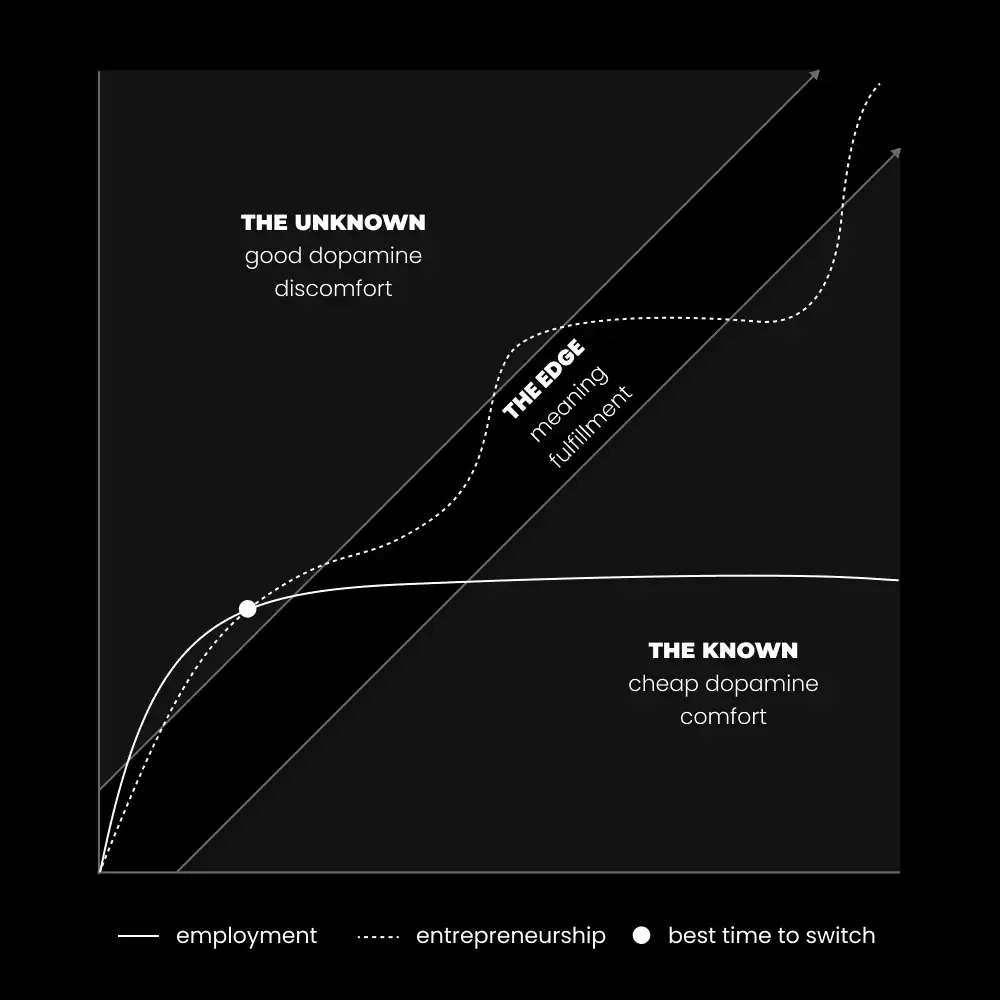
You see, real fun, meaning, and a sense of accomplishment actually lie at the edge of your competence. There's scientific evidence for this. Don't expect me to cite sources here. Enjoyment comes from tackling challenges that are *just slightly* above your current skill level. Not too hard, or you'll get anxious; not too easy, or you'll get bored. Video games have perfected this. The quests you take are always "just the right difficulty," because if you, a level 1 newbie, try to fight a level 100 boss and get instantly killed, you'll delete the game. This is the strongest driver to get you into a flow state. If you can design your life to be flow-triggering, you'll have plenty of fun.
The problem with a job is that after a few months, you've figured it all out. It's clock in, work, clock out. You start to feel utterly bored. This goes against your nature, and you feel it internally. Your attention drifts away from the work and starts wondering: "What else can I do?" For most people, this "what else" is definitely not some grand, meaningful goal; it's pulling out their phone and rotting their brain with short-form videos. Very few jobs require you to constantly level up and take on bigger challenges.
Career progression is beneficial, but again, you don't control the difficulty of the challenge. After all, you're not working on your own project. Curiosity, passion, purpose, autonomy, and mastery — these five engines of flow — are inevitably running on empty.
So how does this relate to wage slavery?
At its core, human civilization is built on tribes enslaving other tribes. That underlying logic has never disappeared; it's just been repackaged into modern employment, laws, and culture. Today's society is essentially a giant pyramid scheme. There are always more people at the bottom than at the top; mathematically, not everyone can be the boss. One boss leads a group of employees, and the employees, to survive, have to cling tightly to the boss's leg.
Our generation was largely mass-produced by assembly-line education: be an expert, master a single skill, get a high-paying job so your parents can show off to relatives. Because you obediently followed along, you remained completely ignorant of how the business machine actually works. You mastered the skill of tightening screws but never learned how the system that pays you actually operates. You didn't spend time in other areas, so you have no idea how to start your own thing. All you know how to do is play the role of a worker bee in someone else's venture.
Unknowingly, your ability to think independently is crippled, even if you're considered "smart" in your field. You have a decent salary, but you feel insecure and financially trapped, sucked into a stressful cycle of overwhelm. Stress narrows your vision, making it harder and harder to imagine a life of working for yourself.
You have no seed money to pursue a dream, no time for self-improvement. You're probably already exhausted (mentally, not physically), with no energy left to reinvest in yourself, because most of your waking hours are spent helping someone else achieve *their* dream.
By the way, the only way to survive the full-scale AI replacement wave is: go work on your own thing.
The sad part is that slaves often don't know they are slaves. This goes far beyond just wage slavery. We are all slaves in some way, usually to ideas and belief systems.
When you think of slavery, you imagine someone being forced at gunpoint. But wage slavery is financial. If your life falls apart if you don't show up for work one day, and you have no other way to make money, then no matter how "good" you feel about it, you perfectly fit the definition of a slave.
Worse, if you've internalized "I am an employee" into your DNA, you might even feel attacked by what I'm saying. Your defense mechanisms will kick in, you'll want to argue—and that's fine, but it just proves my point.
I think you get the idea. It's a bitter pill to swallow; it makes me sick to think about it. So let's talk about the way out now and what you can actually do about it.
II. The Five Core Ingredients of Success
If you don't set your own pace for life, someone else will set it for you.
Most people, for the majority of their lives, are forced to learn things they don't want to learn, to get a job they don't care about, and to work alongside people they wouldn't willingly spend time with outside of work.
While I think AI, technology, and social media have accelerated our awakening to the fact that school and a job aren't the only ways to live, I also think people are just plain tired of the overwhelming sense of meaninglessness in the world around them.
For those who are already tired of going through the motions, to make yourself "anti-fragile"—able to do meaningful work even if all jobs disappear—you need to master these five core ingredients:
-
Agency: The ability to take action without asking for permission. It's about seizing an opportunity when it presents itself, even when no one told you to.
-
Taste: The experiential intuition of "I know it when I see it" when something is worth putting out into the world or if it's just embarrassing.
-
Persuasion: The ability to get others to buy into what you're doing, not through manipulation.
-
Persistence: Understanding that messing up isn't the end of the world, and that trial and error is a necessary part of the process.
-
Iteration: The process of course-correcting based on feedback to move toward a goal (if it doesn't work, learn and adjust direction until it does).
Everyone is obsessed with being a "high-agency" person these days. I get it, it's important. All the tech bros are mimicking each other, talking about how important high agency is, which ironically exposes their lack of it.
Yes, you absolutely need the initiative to take action toward a goal. That's one of the fundamental differences between a boss and an employee. An entrepreneur, by definition, is someone who builds something nobody asked them to build.
But that's only one piece of the puzzle.
The five ingredients above can actually be boiled down to two skills: problem-solving ability, and the accumulation of experience that tells you what to do.
So far, AI has been exceptional at asset creation, but creating hits is not the same as asset creation. Asset creation is a necessary but insufficient condition for hit-making.
"Just like 5 years ago, anyone could build a video game last week. The technology is there; it's completely commoditized. Do you know how many mobile games are released each year? Tens of thousands. Do you know how many hits come out each year? 0 to 5."
— Strauss Zelnick
Now anyone can build anything, which means the barrier to entrepreneurship (the antidote to the wage trap) is plummeting even faster, but so what:
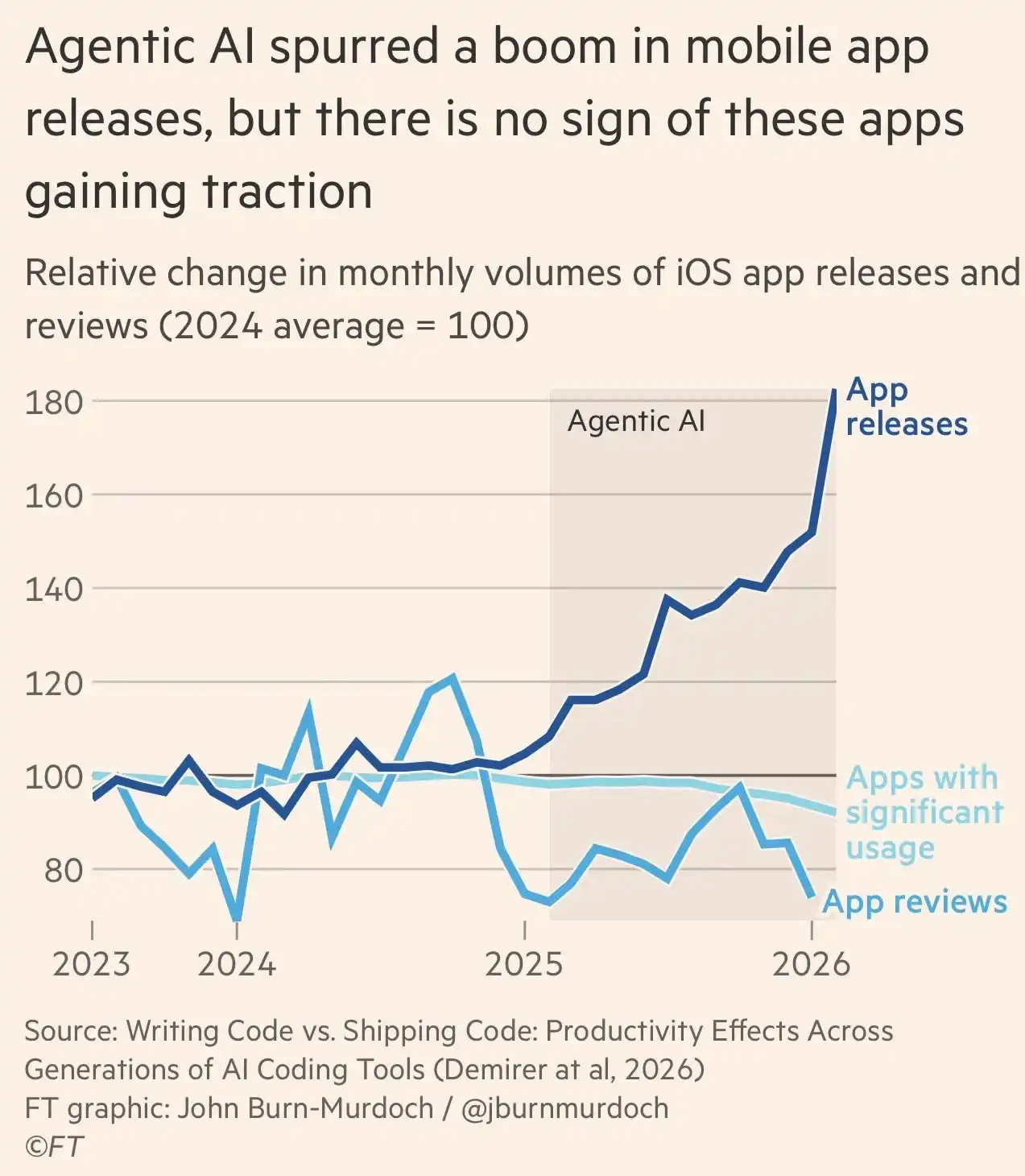
You can go build an app right now. Not the next Notion, but a manageable, focused app or tool for an expected outcome people actually benefit from. Something that doesn't have to be a hit to be valuable.
I actually highly recommend this; I think software is the next generation's "info-product." What I mean is, building software will become the default choice for creators, solopreneurs, and other one-person businesses. Info-products were popular for so long because the barrier to entry was low—anyone could do it—but that didn't mean anyone could make money from it.
The diagram above illustrates the first problem.
You can build anything, but that doesn't mean (1) it's worth building; (2) anyone will care; (3) you have the chops to persist, iterate, and grind based on market feedback until it becomes something worth building that people care about.
If you truly understand this, you will be successful.
The second problem is: agency, taste, persuasion, persistence, and iteration are not "high-value skills" you can learn from a few YouTube tutorials. Watching motivational posts about how to increase your agency every day won't give you an ounce more agency.
The only way to practice is to start working on your own thing. Now.
III. The Antidote to a Job is to Make Yourself "Unemployable"
I still remember the day I landed my first web design freelance gig.
I remember being given $300 to hand-code a basic website. The client was a mattress store, and they just wanted a place online where people could see their mattresses.
That was it.
$300.
That was the moment it clicked for me. I knew deep down that if I could repeat, optimize, and iterate on what I just did for money, I could take control of my lifestyle and future direction. It made me completely "unemployable." I developed a complex where I knew I could never work for someone else again; I had to build my own thing—sounds cheesy.
But that $300 didn't account for all the build-up to that moment—the shift in identity and how I initially tricked myself into believing it was possible. And it certainly didn't account for the 7 years of trial and error that followed.
I want to give you two things: one is to guide you through the identity shift, to become "unemployable" at your core, not just think it sounds cool; the other is a step-by-step plan that anyone can adapt to their own path.
1) Throw Yourself Into an Environment That Forces You to Grow
The fastest way to change your life is to uproot yourself from your current environment (both physical and digital). Overnight. Completely reinvent. Change the places you go, the creators you follow, the content you consume... all of it. It's uncomfortable, but incredibly effective.
Change Behavior = Change Identity.
It's like saying you're going on a diet to lose 50 lbs, but if you don't actually care about health and hate living that lifestyle, you'll always feel like you're swimming upstream. You'll end up like most people, gaining all the weight back, unless you become a completely new person at your core.
So how do you do it?
First, it helps to understand how you got to be the way you are today.
-
You were born into a family and culture with specific values.
-
You were indoctrinated with these values, even if your parents didn't hold a gun to your head.
-
You went to schools with specific values, taught by teachers with specific values.
-
You're bombarded with massive amounts of information that can pull you toward rebellion, apathy, or victimhood.
-
Once you got a phone, the indoctrination process was accelerated due to social media algorithms and our primitive, stimulus-driven brains.
There's more to it, of course, but you get the point.
This isn't all bad; sometimes it's necessary. I hear all these gurus who say "be yourself" and how much they hate "copying" and plagiarism, yet they still walk on two legs and speak English. Why? Because that's what humans do. You're copying. It's called learning.
But it becomes problematic when your behavior is in opposition to the life you deeply desire to live. There's a voice inside you that whispers, "I was meant for something more."
To reprogram yourself, you have to start with your environment.
You must be hyper-aware of every single stimulus around you because it is shaping you every moment.
What you do is this: Go to sleep tonight, and flip the switch tomorrow.
Wake up tomorrow and do not repeat yesterday's routine, even for just one day. Set your alarm for a different time. Plan every single thing you do after waking up. Eat something different. Talk to someone you wouldn't normally talk to. Consume content you would never consume. A full-spectrum overhaul.
As you learn more, you'll start to figure out which direction to tailor your new environment toward.
2) Choose a Vehicle That Gives You the Most Honest Feedback
The most dangerous way to live is to insulate yourself from making mistakes.
Once you stop experiencing the process of messing up, you remove challenge, exploration, and hard-won wisdom—the very things that lead to growth and a sense of achievement.
This doesn't just apply to jobs where the challenge plateaus after you learn the ropes. It applies to business and entrepreneurship, and even to business owners who can't shake the employee mindset: always needing someone to tell them what to do, or needing a manual to feel confident in their own steps.
Let me ask you a question:
Before the internet, before the massive availability of "how-to" guides and step-by-step processes, how did people figure things out? How was the first rocket built?
They tried. They failed. They didn't let failure convince them it was impossible, nor did they give up and scroll for dopamine hits when they hit a wall. They set a new direction based on the feedback reality gave them. Eventually, they found the needle in the haystack.
*They* were the intelligent ones.
Because the most significant characteristic of an intelligent system is: the ability to course-correct based on feedback. They had a lighthouse, and when the winds blew them off course, they didn't choose to abandon ship.
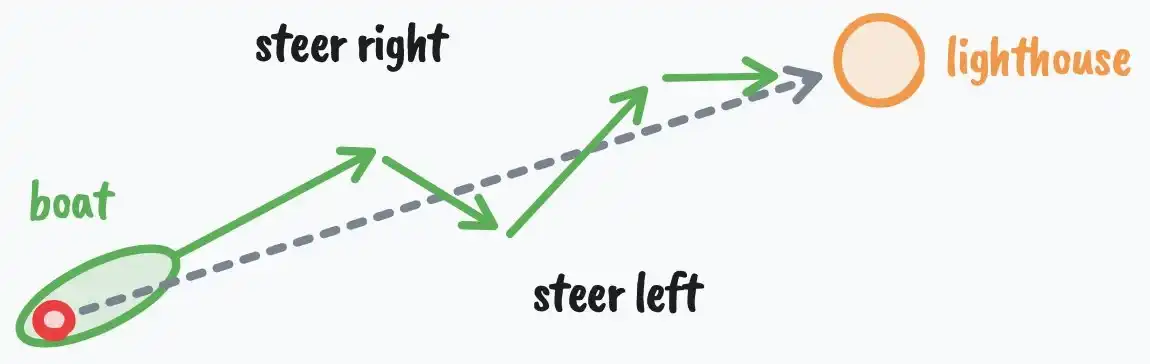
This is what I mean when I talk about entrepreneurship.
I'm talking about embracing your raw, primal nature. To create. To pursue unknown goals that are guaranteed to knock you on your ass a few times.
This is the single common trait among almost all successful people.
To them, failure isn't a dirty word; it's a necessary part of the journey to a life worth living.
That sounds inspiring, but in today's world, how do you actually implement this?
3) If You Want to Thrive in the Future, You Must Master One of These Two Crafts
"Code and media are the ultimate permissionless leverage. They are also the secret weapons behind the new rich. You create software and media, and they work for you while you sleep."
— Naval Ravikant
As a beginner, as an individual, you have no idea the insane leverage you hold, especially with AI today.
And I'm not talking about low-level users who use ChatGPT like Google, or artists complaining because AI "copied" their work.
I'm talking about the realization that you can build *anything* because AI has catapulted you into the fast lane of trial and error. Yes, the initial outputs will be garbage, but if you have agency, can iterate, are persistent, develop taste along the way, then you're literally limitless, and this trend will only intensify. Then, if you have a bit of persuasion skill, the thing you build can make money for you while you dream.
Of course, this was possible before AI. The core issue is that most people don't understand the principle: if you have the 5 ingredients of success and a long enough timeline, there's nothing you can't do. AI just gives you an accelerator, allowing you to do more, faster, and grants you superpowers you never dreamed of—like the ability to code, and turbocharged learning and research efficiency.
That said, I genuinely believe understanding media (content) is more valuable than understanding code.
By media, I mean content creation.
Text, video, podcasts, or articles—you publish once, and it can be seen by thousands, millions, even hundreds of millions. In my opinion, this is the most valuable job security for the future, especially when the entire internet is racing to automate content with AI.
Because with content, you need the taste to know what "good" is.
You still need to accumulate the wisdom AI can't give you, because you haven't even started the trial-and-error process. You don't even know what prompts to give the AI.
The value of content is highly subjective. Beauty is in the eye of the beholder. In other words, with content, there is no "right answer."
Code, on the other hand, has objective value. As long as the program runs, nobody cares how you wrote it. As discussed earlier, there are more apps in app stores than ever before, yet downloads and usage are plummeting.
Why?
Because they have no idea how to distribute! They know nothing about media and content. They can't even convince people to download it, let alone make them feel it's good enough to pay for.
By the way, when I say content creation, I'm not talking about the Instagram gimmick guys bragging: "I gave my account to Claude, went to sleep, and woke up with 100k followers." That kind of traffic is worthless unless you're using storytelling and building authority to connect with an audience. Sure, you can use tools like Eden for this, but you need to know what game you're playing.
As JK Molina says: Likes don't pay the bills.
Advanced content creation is absolutely not about posting thirst traps or rage-bait for attention.
Oh, and in case it hasn't sunk in yet: the new environment you force yourself into for identity reprogramming should be filled with people, communities, and habit triggers related to the life you want to live. Creating content is part of that game.
IV. How to Start: 15 Minutes a Day to Rewrite Your Life's Trajectory
You've already taken the drastic step of overhauling your environment. You've chosen your vehicle. You understand that content is more valuable than code because its value is in the eye of the beholder. This subjectivity will cause assembly-line AI articles to become worthless, opening up a massive playground for real creators—whether they use AI assistance or not, because again, AI was never the core issue.
Now, you only have one, most critical question left to answer: What do you want to build with your life? (i.e., your life's work)
That's the stage we're building together. We're building a life's work, not a flimsy "personal brand."
Peterson, Huberman, Watts—sure, they have "personal brands," but those labels are inextricably linked to their ultimate goals. They knew what they wanted, and they used social media as a tool to achieve it. Because that playbook, combined with AI, is the biggest leverage you have as an individual right now. After all, if you're starting from scratch, you probably won't get far with TV, radio, or traditional publishing houses.
*Note:
Jordan Peterson is a Canadian clinical psychologist, professor of psychology at the University of Toronto, and a well-known cultural critic. He has gained global influence for his insights in personality psychology and his public speeches on personal growth and social trends online.
Andrew Huberman is a prominent American neuroscientist and a professor in the Department of Neurobiology at the Stanford University School of Medicine. He has made significant contributions in areas like brain development and neuroplasticity.
Alan Watts was a British philosopher, writer, and speaker. He called himself a "philosophical entertainer," dedicating his life to interpreting and popularizing Eastern philosophies like Zen, Taoism, and Hinduism for the Western world.
Their personal brand is the person themselves.
It's their identity.
If you want to see what your identity looks like, go run through Eden's onboarding process. It will literally generate a relationship map you can explore.
Most people love this concept but get stuck almost immediately. They chase dopamine, googling "which niche videos make $10k/month easiest," but refuse to dig into the experience and stories they've accumulated over the years—simply because it feels too ordinary to them, so they assume no one would care.
The raw material for building your life's work is already in your head. It's just been paved over by years of being told to "specialize," "be realistic," and "stop asking so many questions." This process isn't about feeding you new ideas. It's about showing you what you already have.
Take this seriously.
Close your distracting tabs. Open a blank document. Set a 15-minute timer. Write down your answers to each of the following questions. Do not skip any question that makes you uncomfortable.
Step 1: Unearth Your Raw Material
What made you unique was smoothed out by rules. Your curiosity was labeled as distraction. Your interest in many things was called a lack of focus. Because the system needed a compliant worker.
Your content will only be interesting if it's extracted from your own bones and blood.
Answer the questions below. If you can't think of an answer immediately, skip it and let the question simmer in your subconscious:
-
What do you know so much about that it can't be an accident? What topic would you research for years, digging through dozens of sources, even if you made zero money from it?
-
What have you solved that you assumed everyone else had already figured out? What comes naturally to you that seems to stump others?
-
What did you get in trouble for as a kid, but it was actually just an early expression of your interests? What were you obsessed with before you were told it wasn't practical?
Now, circle one answer. The one that stirs something in you. That's your raw material. Forget about niches, content pillars, etc. Care about the quality of your thought, because that's what wins in the end.
Step 2: Find Your "Contrarian" Edge
Nobody needs another person repackaging common sense. Your content needs a unique perspective only you can see. This perspective comes from something you believe that the mainstream gets wrong. Taste isn't just about knowing what's good. It's about seeing what's broken and being unable to look away. Answer these questions:
-
What piece of mainstream advice actually made your life worse? What old belief did you have to let go of to get your life back on track?
-
What do you believe about your field so strongly that even if experts called you naive, you wouldn't budge?
-
In your industry, what is everyone pretending not to see?
Look at the answers from Step 1 and Step 2 together. Where they overlap is your direction. Your answers to these questions are your first batch of posts. The best brands are the public release of a person's internal world for others to explore.
Step 3: Publish Your First Idea Tomorrow
This is a letter, not a course. I wish I could cram 20 modules in here, but I can't; that's for a bootcamp. The final step to freeing yourself from financial dependence on others is to actually take action, and real action starts with publishing your first post.
From the previous step, you have post ideas written down. Pick one.
Think about how to make the opening attention-grabbing.
Think about how to phrase the body for impact.
Embrace the reality that the first version will absolutely suck, but you can't improve something that doesn't exist.
If you want a bit of help, here's a prompt/technique to help you brainstorm different angles and draft different versions, giving you an intuitive feel for what "good" content looks like. These are built on proven frameworks. We discussed this in the "Growing on social media is simple" letter.
Your task is incredibly simple.
Take one answer from Step 1 and one answer from Step 2. Combine them into a single sentence only you could write. Then publish it tomorrow as your first piece of content. A post, a video, a newsletter. The format doesn't matter right now.
Now, you have real feedback from reality.
If it doesn't perform well, great, you have something to learn. You have to research, find a persuasion technique you can try in the next post, and the next, until you master the skill, because skill acquisition is the stacking of techniques when you encounter problems.
If you're the type of person saying, "I wish this was more practical," right now, you're being blind. I've given you the formula to do anything. And you just received feedback from your own brain, but you didn't recognize it as an error to correct.