Ethereum Reaches the Milestone of One Million Developers, Sharplink CEO Delves Deep into Ethereum's Future Possibilities

Foresight NewsPublished on 2026-06-16Last updated on 2026-06-16

Abstract

Ethereum Surpasses One Million Developers Milestone: A Look at Its Unshakeable Dominance and Future Joseph Chalom, CEO of Sharplink, reflects on his recent Asia trip where he engaged deeply with Ethereum developers and ecosystem leaders. The most striking takeaway was not just the industry's vibrancy, but the rigorous, long-term vision of local builders. This context brings to life a pivotal statistic: Ethereum has now surpassed one million cumulative developers (1,012,824), with approximately 232,000 remaining active in the past year—a talent pool unmatched by any other crypto ecosystem. The critical question isn't which blockchain is fastest, but where top developers choose to build long-term. Ethereum's answer is unequivocal. Its decade-long lead stems from a unique convergence of technology, institutional culture, economic systems, and composability, cementing its role as the foundational operating system for programmable finance. This massive developer base is tackling the industry's hardest problems, continuously strengthening Ethereum's moat. Key initiatives include: * **The Glamsterdam Upgrade (planned 2026):** Introducing ePBS and Block-level Access Lists for parallel execution and higher throughput while preserving core values like credible neutrality and fair MEV distribution. * **Synchronous Composability:** Projects are working to enable atomic transactions across dozens of Rollups, making them function as one unified chain and eliminating ecosystem fragme...


Author: Joseph Chalom, Sharplink CEO

Compiled by: Saoirse, Foresight News


I just concluded my Asia tour, during which I engaged in in-depth discussions with Ethereum developers and ecosystem leaders. Special thanks to the teams at Nonce Classic, Four Pillars, and DSRV in Seoul, as well as our partners at SNZ, and the newly established Hong Kong Ethereum Community Hub. Supported by the Ethereum Foundation, this hub is Asia's first permanent, physical offline Ethereum community.


What struck me most during this trip was not only the vibrant atmosphere of the industry but also the meticulous, pragmatic attitude and ambitious vision of the local builders. The global Ethereum ecosystem is teeming with high-quality projects, innovative experiments, and long-term strategic thinking, which moved and inspired me deeply.


A set of data also came alive through these offline interactions: According to data provided by Electric Capital, the total number of cumulative contributors to Ethereum has exceeded one million, specifically 1,012,824 individuals; no other ecosystem in the crypto industry comes close.


A Milestone Worth Noting


Although a million is a round number, and many such figures can be hollow, this statistic is profoundly significant. Behind the number lies the world's largest and continuously expanding pool of technical talent, gathered by a global, open, permissionless blockchain network. More crucially, the scale and professional depth of this talent pool are still growing.


Of these one million developers, approximately 232,000 remained active in development over the past 12 months.
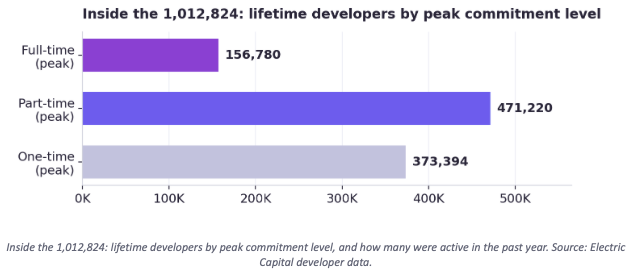

Ethereum's cumulative 1,012,824 developers: Full-time peak 156,780, Part-time peak 471,220, One-time participant peak 373,394. Part-time developers constitute the largest proportion of the total group. Source: Electric Capital


Why Ethereum? This is the Truly Critical Question


For a long time, discussions within the crypto industry have revolved around transaction speed, fees, and throughput. Every emerging public chain claims to be "faster than Ethereum." However, the most critical question in the crypto space has never been which chain has the best performance, but another core inquiry:


On which chain will top-tier developers choose to build and innovate for the long term?


On this point, Ethereum stands alone, irreplaceable. Its advantages extend beyond the technical layer, encompassing institutional, cultural, economic, and composability dimensions. This is the result of a decade-long accumulation of developers, infrastructure, industry standards, development tools, liquidity, academic research, various applications, and collaborative efforts within the industry—a complex ecosystem that others cannot replicate.


Ethereum has already become the underlying universal operating system for programmable finance and the issuance of native on-chain assets.


What Are the Million Developers Building Now? And How Are They Continuously Fortifying the Industry's Moat


The value of the million-developer community is primarily reflected in the industry's most challenging and far-reaching problems they are tackling today: underlying protocol scaling, privacy technology, post-quantum security, and the future intelligent autonomous systems that will run on-chain.


The Glamsterdam Upgrade: Innovating While Upholding Core Foundations


The Glamsterdam upgrade, planned for 2026, perfectly illustrates how Ethereum innovates while adhering to its core values. The core changes in this upgrade include the standardization of the proposer-builder separation mechanism (ePBS) and block-level access lists (BALs). These will enable parallel execution, significantly increasing network throughput. Additionally, there are plans to raise the gas limit, substantially enhancing the capacity of the Layer 1 mainnet.


While meeting future market scaling demands, it ensures network credibly neutrality, security, stability, and fair MEV distribution—this is a clear manifestation of Ethereum's continuously strengthening moat.


Synchronous Composability: Making Dozens of Rollups Feel Like a Single, Complete Public Chain


Composability has always been Ethereum's trump card, and the next breakthrough is extending this capability to all Layer 2 networks. Native, foundational Rollups combined with synchronous composability can solve the problem of ecosystem fragmentation: within a single atomic transaction, a smart contract on one Rollup can directly call a contract on the mainnet or another Layer 2 network, without cross-chain bridges or waiting periods.


Teams like Linea, the Ethereum Economic Zone, Gnosis, and Zisk, in collaboration with the Ethereum Foundation, are advancing related research and development, integrating this architecture with real-time proof technology. The final result will be: dozens of Rollups are no longer isolated networks but merge into one, directly addressing external skepticism about Ethereum's ecosystem fragmentation.


Post-Quantum Security: Ethereum's Most Prominent Leading Track


No other major public chain ecosystem has prepared for the post-quantum era's security framework as proactively as Ethereum. Relying on the "Purge Ethereum" development roadmap, the dedicated Post-Quantum Security Working Group established by the Ethereum Foundation in early 2026, the official website pq.ethereum.org, and over a dozen client teams running weekly post-quantum interoperability devnets, an open-source collaborative migration plan has taken shape, aiming for completion around 2029.


Once quantum computing poses security risks, institutions managing trillions of dollars in custodial assets will focus on one thing: which public chain was the earliest and most comprehensive in its protective preparations.


Moat Beyond Developers: Composability, Unified Standards, and Industry Trust


Ethereum's developer talent advantage will continue to compound, rooted in its underlying architectural design. Its most critical network effect is not liquidity, but extreme composability: applications like lending, stablecoins, exchanges, wallets, tokenized assets, oracles, and Layer 2 Rollups function like freely combinable financial building blocks, interoperable through unified industry standards, allowing developers to avoid building entire systems from scratch.


The EVM is the crypto industry's universal application layer, and the Solidity programming language is applicable across hundreds of networks like Base, Arbitrum, Optimism, Polygon, ZKsync, Scroll, and Linea.


Mastering Ethereum development maximizes development options, creating a virtuous cycle: more developers enter → supporting tools continuously improve → market liquidity increases → institutions continue to enter → attracting more developers to build interoperable protocols and assets. Liquidity begets more liquidity, and composability amplifies the advantages of composability.


Ethereum firmly occupies the core position for value accumulation, not just short-term on-chain activity.
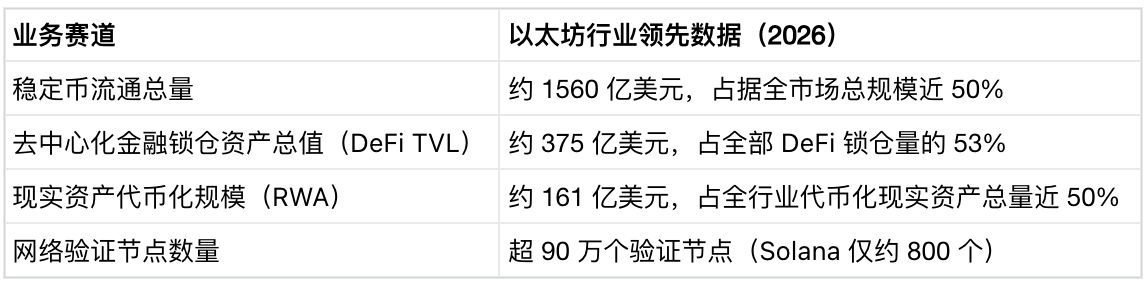


Three core advantages continue to widen the lead:


  • Credible Neutrality: Ethereum has over 900,000 validator nodes, while Solana has only about 800. This highly decentralized, neutral, and unbiased platform attribute is a core trait highly valued by large financial institutions;
  • Modular Architecture: Rollups like Base, Arbitrum, and Optimism do not fragment the Ethereum ecosystem; instead, they expand it into an interconnected, modular on-chain economy where all Layer 2 networks can inherit the mainnet's security guarantees;
  • Industry Ecosystem Culture: Ethereum gathers the industry's top researchers, cryptographers, and EIP standard-setters. This group defines the direction of the entire crypto industry. This cultural barrier, formed through the accumulation of talent, is difficult for any forked project to replicate.


The Uniqueness of Ethereum


There's a world of difference between merely generating short-term on-chain activity and becoming the long-term coordination layer for global native finance, earning the trust of leading financial institutions. In the minds of the largest asset-holding institutions, Ethereum holds an absolute mainstream position. These institutions prioritize security, trust, and liquidity most highly. I witnessed this industry trend firsthand during my previous tenure at BlackRock.


The law of technology industry development is: In the long run, ecosystem resources converge towards unified standards, sufficient liquidity, and developer consensus. This is precisely Ethereum's impregnable moat.


After meeting with local developers, builders, and ecosystem leaders in Seoul and Hong Kong, I am more convinced than ever of Ethereum's competitive advantages. I met the top talent building the next generation of financial infrastructure—the future entrepreneurs of the industry, the designers of intelligent autonomous financial systems. It is precisely these teams and practitioners who will reshape the entire world.


Ethereum's future is happening right now.

Related Questions

QAccording to the article, what is the current total number of developers who have contributed to Ethereum, and why is this milestone significant?

AAccording to data from Electric Capital, Ethereum has surpassed a total of 1,012,824 contributing developers. This milestone is significant because it represents the largest and most professional talent pool concentrated in a global, open, permissionless blockchain network, and this pool continues to grow in both scale and depth of expertise.

QWhat does the article identify as the most important question in the crypto space, and how does Ethereum fare in answering it?

AThe article identifies the most important question as: 'Where will top developers choose to build and dedicate themselves long-term?' On this question, Ethereum is in a league of its own and irreplaceable. Its advantage is not just technical, but also encompasses institutional, cultural, economic, and composability dimensions, built on a decade of accumulated infrastructure, standards, tools, liquidity, and collaboration.

QWhat are the three key areas where Ethereum's million developers are currently working to build its 'moat' or competitive advantage?

AThe three key areas are: 1) Core protocol scaling and upgrades (e.g., the Glamsterdam upgrade), 2) Synchronous composability across rollups to unify the ecosystem, and 3) Post-quantum security, where Ethereum is the most advanced among mainstream public chains in preparing for future quantum computing threats.

QBeyond the developer talent pool, what three core advantages does the article highlight that continuously widen Ethereum's lead?

AThe three core advantages are: 1) Credible Neutrality, supported by over 900,000 validator nodes compared to far fewer on other chains, which is crucial for institutional trust. 2) Modular Architecture, where rollups like Base and Arbitrum extend rather than fragment the economy, inheriting mainnet security. 3) Industry Ecosystem & Culture, defined by top researchers, cryptographers, and standard-setters, creating a cultural moat that is hard to replicate.

QHow does the article describe Ethereum's fundamental network effect, and what is the resulting positive cycle it creates?

AThe article describes Ethereum's fundamental network effect as its extreme composability, where applications like lending, stablecoins, and exchanges act like interoperable financial building blocks based on unified standards. This creates a positive cycle: more developers enter → supporting tools improve → market liquidity increases → institutions continue to enter → attracting more developers to build interoperable protocols and assets. Liquidity begets more liquidity, and composability amplifies the advantages of composability.

Related Reads

7 Key Questions Regarding 'DeepSeek Completes Over 50 Billion Yuan in Financing'

DeepSeek, the prominent Chinese AI company, has reportedly completed its first external funding round, raising over 50 billion RMB (approximately $6.9 billion USD), according to foreign media reports. This financing values the company at over $50 billion USD, a significant increase from a $10 billion valuation when the round began in April 2026. Founder Liang Wenfeng personally contributed 20 billion RMB, with other investors including Tencent, CATL (Contemporary Amperex Technology), JD.com, NetEase, and IDG Capital. Notably, the National Artificial Intelligence Industry Investment Fund also participated with a direct investment of 1 billion RMB. The funding round is distinctive for its structure. Most investors' capital is channeled into a limited partnership controlled by CEO Liang Wenfeng, rather than directly into DeepSeek. These investors face a five-year lock-up period, have no voting rights, but receive priority financial information and future investment rights. This arrangement is seen as a measure to ensure Liang's absolute control over the company's direction, aligning with its stated principles of prioritizing groundbreaking AGI (Artificial General Intelligence) research over short-term profitability. The report highlights strategic reasons for key investors. Tencent's involvement is viewed as a strategic alignment, building on existing collaborations. CATL's investment is linked to the critical energy and power infrastructure needed for AI data centers, a key growth area for the battery giant. The participation of a state-backed fund underscores the national strategic importance of AI development. Post-funding, DeepSeek is expected to accelerate infrastructure development, including building its own data centers, hire more talent, and release new model versions with enhanced capabilities like image and audio support. While this marks a major step, the company's long-term journey towards AGI remains a challenging path that will require balancing its foundational ideals with the expectations of its new investors.

marsbit17m ago

7 Key Questions Regarding 'DeepSeek Completes Over 50 Billion Yuan in Financing'

marsbit17m ago

The World Cup is Here: The Battle for Entry into Prediction Markets Has Begun

The 2026 FIFA World Cup has begun, and alongside the on-field competition, a new off-field battleground is emerging: prediction markets. These blockchain-based platforms, which convert crowd wisdom into tradable probabilities, are gaining significant traction. However, their complexity—involving wallets, gas fees, and smart contracts—has historically limited participation to crypto-native users. Centralized exchanges (CEXs), like Gate, are tackling this adoption barrier. By integrating with leading prediction market protocol Polymarket, Gate simplifies the user experience. Users can participate directly with their exchange account and USDT, bypassing complex Web3 steps. Gate offers a streamlined "Prediction Mode" for casual users and a professional "Trading Mode" with advanced tools. Key features include two-way trading (allowing users to buy or sell positions before event resolution), support for diverse markets (sports, crypto, macroeconomics), and a suite of information tools like a "Smart Money" leaderboard, wallet tracking, and AI-powered insights. For the World Cup, Gate launched a dedicated hub aggregating schedules, standings, and relevant markets. This allows fans to seamlessly follow games and trade on outcomes, transforming passive viewing into active participation where they can monetize their predictions and trade on shifting consensus throughout a match. The article argues that prediction markets have proven their value in event forecasting. The next challenge is mass adoption. The competition is shifting from building effective protocols to creating accessible user entry points. By lowering technical barriers and building a complete ecosystem for information and trading, platforms like Gate aim to transition prediction markets from a niche crypto tool to a mainstream platform for expressing and trading on collective intelligence.

Odaily星球日报27m ago

The World Cup is Here: The Battle for Entry into Prediction Markets Has Begun

Odaily星球日报27m ago

Spain Held to a Draw by Cape Verde, Jucom Prediction Market Witnesses Historic Upset

In a major upset at the 2026 FIFA World Cup, tournament favorites Spain were held to a surprising 0-0 draw by debutants Cape Verde in their Group H opener on June 16, Beijing time. Despite dominating possession (74%) and recording 27 shots with an expected goals figure of 2.16, Spain failed to break down a resilient Cape Verde defense, with their 40-year-old goalkeeper Vozinha making 7 saves to earn Man of the Match. Pre-match predictions on the Jucom prediction market had heavily favored Spain, assigning them a 92% win probability. The actual result, a goalless draw, triggered significant volatility across related prediction markets. This outcome forces a market-wide reassessment of several key probabilities, including Spain's likelihood of winning the group and the tournament itself, while Cape Verde's previously near-zero chance of advancing is now being re-evaluated. The event highlights both the efficiency and the inherent limitations of prediction markets. While prices aggregate known information, football's low-scoring, high-variance nature means unquantifiable in-game factors can lead to unlikely results. The core value of such markets lies not in perfect foresight but in their ability to dynamically reflect how new information is incorporated into collective expectations. Platforms like Jucom, which track outcomes from single matches to the final champion, provide a real-time lens into how global consensus evolves with each game.

链捕手30m ago

Spain Held to a Draw by Cape Verde, Jucom Prediction Market Witnesses Historic Upset

链捕手30m ago

Trading

Spot
Futures

Hot Articles

Discussions

Welcome to the HTX Community. Here, you can stay informed about the latest platform developments and gain access to professional market insights. Users' opinions on the price of ETH (ETH) are presented below.

活动图片