
At midnight on June 12, the 2026 FIFA World Cup in the United States, Canada, and Mexico officially kicked off.
As the world's most-watched sporting event, the World Cup is not just about the direct competition between players on the pitch. Who will lift the trophy? Which team will be the biggest underdog story? Who will claim the Golden Boot? For months before the tournament, hundreds of millions of fans have been actively discussing and predicting various outcomes on social media.
What makes this year different is that, apart from engaging in online debates on social platforms or participating in traditional betting pools (often subject to strict regional regulations), fans now have a new option. A novel on-chain probability perception tool originating from the cryptocurrency world — Prediction Markets — is becoming one of the biggest off-field attractions of this World Cup.
The allure of prediction markets, which transform collective wisdom into actionable odds, is undeniable. Over the past few years, prediction markets represented by platforms like Kalshi and Polymarket have repeatedly broken into the mainstream during major global macroeconomic events, geopolitical conflicts, and financial market movements. Their high sensitivity to information feedback has even led many mainstream media outlets to view them as "more accurate barometers than traditional polls."
However, for a long time, prediction markets have seemed like an exclusive domain for crypto-native users. For an average fan drawn in by the World Cup, participating often requires scaling a steep and daunting learning curve — wallets, seed phrases, on-chain transactions, gas fees, smart contracts, approvals, trading... These concepts, second nature to experienced crypto users, objectively constitute a significant barrier to entry for a vast number of potential new users, potentially deterring 90% of interested individuals.
In other words, while prediction markets have proven their product and value, they have been stuck at the final mile of achieving "Mass Adoption," hindered by cumbersome infrastructure and user experience.
Taking Gate as an Example: Analyzing the Channel Significance of CEXs
Faced with this industry pain point, centralized exchanges (CEXs) like Gate are attempting to break down the cumbersome barriers faced by new users by integrating (or building) prediction market products and redesigning the interaction experience.
Gate is a typical case in this regard. As the first CEX to directly integrate Polymarket, Gate and Polymarket have established a classic collaboration model — Polymarket serves as the underlying layer, providing events to participate in, matching and settlement capabilities; Gate serves as the channel, providing the on-chain trading entry point and account system. Users can complete all trading operations directly using their Gate account and USDT. As of June 16, 2026, the cumulative trading volume on Gate's prediction market product has exceeded $251 million, with a single-day peak reaching nearly $69 million, ranking first in nominal trading volume among over 300 channels collaborating with Polymarket.
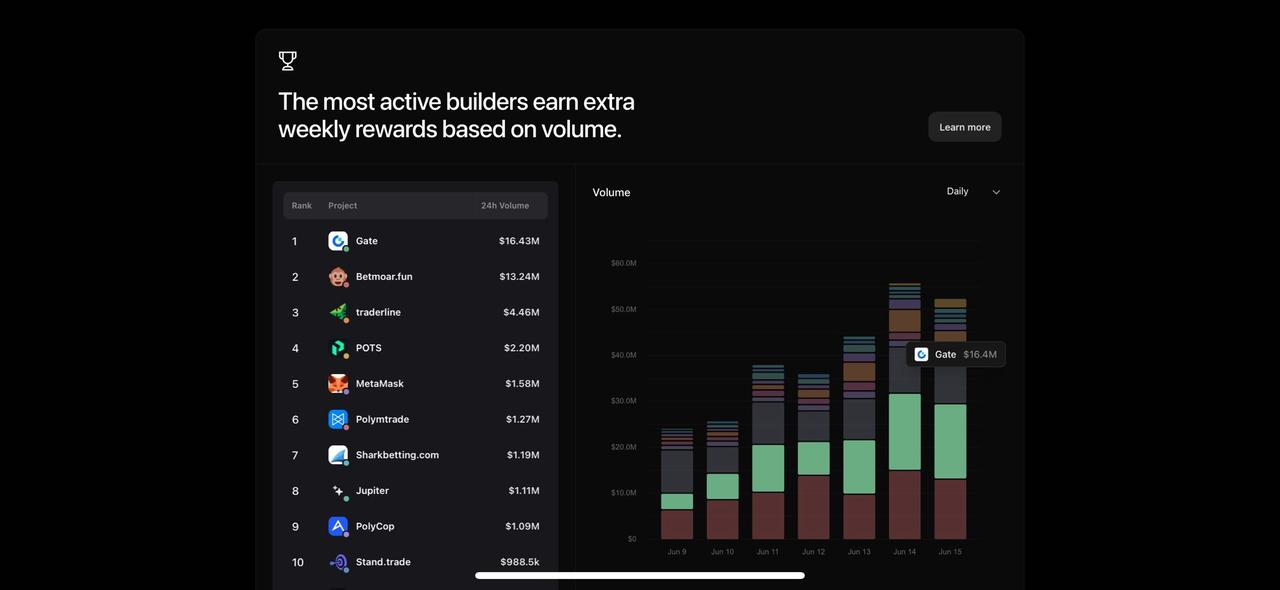
For the average user, the most direct manifestation of this channel value is the lowered participation threshold and the optimized interaction experience.
Within Gate's product ecosystem, users no longer need to consider the cumbersome steps of wallet creation, asset bridging, gas payment, or on-chain approvals. They simply log into their account and use USDT to directly participate in prediction market trading. The entire process is not fundamentally different from spot or futures trading. At the same time, Gate retains a Web3 wallet connection option for experienced users accustomed to on-chain operations, offering greater choice between convenience and a native experience.
Specifically, in terms of trading experience, Gate provides two different interaction modes: "Prediction Mode" and "Trading Mode."
- Prediction Mode is more suitable for general users. In this mode, users simply choose "Yes" or "No," input the participation amount, and confirm to complete the trade. The system simultaneously displays the corresponding probability and potential profit/loss, compressing the entire operation into an extremely simple three-step process.
- Advanced users with trading experience may prefer Trading Mode. This mode offers more professional market tools, including order books, K-line charts, and market depth data. Here, prediction markets are no longer just about betting on final outcomes; they become a real-time market for pricing and trading based on probability shifts.
In terms of trading flexibility, Gate allows users to conduct "two-way trading" at any time, meaning they can buy or sell their holdings based on changing market expectations before the final event settlement, without needing to hold until the result is revealed. As match progress, macro events, or market sentiment change, the prices of corresponding contracts will also fluctuate. This flexibility creates more dynamic trading opportunities for participants.
In terms of scope, Gate's prediction markets now cover various hot sectors including sports events, cryptocurrency, macroeconomics, and traditional financial markets. Whether it's the World Cup winner, Bitcoin price trends, or the direction of global hot-button events, users can find corresponding prediction markets to participate in.
However, merely offering this functionality is evidently insufficient to support the mass adoption of prediction markets. From a product design perspective, Gate aims to transform prediction markets from a relatively niche on-chain tool into a comprehensive information discovery and trading system.
For most users, another practical problem when participating in prediction markets is — even if the operational barrier has been significantly lowered, answering the core question of "what to buy" remains difficult. After all, prediction markets are essentially a game of information and perception. Compared to the trading operation itself, the ability to timely access information, understand shifts in market sentiment, and identify potential opportunities is often the key factor determining the final outcome.
To address this need, Gate has built a relatively comprehensive information support system alongside its trading features.
- Smart Money Leaderboard: Quickly identify "smart money" and active traders in the market, and view their historical performance, current holdings, and trading history. For new users lacking experience, this transparent mechanism for showcasing on-chain behavior reduces information acquisition costs to some extent and provides additional dimensions for market observation.
- Market Activity Monitoring: Users can track specific wallet addresses or entities of interest. The system will automatically send notifications when related accounts execute new trades. For users wishing to continuously monitor whale movements or learn strategies from seasoned traders, this tool enhances market observation efficiency.
- Live Zone & Real-time Feeds: Aggregates real-time updates on trending events, market movements, and live trading data, helping users quickly grasp the most discussed topics.
- AI Insights: Integrates various viewpoints, latest developments, and other information around hot market events, helping users quickly understand the underlying logic and improving trading decision-making efficiency. Provides additional reference angles for judgment.
From discovering hot topics and tracking market sentiment to observing smart money movements, combining AI and capital flow analysis, and finally making trading decisions, Gate is attempting to build more than just a simple Polymarket channel. It is constructing a complete participation pathway covering information acquisition, opinion formation, and trade execution.
The World Cup is Here: From Watching to Participating
If the value of prediction markets lies in transforming collective judgment into market probabilities, then the World Cup is undoubtedly one of their most ideal application scenarios.
Compared to macroeconomic events, football matches feature higher-frequency information changes, a broader participant base, and more intense emotional swings. From pre-match lineup announcements and injury news to every goal, red/yellow card, and tactical adjustment during a game, each can rapidly alter market expectations for the match outcome, directly reflected in the price changes of corresponding prediction markets.
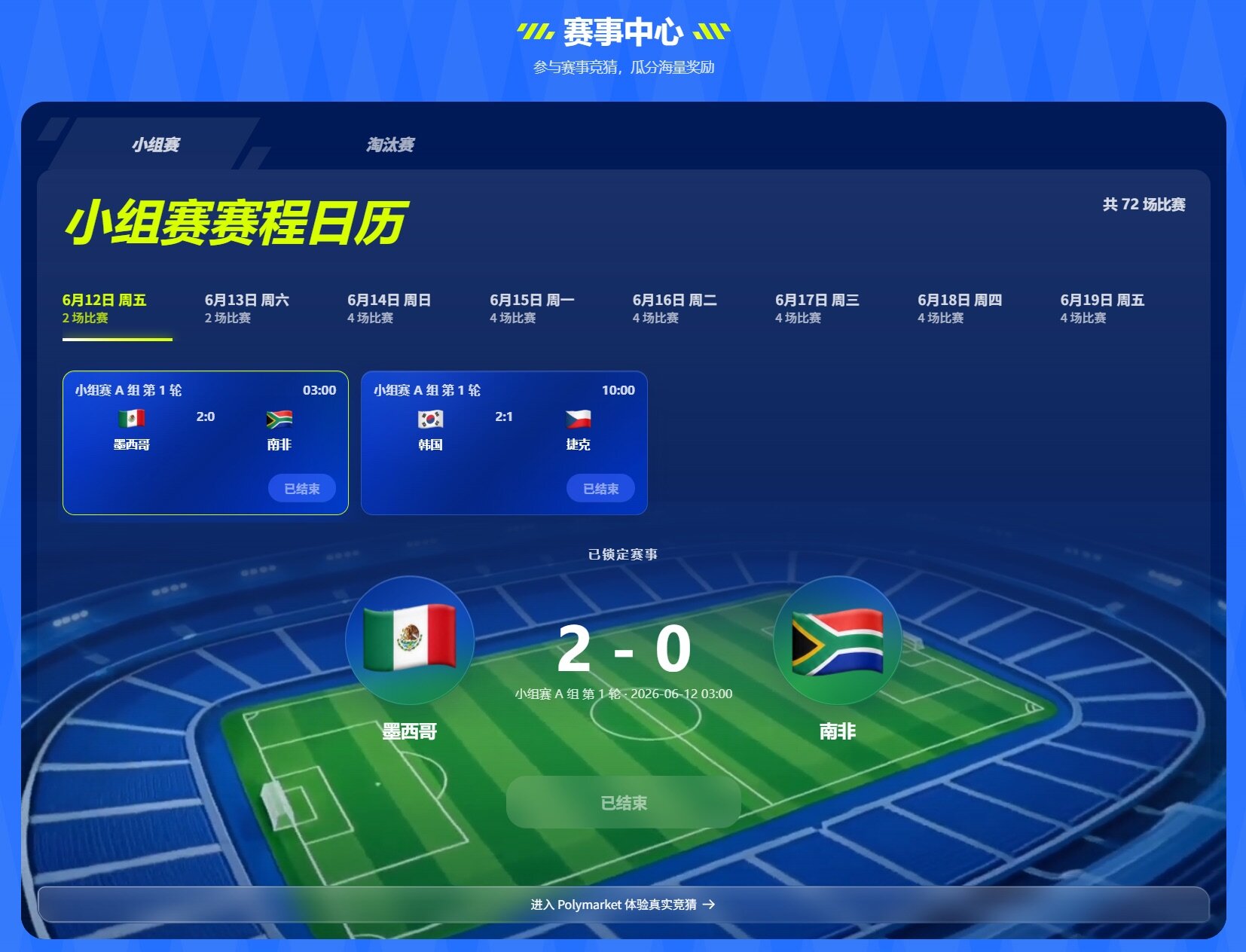
For this global top-tier sports IP, Gate recently launched a dedicated World Cup-themed section, aggregating match schedules, standings, popular prediction markets, and event updates in one place.
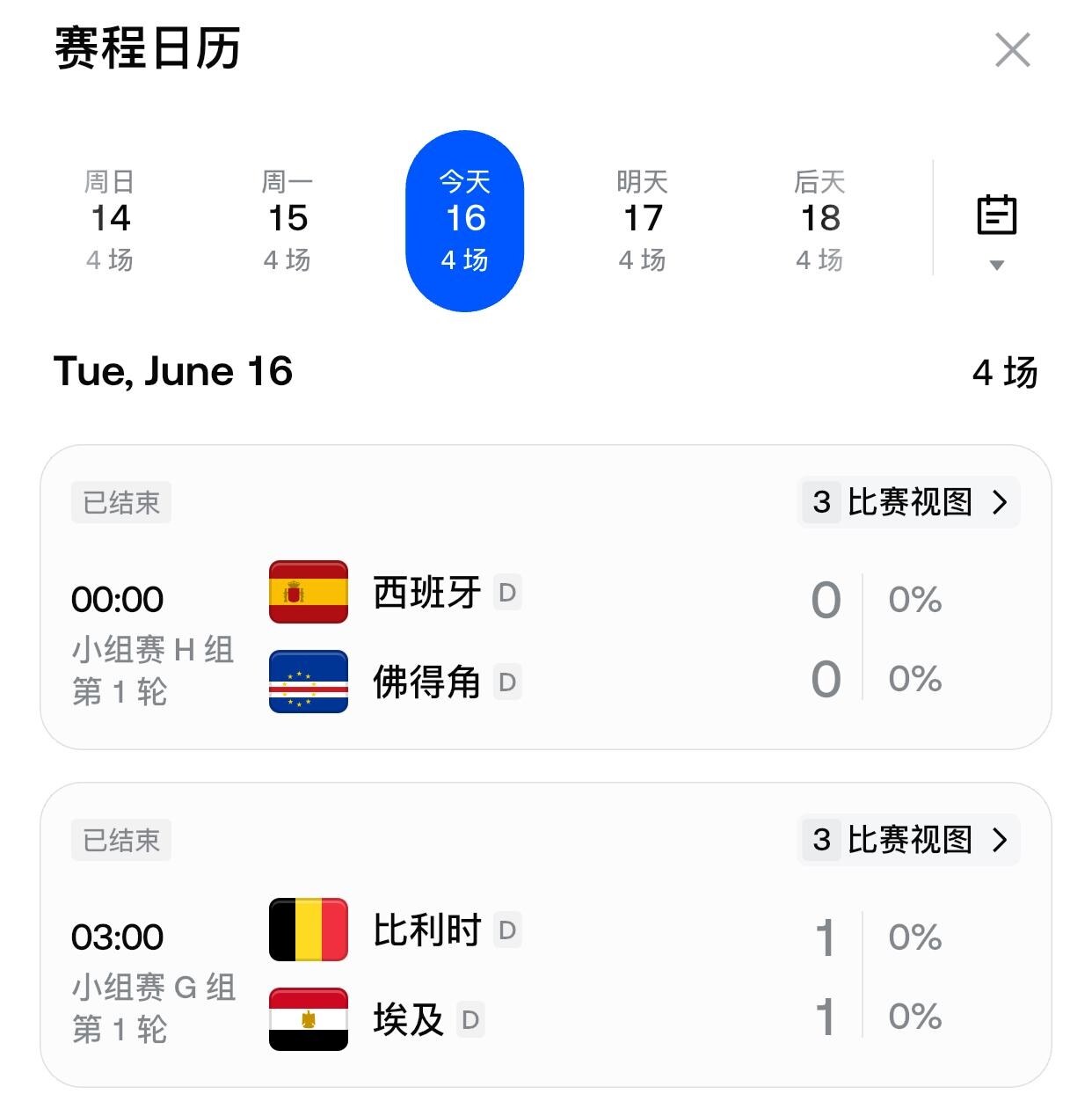
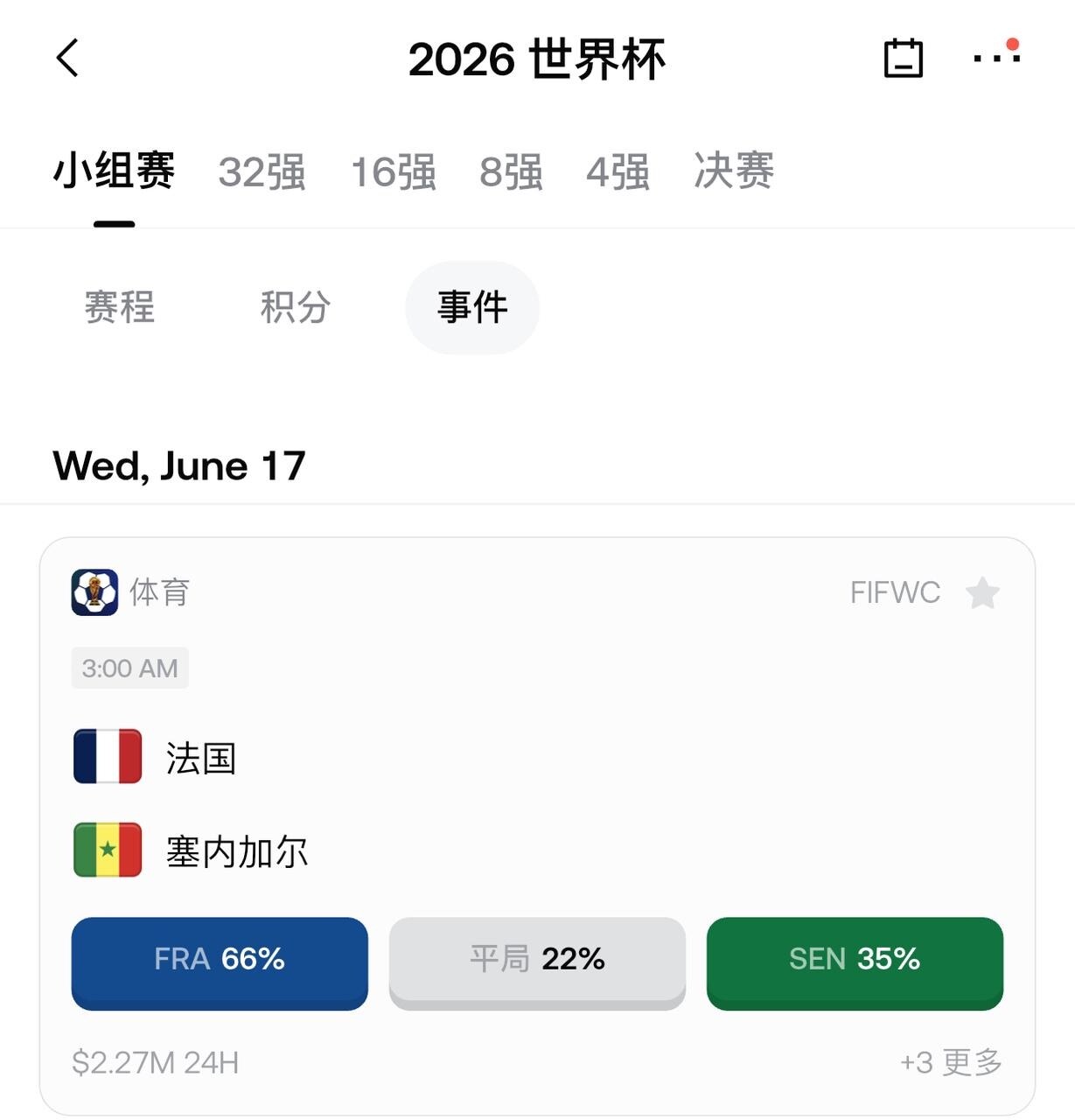
For fans, there's no need to constantly switch between different pages; they can quickly browse matches, access information, and participate in predictions all within Gate's platform. The section also provides a match calendar and kick-off reminder feature, allowing users to follow interesting matches in advance and receive notifications before they start, ensuring they don't miss key games and related prediction opportunities. During matches, the Live real-time feed feature further strengthens the connection between prediction markets and the viewing experience. Match progress, key events, and market trading activity are updated simultaneously. Users can follow the on-field score and also observe the market's real-time pricing of the match's trajectory.
From an operational experience perspective, the entire World Cup participation process has been deliberately simplified by Gate — users enter the relevant match page, simply choose to support or oppose a particular outcome, input the participation amount, and confirm the trade to place an order. As the match progresses, users can either hold their positions until the final result is known or buy/sell in advance based on market price movements.
From this perspective, prediction markets are changing the World Cup viewing experience. For participants, they are not just trading the match outcome; they are trading their own judgment of the match's flow and the process of market consensus adjusting with new information.
The Next Stop for Prediction Markets: From Crypto Circles to the Mass Market
Looking back at their development over the past few years, prediction markets have essentially completed the hardest step — proving the effectiveness and market value of the product.
Whether it's US elections, macroeconomic events, or global sports spectacles like the World Cup, more and more cases demonstrate that when enough people invest real money to express views on a single event, the market can often reflect shifts in collective expectations faster than traditional surveys, expert predictions, or even some media reports.
However, on the other hand, prediction markets clearly still have some distance to go before achieving true mass adoption.
For a long time, crypto-native infrastructure like wallets, gas fees, and on-chain interactions, while forming the foundational framework for prediction markets, have also inadvertently limited their user base. For the vast majority of ordinary people, they might be willing to express their judgment on a World Cup match, an interest rate decision, or a market hot topic, but they are not necessarily willing to learn a whole set of complex on-chain operational procedures for it.
This also implies that the focus of competition in the next phase for prediction markets may no longer be about who can build a more effective product, but rather about who can onboard more users into the market.
From this viewpoint, centralized exchanges, social platforms, and even more internet products could become crucial entry points for prediction markets in the future. Whoever can encapsulate the complex underlying mechanisms, reaching ordinary users with lower learning costs and smoother product experiences, will be better positioned to propel prediction markets from crypto-native applications to the mass market.
And this is precisely the path Gate is attempting. By replacing wallet barriers with account systems, substituting familiar trading experiences for complex on-chain interactions, and building a complete product ecosystem around information discovery, opinion exchange, and trading decisions, prediction markets are gradually evolving from a professional tool for a minority of on-chain players into a new type of market that more ordinary users can understand, participate in, and benefit from.
When prediction markets no longer belong to a niche on-chain experiment but become an open market where anyone can participate, express views, discover consensus, and trade judgments, their true growth story may have just begun.
Disclaimer: This content does not constitute any invitation, solicitation, or recommendation. You should always seek independent professional advice before making any investment decisions. Please note that Gate may restrict or prohibit all or part of its services from restricted regions. Please read the User Agreement for more information.






