SharpLink CEO: How to Interpret Ethereum Developers Surpassing 1 Million?

marsbitPublished on 2026-06-16Last updated on 2026-06-16

Abstract

SharpLink CEO reflects on the milestone of Ethereum surpassing one million historical developers, a figure unmatched in crypto. Based on Electric Capital data and observations from Asian developer hubs, the article argues that Ethereum’s true strength isn't raw speed, but where top builders choose to build long-term. The core advantage is a decade-deep ecosystem of standards, tools, liquidity, and culture. Of the over one million developers, about 232,000 were active in the past year, working on hard problems: protocol scalability (e.g., the upcoming Glamsterdam upgrade), synchronous composability across rollups, and post-quantum security preparedness. Ethereum’s defensibility stems from network effects beyond numbers: deep composability (the "financial Lego" of DeFi), the universal EVM/Solidity stack, credible neutrality (secured by ~900k validators), and its role as the trusted settlement layer for major institutions. The convergence of top researchers, a modular rollup ecosystem, and a culture of long-term thinking create a compounding advantage that is difficult to replicate. The conclusion is that Ethereum has consolidated its position as the default operating system for programmable finance and internet-native capital, attracting the builders who are architecting the next generation of financial infrastructure.

Author: Joseph Chalom

Compiled by: Jiahuan, ChainCatcher

I just returned from Asia, where I spent time with Ethereum developers and ecosystem leaders. Special thanks to Nonce Classic, Four Pillars, and DSRV in Seoul, our friends at SNZ, and the newly opened Ethereum Community Hub in Hong Kong. This hub is the first long-term, physically operational Ethereum community space in Asia, supported by the Ethereum Foundation.

What impressed me most was not just the vibrancy, but the rigor and ambition of the builders. The high-caliber projects, the spirit of experimentation, and the long-term thinking emerging from the global Ethereum ecosystem were truly inspiring.

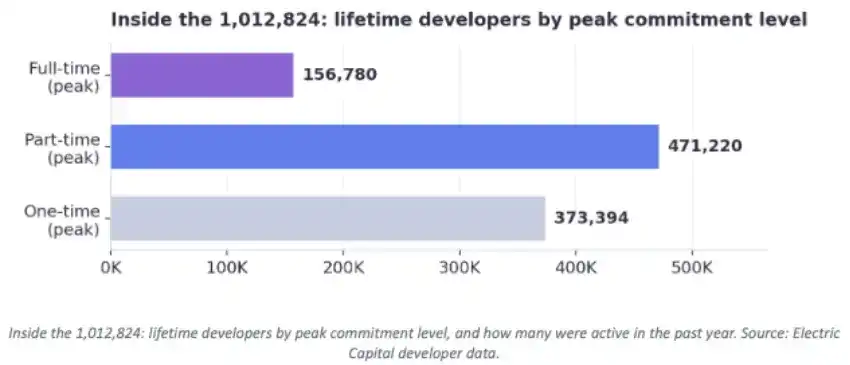
This also gave life to a statistic: According to Electric Capital's data, the total number of historical Ethereum developers has now surpassed one million, with 1,012,824 individuals having contributed to the ecosystem. No other ecosystem in the crypto space comes close.

A Milestone Worth Noting

One million is a round number, and round numbers can sometimes feel hollow. But this one is not. It represents the largest pool of technical talent ever assembled around an open, permissionless blockchain network. More importantly, this pool continues to deepen and broaden.

Of these one million developers, approximately 232,000 have remained active in the past twelve months.
Why Ethereum: The Truly Important Question

For years, discussions in the crypto industry have revolved around speed, fees, and throughput. Every new chain claims to be "faster than Ethereum." But the core question in crypto has never been which chain is the fastest, but rather another:

"Where will the most talented builders choose to build long-term?"

On this question, Ethereum still holds a significant advantage. This advantage isn't merely technical; it's institutional, cultural, economic, and ecological—a complex of a decade's accumulation of developers, infrastructure, standards, tools, liquidity, research, applications, and social coordination that no other ecosystem can replicate.

Ethereum has become the default operating system for programmable finance and internet-native capital formation.

What These Million Builders Are Building, and Why It Strengthens the Moat

The importance of the million builders lies crucially in what they are doing now. The current focus is on the hardest, riskiest problems in the industry: core protocol scalability, privacy, quantum resistance, and the autonomous agent systems that will run on top of it.

The Glamsterdam Upgrade: Innovating Without Compromising Core Principles. The Glamsterdam upgrade, expected in 2026, exemplifies how Ethereum progresses while holding fast to its core values. Core changes include enshrined Proposer-Builder Separation (ePBS) and Block-Level Access Lists (BALs), unlocking parallel execution and higher throughput, potentially raising the Gas limit and significantly increasing Layer 1 capacity.

Scaling for future demand while defending credible neutrality, security, and MEV fairness is a moat that evolves.

Synchronous Composability: Making Many Rollups Act Like One Chain. Composability has always been Ethereum's superpower; the next leap is extending it to Layer 2. Native Rollups and Based Rollups, combined with synchronous composability, solve this. A contract on one rollup can call a contract on the mainnet or another rollup in a single atomic transaction—no bridges, no waiting.

Linea, the Ethereum Economic Zone, Gnosis, Zisk, and the Ethereum Foundation are collaborating to couple this design with live proofs. The result is that dozens of rollups no longer function as isolated networks but begin to operate like a unified chain. This is a direct response to fragmentation criticism.

Quantum Resistance: Ethereum's Most Obvious Lead. No mainstream ecosystem is better prepared for the post-quantum era. The "Lean Ethereum" roadmap, the Ethereum Foundation's Post-Quantum Security team established in early 2026, pq.ethereum.org, and over a dozen client teams already running weekly post-quantum interoperability devnets constitute a coordinated open-source migration targeting readiness by 2029.

When quantum risk materializes, institutions holding trillions in assets will care about one thing above all: which chain prepared the earliest and most thoroughly.

The Moat Beyond Developers: Composability, Standards, and Trust

The aggregation of developer talent creates compound interest, thanks to how Ethereum is built. Its deepest network effect isn't liquidity; it's the depth of composability: applications interact like interoperable financial LEGO bricks.

Lending, stablecoins, exchanges, wallets, tokenized assets, oracles, and Layer 2 rollups all interact through shared standards, and developers never need to start from scratch. The EVM is the application layer of crypto; Solidity skills are transferable across Base, Arbitrum, Optimism, Polygon, zkSync, Scroll, Linea, and hundreds of other networks.

Learning the Ethereum tech stack maximizes optionality, which in turn spins the flywheel: more developers, more tools, more liquidity, more institutions, attracting even more developers to build composable protocols and assets. Liquidity begets liquidity, and composability begets composability.
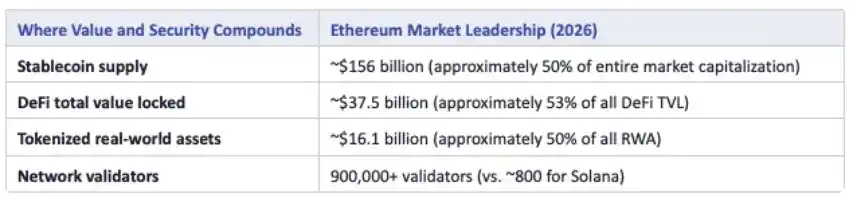
Moreover, Ethereum dominates where true value settles, not just where the most noise is made:

Three forces reinforce this lead.

Credible Neutrality: Ethereum is secured by over 900,000 validators, compared to roughly 800 for Solana. Major institutions place immense value on this degree of decentralization and platform neutrality.

Modularity: Rollups like Base, Arbitrum, and Optimism don't fragment Ethereum; they extend it into an increasingly connected modular internet economy that inherits the security of the mainnet.

Culture: Ethereum attracts top researchers, cryptographers, and EIP standards drafters far beyond any other ecosystem, setting the direction for the entire industry. This is also the advantage most difficult for others to copy.

There's Only One Ethereum

There's a fundamental difference between generating on-chain activity and being the long-term coordination layer for internet-native finance. The latter means being the layer trusted by the world's largest financial institutions.

Ethereum firmly holds the mindshare of large asset holders, institutions that value trust, security, and liquidity above all. I witnessed this firsthand from the front row during my tenure at BlackRock.

In technology markets, ecosystems consolidate over time around standards, liquidity, and developer mindshare. This is Ethereum's moat.

After meeting these developers, builders, and ecosystem leaders in Seoul and Hong Kong, I am more convinced than ever of Ethereum's competitive edge. I met the talent building the next generation of financial infrastructure—the future founders of our industry and the architects of agentic finance. It is these individuals and teams who will change the world.

The future of Ethereum is happening now.

Related Questions

QAccording to the article, what is the significance of Ethereum surpassing 1 million total developers?

AIt represents the largest and most skilled technical talent pool ever assembled around an open, permissionless blockchain network. It signifies deep, broad, and sustainable developer engagement that forms a critical competitive moat for Ethereum.

QBeyond just technical speed, what does the author argue is the most important question in the crypto space?

AThe most important question is not which chain is the fastest, but: 'Where will the very best builders choose to build for the long term?'

QWhat are three key technical areas the article highlights where Ethereum's large developer base is focusing to build its moat?

A1) Core protocol scalability through upgrades like Glamsterdam (ePBS, BALs). 2) Synchronous composability across rollups to unify the ecosystem. 3) Post-quantum resistance via coordinated research and migration efforts.

QWhat three reinforcing forces does the article identify as strengthening Ethereum's leading position?

A1) Credible neutrality, secured by extensive decentralization (e.g., ~900k+ validators). 2) A modular architecture where rollups extend rather than fragment the network. 3) A deeply rooted culture that attracts top-tier researchers and sets industry standards.

QHow does the article describe the difference between generating on-chain activity and being a long-term coordination layer for internet-native finance?

AThe latter means becoming the trusted layer for the world's largest financial institutions. It involves capturing the 'mindshare' of large asset holders who prioritize trust, security, and liquidity over mere transaction speed or volume.

Related Reads

As the US and Japan Hike Interest Rates, Which Asset Class is Most at Risk?

This week, global markets face two major events: the Bank of Japan's likely interest rate hike and the US Federal Reserve's FOMC meeting. For risk assets, it is a pivotal and volatile week. In the US, expectations for rate cuts have faded dramatically. May's higher-than-expected CPI and resilient jobs data have shifted the Fed's focus from potential cuts to the possibility of future hikes. New Fed Chair Wash is unlikely to raise rates at this meeting, but any hawkish shift in communication, the dot plot, or the policy statement could lead markets to price in tighter policy, pushing up short-term Treasury yields and strengthening the dollar. High-valuation growth stocks, AI-related assets, and small-cap stocks reliant on cheap funding are most vulnerable to rising rates. In Japan, a 25 basis point hike is almost fully priced in (98.3% probability), which would bring the policy rate to 1%, its highest since 1995. The concern is not the hike itself, but its potential to unwind the massive "carry trade," where investors borrowed low-yielding yen to invest globally. Historically, Japan's rate hikes have coincided with global market stress (2000, 2007, 2024). While this well-telegraphed hike may be digested smoothly, two key factors increase uncertainty: 1) Governor Ueda's absence due to illness, putting communication in the hands of less-familiar deputies, and 2) the Fed meeting occurring just days later, creating potential for a compounded market reaction if both central banks sound hawkish. Asset implications: * **Bonds:** US short-term yields sensitive to Fed signals. Japan's rate hike could pressure its massive US Treasury holdings. * **Currencies:** Dollar likely supported by Fed; Yen's reaction hinges on BoJ's forward guidance. * **Equities:** US growth stocks, small-caps most at risk. Japanese stocks face pressure from a stronger yen. * **Crypto:** Assets like Bitcoin face headwinds from higher rates and tighter liquidity; high-beta altcoins are even more vulnerable. The convergence of these two central bank meetings amplifies market volatility risks, with potential spillovers across asset classes globally.

marsbit8m ago

As the US and Japan Hike Interest Rates, Which Asset Class is Most at Risk?

marsbit8m ago

Data Decrypts the BTC Cycle: Three Major Bottom Signals Illuminate Simultaneously, Q4 Could Be a Crucial Turning Point Window?

"Decoding the Bitcoin Cycle: Three Bottom Signals Flash Simultaneously, Is Q4 the Key Turning Point?" The article analyzes Bitcoin's current market position, comparing it to historical cycles. BTC has corrected over 52% from its October 2025 peak of $126,198 to around $59,100 in June 2026. While significant, this drawdown is milder than the 77-86% declines seen in past bear markets. The analysis is framed within Bitcoin's four-year halving cycle. Past cycles show a pattern: prices peak 12-18 months post-halving, bottom 12-14 months after the peak, with lows typically occurring roughly 17 months before the next halving. Following the April 2024 halving and the October 2025 peak, this pattern suggests a potential bottoming window around Q4 2026, ahead of the expected 2028 halving. Three key on-chain metrics are signaling undervaluation: The MVRV Z-Score has dropped near 0.27, approaching historic bottom zones. The market price is only about 9% above the network's average realized price of ~$53,600, a rare low premium. Bitcoin's price recently touched its 200-week moving average (~$62,200), a level that aligned with bottoms in 2015, 2018, and 2020. While US spot Bitcoin ETFs saw record outflows in May/June 2026, indicating retail panic, whale addresses (holding 100+ BTC) reached a yearly high. Entities like MicroStrategy resumed buying, and long-term holders control a near-record 78% of the supply, suggesting accumulation. A major macro overhang was partially removed with a US-Iran ceasefire agreement in mid-June 2026, which eased oil prices and triggered a sharp BTC rally. However, persistent inflation means high-interest rates remain a constraint. The conclusion notes that genuine investment opportunities often arise when confidence is lowest, amidst narratives that "this time is different." While not guaranteeing an immediate bottom, the confluence of cycle timing, undervaluation signals, and shifting macro risks suggests late 2026 may be a critical period for reassessing risk/reward and patient accumulation for long-term believers.

marsbit8m ago

Data Decrypts the BTC Cycle: Three Major Bottom Signals Illuminate Simultaneously, Q4 Could Be a Crucial Turning Point Window?

marsbit8m ago

The Shutdown of Claude Mythos Revealed the True Cost of Renting AI to Me

The sudden shutdown of Claude Mythos this week starkly highlights a critical, often overlooked risk for founders: when your core capability relies entirely on someone else's platform, your fate is not in your own hands. The key question becomes: who truly owns the intelligence your product depends on? For years, the debate around open-source models focused on cost. Now, the evidence is clear: fine-tuned open-source models can achieve frontier-level quality for specific, mission-critical tasks at a fraction of the cost. However, the deeper issue is control. Relying on a third-party API is like renting; it works until the landlord changes the rules, raises the rent, or asks you to leave—as Mythos experienced. The lesson is not to stop using frontier models—they are incredible infrastructure. The goal is ownership. Ownership means starting with a powerful open-source model and shaping it around what makes your company unique: your data, workflows, domain expertise, and definition of "good." Over time, the model becomes less generic and more reflective of your business, creating durable value. The optimistic conclusion is that AI's future doesn't hinge on one superior model. There is no single frontier. The frontier includes proprietary models, models fine-tuned on company-specific knowledge, specialized models for narrow problems, and intelligent routers orchestrating model ensembles. The most interesting development is not models getting smarter, but intelligence becoming increasingly customizable. The winning companies will be those that transform intelligence into a unique, owned asset. Looking ahead, the vision is not one model dominating all, but many teams owning the part of the frontier that matters most to them.

marsbit56m ago

The Shutdown of Claude Mythos Revealed the True Cost of Renting AI to Me

marsbit56m ago

Tiger Research: U.S. Strategic Bitcoin Reserve - Should the Market Be Happy or Disappointed?

Tiger Research analyzes the evolution of U.S. legislative efforts regarding a strategic Bitcoin reserve, concluding the market impact is limited in the short term but potentially positive long-term. The core event was a March 2025 executive order by former President Trump, which designated confiscated Bitcoin as a strategic reserve and promised not to sell existing holdings (approx. 190k BTC). As it contained no mandate to purchase new Bitcoin, the market reacted negatively, with prices dropping 5.7%. Legislative history shows a significant retreat from initial ambitions. The 2024 "BITCOIN Act" proposed mandatory purchases of 1 million BTC over five years. Reintroduced in 2025, it stalled due to high fiscal costs, concerns over dollar hegemony, and opposition from the Treasury Secretary. The current frontrunner, the 2026 "American Retirement and Monetary Advancement (ARMA) Act," is a compromise. It lacks any purchase requirement, instead focusing on consolidating existing government-held Bitcoin and legally prohibiting its sale for at least 20 years. While ARMA has higher passage odds due to bipartisan support and no purchase mandate, its immediate market effect is neutral. It eliminates potential government selling pressure but creates no new demand. The long-term significance is that formally establishing Bitcoin as a national reserve asset in law could later reignite debates on mandatory purchases. Therefore, the path to a government buyer is longer than initially priced by the market, but the directional narrative remains intact.

marsbit59m ago

Tiger Research: U.S. Strategic Bitcoin Reserve - Should the Market Be Happy or Disappointed?

marsbit59m ago

Trading

Spot
Futures

Hot Articles

Discussions

Welcome to the HTX Community. Here, you can stay informed about the latest platform developments and gain access to professional market insights. Users' opinions on the price of ETH (ETH) are presented below.

活动图片