Prediction Markets Take Center Stage, But Perp DEXs Quietly Profit from the US-Iran War

marsbitPublished on 2026-03-20Last updated on 2026-03-20

Abstract

In late February 2025, escalating tensions in the Middle East led to large-scale airstrikes by the U.S. and Israel against Iran, causing significant volatility in global financial markets. While traditional markets were closed during the weekend, investors turned to on-chain platforms to trade assets like gold, oil, and silver. Prediction markets such as Polymarket and Kalshi saw a surge in activity, with war-related contracts driving record trading volumes. However, perpetual decentralized exchanges (perp DEXs), particularly Hyperliquid, also capitalized on the situation. Hyperliquid’s commodities contracts—including gold, oil, and silver—experienced unprecedented liquidity and trading volume, with silver contracts alone reaching over $3.5 billion in daily volume at their peak. The platform’s HIP-3 market, trade.xyz, saw weekend trading volumes hit all-time highs, attracting large institutional and high-net-worth users due to its transparency, lack of trading restrictions, and non-custodial nature. In contrast, centralized exchanges (CEXs), though also offering real-world asset (RWA) trading, lacked the same level of visibility and trust among sophisticated traders. Hyperliquid’s upcoming HIP-4 feature introduces outcome-based contracts for prediction and options-like products, further expanding its role as a platform for pricing uncertainty. The growth of perp DEXs reflects a broader trend toward 24/7, globally accessible financial markets, though regulatory challenges r...

Since late February 2025, tensions in the Middle East have escalated sharply. The United States and Israel launched large-scale airstrikes against Iran, sending shockwaves through global financial markets.

During that war-torn weekend, while traditional financial markets were closed and Wall Street traders could only wait for Monday's opening in anxiety, another wave of investors was trading frantically on on-chain platforms.

They weren't trading cryptocurrencies; they were trading gold, crude oil, and silver.

Prediction markets like Polymarket and Kalshi saw trading volumes surge due to war-related contracts, becoming the focus of market attention.

But on the other side of the lens, Perp DEXs, including Hyperliquid, were also "profiting handsomely from the war": trading volumes for commodity contracts on these platforms soared, and on-chain derivatives for traditional assets like gold, crude oil, and silver experienced an unprecedented liquidity explosion.

The War Dividend for Prediction Markets

Before delving into Perp DEXs, it's necessary to first review the performance of prediction markets during this geopolitical crisis. After all, it was the impressive data from Polymarket and Kalshi that made people truly feel for the first time that the era of "betting on anything" has arrived.

According to data from Dune Analytics, for the week ending March 1, 2025, traders wagered a whopping $425.4 million on geopolitical issues on Polymarket, far exceeding the $163.9 million from the previous week. The platform's total trading volume reached a record $2.4 billion, a significant increase from the previous week's $1.8 billion. Kalshi also performed well, with its contract on "Whether Khamenei will step down" attracting over $54.5 million in trading volume.

Behind these numbers is the strong stimulation of users' trading欲望 (desire to trade) by a globally known event like war. When missiles streaked across Tehran's night sky, when Trump announced on social media that "Khamenei is dead," the price curves on prediction markets reflected the "truth" faster than any news release.

But it's important to clarify that "profiting from the war" here is not meant pejoratively. Prediction markets provide an unprecedented way for people to express their judgment on major events with real money. As Kalshi CEO Tarek Mansour said, the essence of these platforms is to "make uncertainty priceable," and war simply pushes this pricing demand to the extreme.

"Crazy Saturday" on Hyperliquid

Prediction markets are undoubtedly the role directly benefiting from the war in the Web3 space, but another slightly "outdated"赛道 (sector) also opened the door to a new world because of this conflict.

On March 1st, the second day after the US-Iran war officially started, the Iranian side admitted that morning that Supreme Leader Khamenei had been killed in the war. That day, the cryptocurrency market briefly fell before quickly recovering, with Bitcoin's intraday fluctuation slightly exceeding 7%, a reaction not considered particularly drastic.

It happened to be a weekend, and most people's focus was still on cryptocurrencies because, in their eyes, cryptocurrency was the only "commodity" that could be traded without restrictions on weekends. But in fact, this has long not been the case.

Bloomberg reported on March 1st that on the first day of the war, Saturday, the price of oil perpetual contracts on Hyperliquid rose about 5% to $70.6 per barrel, while gold and silver perpetual contract prices rose about 1.3% and 2% to $5,323 and $94.9 per ounce, respectively. Silver futures trading volume exceeded $227 million within 24 hours, and gold futures trading volume was about $173 million.

The perpetual contract markets for gold, silver, and crude oil were already launched on Hyperliquid's largest HIP-3 market, trade.xyz, in late 2025 and early 2026.

Furthermore, February 28th was not the peak of daily trading volume. On January 29th, when silver hit a historic high of $120/oz, the daily trading volume of silver contracts on Hyperliquid exceeded $1.2 billion. On February 5th, this number was刷新 (refreshed) to over $3.5 billion, accounting for 68% of the total trading volume of the HIP-3 RWA market that day.

Crude oil, newly arrived on the on-chain market, also performed impressively.

Before the conflict broke out, the average daily trading volume of crude oil contracts on Hyperliquid was only around $20 million. After the war broke out, as oil prices kept rising, the daily trading volume of crude oil contracts on Hyperliquid quickly broke through $100 million. On March 9th, this number reached nearly $2 billion, second only to the trading volume of Bitcoin contracts on the platform and far surpassing Ethereum.
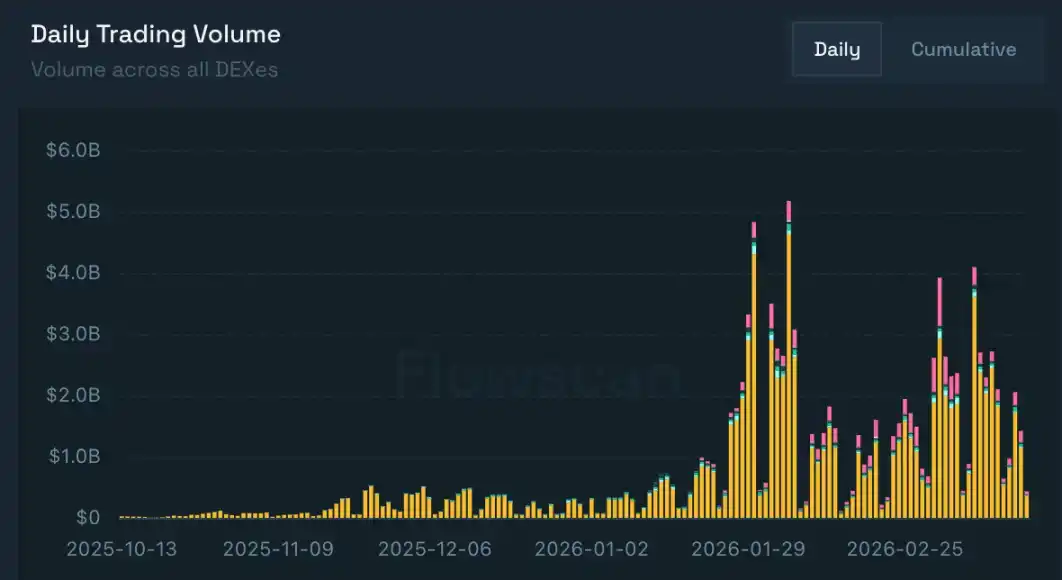
According to data from Flowscan, on March 8th, the trading volume of Hyperliquid's HIP-3 market exceeded $880 million, setting a historical record for weekend trading volume. Just a week later, this number was刷新 (refreshed) again to nearly $966 million.

The ample weekend liquidity not only provided investors with a place where "money never sleeps" but also brought a better pricing mechanism to traditional financial markets. The managing partner of Arete.xyz stated on X that this is the first time decentralized platforms have achieved price discovery for traditional assets.

If this continues to develop, traders won't need to scramble frantically after Monday opens. Perhaps they already completed their trades on Hyperliquid over the weekend, or perhaps the opening price will be very fair, with little arbitrage opportunity.

Of course, it's not just on-chain platforms eyeing this lucrative piece.

Who's Watching Closely?

Major exchanges also smelled the opportunity early.

Well-known exchanges like Binance, OKX, Bitget, etc., have long listed RWA tokenized assets. OKX listed gold perpetual contracts as early as last May, while Binance and Bitget did so in December last year.

Exchanges might not have taken these assets seriously in the past because their volatility was low, with "investment" outweighing "trading" attributes, not worthy of attention. But with Trump first capturing Maduro and then decapitating Khamenei, the volatility of大宗资产 (bulk assets) like gold, silver, and crude oil rivals that of former altcoins, while现在的山寨币 (current altcoins) have long since躺下装死 (laid down playing dead).

Cryptocurrencies can't seem to rise, traditional financial markets party every day, anyone would be envious seeing this. Cryptocurrency exchanges are inherently never closed, the listed大宗资产 (bulk asset) markets also have no settlement, just like trading "air" like altcoins, one more doesn't matter.

Not just cryptocurrency exchanges, the holy temples of global quality assets: Nasdaq and NYSE are also unwilling to give up pricing power for commodities.

As early as last year, the rivals Nasdaq and NYSE hinted to the market that they were not only researching security tokenization but also wanted to support 7x24 trading. But obviously, it's not easy for traditional institutions to take this step. Rules that have lasted for a hundred years, if they want to change, the entire upstream and downstream need to change simultaneously: who will make the market? Who will clear? Can T+0 be achieved? These are all issues on the table.

The specific details are still hidden under the table. But just this month, Nasdaq announced a cooperation with xStocks, a subsidiary of the US-based cryptocurrency exchange Kraken, while NYSE's parent company ICE officially announced an investment in OKX at a $25 billion valuation. Clearly, they don't want to拱手让人 (surrender) the territory they've conquered; the arrow is already on the string, waiting for the order to launch.

On the second weekend of March, Bloomberg again reported Hyperliquid's commodity trading data. This kind of reporting twice in a short period made many sensitive people feel the change: a platform that makes money from data and information began paying attention to on-chain exchanges and used the trading prices of commodities on them as a reference. But this also raises another question: why did the leading cryptocurrency exchanges get an early start but didn't attract as much attention as Hyperliquid?

Taking the silver perpetual contract as an example, on March 9th, the trading volume of the XAGUSDT contract on Binance was $6.464 billion, while on Hyperliquid it was over $3.5 billion. Although numerically, Hyperliquid's trading volume in this single market was only 54% of Binance's, Binance has over 300 million users, while Hyperliquid's total user count is only接近 (close to) 1.7 million.

Winner Takes All

According to statistics from crypto asset researcher ASXN, Hyperliquid's total trading volume exceeded $8 trillion (other data shows $4 trillion, possibly ASXN double-counted the volume of both trading parties). Accounts with trading volumes exceeding $1 billion accounted for 76% of the total volume, and accounts with trading volumes between $100 million and $1 billion accounted for 16%.
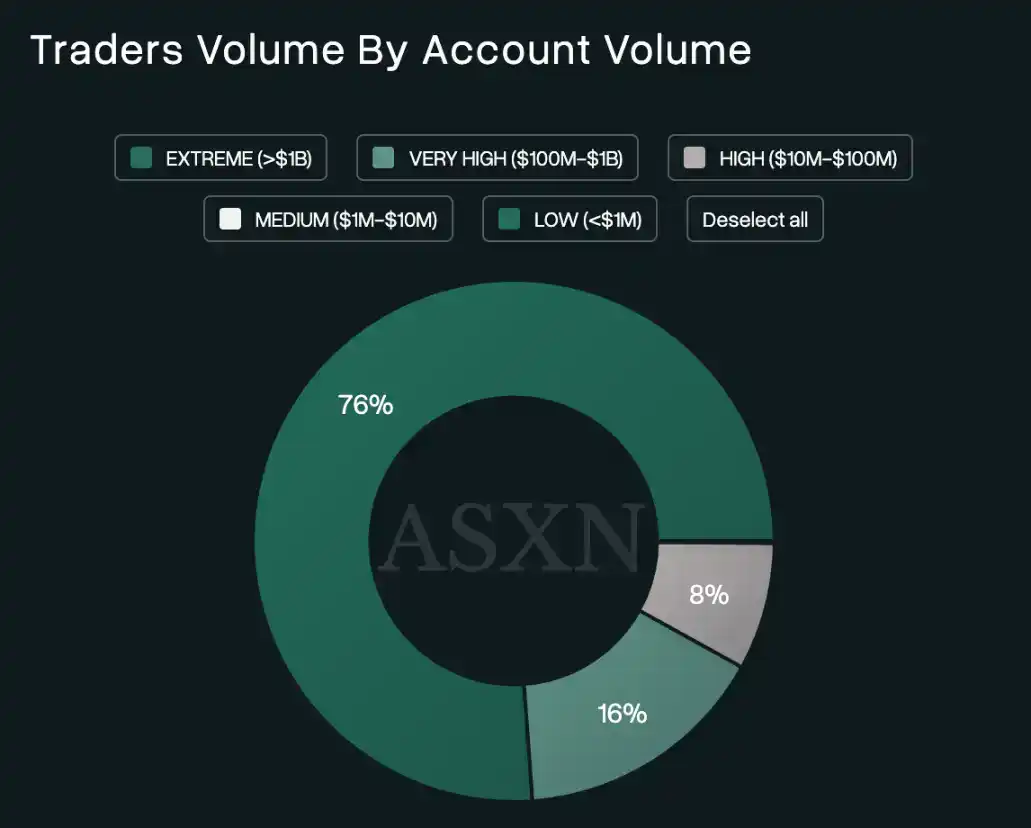
There are no specific market maker accounts on Hyperliquid; some accounts with trading volumes reaching hundreds of billions of dollars should likely be controlled by market makers. But even so, the 76% ratio is enough to prove that most users trading on Hyperliquid are actually whale investors. Although the overall volume might not match CEXs, the price traded by whales with real money indeed has more reference value.

But this still doesn't answer why the market consistently chooses and favors perp DEXs. The author once compiled the views of Chinese users on perp DEXs in the article "Choosing Perp DEX is a Rebellion of 'The World is Tired of Qin's Tyranny for Too Long'". Not many people said CEXs did poorly; more turned to DEXs out of profit-seeking or airdrop farming needs.

But for foreigners, it's a different story.

The founder of Equation News, the genius 00s trader Vida, once shared some insights on Telegram to explain why foreigners are疯狂看好 (crazy bullish on) Hyperliquid. According to a screenshot provided by X user JinMu, Vida attributed the reasons to strict KYC and the糟糕的用户体验 (poor user experience) of US-based exchanges.
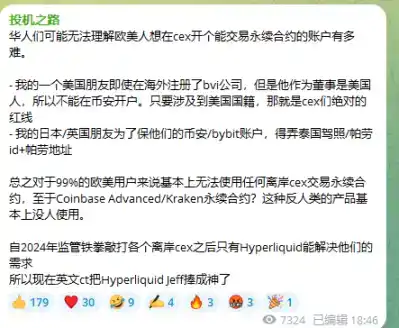
Several investment institutions within the Web3 industry have also told the author that high-net-worth investors and family offices in China with large funds have relatively low trust in crypto. Even Li Lin, the founder of Huobi, holds Bitcoin positions indirectly through BlackRock's IBIT in his Hong Kong family office. In contrast, large funds or high-net-worth individuals abroad have a higher acceptance of crypto, and many traditional financial institutions are testing Web3 products.

No wonder Bloomberg started paying frequent attention to Hyperliquid in March, as the whale users on the platform might include some traditional financial institutions找不到流动性 (unable to find liquidity) on weekends.

As for CEXs, no matter how high the trading volume, you never know who is actually trading. From the single dimension of "reference value," they确实比不上 (really can't compare to) DEXs. Additionally, DEX's self-custody, transparent trading, and unrestricted leverage also provide fertile ground for financial traders to发挥 freely (play freely).

"Such an unregulated platform will eventually be taken down by regulators."

I believe this is a sentiment many have seen recently. Listing new assets without review,不问来源 (not asking the source) of funds, uniform leverage for all—these are indeed behaviors dancing on regulatory red lines. But this might be a platform默许存在于 (tacitly allowed to exist in) a gray area. Just like TikTok, the government can shut it down on grounds of "national security," but the American people won't agree, and the stakeholders and officials hoping to profit from it won't agree either.

In the future, when certain international events affect the prices of metals, grains, raw materials, etc., Hyperliquid can still replicate the miracle of gold and crude oil. The author believes that regulation will not target Hyperliquid in the short term.

The当年的 (former) "Golden Triangle" region, which was unregulated, was eliminated not entirely because of the harm of drugs themselves, but perhaps because someone wanted to make this money themselves. The fact that S&P Dow Jones Indices authorized Hyperliquid, rather than any CEX, to launch the S&P 500 index perpetual contract is the best proof.

The same logic applies to Hyperliquid and other perp DEXs. As long as they don't touch certain core interests, they have value in existing.

Pricing "Uncertainty"

While HIP-3 is in full swing, HIP-4 is also quietly gaining momentum.

Launched on the testnet on February 2, 2026, HIP-4 introduced the "Outcome Trading" function, a type of fully collateralized contract that settles within a fixed price range, specifically designed for prediction markets and option-like products.

Unlike Hyperliquid's core perpetual contracts, HIP-4 outcome contracts have an expiration date, require no leverage, have no liquidation risk, and settle within a predefined price range. For example, if you believe Bitcoin will break through $80,000 by the end of March, you can buy the corresponding outcome contract. At expiration, if Bitcoin确实超过 (indeed exceeds) $80k, the contract settles at the upper limit for profit; if not, it settles at the lower limit, with losses limited to the initial investment.

The market普遍将 (generally interprets) HIP-4 as "Hyperliquid entering the prediction market," but this might underestimate its strategic significance. The true value of HIP-4 lies in expanding Hyperliquid from a pure derivatives trading platform to a more comprehensive "uncertainty pricing platform."

Doesn't Polymarket price uncertainty? Not really. Prediction markets display更多的是概率 (more of probability). When you believe an event has an 80% chance of happening, but the amount you intend to invest would directly pull the probability to 99%, you would naturally choose to reduce the funds.

Outcome contracts, however, can reveal risk appetite through the amount of capital. Taking the example of whether Bitcoin will break $80k by the end of March, many on Polymarket might choose "no," but on Hyperliquid, you might see many people buying call options. This means that although many are indeed bearish, they are not that pessimistic, or these investors believe they need to hedge against a possible rise.

If Bitcoin真的 (really) rises to $80k by the end of March, waiting until 79,000 and watching the probability on Polymarket rise from 20% to 80% is too late.

Furthermore, HIP-4 complements Hyperliquid's existing perpetual contracts. Traders can seamlessly switch between linear derivatives (perpetual contracts) and non-linear derivatives (outcome contracts) under the same account and margin system, building more precise and efficient investment portfolios. This "composability" is Hyperliquid's advantage over specialized prediction market platforms.

Money Never Sleeps

We are witnessing the era where "money never sleeps" becomes reality.

On one hand, prediction markets, a sector treading the edge of gambling, allow events with deterministic outcomes to be wagered on with money; on the other hand, on-chain exchanges allow ample liquidity to price unexpected events even on holidays when markets are traditionally closed.

The arbitrage space created by information asymmetry has become the survival foundation of a "platform." The boundaries of platforms will continuously expand. Now暂时被限制 (temporarily restricted) to Earth; ten or twenty years later, you might be able to trade lunar minerals on a spaceship heading to Mars.

We are pleased to see finance, a product invented by humans, advance further with the加持 (empowerment) of blockchain, but we must also remind:

My life is finite, but knowledge is infinite. To pursue the infinite with the finite is perilous! (吾生也有涯,而知也无涯。以有涯随无涯,殆已!)


Related Questions

QWhat was the main reason for the surge in trading activity on platforms like Hyperliquid during the US-Iran conflict in early 2025?

AThe surge was primarily due to the outbreak of the US-Iran war, which caused significant volatility in traditional assets like gold, oil, and silver. Investors turned to perpetual decentralized exchanges (perp DEXs) like Hyperliquid to trade these assets during weekends when traditional markets were closed, leading to unprecedented liquidity and trading volume spikes.

QHow did the trading volume on Hyperliquid's oil contracts change after the conflict began?

ABefore the conflict, Hyperliquid's oil contracts had an average daily trading volume of around $20 million. After the war broke out, the daily trading volume quickly exceeded $100 million, and by March 9, it reached nearly $2 billion, second only to Bitcoin contracts on the platform.

QWhat is the key difference between Hyperliquid's HIP-4 result contracts and traditional prediction markets like Polymarket?

AHIP-4 result contracts are fully collateralized, have expiration dates, no leverage, no liquidation risk, and settle within a predefined price range, functioning more like binary options. In contrast, prediction markets like Polymarket focus on probability-based betting on event outcomes, where prices reflect the perceived likelihood of an event occurring.

QWhy did Bloomberg and other traditional financial data providers start paying attention to Hyperliquid's trading data during the conflict?

ABloomberg and others focused on Hyperliquid because it provided real-time, transparent pricing for traditional assets like gold and oil during weekends when conventional markets were closed. The platform's credibility was enhanced by its large whale investors, whose trades offered valuable price discovery, making it a reference for market movements.

QWhat advantage does Hyperliquid have over centralized exchanges (CEXs) like Binance in terms of asset pricing and transparency?

AHyperliquid offers greater transparency because all trades are on-chain and publicly verifiable, allowing users to see who is trading (e.g., large whales or institutions). This transparency provides more reliable price discovery. In contrast, CEXs like Binance do not reveal trader identities, making their data less indicative of genuine market sentiment.

Related Reads

Conversation with Patagon Founder: Revealing the Inside Story of Anthropic's Secondary Market

**Summary: Inside Anthropic's Massive, Opaque Secondary Market** In a revealing interview, Patagon founder Dio Casares pulls back the curtain on the booming, high-risk secondary market for shares in companies like Anthropic. This private market, fueled by companies staying private longer and massive funding rounds, is estimated to involve hundreds of billions of dollars. Casares distinguishes between two types of "secondary" trading: 1. **Company-approved SPV (Special Purpose Vehicle) sales:** Where new capital flows into the company, often facilitated by select private equity firms. Anthropic supports this to manage liquidity and pre-IPO selling pressure. 2. **The "gray" market:** Platforms like Hive and Forge that match buyers and sellers, often creating pricing confusion and competing with official funding rounds. These intermediaries are widely disliked by companies. The market structure is complex and fragmented, relying heavily on personal connections. Brokers connect buyers and sellers, often layering multiple SPVs to pool capital, with single transaction fees as high as 10%. Strikingly, some finance professionals earn more from this trading than from their primary investment roles. **Key risks highlighted include:** * **High Fraud Rates:** An estimated 10-20% of transactions involve fake stock certificates or sellers who take payment without having the shares. * **Complex, Risky Structures:** Nested SPVs, "forward contracts" on employee equity, and tokenized private equity create layers of opacity. This is exemplified by a recent incident where an xAI employee's shares were revoked after an espionage allegation, leaving buyers empty-handed. * **Post-IPO "Settlement Hell":** After an IPO, delays in distributing shares through multiple SPV layers and decisions by fund managers to hold onto shares could trigger years of lawsuits as downstream investors are locked out. **For small investors** holding positions through tokenized vehicles or layered SPVs, it's often impossible to verify the underlying asset. Casares advises caution: if the investment feels wrong, consider exiting. As the private market now surpasses IPO fundraising, this "wild west" ecosystem faces a looming reckoning. While it will likely professionalize, the post-IPO period for a company like Anthropic could unleash a wave of disputes, exposing the vulnerabilities built into this frenzied, largely unregulated marketplace.

marsbit1h ago

Conversation with Patagon Founder: Revealing the Inside Story of Anthropic's Secondary Market

marsbit1h ago

Trading

Spot
Futures

Hot Articles

What is LINON

Linde plc Tokenized Stock (Ondo): Revolutionizing Traditional Equity Access Through Blockchain Innovation The emergence of Linde plc Tokenized Stock (Ondo), represented by the ticker $LINON, signifies a monumental shift in the fusion of traditional financial structures and decentralized finance (DeFi). This innovative financial instrument showcases the tremendous potential of blockchain technology to democratize access to traditional equity markets while ensuring the security and regulatory compliance necessary for institutional-grade financial products. Through Ondo Finance's pioneering tokenization platform, $LINON provides a seamless pathway for global investors to engage with one of the world's leading industrial gas companies, Linde plc, creating a blockchain-native representation of the underlying equity. Introduction to Linde plc Tokenized Stock The landscape of financial markets is witnessing a groundbreaking transformation through the tokenization of real-world assets. Linde plc Tokenized Stock (Ondo) epitomizes this revolutionary approach by bridging the gap between conventional stock ownership and blockchain-enabled financial infrastructure. The $LINON token allows investors to gain exposure to one of the prominent industrial companies worldwide through decentralized technology. Operating within Ondo Finance's comprehensive ecosystem, $LINON symbolizes a practical application of tokenization technology that enhances accessibility, efficiency, and global connectivity in traditional financial markets. By leveraging blockchain infrastructure, this tokenized stock enables international investors to participate in U.S. equity markets, overcoming traditional barriers associated with cross-border investing. The significance of $LINON goes beyond technological innovation; it represents a fundamental shift in asset structuring, distribution, and trading in the digital age. This tokenized stock maintains all the economic benefits associated with traditional Linde plc shares while offering improved liquidity, programmable compliance features, and seamless integration with decentralized finance protocols. The development of $LINON indicates a growing acceptance of blockchain technology as a viable means for traditional finance, exemplifying how even well-established assets like Linde plc can integrate into blockchain systems. This approach preserves the core attributes that appeal to investors while introducing advanced capabilities that enhance the overall investment proposition. Project Overview and Objectives Linde plc Tokenized Stock (Ondo) encapsulates a strategic effort to democratize access to traditional equity markets through advanced blockchain technologies. The primary objective of $LINON is to provide approved global investors seamless access to the economic exposure associated with Linde plc shares, furthering an effort to create a more inclusive financial ecosystem. Beyond the digital representation of traditional assets, $LINON endeavors to eliminate barriers of geography and time zones that limit investor participation. Its design ensures that blockchain technology can elevate traditional investment vehicles without undermining the security or compliance requirements expected by investors. Key goals of the project include enhanced liquidity provision, programmable compliance mechanisms, and interoperability with other blockchain networks. Each $LINON token is fortified by actual Linde plc securities housed at U.S.-registered broker-dealers, allowing holders to reap economic advantages akin to traditional stockholders, such as dividend reinvestment. Furthermore, $LINON aims to establish new industry standards for institutional-grade tokenized securities, paving the way for traditional assets to embrace blockchain technology while remaining compliant with regulatory frameworks. By associating itself with a company as reputable as Linde plc, the project opens avenues for exploring tokenized equities catering to both conservative institutional players and daring retail investors. Project Creator and Development Team The vision for Linde plc Tokenized Stock (Ondo) comes from Nathan Allman, founder and CEO of Ondo Finance. His background in traditional finance coupled with expertise in blockchain technology positions him uniquely to navigate the complexities of asset tokenization. Allman's academic journey began at Brown University, focusing on Economics and Biology, equipping him with valuable analytical skills. His time at Goldman Sachs in the Digital Assets division strengthened his understanding of the interplay between financial institutions and emerging technologies, laying the groundwork for his later endeavors in alternative investment strategies. Under Allman's guidance, Ondo Finance has emerged as a leader in asset tokenization, launching $LINON as a flagship example of the company's larger mission towards revolutionizing traditional financial systems using blockchain technology. His commitment to leveraging blockchain for creating institutional-grade financial products has shaped the landscape of real-world asset tokenization. Investment and Funding Structure The growth of Ondo Finance, the platform powering Linde plc Tokenized Stock (Ondo), is bolstered by robust financial backing from prestigious venture capital firms and strategic investors. This strong investment foundation underpins the development of the key infrastructure essential for compliant tokenized securities like $LINON. In August 2021, Ondo Finance secured $4 million in seed funding led by a major venture capital firm, which enabled the company to commence platform development and establish the necessary regulatory processes for tokenizing real-world assets. This early investment cemented Ondo Finance's credibility within the industry. The Series A funding round followed, garnering $20 million with participation from renowned firms committed to transformative technology companies. This backing demonstrated substantial institutional confidence in Ondo Finance's vision, allowing it to hone its approach to asset tokenization through mechanisms that ensure compliance and accessibility. Noteworthy contributors, including institutional investors and experienced partners, have added significant value to Ondo Finance’s development efforts. Their involvement underscores the confidence across sectors in Ondo Finance's approach to bridging traditional finance with blockchain innovations. Technical Infrastructure and Innovation The technical architecture that underpins Linde plc Tokenized Stock (Ondo) represents a sophisticated melding of traditional finance systems and cutting-edge blockchain technology. The architecture's foundation is built on the Ethereum network, renowned for its security and programmability—both critical for intricate financial instruments. The $LINON tokenization process comprises creating a blockchain-native representation of Linde plc shares that preserves economic benefits while augmenting investor capabilities. Each token corresponds to actual shares held at U.S.-registered broker-dealers, creating a compliant custody structure that legitimizes the asset's existence and value. Automated compliance systems are integrated into the tokenization process, managing critical components such as know-your-customer (KYC) verification and anti-money laundering (AML) protocols. This incorporation of programmable compliance empowers $LINON to uphold regulatory standards essential for institutional proliferation. Cross-chain interoperability characterizes the advanced technical features of $LINON. While initially deployed on Ethereum, the framework is designed for expansion to other networks such as Solana and BNB Chain. This adaptability enhances liquidity and accessibility, allowing investors to select their preferred blockchain ecosystems. Historical Timeline and Development Crafting the history of Linde plc Tokenized Stock (Ondo) unfolds in parallel with the evolution of Ondo Finance's tokenization platform. The timeline's inception dates back to March 2021 when Nathan Allman laid the foundations for creating institutional-grade financial products on blockchain infrastructure. The initial funding round in August 2021 provided crucial resources for developing the platform and establishing partnerships necessary for effective tokenization. By January 2023, Ondo Finance launched its tokenized treasury products, establishing mechanisms that would facilitate future tokenized equities such as $LINON. A pivotal milestone arose in February 2025 when Ondo Chain—a Layer 1 blockchain designed specifically for asset tokenization—was introduced. This infrastructure enhances capabilities vital for institutional markets, demonstrating Ondo Finance's long-term commitment to tokenization. Subsequently, the launch of Ondo Global Markets in September 2025 marked the official debut of $LINON. This milestone showcased the successful transition from development to active trading, enabling investors around the world to access American financial markets seamlessly. Ongoing development plans include a targeted expansion of available tokenized assets to over 1,000 by the end of 2025, pointing to a bright future for Ondo Finance's ecosystem and its mission to broaden tokenized equity accessibility. Regulatory Compliance and Legal Framework The legal architecture governing Linde plc Tokenized Stock (Ondo) emphasizes a sophisticated approach to regulatory compliance, allowing tokenized securities to be implemented within a blockchain-based framework. The legal structure governing $LINON spans multiple jurisdictions while maintaining a robust legal footing. Compliance systems ensure that only eligible investors can access the token, enforced through automated verification that aligns with international regulations. This innovative regulatory technology promises real-time enforcement of complex requirements, considerably enhancing efficiency in operating within the regulatory landscape. The custody framework undergirding $LINON ensures that the underlying shares are securely held at U.S.-registered broker-dealers, complying with necessary regulations while delivering blockchain-driven access to investors. The token maintains its economic equivalency and security through this carefully structured custody arrangement. KYC and AML compliance systems are embedded within the smart contract architecture, ensuring integrity and adherence to regulatory practices while fostering transparency for investors. The jurisdictional restrictions mark a commitment to navigating the evolving landscape of international securities laws. Market Impact and Industry Significance The advent of Linde plc Tokenized Stock (Ondo) holds profound implications for the broader financial landscape, symbolizing a clear shift towards blockchain-enabled markets. $LINON serves as a proof-of-concept for integrating traditional companies into blockchain ecosystems, showcasing the potential benefits such as broader accessibility and improved efficiency. The market's response to $LINON indicates a growing acceptance of tokenization among institutional investors, contributing to the emergence of an expanding sector wherein traditional assets can be interconnected with blockchain innovations. The success of $LINON further solidifies market confidence, indicating an overarching shift towards recognizing asset tokenization as a transformative force in finance. Future Development and Expansion Plans The future trajectory for Linde plc Tokenized Stock (Ondo) centers around the expansion of the tokenization ecosystem and enhanced infrastructure supporting blockchain-enabled financial services. Plans for cross-chain integration usher in new opportunities for liquidity and flexibility within the investment framework, with existing capabilities poised for continuous enhancement. With the introduction of Ondo Chain, Ondo Finance aims to transition $LINON to an optimized blockchain environment specifically designed for asset tokenization. This new infrastructure heralds exciting prospects for the development of institutional-grade financial products, ensuring ongoing compatibility with contemporary investment strategies. Further integration with decentralized finance protocols signifies a commitment to empowering $LINON holders through advanced financial strategies. The anticipated expansion of available tokenized assets promises to broaden investor access, enhancing the utility and appeal of the platform. In alignment with ambitions for regulatory expansion, ongoing efforts to secure approvals for new jurisdictions will enhance investor access, further positioning $LINON at the forefront of the burgeoning tokenization market. Conclusion Linde plc Tokenized Stock (Ondo), as represented by the $LINON token, stands at the intersection of traditional finance and blockchain innovation. It embodies a transformative milestone in how financial assets are structured, distributed, and engaged within modern investment ecosystems. The technical sophistication behind $LINON, combined with its regulatory compliance framework, illustrates that asset tokenization can improve financial infrastructure rather than simply digitizing existing products. This pioneering effort not only enhances investor access to U.S. equity markets but also signifies an evolution of how traditional financial services can integrate blockchain technology. As the asset tokenization market grows exponentially, with prospects suggesting significant valuation increases, $LINON paves the way for a future where tokenized securities become standard fixtures in the financial landscape. The trajectory of $LINON will undoubtedly influence how traditional finance adapts to a transformed, blockchain-powered world.

2.8k Total ViewsPublished 2025.12.05Updated 2025.12.05

What is LINON

What is CRMON

Salesforce Tokenized Stock (Ondo): Revolutionising Traditional Equity Access Through Blockchain Innovation The emergence of Salesforce Tokenized Stock (CRMON) marks a pivotal advancement in integrating traditional financial markets with blockchain technology. This innovative approach offers investors unprecedented access to equity exposure through tokenisation. Developed by Ondo Finance, CRMON provides tokenholders with economic exposure equivalent to holding Salesforce stock (CRM) while automatically reinvesting dividends. This effectively bridges the gap between conventional equity markets and decentralised finance (DeFi). Introduction and Comprehensive Overview of Salesforce Tokenized Stock In recent years, the financial landscape has dramatically transformed due to blockchain technology, fundamentally altering how investors access and interact with traditional assets. The development of Salesforce Tokenized Stock (CRMON) is a prime example of this evolution, representing a sophisticated fusion of conventional equity markets with cutting-edge distributed ledger technology. CRMON is a tokenised version of Salesforce stock, emerging from the innovative work of Ondo Finance, a leading platform in the real-world asset tokenisation sector that positions itself as a bridge between traditional finance and decentralised systems. Designed to provide tokenholders with economic exposure that mirrors the performance of the underlying Salesforce stock, CRMON incorporates automatic dividend reinvestment mechanisms. This eliminates many traditional barriers associated with international equity investment, such as complex brokerage relationships, currency conversion challenges, and restricted trading hours. The tokenisation process reimagines stock ownership as a blockchain-native asset while maintaining its economic equivalence with the underlying security, offering enhanced portability and integration capabilities within decentralised finance ecosystems. CRMON transcends its individual utility as an investment instrument to represent a fundamental shift in how financial markets can operate in an increasingly digital world. By maintaining full backing through U.S.-registered broker-dealers and implementing robust compliance frameworks, CRMON demonstrates that tokenised securities can achieve the regulatory standards necessary for institutional adoption while delivering the technological advantages of blockchain infrastructure. Understanding Tokenized Real-World Assets and CRMON's Strategic Position Tokenised real-world assets signify one of the most significant innovations in modern finance, fundamentally reimagining how traditional securities are represented, traded, and utilised within digital ecosystems. CRMON operates as a tokenised equity instrument correlating directly with Salesforce stock while optimising accessibility and efficiency. This aligns with Ondo Finance's broader mission to democratise access to institutional-grade financial products through innovative tokenisation strategies. The tokenisation process guarantees complete economic equivalence with the underlying Salesforce equity. Each CRMON token represents a proportional claim on Salesforce stock held by qualified custodians, with dividend payments automatically reinvested to maintain continuous exposure to total return performance. This structure simplifies dividend management and ensures that tokenholders receive the full economic benefit of their equity exposure, encompassing both capital appreciation and income generation. Ondo Finance's strategy in tokenising Salesforce stock demonstrates its expertise in creating compliant, institutional-grade products that meet traditional financial markets' stringent requirements. The platform’s focus on merging regulatory compliance with blockchain benefits positions it at the forefront of decentralised finance, captivating both institutional and retail investors seeking blockchain-native solutions. The Technology and Innovation Framework Behind CRMON The technological infrastructure supporting CRMON integrates blockchain technology with traditional financial mechanisms, delivering institutional-grade security and compliance while maintaining the operational advantages of decentralised systems. Built on the Ethereum blockchain, CRMON utilises robust smart contract capabilities to ensure transparent, secure operations. The smart contract architecture incorporates layered security and compliance mechanisms, enabling automated compliance checks and real-time asset backing verification. Integration with oracle services maintains accurate pricing and dividend information, ensuring CRMON reflects the underlying Salesforce stock's accurate performance. This architecture delivers automated dividend reinvestments and other corporate actions, eliminating manual processing requirements and directly enhancing tokenholder benefits. Ondo Finance ensures CRMON's security structure includes daily third-party verification of holdings, independent collateral agents, and a multiple-layer custody system through partnerships with established financial institutions. This framework safeguards tokenholder interests against operational risks while providing robust asset backing. The user interface enhances integration capabilities, allowing seamless interaction between CRMON and various decentralised finance protocols, as well as cryptocurrency exchanges. This interoperability enables users to leverage their tokenised equity across multiple platforms, creating sophisticated investment strategies that marry traditional equity characteristics with blockchain-native innovation. Leadership and Corporate Structure of Ondo Finance The leadership team behind CRMON and Ondo Finance blends expertise from traditional finance and blockchain technology, presenting a robust combination of skills essential for successfully bridging conventional markets with decentralised finance. Nathan Allman, the founder and CEO, emerged from a distinguished financial background before establishing Ondo Finance in 2021. Allman's experience includes notable roles at major financial institutions, including significant contributions to developing cryptocurrency market services. His insights into regulatory compliance were paramount in developing products like CRMON that successfully unify traditional securities with blockchain technology. With a team of professionals boasting substantial experience in both conventional finance and blockchain sectors, Ondo Finance's leadership comprises diverse expertise that covers every aspect of tokenised asset development. Justin Schmidt serves as President and COO, contributing unique operational expertise, while Chris Tyrell brings essential compliance knowledge. Investment Landscape and Funding History The investment landscape surrounding Ondo Finance reflects significant institutional confidence in its mission to tokenise real-world assets. The company has raised substantial funds through various investment rounds, attracting leading venture capital firms and strategic investors that recognise the transformative potential of tokenised securities like CRMON. Notably, Ondo Finance completed a successful Series A funding round in 2022, led by well-known venture capital firms. This funding success validates Ondo Finance's innovative approach to creating compliant, institutional-grade tokenised products. In total, Ondo Finance has successfully secured substantial funding, raising significant capital for product development and market expansion, including a noteworthy token sale that reinforced its governance structure through the establishment of the ONDO token. The diverse composition of investors reflects broad market confidence in Ondo Finance's business model, demonstrating support from both traditional and blockchain-native organisations. Operational Mechanics and Technical Implementation The operational framework supporting CRMON exemplifies sophisticated integration of traditional financial mechanisms with blockchain technology. The technical implementation introduces multiple layers of security, compliance, and operational efficiency to meet institutional standards while enhancing accessibility. The tokenisation process begins by acquiring actual Salesforce stock through U.S.-registered broker-dealers, ensuring each CRMON token maintains direct correlation with the underlying equity performance. Smart contracts automate operational processes, including dividend reinvestment and corporate action processing, facilitating a streamlined user experience. The Minting and redemption processes allow authorised participants to manage CRMON tokens effectively. During U.S. trading hours, institutions can mint new tokens by depositing stablecoins that are used to purchase corresponding Salesforce equity. This structure maintains a tight correlation with underlying assets, enhancing liquidity and price discovery. Additionally, the infrastructure supports twenty-four-hour token transfer capabilities, providing CRMON holders with operations outside traditional market hours. This represents a significant advantage over conventional securities ownership, thus promoting integration with decentralised finance applications. Plans for cross-chain compatibility through partnerships signal further ambitions for CRMON's market reach. By expanding to other blockchain networks, Ondo Finance aims to enhance accessibility and user engagement with tokenised equity products. Timeline and Historical Development of Tokenized Equity Innovation The timeline of CRMON's development and Ondo Finance's broader tokenised capabilities demonstrates a systematic innovation process beginning with the company's founding in 2021. 2021: Ondo Finance is founded by Nathan Allman and co-founders, launching initial products focused on structured vault offerings on the Ethereum blockchain. 2022: The company completes substantial funding rounds—both equity and token sales—totaling significant capital and launching initial tokenised U.S. Treasury products. 2023-2024: Ondo Finance experiences substantial growth, establishing partnerships with major financial institutions while expanding its product offerings beyond fixed-income securities. February 2025: Ondo Global Markets is announced, marking the transition into equity tokenisation with plans for accessing over one hundred U.S. stocks and ETFs. September 2025: The official launch of Ondo Global Markets includes CRMON alongside other tokenised equity offerings, marking a significant evolution in Ondo Finance's product ecosystem. This timeline highlights the organisation's rapid growth and its capability to adapt its technological and compliance frameworks to accommodate different asset classes effectively while maintaining security and regulatory integrity. Regulatory Framework and Compliance Approach Ondo Finance's regulatory framework showcases a sophisticated compliance strategy, essential for achieving institutional adoption in the tokenised securities market. The company's strong partnerships with U.S.-registered broker-dealers promote adherence to Securities and Exchange Commission regulations and apply robust investor protections. Acquisitions, such as Oasis Pro—a registered broker-dealer—significantly enhance Ondo Finance's compliance capabilities, ensuring thorough alignment with existing regulatory structures. The company employs independent verification procedures that foster transparency, aiming for a solid performance standards reputation. Furthermore, Ondo Finance's commitment extends to international regulatory compliance, ensuring token access remains restricted to eligible investors while adhering to pertinent cross-border securities regulations. Comprehensive attention to tax implications and reporting requirements fortifies the security and compliance landscape of CRMON, ensuring that investor obligations remain manageable. Future Prospects and Market Positioning The forward-looking landscape for CRMON and Ondo Finance illustrates substantial growth opportunities driven by institutional adoption of blockchain technology and escalating demand for efficient alternatives to conventional securities ownership. Market projections indicate the tokenised asset sector could value multiple trillion dollars by 2030. With plans to scale CRMON offerings significantly and integrate it with a dedicated blockchain infrastructure—Ondo Chain—Ondo Finance aims to elevate its institutional-grade tokenised asset operations. Additionally, the development of strategic partnerships enhances distribution capabilities while establishing the company's credibility in the financial market. Furthermore, the integration of tokenised equity with decentralised finance protocols offers new potential for innovative financial products and strategies previously impossible with traditional securities. These factors underscore CRMON's positioning to effectively capture increased market share and deliver innovative solutions for international investment exposure. Conclusion Salesforce Tokenized Stock (CRMON) symbolises a transformative development within financial markets, successfully bridging traditional equity ownership with blockchain technology to create unprecedented accessibility for global investors. Through Ondo Finance's sophisticated tokenisation framework, CRMON provides complete economic exposure to Salesforce equity performance while enhancing operational advantages that exceed traditional ownership. The launch of CRMON reflects the broader evolution of financial markets towards blockchain infrastructures that maintain regulatory compliance while delivering increased efficiency. Ondo Finance's extensive approach to regulatory adherence, institutional-grade security, and technological innovation solidifies CRMON as a model for future tokenised securities, delivering access previously unattainable in conventional brokerage structures. As the tokenised asset sector continues to develop, CRMON is well-positioned to address historical inefficiencies in capital markets while providing investors with innovative solutions for accessing traditional securities. The outlook for CRMON looks exceptionally promising, supported by ambitious expansion plans, technological innovations, and strategic partnerships, thereby representing a pioneering model of modern financial infrastructure evolving through blockchain integration.

2.9k Total ViewsPublished 2025.12.05Updated 2025.12.05

What is CRMON

What is SHOPON

Shopify Tokenized Stock (Ondo): A Comprehensive Analysis of Real-World Asset Tokenization in Web3 This article delves into the Shopify Tokenized Stock (Ondo), recognised by its ticker symbol $SHOPON, exploring its implications at the intersection of traditional finance and blockchain technology. As a part of Ondo Finance's tokenized securities platform, Shopify’s tokenized stock exemplifies advancements in democratizing access to global capital markets through innovative digital assets. Introduction and Overview of Shopify Tokenized Stock (Ondo) Shopify Tokenized Stock (Ondo), or $SHOPON, portrays a pivotal innovation in the realm of tokenized securities, allowing investors to gain economic exposure akin to directly owning shares of Shopify Inc. This token, developed under the umbrella of Ondo Finance, not only provides investors with the ability to hold digital representations of the company’s stock but also integrates features such as automatic reinvestment of dividends. This advancement represents a substantial shift in the landscape of decentralized finance (DeFi), linking conventional equity markets with blockchain solutions designed to enhance accessibility, transparency, and liquidity. By eliminating geographical barriers and enabling 24/7 trading capabilities, $SHOPON is positioned as a bridge connecting traditional financial instruments and the emerging Web3 ecosystem. What is Shopify Tokenized Stock (Ondo), $SHOPON? The $SHOPON token serves as a digital manifestation of Shopify Inc.'s shares, engineered to provide a direct correlation to the underlying asset's performance. Through the utilization of blockchain technology, the token gives holders a mechanism to participate in the economic benefits associated with equity ownership, including capital appreciation and dividend distribution. The unique aspect of $SHOPON lies in its automatic dividend reinvestment mechanism, which allows returns to compound without necessitating active management by the investor. This feature inherently enhances its attractiveness as an investment vehicle, particularly for individuals seeking passive income growth alongside exposure to high-performing equities. The tokenization process is facilitated by the custody of actual Shopify shares through regulated intermediaries, ensuring that every $SHOPON token is verifiably backed by real equity. This structure empowers investors with the dual advantages of both traditional financial characteristics and the innovative benefits tied to blockchain technology. Who is the Creator of Shopify Tokenized Stock (Ondo)? The creator of Shopify Tokenized Stock (Ondo), Nathan Allman, is an experienced figure in the finance sector, formerly associated with Goldman Sachs. His rich background includes significant expertise in digital asset development, bridging the gap between traditional finance and cryptocurrencies. Allman’s educational journey, marked by studies at Brown University, provided him with a deep understanding of economics and biology, equipping him with analytical skills that inform his strategic vision. In 2021, he founded Ondo Finance, committing to developing tokenized securities that meet institutional-grade standards while leveraging blockchain's transformative capabilities. Under Allman's leadership, Ondo Finance has focused on creating compliant and innovative financial products that empower a diverse investor base. Who are the Investors of Shopify Tokenized Stock (Ondo)? The investment landscape surrounding Shopify Tokenized Stock (Ondo) is notably robust, underpinned by significant institutional support. Primarily, Pantera Capital stands out as a strategic partner through the Ondo Catalyst initiative, a $250 million commitment aimed at accelerating the development of on-chain capital markets. This partnership not only signifies institutional confidence in the potential of tokenized assets but also reinforces Ondo Finance's operational capabilities and market positioning. The funding pathways have included earlier rounds that amassed millions in seed funding and further structural investments, solidifying relationships with both venture capital firms and private investors. Moreover, the financial framework is complemented by strategic partnerships with established financial institutions and technology companies, enhancing Ondo’s infrastructure and operational expertise. How Does Shopify Tokenized Stock (Ondo), $SHOPON Work? At the core of $SHOPON's operational framework is a sophisticated system integrating traditional finance mechanisms with blockchain technology. The custody of actual Shopify shares ensures that token holders retain authentic economic exposure, safeguarding their investments in line with recognized legal structures. The smart contracts employed in managing $SHOPON handle various functions, including automatic dividend reinvestment and ownership transfer, offering instant settlement and increased liquidity, marking a significant departure from conventional trading systems plagued by multi-day settlement delays. By providing interoperability with other decentralized finance applications, $SHOPON empowers holders with potentially lucrative opportunities for advanced investment strategies, including lending and automated market making. This complex integration presents a unique value proposition, catering to both traditional and crypto-native investors. The innovative structure of $SHOPON also allows for real-time settlements and transactions documented on the blockchain, delivering unparalleled transparency and security—a major advancement over standard equity trading practices. Timeline of Shopify Tokenized Stock (Ondo) March 2021: Nathan Allman establishes Ondo Finance, initially focusing on decentralized finance yield optimization. August 2021: Completion of a $4 million seed funding round led by Pantera Capital. January 2023: Launch of initial tokenized treasury security products, laying the groundwork for future equity tokenization. July 2025: Announcement of the Ondo Catalyst initiative, a strategic investment program valued at $250 million, aimed at propelling the development of tokenization in capital markets. September 3, 2025: Launch of Ondo Global Markets featuring over 100 tokenized U.S. stocks and ETFs, including $SHOPON. Technical Implementation and Blockchain Infrastructure Shopify Tokenized Stock (Ondo) operates on a technical architectural framework that marries blockchain protocols with traditional financial custody arrangements. The ecosystem leverages Ethereum's smart contract capabilities, providing seamless transaction management while ensuring compliance with regulatory standards through established financial custodians. Central to this architecture are security measures and transparent transaction records that affirm the legitimacy of each tokenholder's economic stake. With automated features managed by intricate smart contracts, $SHOPON not only streamlines ownership transfers but also allows for the tactical reinvestment of dividends—a hallmark of modern investment strategies. Moreover, the incorporation of LayerZero technology facilitates cross-chain interoperability, making $SHOPON accessible across multiple blockchain environments while preserving its functional robustness. This forward-thinking technical design positions $SHOPON as an adaptable asset within the larger DeFi milieu. Regulatory Framework and Compliance Architecture $SHOPON's regulatory framework is built upon the meticulous navigation of existing financial regulations that govern securities. The custody arrangements for the underlying Shopify shares are managed by U.S.-regulated broker-dealers, ensuring compliance and protection for investors. By maintaining a separation between the blockchain tokenization process and traditional custody, $SHOPON adheres to legal requirements while offering innovative functionalities that challenge conventional constraints. This dual-layered compliance approach enhances investor confidence and underscores Ondo Finance's commitment to regulatory integrity. Notably, the availability of $SHOPON is tailored to international investors from regions such as Asia-Pacific, Europe, and Africa, as regulatory parameters in the U.S. and U.K. present challenges in accessing tokenized securities. Market Access and Global Distribution Strategy The distribution strategy of $SHOPON is keenly designed to optimize global access while conforming to regulatory standards. The platform aims to establish comprehensive coverage for eligible investors across multiple regions, effectively dismantling traditional barriers through the implementation of blockchain technology. Integration with various cryptocurrency wallets and exchanges also promotes user-friendliness and accessibility, establishing a streamlined experience for investors to manage their holdings. Moreover, the 24/7 trading capabilities afforded by the tokenized model allow participants to react promptly to market shifts, fundamentally transforming how global equities are accessed and traded. Technology Integration and Cross-Chain Functionality The remarkable technological underpinnings of $SHOPON propagate its multi-chain functionality, set to expand its reach beyond Ethereum to networks such as Solana and BNB Chain. Such cross-chain capabilities allow users flexibility when navigating between blockchains, concurrently leveraging distinct network attributes to optimize their trading experience. LayerZero serves as the backbone for ensuring decentralized transfers between networks while providing the requisite security and speed, quintessential for maintaining investor trust. This comprehensive interoperability illustrates $SHOPON's commitment to being a versatile, user-centric asset in the evolving investment landscape. Ecosystem Integration and DeFi Compatibility Incorporating $SHOPON into broader DeFi protocols signifies its potential beyond traditional stock ownership. Token holders can leverage their holdings for various sophisticated strategies and applications, enhancing investment returns and liquidity management. By establishing a presence in lending protocols and automated trading systems, $SHOPON effectively democratizes access to advanced financial strategies previously limited to institutional investors. Such integration contributes to a more competitive and dynamic financial landscape, where individual investors can capitalize on tools typically reserved for larger entities. Risk Management and Security Framework Security remains paramount in the operational infrastructure of $SHOPON. The tokenization framework employs multiple layers of protection—beginning with regulated custody of the underlying Shopify shares. The operational protocols establish rigorous auditing, key management, and transaction monitoring standards, thus safeguarding against potential vulnerabilities. Moreover, meticulous adherence to evolving regulatory requirements provides an extra layer of security, fortifying investor protections and institutional compliance. Market Impact and Industry Implications The introduction of Shopify Tokenized Stock (Ondo) heralds a transformative shift in how financial markets operate, emphasizing the potential of tokenized securities to reshape traditional investment paradigms. The successful integration of $SHOPON encapsulates the efficiencies inherent in blockchain technology and opens avenues for new user demographics previously barred from extensive market participation. The impact extends beyond the immediate benefits to token holders, indicating broader trends that may challenge the status quo of investment services, particularly in addressing geographic restrictions and operational costs typically associated with traditional brokerage platforms. Undeniably, $SHOPON encapsulates the potential for traditional institutions to innovate further, leveraging the increasing demand for seamless blockchain access to complement existing financial infrastructure. Future Development Roadmap and Strategic Vision As Ondo Finance looks forward, the trajectory of $SHOPON rests on ambitious goals aimed at broadening the spectrum of available tokenized assets significantly. Over the next few years, plans are in place to expand to more than 1,000 tokenized securities, further enhancing market participation and investment options for individuals worldwide. Continued integration with traditional financial actors, development of specialized institutional products, and enhancements in automated trading capabilities will ensure that $SHOPON maintains its position at the forefront of financial innovation. Regulatory collaboration will also remain a focal point, establishing a framework that not only supports the compliance requirements but also promotes a healthy environment for tokenized asset proliferation. Conclusion and Market Significance In summary, Shopify Tokenized Stock (Ondo), represented by the ticker $SHOPON, is more than merely a tokenized equity offering; it embodies the innovation possible when traditional finance collides with modern blockchain applications. With a robust technical architecture, a commitment to compliance, and a clear strategic vision, $SHOPON exemplifies the potential for tokenized assets to enhance liquidity, accessibility, and functionality in capital markets. As the global investment landscape evolves, the transformative implications of $SHOPON extend beyond individual investors to revolutionize how financial instruments are perceived, traded, and utilized within both traditional and decentralized frameworks.

2.9k Total ViewsPublished 2025.12.05Updated 2025.12.05

What is SHOPON

Discussions

Welcome to the HTX Community. Here, you can stay informed about the latest platform developments and gain access to professional market insights. Users' opinions on the price of WAR (WAR) are presented below.

活动图片