TL;DR
Over the past two days, Strategy's perpetual preferred shares, STRC, have fallen to around $89, significantly deviating from their $100 par value. This has pushed its current simple yield at the current price to about 12.9%.
The anomaly lies in the fact that STRC was originally designed as a high-yield instrument trading around par value. Strategy maintains an 11.5% annualized dividend, and shareholders approved a change in the dividend payment frequency from monthly to semi-monthly on June 8th. The public implementation is expected to start in July, with the first semi-monthly payment date projected for July 15th, pending declaration by the board. Intuitively, more frequent payouts should help pull the price closer to $100.
The market hasn't priced it that way. Strategy and Michael Saylor emphasize the asset coverage logic: as of June 15th disclosure, the company holds 846,842 BTC. Their credit metrics page shows BTC Years of Dividends is about 31.6 years, and the STRC BTC Rating is 3.1x. The market's concern expressed by the $89 price is a different layer: these high-yield financing tools backed by BTC reserves bear higher leverage, liquidity, competition, and cash flow discount risks.
For holders, the question isn't whether 12.9% looks high enough, but why the high yield isn't pulling the price back to par. This determines whether STRC's current discount is a temporary mispricing or the starting point for a new risk premium.
High-Yield Assets Can Also Trigger Reverse Deleveraging
After STRC fell to $89, one of the most discussed explanations in the market is the potential unwinding of carry trades.
Carry trade refers to borrowing low-cost funds to buy high-yield assets. Investors borrow USD or stablecoin funds to buy STRC, profiting from the spread between the 11.5% nominal dividend and their funding cost. As long as STRC hovers around $100, this trade appears stable and backed by Strategy's BTC narrative.
The risk appears when the price anchor loosens. Once STRC falls from around $100 to $95, $92, $89, the risk management logic for leveraged accounts changes. Some investors may need to post additional margin, reduce positions, or even sell STRC to repay loans. Selling pressure drives the price down further, which triggers more risk controls, leading to a self-reinforcing selling cycle even for a high-yield asset.
Boundaries should be maintained here. Currently, there's no public data at the exchange, brokerage, or custodian level proving large-scale institutional liquidations. A more accurate statement is that if STRC's high-yield stability narrative attracted sufficient leveraged capital over the past few months, the decline to around $89 may not be solely a fundamental revaluation, but also include mechanical deleveraging.
This explains why a higher yield doesn't necessarily immediately bring in buyers. For unleveraged cash buyers, 12.9% is more attractive. For leveraged buyers, the price drop first brings margin pressure; the higher yield may not be realized in time.
On-Chain Wrapping Amplifies Price Adjustments
A new variable for STRC is that it no longer exists solely in traditional brokerage accounts but has also been wrapped into DeFi yield and leverage structures.
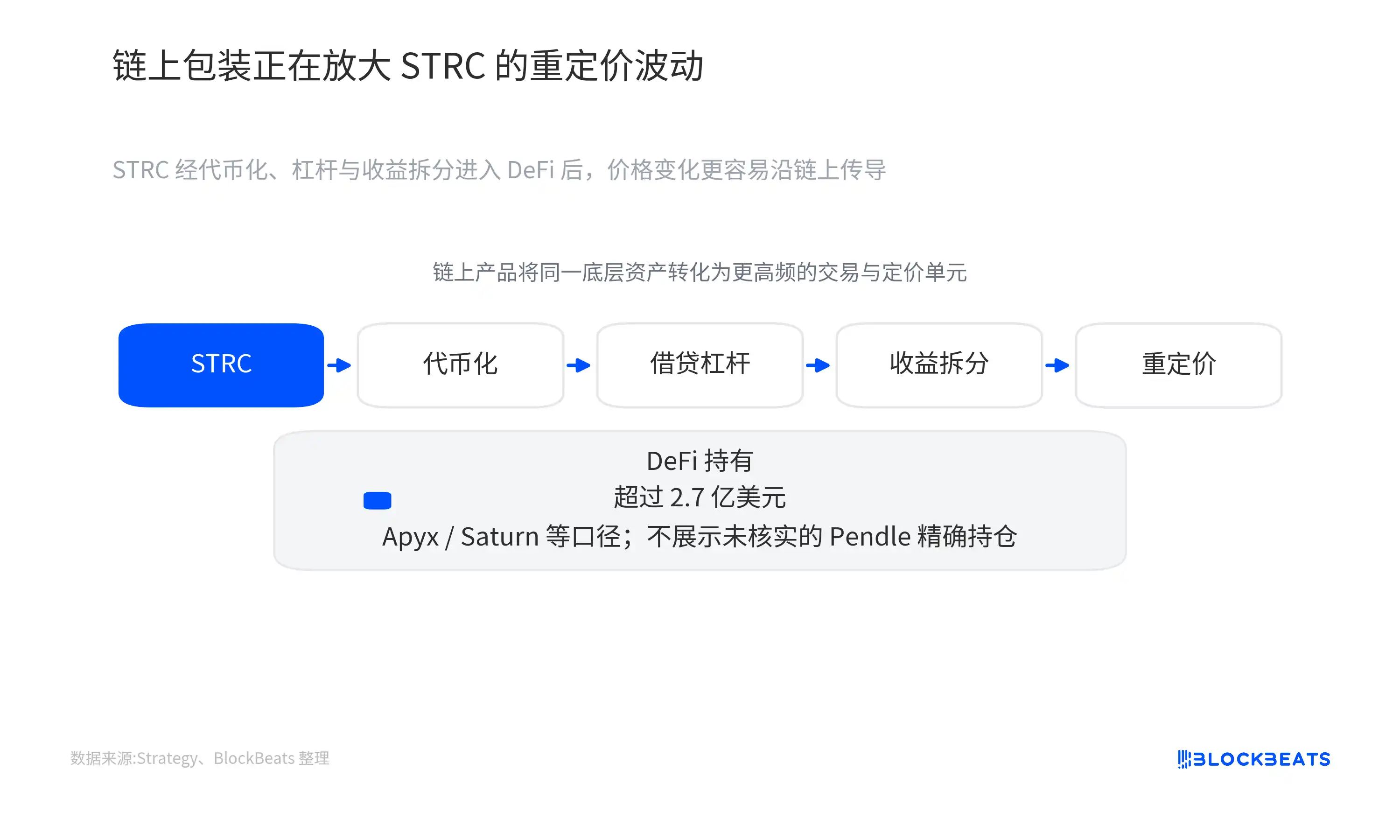
Preferred shares are inherently relatively slow assets: periodic dividends, secondary market trading, and price fluctuation around yield. When STRC is tokenized and enters lending, leverage, and yield-splitting systems, it connects to the faster liquidation and speculation mechanisms of the crypto market.
Protocols like Apyx, Saturn, Pendle have already built various forms of on-chain products around STRC. Saturn tokenizes it into an interest-bearing asset, Apyx offers leveraged yield aggregation, and Pendle can split the asset into PT (Principal Token) and YT (Yield Token) components. Investors can not only buy STRC itself but also trade the discounted principal or the rights to future dividends.
In plain terms, this is akin to splitting a traditional high-yield preferred share into multiple layers of crypto yield components. Some buy stable yield, some add leverage to amplify APY, and some bet solely on future dividends. Capital efficiency increases, but so does fragility. Once the underlying asset price drops, on-chain collateral ratios, borrowing positions, and yield token prices may adjust simultaneously.
A more prudent current assessment is that STRC has entered the on-chain yield, leverage, and splitting ecosystem. Strategy's documentation mentions sizes like Apyx (~$280M), xSTRC (~$83M), and STRC-backed stablecoins (~$70M). Pendle-related pools and trading also have notable size, though public information is insufficient to support claims of vault holdings reaching hundreds of millions of dollars.
Therefore, DeFi wrapping is better understood as a volatility amplification channel. It may not be the first domino to fall, nor can it directly prove this decline was led by on-chain liquidations. But it makes the originally slower price adjustment faster, more transparent, and more susceptible to repeated trading by leveraged capital.
SATA Changes the Yield Benchmark
Part of STRC's past appeal came from scarcity. It was a key product within the Strategy BTC financing system targeting yield-seeking capital, combining high yield, the BTC narrative, and a relatively clear par value anchor.
The emergence of SATA weakens this scarcity. According to Coindesk, Strive's SATA offers a 13% annualized yield and switched to distributing dividends every business day starting June 16th. Compared to STRC, SATA is smaller in scale and less liquid; it cannot be simply considered a direct replacement of the same magnitude. However, for purely yield-seeking capital, it provides a new benchmark for comparison.
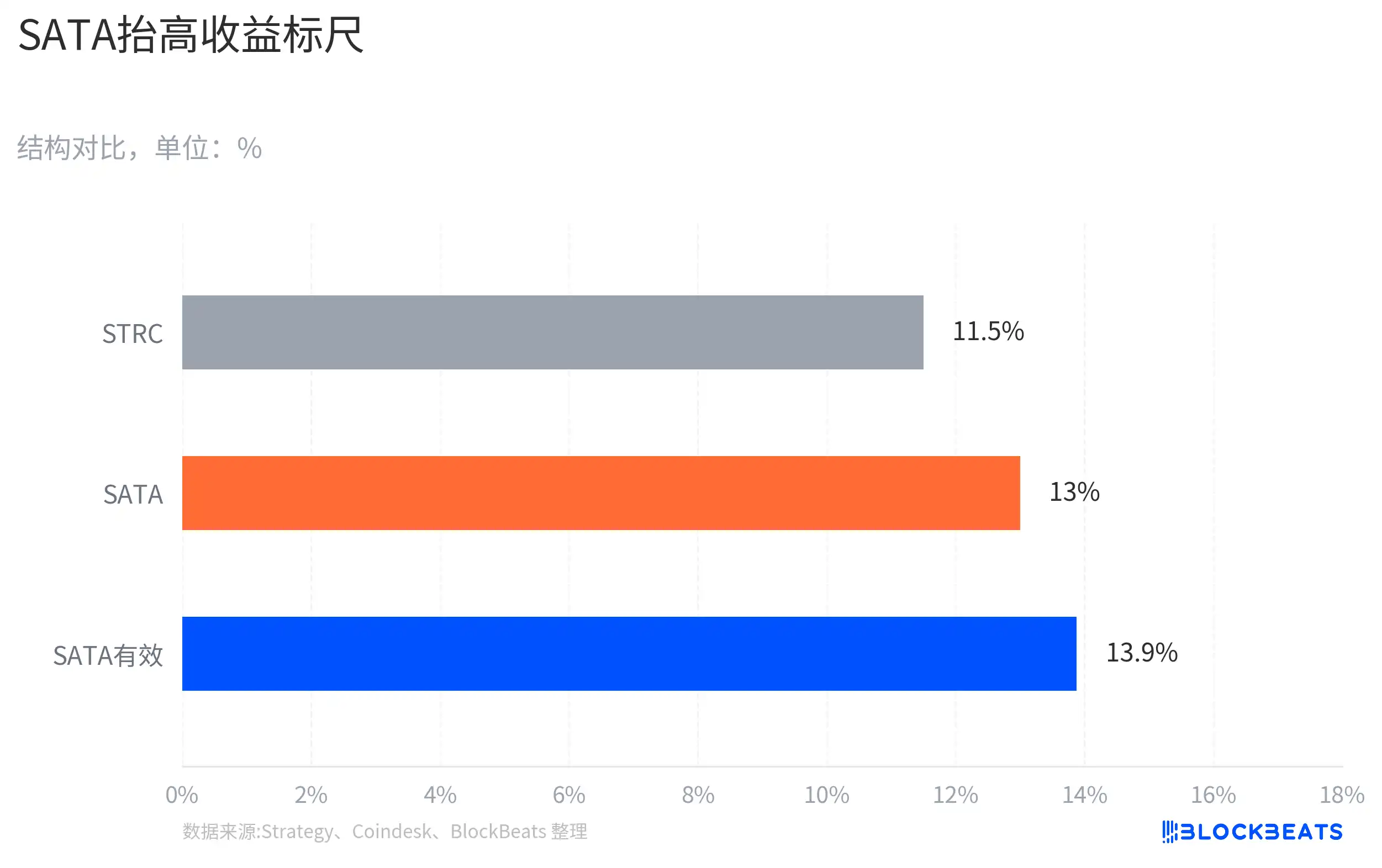
This impact doesn't require the premise that capital has already flowed massively from STRC to SATA. Yield-seeking capital will compare nominal yield, payout frequency, liquidity, issuer credit, asset coverage metrics, and secondary market discounts. As long as the market sees a benchmark offering higher yield and more frequent payouts, STRC's original "unique high-yield BTC instrument" narrative gets re-evaluated.
Around $100, STRC's 11.5% might have been attractive enough. But when the price falls to $89, the question becomes: Is the current simple yield of 12.9% sufficient compensation for Strategy's financing structure, BTC volatility, potential leverage squeeze, and cash flow uncertainty?
STRC's former anchor was "Strategy + BTC reserves + $100 par." The market now incorporates a yield curve of similar products. When a similar product offers higher nominal yield and more frequent payouts, for STRC to return to par, it needs stronger buying, clearer expectations of rate adjustments, or reduced leverage pressure.
Parity Mechanism Faces Cash Flow Scrutiny
STRC can be understood as a high-yield preferred share with no maturity date, anchored to a $100 par value. It has no fixed principal repayment date. Investors mainly look at two things: whether dividends can be sustained, and whether the secondary market price can stay near par.
Strategy designed an adjustable dividend mechanism for STRC. It's not a fixed-coupon preferred share leaving pricing entirely to the market; the company can adjust the dividend level monthly, aiming to keep the price around $100. Shareholder approval for the semi-monthly payment arrangement follows the same price stabilization logic: shortening the dividend waiting period, reducing uncertainty for yield-seeking capital.
Another layer of backing provided by the Saylor system is the BTC reserve. Strategy packages STRC as a special security: not a regular bank preferred share, nor a pure crypto token, but a high-yield financing tool backed by one of the world's largest corporate BTC holdings.
But asset coverage does not equate to cash flow without risk. The ~31.6 years of dividend coverage indicates a balance sheet buffer, reliant on BTC price, financing capability, and the company's long-term capital market access. It doesn't guarantee stable operating cash flow for each dividend period, nor does it mandate that the secondary market price must return to $100.
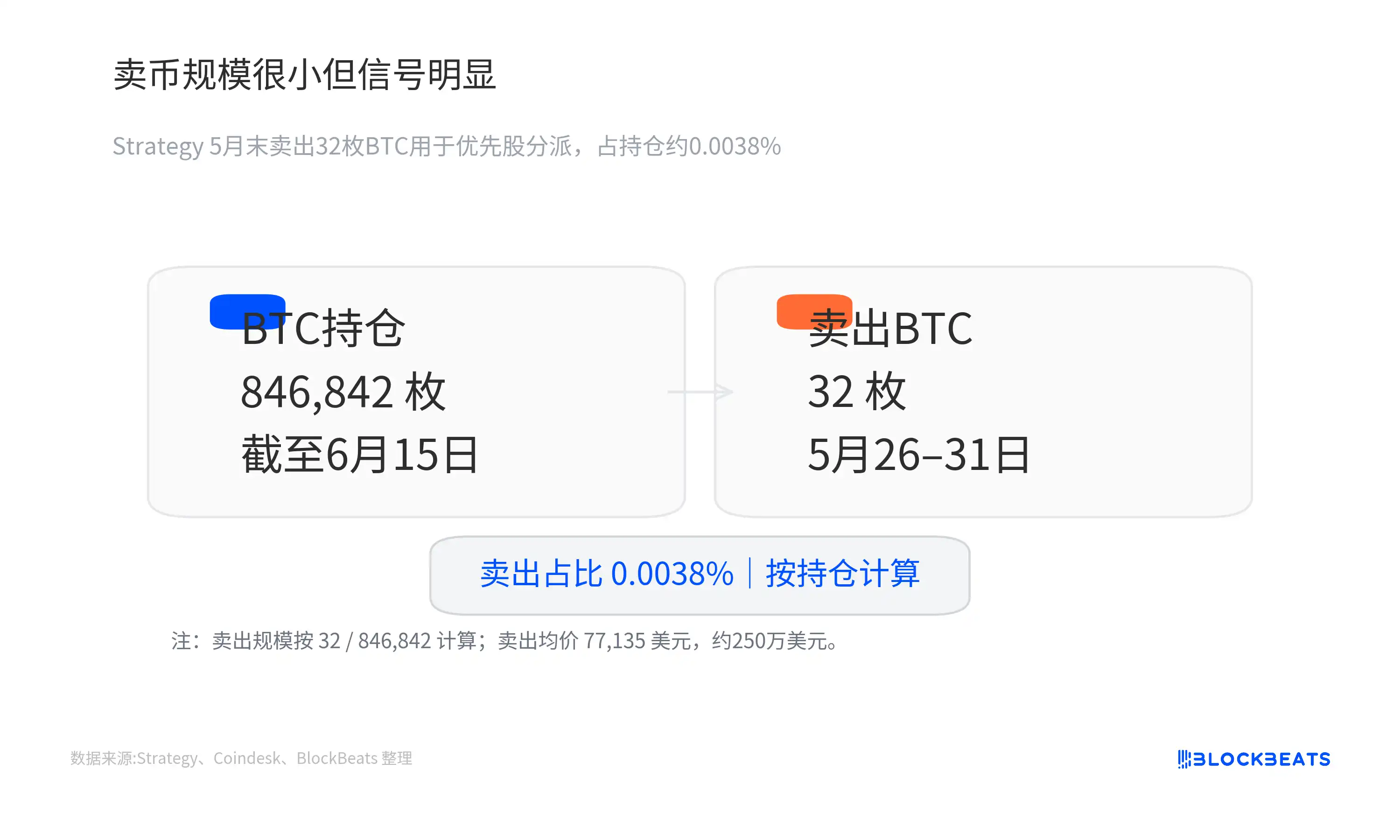
Strategy's June 1st disclosure showed that between May 26th and 31st, it sold 32 BTC at an average price of ~$77,135, totaling ~$2.5 million, for dividend-related arrangements. This scale is a tiny fraction of the holdings, hardly indicative of reserve pressure. But it reminds the market to distinguish between two things: having a large amount of BTC, and having stable cash flow.
Whether the Parity Anchor Can Be Restored Determines Financing Cost
The most important test for STRC now is not the ~31.6-year coverage claim itself, but whether Strategy will use actual mechanisms to pull the price back towards $100.
If Strategy continues to maintain an 11.5% annualized dividend while STRC remains in the $90 range for an extended period, the market may conclude the company tolerates higher financing costs, or that the adjustable dividend mechanism is not immediately repairing the unpegging. Conversely, if the company further increases the dividend rate, adjusts issuance pace, or uses other methods to boost secondary market confidence, $89 is more likely to be seen as an excessive discount following a deleveraging wave.
The on-chain side also needs monitoring. Whether STRC-related positions in Apyx, Saturn, Pendle, etc., cool down, and whether collateral and yield-splitting trades stabilize, will determine if the DeFi amplifier continues to add volatility or becomes a source of demand again post-deleveraging. The size and liquidity of SATA are also crucial. If it remains a small-scale high-yield benchmark, its impact on STRC stays largely in valuation comparison; if it continues to scale while maintaining the appeal of daily business-day payouts, STRC's scarcity discount will be harder to eliminate.
For investors, $89 is not simply a cheap tag, nor definitive proof of Strategy's model failure. It's more like a stress test: when BTC reserves, high nominal yield, on-chain leverage, and competing products are all presented to the market, what yield investors are ultimately willing to accept to hold such instruments. The next dividend adjustment, whether STRC can return near par, and whether leveraged positions continue to unwind, will answer this question better than the coverage period declaration.