Author丨Hu Shixin Editor丨Ye Jinyan
Produced by丨Shenwang·Tencent News Xiaoman Studio
At 1:00 AM Beijing time on June 9, Apple's WWDC 2026 kicked off in Cupertino. Tim Cook took the stage as usual with a "Good morning," but this time it felt more like a farewell: it was his 15th and final time hosting WWDC as CEO. On September 1st, John Ternus, Senior Vice President of Hardware Engineering, will take the helm of Apple.
This year marks Apple's 50th anniversary, with its market capitalization reaching a high of $4 trillion. However, this 78-minute keynote speech featured no new hardware products, almost entirely betting on AI. Over the past two years, Apple Intelligence has been delayed multiple times, the Siri overhaul has failed to materialize, and Apple paid a $250 million settlement in North America due to AI advertising controversies.
ChatGPT has already reshaped the industry for two and a half years. Can the Siri that Apple users once disliked become the gateway to the iPhone again?
Apple's answer is to remake Siri, build underlying capabilities with the help of Google's model technology, and embed AI into native apps like Safari, Photos, Passwords, and Shortcuts. However, the capital market did not seem immediately convinced. On the day of the launch, Apple's stock price closed down 1.89%, falling another approximately 1.92% after hours, wiping out over $75 billion in market value.
An Apple AI that the world has waited two years for has finally come to the fore. The question is, has it truly addressed its shortcomings, or is it merely packaging its lateness as a new beginning?
Siri AI, Lending Its "Soul" to Google
About 30 minutes into the launch event, Apple Intelligence and Siri AI took the stage.
It is reported that the new generation of Apple Intelligence will be advanced through collaboration with Google, building the next generation of Apple Foundation Models based on the technology behind the Gemini series of models. Part of this model suite runs on the device, handling tasks with lower latency and more personal data relevance; another part is handled by private cloud computing servers for heavier requests like image generation and complex reasoning.
Apple also introduced a system orchestrator to schedule capabilities such as personal context understanding, world knowledge, app operations, and screen awareness. In other words, Apple wants AI not just to answer questions, but to understand what the user is looking at, what's on the device, and which apps can be invoked.
Apple also continued to emphasize its consistent privacy narrative: data only serves the current request, is not stored, and cannot be accessed by Apple or third parties.
After the launch, Apple executives added that this is not simply integrating Gemini. The Apple Foundation Model consists of multiple groups of models on-device and in the cloud, customized for Apple Silicon, trained using Gemini's distillation techniques, but ultimately the models running for users are Apple's own.
The remade Siri is renamed Siri AI, has its own app for the first time, and conversation history can sync across iCloud. It is placed in the Dynamic Island, supports screen content understanding, and can invoke apps through App Actions to complete tasks: such as generating a party menu based on a schedule, extracting information from text messages to complete an invitation, identifying bills for splitting costs, and determining if a backpack is allowed on a flight based on flight details. Native apps like Safari, Passwords, Phone, and Photos also have AI capabilities embedded.
Apple's intent is clear: Siri is no longer just a voice gateway, but an operational hub embedded between the system and applications.
However, post-launch feedback wasn't entirely optimistic. External controversy mainly focused on one point: Siri AI did address shortcomings like context understanding, screen awareness, and cross-app invocation, but the capabilities it demonstrated are largely directions that other large model products have repeatedly proven over the past two years. It makes Siri more of a system-level assistant than before, but has yet to show a truly unexpected new gateway.
Additionally, due to regulatory requirements, Siri AI and the full Apple Intelligence features are not available in the EU and mainland China. For users of domestic models, the core AI updates from the launch remain visible but not immediately usable.
Cook's AI Debt
Apple's current passivity in AI has accumulated bit by bit over the past decade or so.
Since taking over Apple, Tim Cook has brought the company to what could be considered the peak in commercial terms. Over the past 15 years, Apple's market capitalization has risen from about $350 billion to $4 trillion. But on the other hand, the certainty-driven management that characterizes the "Cook era" has also made Apple slow in the generative AI race.
Senior analyst Ming-Chi Kuo previously commented that Cook built a profit fortress with extreme supply chain management, but also saddled Apple with a heavy AI debt.
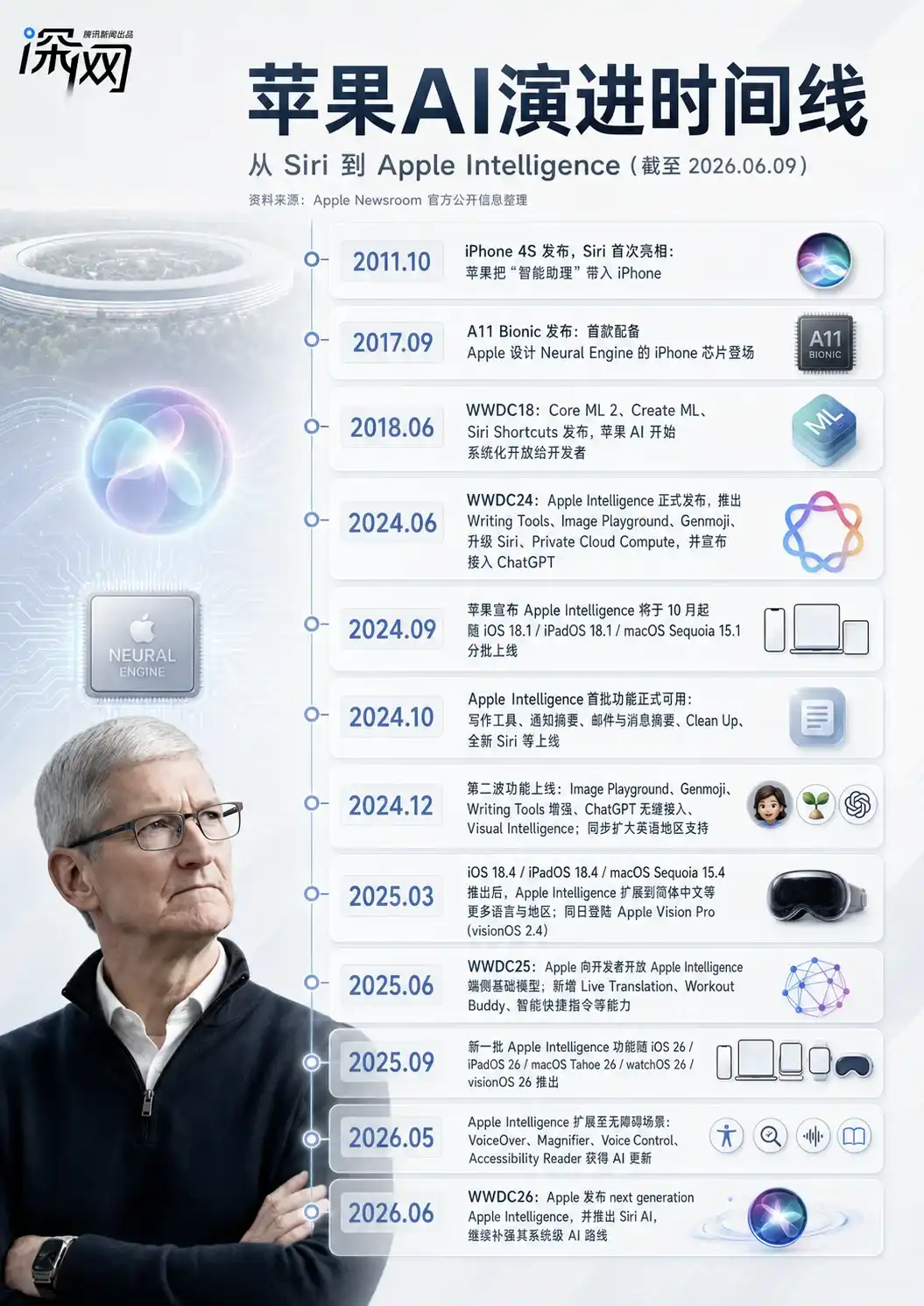
Siri is the most typical example of this debt. In 2010, Steve Jobs acquired Siri for $200 million. In 2011, with the launch of the iPhone 4S, Siri debuted. It was originally Apple's early bet on an intelligent assistant gateway, but over the next decade, it repeatedly missed upgrade windows. Siri's leadership changed hands multiple times, from Scott Forstall, Eddy Cue, to Craig Federighi, John Giannandrea. Each reshuffle was hoped to be a restart, but ultimately failed to make Siri truly intelligent.
In 2018, Cook poached Giannandrea from Google to bolster AI capabilities. At the time, Craig Federighi, Apple's Senior Vice President of Software Engineering, told the team that this was the AI talent Apple needed. But seven years later, Siri remains stuck in the awkward position of being "able to wake up, able to answer, but not easy to use." What laid the problem bare was the emergence of ChatGPT. An Apple executive later admitted to Bloomberg that before that, Apple Intelligence wasn't even a clear plan.
Apple also tried to remedy the situation. At WWDC 2024, Apple Intelligence was announced. The demo showed Siri could understand personal data, operate across apps on the phone, and the iPhone 16 was marketed as "born for Apple Intelligence." But after the new phone went on sale, the core version of Siri did not launch as promised. Bloomberg later reported that Federighi found during internal testing that some demo functions were not stable, and those impressive scenes were more like pre-recorded prototype videos. After repeated delays, Apple pulled related advertisements, and users who purchased the iPhone 16 filed lawsuits.
Apple then reorganized its AI team. It is reported that in March 2025, Siri was stripped from Giannandrea's purview and transferred to Mike Rockwell, head of Vision Pro. Rockwell brought in core Vision Pro team members, replaced part of the original Siri team, and worked with Federighi and others to advance collaboration with Google, using Gemini and Google Cloud to strengthen the underlying capabilities of the new Siri. The Information disclosed that the key reason behind the collaboration was that Apple's in-house models were not yet ready, particularly struggling to run stably on-device.
Organizational turmoil followed. Core members like the head of the foundation model team, Ruoming Pang, left for Meta one after another. At the end of 2025, Giannandrea announced his retirement. Former Google executive Amar Subramanya took over as Vice President of AI, reporting to Federighi. Apple's traditionally stable product system appeared rushed for the first time in the face of AI.
This is not the only time the Cook era missed a window. Shenwang previously outlined several of his regrets: the decade-long, nearly $10 billion "Project Titan" car project was ultimately scrapped; Vision Pro is technologically impressive, but its $3,499 price tag and limited use cases led to a lukewarm market response, with about 390,000 units shipped in 2024. In comparison, Siri makes the outside world even more anxious.
Bloomberg reported that after the Apple Intelligence setback, Cook rarely intervened deeply in the AI roadmap, participating in key decisions. In an all-hands meeting in August 2025, he stated this was "somewhat our opportunity" and that Apple would invest unlimited resources. A senior executive's judgment was: Apple's past playbook of coming from behind, relying on over a billion users to overtake competitors, might not work this time.
(AI-generated image)
Not Building the Strongest Model, But Cannot Lose the Gateway
In the view of several analysts, what Apple most wants to protect with this AI push is not the label of "strongest model," but the primary gateway on the iPhone.
A developer long focused on the Apple ecosystem believes Apple can accept that model capabilities come from external partnerships, can offload some computing costs to model vendors, but cannot accept users bypassing Siri and system services, directly using ChatGPT, Gemini, or Claude as the default gateway on their phones. What Apple wants to protect is that layer of system permission where users make requests, access data, and complete tasks.
This is also why Apple Intelligence repeatedly emphasizes on-device computing, private cloud computing, and personal context. Compared to simple Q&A, Apple cares more about whether AI can understand the screen the user is viewing, the information already on the device, and which apps can be invoked. The above-mentioned person judges that third-party large models can become increasingly powerful, but they cannot naturally access the deepest personal context within a user's phone, a part Apple is unwilling to give up.
Private cloud computing is therefore not just a technical solution but also related to commercialization. Federighi mentioned that some functions relying on server models would have daily usage limits, with iCloud+ users getting higher quotas. Several analysts thus speculate that Apple may tie high-cost AI features to subscription systems in the future, but the premise remains making users believe: data is not given to external model companies, and Apple has not sacrificed its privacy promises.
The gateway battle could also change App Store rules. Bank of America analyst Wamsi Mohan proposed that if Siri evolves into an AI agent, future app competition might focus less on downloads and usage time, and more on which service becomes invoked by Siri. Mohan estimates that if Siri successfully transforms into an AI agent, it could bring Apple $15 to $30 billion in incremental revenue by fiscal year 2030.
The concerns of the cautious camp are also clear. MoffettNathanson analyst Craig Moffett believes the market has already priced Apple Intelligence as a catalyst, not a potential risk. Apple's current valuation is above its five-year average. To support this valuation, it must prove that AI can drive a larger-scale device replacement cycle or translate into new service revenue. The capital market wants to see not just Siri becoming more useful, but whether AI can reignite Apple's growth curve.
Hardware gateways were originally seen as another undercurrent for Apple's AI. Multiple sources previously indicated that Apple had been advancing a series of wearable devices centered around Siri and visual perception, including smart glasses, pendant devices, and AirPods with cameras. They point in the same direction: if the AI gateway shifts from screens to vision, voice, and spatial perception, Apple cannot rely solely on the iPhone.
But progress on this path has not been smooth. According to multiple reports, Apple has adjusted part of its Vision hardware roadmap, shifting resources to lighter smart glasses; the AirPods with camera project, once thought to be near late-stage testing, later faced news of being shelved due to EU privacy compliance and supply chain adjustments.
An industry insider long tracking Apple believes what Cook leaves for the next CEO is a system logic that needs rewriting in the AI era. In the past, Apple could wait for technology to mature, then rely on integrated hardware and software to create a better experience. But the AI window doesn't entirely follow this rhythm; it requires continuous iteration, user habits, and faster organizational reactions.
Siri's original co-founder, Dag Kittlaus, remains optimistic. He told Bloomberg that as long as Siri gets a "brain transplant," Apple still has a chance to make it the user's first choice again. This sounds simple but points to Apple's core problem over the past decade-plus: Siri never lacked a gateway; what it lacked was being smart enough.