Original | Odaily Planet Daily (@OdailyChina)
Author | Azuma (@azuma_eth)
After the U.S. market closed on Wednesday, storage chip giant SanDisk announced its fourth fiscal quarter and full fiscal year results for the period ended July 3.
The financial report data shows that SanDisk's revenue for this fiscal quarter was $8.97 billion (market expectation $8.48 billion), a surge of 372% year-on-year and an increase of 51% quarter-on-quarter; the adjusted earnings per share (EPS) under the non-GAAP measure was $39.25, 135 times the level of a year ago ($0.29), also an increase of 68% quarter-on-quarter, nearly 10% higher than market expectations; the adjusted gross profit margin reached 84.6%, a significant increase of 58.2 percentage points year-on-year.
From a full-year perspective, SanDisk's fiscal year 2026 was also stunning. Full-year revenue reached $20.25 billion, a year-on-year increase of 175%; net profit under the GAAP measure was $11.43 billion, and the full-year Non-GAAP EPS was as high as $70.88. It is worth noting that in fiscal year 2025, SanDisk was still in a loss position of $1.64 billion. Completing such a reversal in one year itself illustrates the combined power of the NAND storage cycle and AI demand.
However, the capital market did not give positive feedback to this earnings report. Before the earnings release, SanDisk's closing price had already fallen by 5.4%; after the earnings release, it plummeted nearly 8% in after-hours trading, temporarily reporting at $1,243 as of 11:00.
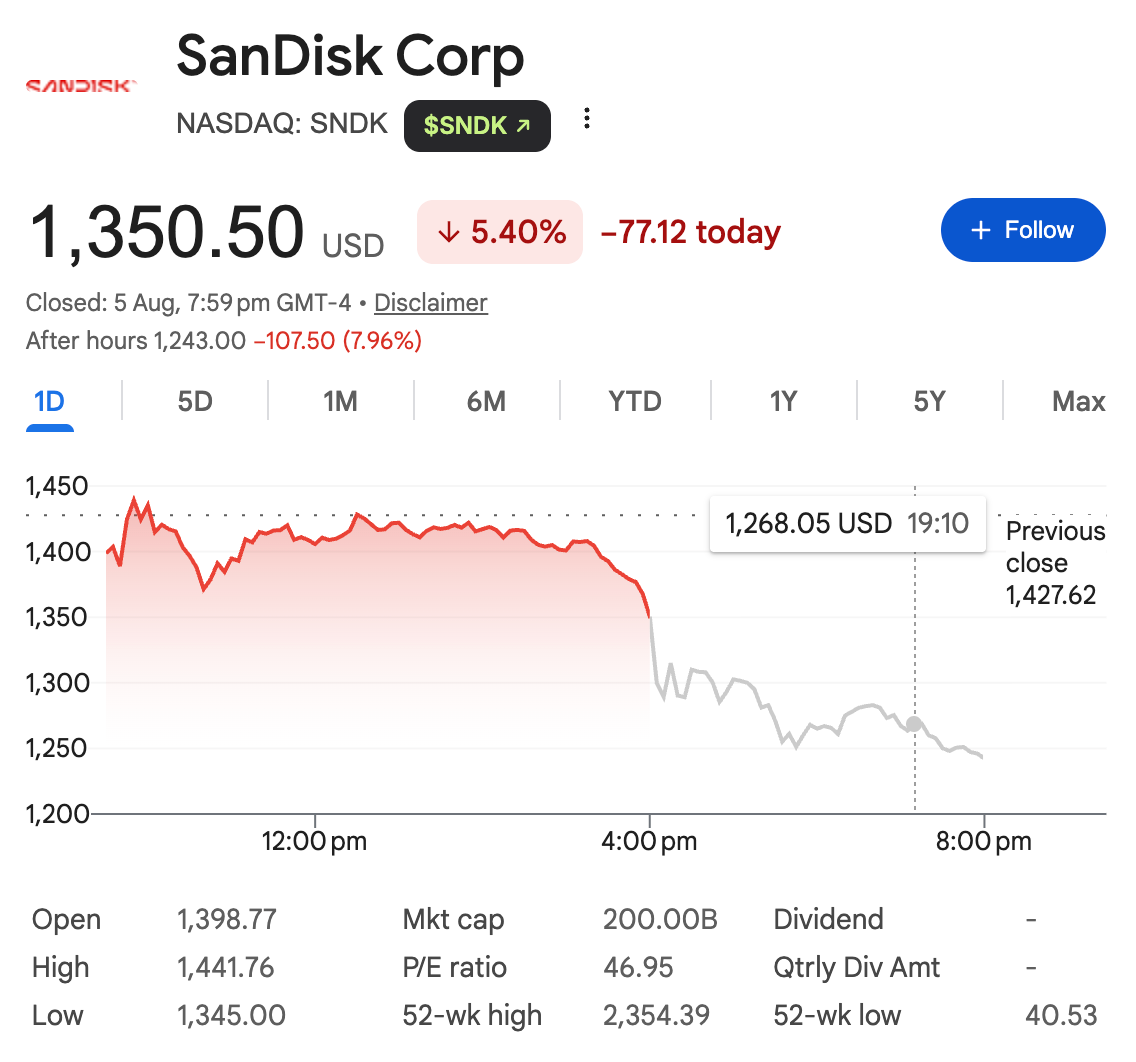
Why didn't the market reward such a "record-breaking" earnings report? The underlying logic is similar to what we wrote about SK Hynix's earnings this quarter (refer to "SK Hynix's Most Profitable Quarter Ever, Why Still 'Missed Expectations'?"). For such major storage manufacturers, investors are no longer just concerned about whether performance can grow, but whether growth can continue to exceed already significantly elevated expectations.
There is another issue, different from SK Hynix, related to unfinished guidance. SanDisk's revenue guidance range for the next fiscal quarter is $10.3 billion to $10.8 billion, with a midpoint of $10.55 billion, while the market previously expected $11.16 billion, a gap of about 5.5% — in summary, the market is not denying the performance SanDisk has already delivered, but is worried about whether its future growth rate can continue to meet even higher expectations.
Core Business Breakdown: What Changes in Revenue Structure?
By breaking down SanDisk's revenue structure for this fiscal quarter, we can see more clearly the qualitative transformation this company is undergoing.
As SanDisk CEO David Goeckeler emphasized, the data center business has become SanDisk's undisputed growth engine. Fourth-quarter data center revenue was $2.98 billion, a nearly 13-fold (1298%) year-on-year increase, doubling (103%) quarter-on-quarter, with its share of revenue rising from about 11% a year ago to 33%. For the entire fiscal year 2026, data center revenue skyrocketed 437%, and management has clearly established it as a "key growth pillar." Against the backdrop of exploding demand for AI servers and high-performance computing storage, SanDisk is clearly benefiting from this wave of infrastructure investment.
The Edge Computing business remains SanDisk's largest source of revenue currently, with quarterly revenue of $5.43 billion, a 392% year-on-year increase and 48% quarter-on-quarter growth. This part mainly serves the enterprise and terminal equipment markets, with a large scale and steady growth rate, forming SanDisk's foundation.
The only relative weakness appears in the Consumer segment. This quarter's consumer business revenue was only $556 million, a slight year-on-year decrease of 5%, and a sharp quarter-on-quarter decline of 32%, far below the market expectation of $874 million. Weak demand in traditional consumer electronics and lengthening PC and smartphone replacement cycles have made this business the most obvious drag in the earnings report. However, from a strategic perspective, SanDisk is actively optimizing its customer structure, tilting towards the high value-added data center and enterprise markets. The contraction of the consumer business is, to some extent, a growing pain during the transition period.
Biggest Highlights: Long-Term Agreements + Buyback
It is worth noting that SanDisk management spent a significant portion of the earnings call explaining the strategic significance of its "New Business Model" (NBM) long-term agreements.
In the history of the NAND industry, supply and prices have typically been negotiated quarterly, resulting in severe cyclical fluctuations. SanDisk disclosed that after announcing 5 NBM long-term agreements during the April earnings season, this quarter's earnings report revealed another 5 NBM agreements, including 3 new agreements and expansions/upgrades to 2 existing agreements. Related orders will cover supply for many years into the future, with over half of the supply for fiscal year 2027 already locked in advance, and about two-thirds of the supply for fiscal year 2028 also arranged.
David Goeckeler bluntly stated the hope to "enhance business predictability and cyclical resilience through long-term agreements, breaking free from the industry's past cycle of booms and busts." From an industrial logic perspective, this is undoubtedly the correct long-term strategy — using long-term agreements to lock in capacity, smooth price volatility, and deepen ties with major customers; but in short-term trading, long-term agreements also mean that some price elasticity is locked in. When the market is at the peak of a price increase cycle, investors may worry whether the company "sold too cheaply" by locking in orders in advance.
The $14 billion stock buyback plan announced concurrently with the earnings is another noteworthy signal. Combined with the existing amount, SanDisk's total remaining repurchase authorization has reached $15.5 billion. For a company that experienced a 47% stock price plunge in July and lost over $150 billion in market value, such a large-scale buyback is not only a demonstration of management's confidence in cash flow but also a signal to the market that "the current stock price is attractive."
However, buybacks generally belong to medium-to-long-term variables and are difficult to counteract the selling pressure caused by guidance disappointment in the short term. Especially during the earnings release event window, trading logic will still prioritize the core proposition of "whether revenue guidance is revised upward."
Where Exactly is the "Gap" in Guidance?
Returning to the forward guidance most concerning to the market. SanDisk expects first fiscal quarter 2027 revenue of $10.3 billion to $10.8 billion, with a midpoint of $10.55 billion, corresponding to a year-on-year growth of approximately 359%. This number itself is not bad — still showing quarter-on-quarter growth, with year-on-year growth rate remaining high — but the market had already priced in this expectation too fully.
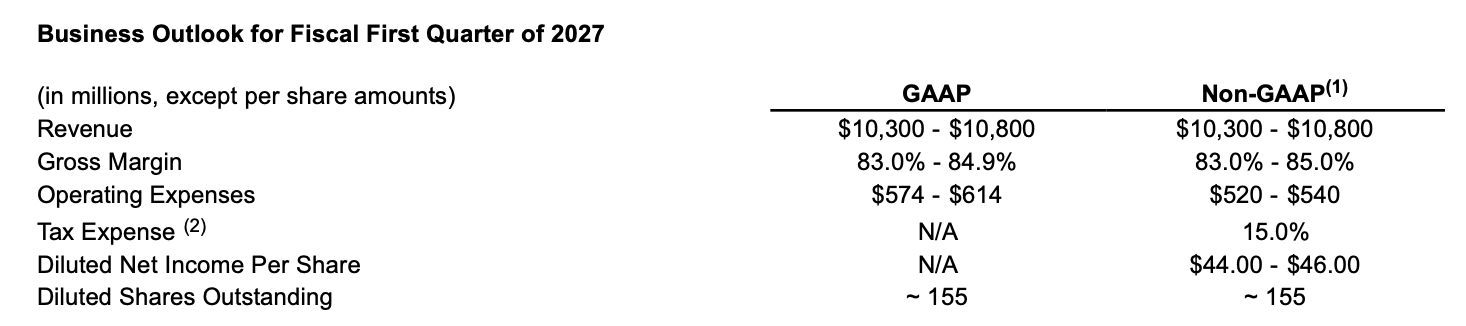
A more subtle signal comes from gross margin. SanDisk's adjusted gross margin reached a historical high of 84.6% in the fourth quarter, but the company's gross margin guidance range for the next quarter is 83% to 85%, with a midpoint of about 84%. Although still at an extremely high level, there is no sign of further expansion, instead giving a sense of "peaking at a high level, entering a plateau phase." For investors accustomed to SanDisk continuously breaking through gross margin ceilings over the past few quarters, this mentality of "unchanged is negative news" is further amplified in the current market environment.
The EPS guidance range is $44 to $46, with a midpoint of $45, basically falling near market expectations,谈不上惊喜。 Following a "record-breaking" earnings report, the market was waiting for guidance that was "even more record-breaking," but what SanDisk provided was just "normally good."
The Market Focuses Not on Growth, But on the Acceleration of Growth
Yesterday, while compiling Arthur Hayes' new article, I saw this sentence: "What investment really trades is not growth itself, but the acceleration of growth."
In other words, the market is actually focused on the second derivative — whether growth is accelerating or decelerating.
Judging from this earnings report, SanDisk's fundamentals have not shown obvious weakening. Whether it's record quarterly revenue, high gross margin maintenance, or the data center business becoming a new growth pillar, the company is benefiting from the NAND cycle recovery and the structural changes brought by AI infrastructure investment. However, the capital market's focus has long shifted from "whether performance is excellent" to "how can it grow further."
Over the past year, the storage sector has undergone a significant revaluation of expectations. On one hand, AI data center construction has driven demand growth for high-performance storage; on the other hand, NAND industry supply contraction and price recovery have also propelled soaring profit margins for related companies.
Against this backdrop, the valuation given to SanDisk by the market has long reflected not only the current profit level but also priced in expectations for continued accelerated growth in future quarters. Therefore, when the company's guidance for the next quarter only maintains high growth without further upward revision, the market reaction becomes even more sensitive.
This is also the core contradiction of SanDisk's earnings report this time — fundamentals remain strong, but expectations have already run ahead of performance.