U.S. 'Operation Economic Outcast' Targets Iran's Crypto Sector, Over $100 Million in Oil-Related Payments Allegedly Facilitated via Cryptocurrency

marsbitPublished on 2026-08-25Last updated on 2026-08-25

Abstract

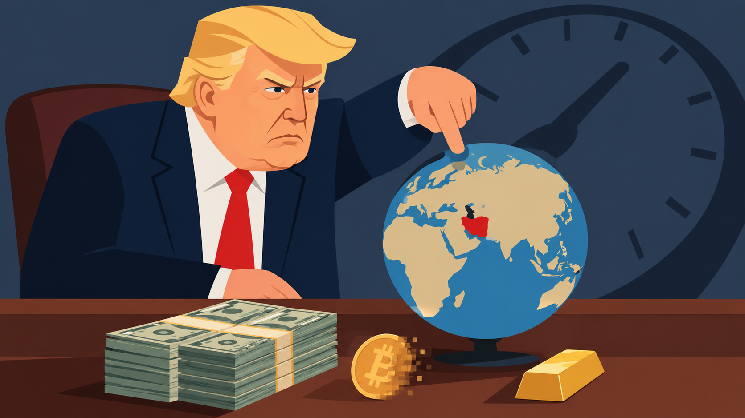
U.S. Treasury Launches "Operation Economic Outcast," Sanctions Iran's Crypto Sector On August 24, the U.S. Treasury Department initiated "Operation Economic Outcast," a government-wide economic campaign against Iran. As part of this, the Office of Foreign Assets Control (OFAC) issued a sectoral sanctions determination targeting digital assets under Executive Order 13902, significantly expanding its authority. The Treasury stated that Iran is increasingly using cryptocurrency as a "tool of choice" to evade sanctions and support transactions linked to the Islamic Revolutionary Guard Corps (IRGC). Concurrently, OFAC sanctioned Ukrainian-Emirati broker Ivan Obukhov and his company, Foscom FZE. The Treasury alleges that since 2023, Obukhov has processed over $100 million in cryptocurrency payments to facilitate oil sales on behalf of the IRGC-Quds Force. Nearly 60 other entities, individuals, and vessels involved in nuclear procurement, cyber operations, and oil revenue networks were also sanctioned. This move marks an escalation from prior actions against specific exchanges, now establishing a broad basis to sanction any foreign entity deemed to operate in or support Iran's digital asset sector. Treasury Secretary Scott Bessent warned that any entity engaging economically with the Iranian regime will face the full reach of U.S. power, calling the operation an "economic D-Day" aimed at isolating Tehran.

Author: Claude, Deep Tide TechFlow

Deep Tide's Guide: On August 24, the U.S. Treasury Department launched "Operation Economic Outcast." OFAC included digital assets within the scope of sanctions on Iran's economic sector under Executive Order 13902, stating that Iran is increasingly using cryptocurrency as a preferred tool for sanctions evasion. The Treasury Department alleges that Emirati-Ukrainian broker Ivan Obukhov has facilitated over $100 million in cryptocurrency payments since 2023, assisting in oil sales for the Islamic Revolutionary Guard Corps' Quds Force (IRGC-QF), and sanctioned him and his company Foscom FZE. Concurrently, nearly 60 entities, individuals, and vessels were added to the sanctions list.
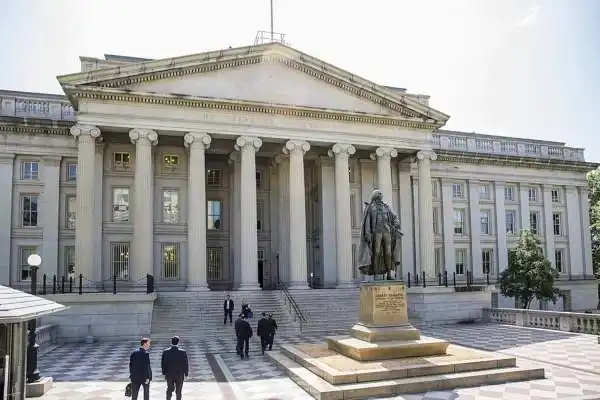
The U.S. Treasury Department announced the launch of "Operation Economic Outcast" on August 24, describing it as a whole-of-government economic campaign targeting the Iranian regime and its supporters. As part of the operation, the Office of Foreign Assets Control (OFAC) issued sectoral sanctions determinations targeting five key sectors—digital assets, technology, gold, aviation, and shipping—under Executive Order 13902.

This determination "significantly expands" OFAC's ability to sanction foreign individuals and companies: they can be sanctioned if they are determined to be operating in or providing supportive services to Iran's digital asset sector, regardless of location. Property of designated persons subject to U.S. jurisdiction will be blocked, and foreign financial institutions that facilitate significant transactions for them may face restrictions on their U.S. correspondent or payable-through accounts.

The Treasury Department stated clearly in its announcement: "The Iranian regime is increasingly turning to cryptocurrency as the tool of choice for sanctions evasion, facilitating transactions linked to the Islamic Revolutionary Guard Corps (IRGC) and Iranian regime insiders."

Over $100 Million in Crypto Payments Allegedly Aid IRGC Oil Sales

In this action, OFAC specifically sanctioned Emirati-Ukrainian broker Ivan Obukhov and his company, Foscom FZE.

According to the Treasury statement, Obukhov has for years served as a broker for vessels in Iran's shadow fleet and facilitated oil shipments for the Iranian military and its proxies. Since 2023, he has processed over $100 million in cryptocurrency payments to facilitate oil sales on behalf of the IRGC-QF. He also coordinated with others to procure vessels later used for sanctions evasion activities. Foscom FZE is a UAE-based company he acquired and serves as the owner and general manager of, in 2022.

Obukhov was designated pursuant to E.O. 13224, as amended, for having materially assisted, sponsored, or provided financial, material, or technological support for, or goods or services to or in support of, the IRGC-QF. Foscom FZE was designated for being owned, controlled, or directed by, or having acted or purported to act for or on behalf of, directly or indirectly, Obukhov.

The Treasury Department concurrently sanctioned nearly 60 entities, individuals, and vessels, covering networks for nuclear and missile procurement, cyber operations, and oil revenue.

Sectoral Sanctions Significantly Move Secondary Sanctions Risk Forward

Unlike previous pinpoint actions against specific exchanges or wallets, this digital asset sector determination establishes a broader sanctions basis. Any foreign person determined to be operating in or providing supportive services to Iran's digital asset sector may be added to the sanctions list.

In a related statement, Treasury Secretary Scott Bessent said: "Today, at the direction of President Trump, the U.S. Treasury Department is launching 'Operation Economic Outcast'... Our goal is to sever every economic lifeline propping up this authoritarian regime until Tehran is left isolated." He likened the operation to an "economic D-Day," emphasizing that the United States is no longer merely "managing" the Iranian threat but seeking to "end" it.

Bessent also warned that any entity engaging economically with the regime will face the full reach of American power.

Previous Series of Enforcement Actions Targeting Iran's Crypto Channels

This sector-level action is the latest escalation in the U.S. ongoing effort to constrict Iran's cryptocurrency channels.

In January 2026, OFAC sanctioned digital asset exchanges linked to Iran for the first time, designating UK-registered Zedcex and Zedxion. In June, the Treasury Department sanctioned four Iranian crypto exchanges, including Iran's largest platform, Nobitex. On August 7, OFAC sanctioned Shelbit and Aban Tether, stating the pair collectively facilitated approximately $5 million in digital asset flows linked to Iran.
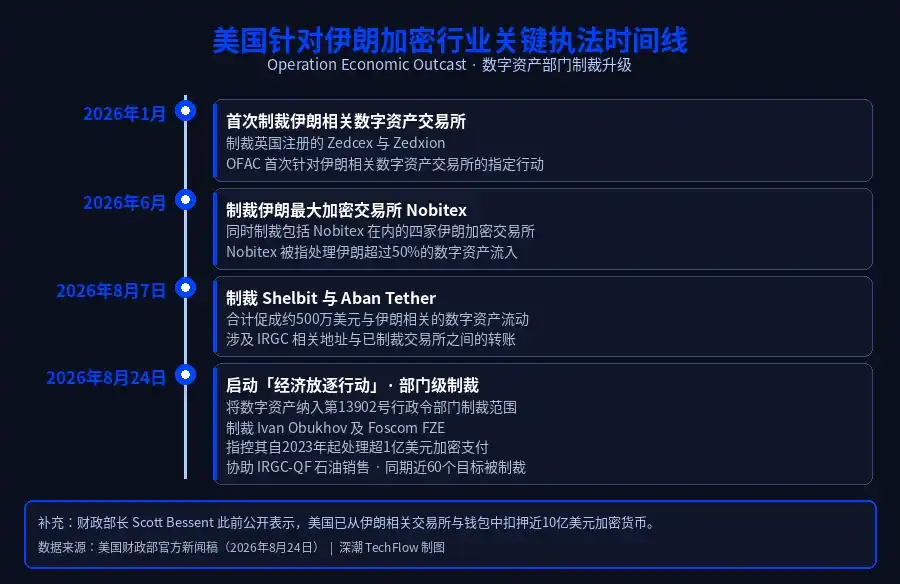
Treasury Secretary Bessent previously stated publicly that the U.S. had seized nearly $1 billion in cryptocurrency from Iran-linked exchanges and wallets. Previous enforcement also included blocking actions against specific wallets.

The Treasury Department listed digital assets alongside technology, gold, aviation, and shipping as key areas through which Iran seeks to prop up its economy, stating it has mapped the nodes of the networks Iran uses to smuggle oil, evade sanctions, and fund related activities.

Role of Crypto Payments in Oil Sales and Sanctions Evasion Further Targeted

U.S. officials have characterized cryptocurrency as a critical alternative pathway for Iran after its traditional financial channels were restricted. The Treasury Department noted that digital assets are being used to support transactions linked to the IRGC and regime insiders, and are tied to activities such as the repatriation of oil sales revenue.

The inclusion of the entire digital asset sector under the E.O. 13902 framework means the threshold for future sanctions against foreign intermediaries, exchange service providers, payment channels, and even related technical support providers is further lowered. Designated persons not only face asset blocking risks themselves, but their transaction counterparts may also trigger secondary sanctions considerations.

As of publication, OFAC has already taken designation actions against relevant persons pursuant to the above determination and continues to update the sanctions list.

Related Questions

QWhat is the main focus of the U.S. Department of the Treasury's "Operation Economic Outcast" announced on August 24?

AThe main focus of Operation Economic Outcast is a whole-of-government economic campaign targeting Iran's regime and its supporters. It involves sanctioning five key sectors: digital assets, technology, gold, aviation, and shipping, significantly expanding OFAC's ability to sanction foreign individuals and companies operating within these sectors on behalf of Iran.

QAccording to the U.S. Treasury, how has Iran allegedly used cryptocurrencies, and what specific case was highlighted?

AAccording to the U.S. Treasury, Iran is increasingly using cryptocurrencies as a tool of choice for sanctions evasion, particularly to support transactions linked to the Islamic Revolutionary Guard Corps (IRGC) and regime insiders. A highlighted case involves Emirati-Ukrainian broker Ivan Obukhov, who is accused of facilitating over $100 million in cryptocurrency payments since 2023 to support oil sales for the IRGC-Quds Force.

QWho is Ivan Obukhov, and what actions led to his sanctioning by OFAC?

AIvan Obukhov is an Emirati-Ukrainian broker and the owner/manager of the UAE company Foscom FZE. He was sanctioned by OFAC for acting as a broker for vessels in Iran's shadow fleet, assisting in oil shipments for the Iranian military and its proxies, and specifically for facilitating over $100 million in cryptocurrency payments to support IRGC-QF oil sales since 2023. He was designated under Executive Order 13224 for providing material support to the IRGC-QF.

QHow does the new digital asset sector sanction differ from previous U.S. actions against Iran's cryptocurrency use?

AThe new digital asset sector sanction, established under Executive Order 13902, differs from previous actions by creating a broader basis for sanctions. Instead of targeting specific exchanges or wallets individually, it allows OFAC to sanction any foreign person determined to operate or provide support services within Iran's digital asset sector. This significantly lowers the threshold for future sanctions against intermediaries, service providers, and payment channels.

QWhat previous enforcement actions against Iranian cryptocurrency channels does the article mention leading up to this announcement?

AThe article mentions several previous enforcement actions: In January 2026, OFAC sanctioned UK-registered exchanges Zedcex and Zedxion. In June, it sanctioned four Iranian crypto exchanges, including the largest platform Nobitex. On August 7, OFAC sanctioned Shelbit and Aban Tether for facilitating around $5 million in Iran-related digital asset flows. Treasury Secretary Bessent also stated that nearly $1 billion in cryptocurrency had been seized from Iran-related exchanges and wallets.

Related Reads

Zhong Shanshan Invests in Liang Wenfeng

Chinese billionaire Zhong Shanshan, known for his low-profile and solitary investment style, has made a rare foray into the red-hot AI sector by indirectly investing approximately 350 million RMB into AI startup DeepSeek. This investment was executed through his private equity firm, Guānzī Venture Capital, as part of DeepSeek's first funding round in June, which also attracted major players like CATL, Tencent, JD.com, and state funds. Zhong, the founder of Nongfu Spring and a controlling shareholder of Wantai Biological, typically focuses his investments in pharmaceuticals and new materials through his investment vehicles under the Yangshengtang umbrella. These include Guānzī Venture Capital, Qiantang New Materials Laboratory, and the Kunshan Gewu Zhizhi Fund. His investment in DeepSeek marks a significant expansion into AI large models, following a previous investment in the AI optical chip company, X-Chip. The article highlights a growing trend of "Old Money" — successful entrepreneurs from traditional industries like consumer goods, healthcare, and apparel — entering the AI and hard tech investment arena. Examples from the same DeepSeek funding round include Jiuan Medical, By-Health, and Septwolves' Zhou Shaoxiong, who are all deploying capital from their industrial empires into next-generation tech companies. This shift illustrates how established wealth is seeking new growth vectors and aligning with the technological epoch, moving beyond their original sectors as those mature.

marsbit2m ago

Zhong Shanshan Invests in Liang Wenfeng

marsbit2m ago

Jackson Hole Becomes a Critical Battle for U.S. Treasuries, BofA Warns: If Warsh Doesn't Signal Rate Hikes, 30-Year Yield May Surge to 5.5%

The Jackson Hole Economic Policy Symposium is shaping up as a crucial battle for the US Treasury market, with the spotlight on Federal Reserve Chair Warsh's upcoming speech. Markets view this as the most critical near-term risk event for bond yields and the US dollar. A key concern is whether Warsh will provide clear signals on the Fed's willingness to resume interest rate hikes should inflation fail to improve. American Bank warns that if he avoids offering such forward guidance, the 30-year Treasury yield could surge toward or above 5.5%, putting further downward pressure on the dollar. This heightened sensitivity stems from fragile market conditions, including the Treasury's recent increased long-end bond buybacks and a string of weaker economic data. Analysts note that Warsh has historically been resistant to providing specific policy guidance, but sustained bond market pressure may force a shift in communication strategy. The market anticipates a framework outlining potential policy responses based on incoming inflation data. Barclays economists assign over a 50% probability to Warsh delivering a hawkish message. Historically, Jackson Hole speeches have had limited lasting market impact, but analysts suggest this year could be an exception due to the unique confluence of pressures, making Warsh's credibility and clarity paramount for stabilizing expectations.

marsbit11m ago

Jackson Hole Becomes a Critical Battle for U.S. Treasuries, BofA Warns: If Warsh Doesn't Signal Rate Hikes, 30-Year Yield May Surge to 5.5%

marsbit11m ago

“Economic Outcast”: US Treasury Takes Aim at Iran's Cryptocurrency, Technology, and Gold

On August 24, 2026, the U.S. Treasury Department, under Secretary Scott Bessent, launched "Operation Economic Outcast," a major campaign targeting the financial networks of the Islamic Republic of Iran and its affiliates. The primary goal is to cut off revenue streams supporting the Iranian regime, with a specific focus on denying funding to the Islamic Revolutionary Guard Corps (IRGC). The Office of Foreign Assets Control (OFAC) activated authorities to sanction any entities, regardless of location, operating in or servicing five key Iranian economic sectors: digital assets (cryptocurrency), technology, gold, aviation, and shipping. OFAC noted Iran's increasing use of cryptocurrency to evade sanctions, including for operations linked to the IRGC and government officials. Initial measures targeted nearly 60 organizations, individuals, and vessels across multiple jurisdictions involved in procuring nuclear/missile technology, conducting cyber operations, and facilitating illicit oil sales. The U.S. State Department joined the campaign, announcing additional sanctions against Iranian military officials, intelligence entities targeting U.S. forces, and networks moving Iranian oil. Treasury warned foreign partners that they have a specific deadline to halt identified Iran-related activities, or face unilateral U.S. action. Entities facilitating sanctions evasion risk being cut off from the U.S. financial system and the dollar economy. The operation consolidates sanctions against Iran's crypto, tech, and commodity financing into a unified campaign with clear deadlines. It expands OFAC's reach to crypto brokers and payment networks handling Iranian oil. Analysis suggests crypto tools are already embedded in Iran's trade practices, as seen with capital flight from the Nobitex exchange and discussions of Bitcoin payments for Strait of Hormuz transit, indicating new OFAC powers target existing, not hypothetical, evasion channels.

cryptonews.ru27m ago

“Economic Outcast”: US Treasury Takes Aim at Iran's Cryptocurrency, Technology, and Gold

cryptonews.ru27m ago

Trading

Spot
活动图片