Two Traders Earn Nearly $1 Million Each on Robinhood Memecoin

cryptonews.ruPublished on 2026-08-06Last updated on 2026-08-06

Abstract

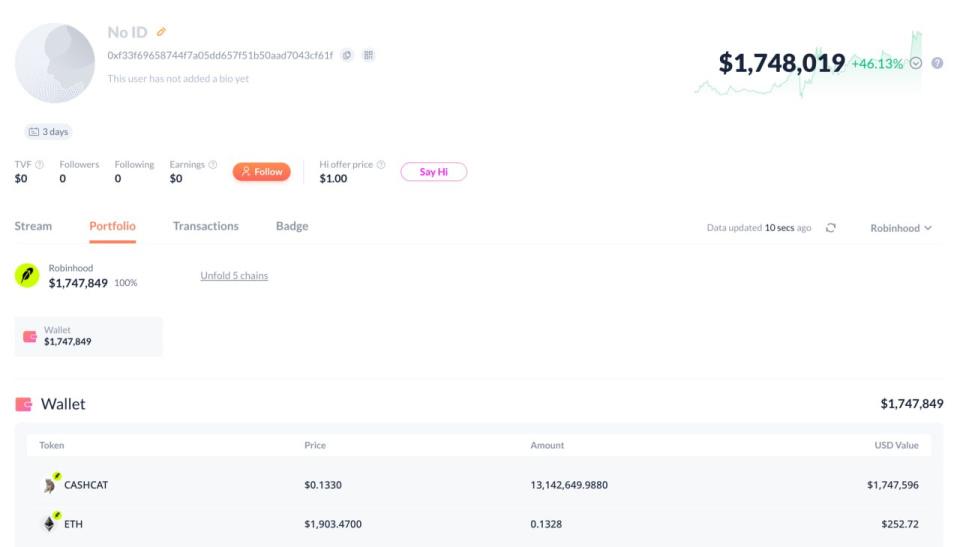
Two cryptocurrency traders each made nearly $1 million in profit from the memecoin $CASHCAT following its listing on the Robinhood trading app. The first investor, who initially spent $791,000 on 13.14 million tokens, saw their value rise to $1.75 million, securing a $956,000 profit. The second trader purchased 9.96 million $CASHCAT for just $519, achieving a $985,000 gain within 12 hours. On Thursday, August 6, $CASHCAT's price surged by roughly 80% at its peak, with its market capitalization skyrocketing from $15 million to around $137 million. This spike coincided with the token's addition to Robinhood. The previous day, Uniswap launched "Pools," a dedicated platform for memecoin launches on the Robinhood Chain. While initially intended for tokenized stocks and real-world assets, Robinhood Chain has seen memecoins become its dominant product. Data from DeFiLlama shows a significant increase in activity on Robinhood Chain, with daily fees reaching $3.29 million, $2.2 million of which came from Uniswap. $CASHCAT is now the most popular token in the ecosystem, boasting a daily trading volume exceeding $46 million, far ahead of other memecoins like PIPEDOG and FRONG. This news follows a late-July incident where hackers compromised the social media account of Robinhood's CEO to promote a different memecoin.

The first crypto investor previously spent $791,000 to purchase 13.14 million $CASHCAT. The current value of these tokens is $1.75, meaning the trader has made a profit of $956,000. The second trader bought 9.96 million $CASHCAT memecoins for $519. In 12 hours, this crypto market participant earned a profit of $985,000.
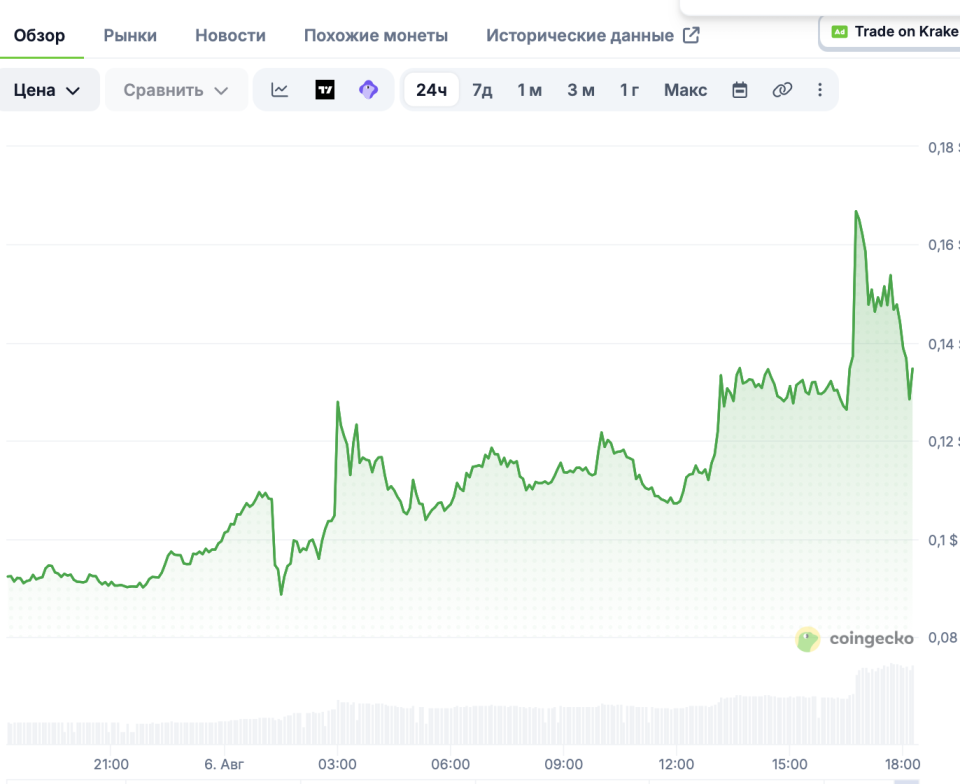
On Thursday, August 6, the memecoin's price surged sharply: at its peak, the 24-hour increase reached about 80%, and its market capitalization grew from $15 million to approximately $137 million. The spike coincided with $CASHCAT being added to the Robinhood trading app.

The day before, the largest decentralized exchange, Uniswap, launched a platform for issuing memecoins called Pools, which operates on the Robinhood Chain blockchain. The Robinhood Chain network itself went live on July 1 and was initially positioned as a platform for tokenized stocks and real-world assets — but memecoins quickly began appearing on it and eventually became the dominant product. Uniswap emphasized that only memecoins will be listed on Pools.
According to DeFiLlama, the Robinhood Chain ecosystem has significantly increased its activity: the total daily fees in the blockchain reached $3.29 million, of which $2.2 million came from Uniswap. $CASHCAT is the most popular token in the network: according to CoinGecko, the 24-hour trading volume exceeds $46 million. For comparison, the second most popular token, PIPEDOG, has a volume of $5.7 million, and the third, FRONG, has just over $4 million.

At the end of July, hackers breached the social media account of Robinhood CEO Vlad Tenev to promote the Vladhood (VLAD) memecoin. The hackers called the token the 'official mascot of Robinhood Chain.'


Related Questions

QWhat is the name of the meme coin mentioned in the article, and on which trading platform was it recently listed?

AThe meme coin mentioned is $CASHCAT. It was recently added to the Robinhood trading app.

QWhat was the approximate profit of the first trader who invested $791,000 in $CASHCAT?

AThe first trader made a profit of approximately $956,000 on their $791,000 investment in $CASHCAT.

QHow did the price and market capitalization of $CASHCAT change on Thursday, August 6th, according to the article?

AOn Thursday, August 6th, $CASHCAT's price surged sharply, with a peak daily increase of around 80%. Its market capitalization grew from about $15 million to approximately $137 million.

QWhat is the Robinhood Chain, and what kind of tokens have become dominant on it despite its initial purpose?

AThe Robinhood Chain is a blockchain platform that launched on July 1st. It was initially positioned for tokenized stocks and real-world assets, but meme coins quickly appeared and eventually became the dominant product on the network.

QWhat recent platform launch by Uniswap is mentioned, and what is its specific focus?

AUniswap recently launched a platform called 'Pools' for meme coin issuance. It operates on the Robinhood Chain, and Uniswap emphasized that only meme coins will be listed on this Pools platform.

Related Reads

Capital is Moving from Cryptocurrency Speculation to Tokenized RWA Assets

In 2026, tokenized real-world assets (RWA) became one of the fastest-growing areas in crypto. Investors, weary of market volatility, are shifting capital from speculative crypto trading towards assets offering stable yield. These include tokenized government bonds (e.g., T-bills), private credit, real estate income, commodities, and money market funds. Data shows a clear preference for transparent, regulated products. Deposits into RWA protocols more than tripled year-on-year, reaching $7.4 billion in Q2, while spot trading activity surged 220%. The total on-chain value of tokenized RWAs exceeded $30 billion in 2026, more than doubling from the previous year, and approached $38 billion by August. RWA acts as a bridge between traditional finance and blockchain, not a replacement. It allows banks and asset managers to launch regulated products on public blockchains, while DeFi users gain access to previously unavailable real-world assets. Blockchain provides 24/7 settlements, transparency, programmability, and lower fees, while traditional finance contributes capital, regulation, and proven products. Tokenized private credit remains the largest RWA category (over $7 billion on-chain), benefiting from blockchain's cost reduction and transparency. Treasury bills are the fastest-growing institutional segment, driven by higher interest rates. Tokenized commodities, especially gold, are expanding, combining asset safety with blockchain trading ease. Real estate, though smaller, is also growing steadily. Tokenization is increasingly viewed as core financial infrastructure.

cryptonews.ru2h ago

Capital is Moving from Cryptocurrency Speculation to Tokenized RWA Assets

cryptonews.ru2h ago

Lone Bitcoin Miner Defies All Odds, Hits $200,000 Jackpot with Block Reward

A solo Bitcoin miner, contrary to all predictions, won a $200,000 jackpot as a block reward. The payment went to an address linked to CKPool, a solo-mining service. This was the 317th solo block found by the pool. The reward consisted of the 3.125 BTC fixed subsidy and about 0.032 BTC in transaction fees from 4,243 transactions. CKPool operator Dr -ck (Con Kolivas) confirmed the win, noting the miner's hashrate was "extremely volatile, presumably rented," peaking at 100 PH/s. This represented about 0.011% of Bitcoin's total network hashrate. At that level, a miner could statistically expect to find a block roughly every 64 days, far more likely than for a typical small home setup. Solo mining differs from pool mining, where rewards are shared based on contributed work. In solo mining, a miner gets nothing unless they personally find a block, but then receives the entire reward. CKPool charges a ~2% fee on blocks found. Dr -ck noted the hashrate pattern suggested rented computing power, a practice making solo wins more accessible. He also highlighted this was the first mainnet block mined after integrating Stratum V2 code into ckpool, though the block itself was found using the older Stratum V1 protocol. Against a backdrop of mining concentration in large industrial pools, such solo finds remain rare but demonstrate that anyone with sufficient hashrate can claim a full reward without corporate or government permission. The block subsidy will remain 3.125 BTC until the next halving around April 2028. The miner's identity remains unknown, as is typical. Bitcoin's mining difficulty is due for an adjustment, and network hashrate has declined from late 2025 peaks, partly due to competition for power and hardware from AI data centers.

cryptonews.ru2h ago

Lone Bitcoin Miner Defies All Odds, Hits $200,000 Jackpot with Block Reward

cryptonews.ru2h ago

Blackrock Leads with $305 Million Inflow into Bitcoin and Ether ETFs

Money continued to flow rapidly into the largest cryptocurrency ETFs. Bitcoin and Ethereum ETFs collectively attracted over $305 million in inflows, with BlackRock again leading the charge, marking the third consecutive session of strong institutional demand. The broader market picture was mixed. Hyperliquid ($HYPE) ETFs finally saw renewed buying interest, while XRP ($XRP) ETFs faced outflows, and Solana-based products remained stagnant. In a strong session, Bitcoin ETFs recorded a net inflow of $244.42 million across five funds. BlackRock's IBIT dominated with $196.83 million, followed by ARK 21Shares' ARKB at $37.63 million and Fidelity's FBTC at $11.28 million. Vaneck's HODL was the sole fund to see an outflow (-$14.67 million), barely impacting the category's overall positive trend. Total trading volume reached $1.58 billion. Ethereum ETFs also continued their positive run, attracting $60.86 million. BlackRock's ETHA led with $50.34 million. The staking-oriented ETHB and Fidelity's FETH followed. No Ethereum ETF saw outflows. Among smaller tokens, Hyperliquid ETFs saw a minor but notable inflow of ~$966,690, potentially signaling easing selling pressure. Conversely, XRP ETFs experienced a $3.58 million outflow. Solana ETFs saw no net activity. The session solidified Bitcoin and Ethereum as the focal point for institutional capital, with BlackRock as the dominant source of demand, while activity in altcoin ETFs remained volatile.

cryptonews.ru2h ago

Blackrock Leads with $305 Million Inflow into Bitcoin and Ether ETFs

cryptonews.ru2h ago

Trading

Spot
活动图片