Every Vote on the CLARITY Act Will Be Scored: 3 Million Crypto Supporters Want Senators to Vote 'Yes'

cryptonews.ruPublished on 2026-07-27Last updated on 2026-07-27

Abstract

The advocacy group Stand With Crypto announced it will track and publicize U.S. senators' votes on the CLARITY Act, incorporating them into public legislator scorecards for its 3 million members to use ahead of the November elections. The group is urging a "yes" vote, stating the bill has mobilized cryptocurrency owners who seek regulatory clarity. Their pre-election survey indicates nearly 80% of crypto owners are highly likely to vote, with 70% saying a candidate's crypto stance influences their choice, and 59% identifying as swing voters—potentially making the issue decisive in tight races. The bill, which passed the Senate Banking Committee in May, now awaits a full Senate vote. However, its path is uncertain, with Galaxy Research lowering its 2026 passage odds to 30% due to timing, bipartisan support challenges, and unresolved provisions on ethics and consumer protection.

Stand With Crypto, an American cryptocurrency community advocacy organization, announced on X on July 27 that senators' votes on the CLARITY Act bill will be recorded in its public ratings on behalf of 3 million American crypto supporters.

The organization stated that each senator's vote will become part of its public legislator ratings, which cryptocurrency owners can use to compare candidates ahead of the November elections. It also urged lawmakers to vote 'yes' on this bill.
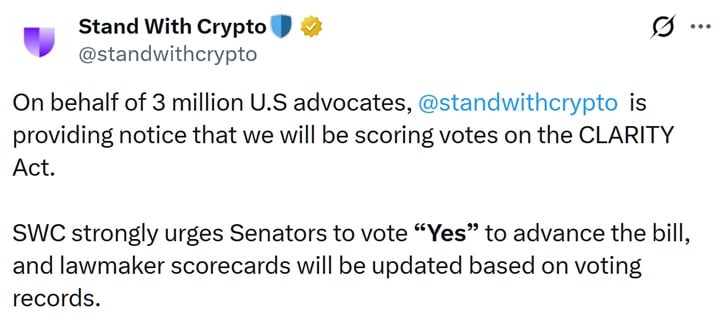
"The CLARITY Act has mobilized millions of cryptocurrency owners who eagerly await the passage of market structure legislation that will provide certainty regarding the technology they rely on," added Stand With Crypto, noting:

"Cryptocurrency-owning voters across the country are watching to see which legislators stand with them at this critical moment."

The updated ratings will record whether each senator supported advancing the bill; the vote on the CLARITY Act will be added to Stand With Crypto's existing ratings based on lawmakers' actions and public stances on cryptocurrency. The CLARITY Act vote will be one of the most prominent positions in these ratings ahead of the November midterm elections.

The organization has expanded its midterm-focused campaign, placing its scoring system at the center of efforts to transform cryptocurrency policy positions into voter-focused political achievements.

Public Scorecards Put Senators' Votes in the Spotlight

With less than 100 days until the midterm elections, Stand With Crypto's report on pre-midterm voter sentiment showed that nearly eight in ten cryptocurrency owners believe they will almost certainly vote.

Nearly 70% indicated that a candidate's stance on cryptocurrency would influence their choice, while 73% were closely following the digital asset policies legislators supported. Another 59% identified themselves as voters who do not consistently support one party, potentially giving cryptocurrency policy greater significance in tight congressional election races.

These findings reinforce the potential impact of the scorecards, especially in competitive races where politically unaffiliated cryptocurrency owners can compare candidates using their recorded positions on the CLARITY Act.

The campaign is taking place during the two-week legislative window before the August recess, with ethics provisions regarding public officials remaining a central issue in negotiations between lawmakers. Several Democratic lawmakers are pushing for stricter ethics measures and consumer protections, complicating vote counting as supporters need to secure the 60 senator votes typically required to advance a bill.

Galaxy Research lowered its assessment of the likelihood of the CLARITY Act passing in 2026 to 30%, as the Senate vote faces challenges related to timing, bipartisan support, and unresolved provisions.

Next Stage: Senate Floor

On May 14, the Senate Committee on Banking, Housing, and Urban Affairs approved the revised market structure bill with a vote of 15 to 9, sending it to the full Senate for consideration. This bipartisan committee vote reflected the outcomes of negotiations on federal oversight, investor protection, enforcement authority, and operational requirements for digital asset companies. The bill now awaits a full Senate vote.

Under the proposed framework, federal regulators would receive clearly defined authority over various digital assets, and exchanges and intermediaries would be required to comply with registration, disclosure, and customer protection requirements.

For senators, the upcoming vote carries two significant implications: it will determine whether the bill moves forward, and it will establish a result that Stand With Crypto will present to millions of supporters.


Related Questions

QWhat is the main purpose of the organization Stand With Crypto's announcement regarding the CLARITY Act?

AThe main purpose is to announce that each U.S. Senator's vote on the CLARITY Act will be recorded in their public legislator scorecards, representing 3 million American crypto supporters, to help voters compare candidates ahead of the November elections.

QAccording to Stand With Crypto's pre-midterm report, what percentage of crypto owners are 'almost certain' they will vote, and why does their vote matter for tight races?

ANearly eight in ten (almost 80%) crypto owners are almost certain they will vote. Their vote matters because 59% identify as non-straight-ticket voters, meaning crypto policy positions could significantly influence their choice in competitive congressional races.

QWhat was the outcome of the CLARITY Act vote in the Senate Banking Committee, and what is the next step for the bill?

AThe Senate Banking Committee approved the amended market structure bill with a 15-9 vote, sending it to the full Senate. The next step is a floor vote in the full Senate.

QHow does Galaxy Research currently assess the likelihood of the CLARITY Act passing in 2026, and why?

AGalaxy Research has lowered its assessment of the bill's chances of passing in 2026 to 30%. This is due to challenges with timing, securing bipartisan support, and unresolved provisions related to ethics and consumer protection.

QWhat are two key implications of the upcoming Senate floor vote on the CLARITY Act for senators, according to the article?

AFor senators, the upcoming vote has two key implications: 1) It will determine whether the bill moves forward in the legislative process. 2) It will establish a result that Stand With Crypto will present to its millions of supporters as part of their public scorecards.

Related Reads

Uncertainty persists regarding cryptocurrency regulation, and there is a possibility of delay in passing the Clarity Act! Here are the details

The U.S. Senate's vote on the CLARITY Act, which aims to establish a legal framework for the crypto market, faces a potential delay. Priority on the Senate agenda is being given to a Russia sanctions bill and confirmations of federal officials, making a vote on the crypto bill after next week increasingly likely. Senate tradition of handling only one contentious bill at a time further complicates early consideration of the CLARITY Act. Key political disagreements persist, notably over provisions to restrict cryptocurrency trading by senior government officials and elected representatives, including potentially former President Donald Trump. A bipartisan consensus has not been reached. This uncertainty raises doubts about whether a vote can occur before the Senate's August recess. If disputes intensify, the bill's passage could be jeopardized not only for this year but potentially until 2026. Even if the Senate approves the bill, it would still require a revote in the House of Representatives and the President's signature to become law, potentially prolonging the establishment of a comprehensive regulatory framework long awaited by the crypto industry. The Clarity Act is considered crucial for clarifying which agencies will oversee digital assets, defining their legal status, and setting operational principles. Industry advocates argue its passage would boost institutional investor confidence and strengthen the U.S. position in the global digital asset market.

cryptonews.ru2m ago

Uncertainty persists regarding cryptocurrency regulation, and there is a possibility of delay in passing the Clarity Act! Here are the details

cryptonews.ru2m ago

SWIFT Shared Ledger Launches Live Pilot, How Will the 50-Year-Old Payment Network Reconstruct the Financial System?

SWIFT, a global financial messaging provider with a 50-year history, has launched a live pilot of a blockchain-based "shared ledger" in July 2026, involving 17 major banks. This marks a direct move by traditional finance to upgrade its core payment infrastructure using blockchain technology, transforming SWIFT's role from a messaging channel to a "value orchestration layer" for digital payments. The system is built on Hyperledger Besu (EVM-compatible) and integrates Chainlink's CCIP for cross-chain interoperability. It deepens the fusion of the ISO 20022 messaging standard with smart contracts to automate compliance (KYC/AML). The primary settlement medium in this network is "tokenized deposits"—digital representations of traditional bank deposits, not independent stablecoins—preserving the existing two-tier banking system. The move introduces "atomic settlement" (24/7, instant) but requires banks to adopt "pre-funding" models, increasing demands on liquidity management. It presents direct competitive pressure on native blockchain payment tokens (e.g., XRP) by offering an efficient, bank-backed alternative for cross-border settlement. Significant regulatory hurdles remain, including legal jurisdiction over cross-border digital assets, legal definitions of "settlement finality" for smart contracts, and balancing blockchain transparency with data privacy/localization laws. Technologies like zero-knowledge proofs may be needed to resolve privacy-compliance conflicts. Industry views are mixed: participating banks and SWIFT emphasize extending trusted, compliant finance into the digital realm with real-time efficiency, while crypto analysts warn of potential "liquidity backlash" as capital flows back to the traditional, now-tech-enhanced banking system. This pilot signifies that traditional finance and crypto are entering a phase of direct competition and fusion at the infrastructure level, likely leading to a future of interconnected, highly regulated financial networks rather than a fully decentralized system.

marsbit12m ago

SWIFT Shared Ledger Launches Live Pilot, How Will the 50-Year-Old Payment Network Reconstruct the Financial System?

marsbit12m ago

Trading

Spot
活动图片