The United States Finally Gets Perpetual Futures Contracts

marsbitPublished on 2026-06-10Last updated on 2026-06-10

Abstract

The U.S. has finally entered the era of regulated perpetual futures contracts, a transformative development for the crypto derivatives market. On May 29, the CFTC approved Kalshi to list the first-ever regulated Bitcoin perpetual futures contract in the U.S. and allowed Coinbase to route its customers to global perpetual and options trading via Deribit. This approval acknowledges the critical role of perpetuals, which have grown to a staggering $90 trillion in annual trading volume, surpassing the combined GDP of the world's ten largest economies. Perpetual contracts, pioneered by BitMEX in 2016, eliminate expiration dates and use a funding rate mechanism to track the underlying asset's price, offering traders efficient, high-leverage exposure without the need for periodic rollovers. While this legitimizes the product category dominated by offshore and decentralized exchanges like Hyperliquid, U.S.-regulated offerings remain distinct. They are limited to Bitcoin, offer lower leverage caps (around 10x vs. 50-100x offshore), and provide CFTC-mandated protections. This creates separate markets for regulated U.S. institutions and the global, high-leverage retail traders. The significance extends far beyond crypto. Perpetuals are rapidly expanding to trade a wide array of assets like commodities (silver, oil), equities (Nvidia, Tesla), and even prediction markets. Their 24/7, digital-native structure challenges traditional time-bound derivatives. Hyperliquid, a leading decentra...

Author: Vaidik Mandloi

Compiled by: Block unicorn

Last year, trading volume for perpetual futures contracts (perps) exceeded $90 trillion. For comparison, that's more than the combined GDP of the world's top ten countries. Today, perpetual futures account for about three-quarters of all cryptocurrency derivatives trading, growing faster than almost any other financial product in history.

Even so, until last Friday, no U.S.-based institution could legally trade these contracts. On May 29th, the U.S. Commodity Futures Trading Commission (CFTC) approved Kalshi to list the first regulated Bitcoin perpetual futures contract in U.S. history. On the same day, the CFTC also approved Coinbase to direct its clients to global perpetual and options trading via the Deribit platform.

Following the announcement, the price of Hyperliquid's HYPE token surged 30%. For reference, Hyperliquid is currently the largest on-chain perpetual futures exchange, but it does not serve U.S. users. CFTC Chairman Michael Selig wrote in a CoinDesk op-ed that perpetual contracts are "a foundational tool for risk management and price discovery in the global crypto asset markets." If you've been around in crypto for a while, seeing all this unfold in front of your eyes does feel somewhat unbelievable. Let me explain why this is so significant.

How Did Perpetual Futures Accumulate $90 Trillion?

It all started in 1993 when Nobel Prize-winning economist Robert Shiller published a paper proposing a futures contract that never expires. His idea was that homeowners could use such a contract to hedge against falling house prices without having to sell their homes.

The concept was interesting but had no practical application at the time because the entire derivatives market operated on an expiration settlement model, with clearinghouses and margin models designed for fixed-date settlements. For example, agricultural contracts settled monthly, and bond futures had coupon payment dates. There simply was no supporting infrastructure, so the concept lay dormant in academic journals for decades.

Then, in May 2016, three founders in Hong Kong decided to give it a try. Arthur Hayes, Ben Delo, and Sam Reed launched BitMEX, their concept being a modification of Shiller's original idea. They built a Bitcoin-based futures contract with no expiration date and added a mechanism to peg its price to the underlying market, allowing users to trade with leverage up to 100x. Within just 18 months, BitMEX became the largest cryptocurrency derivatives exchange.

So, what exactly is a perpetual futures contract, and how does it work?

In an ordinary futures contract, you bet on the price of an underlying asset on a specific date. For example, a Bitcoin futures contract expiring in June 2026 will settle at the price in June when the time comes. If you want to keep your position, you must buy the next contract. The problem is that each contract rollover incurs costs and creates gaps in your position.

Perpetual futures, on the other hand, do away with the expiration date entirely. You can open a position, and it remains open until you close it. The duration can be as short as five minutes or as long as five months. The key is that ordinary futures contracts naturally converge to the spot price at expiration. Perpetuals do not, so something else is needed to ensure price accuracy. For this, they use a funding rate.
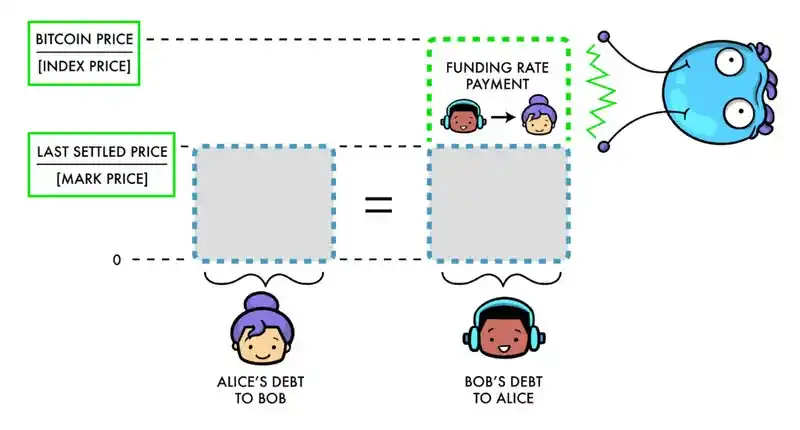
One reason perpetual exchanges have become so popular is that, unlike traditional exchanges which fragment liquidity across quarterly contracts (March, June, September, December), perpetual exchanges concentrate all trading on one platform with a single order book. This makes perpetual exchanges one of the most efficient places to trade, and in financial markets, efficiency tends to compound. More traders lead to tighter spreads, which in turn attracts more traders.

Offshore derivatives volume grew from $28 trillion in 2023 to over $90 trillion in 2025. On-chain derivatives volume on decentralized exchanges grew even faster, surging 346% in 2025 alone to $6.7 trillion. Moreover, on any given day, derivatives volume is roughly 10 to 15 times the spot volume. This means price discovery for assets has shifted from spot markets to derivatives markets. When Bitcoin moves 5% on a Tuesday afternoon, that move almost always starts in derivatives trading. The cascading effect of leveraged positions triggers liquidations, leading to buying and selling, and the spot market follows.

The "tail wagging the dog" phenomenon is happening; the very part of the market that truly determines prices—the heart of the crypto market—has, until now, completely shut out U.S. institutions.

What Does This Mean for the United States?

The U.S. finally has perpetual futures, but it doesn't have access to the same product the rest of the world trades. Even Coinbase's own operation requires funds to be routed via its Bermuda subsidiary to Deribit in Dubai because liquidity accumulated offshore over years of regulatory hostility and can't be brought back overnight.

U.S. traders are limited to leverage of about 10x and enjoy full segregation protections from the CFTC; offshore traders, in contrast, use leverage multiples of 50x to 100x. 100x leverage means $1 controls $100 of exposure. A 10% price move can deliver a 10x return. Returns on an options contract for the same price move are much lower because the upfront option premium already prices in some expected volatility, and the position decays over time. A typical one-month Bitcoin call option might return about 3x for the same 10% price move. Leverage is the key, and U.S. leverage is still relatively tame.

This is why Hyperliquid's stock price soared on the day the CFTC legalized previously illegal trading. The first reaction for many was that volume would shift from Hyperliquid to Kalshi and Coinbase, and regulated platforms with institutional capital would eat into Hyperliquid's accumulated market share.

Hyperliquid generated $907 million in revenue last year without a single U.S. user. Think about it, who is trading on these platforms? The person shorting a memecoin 50x at 3 AM is not going to open a Kalshi account to short Bitcoin 10x. Institutional investors who need regulated, segregated custody were never using Hyperliquid. These are products for entirely different populations. The CFTC's move essentially validates the product category Hyperliquid dominates. For Hyperliquid, this is a validation of its worth.

Despite regulatory constraints, while U.S. exchanges are currently limited to Bitcoin, Hyperliquid has already moved far beyond crypto. Via the HIP-3 protocol, anyone can propose trading any asset, and many are already live. During peak trading in February, daily volume for silver hit $4 billion at one point, and oil trading volume briefly surpassed Bitcoin in April.

Two days before the CFTC approved the Hyperliquid exchange, Intercontinental Exchange (ICE, parent of the New York Stock Exchange) CEO Jeffrey Sprecher said at a Bernstein conference: "We're now talking about Hyperliquid, which if you haven't heard of it, is bigger than NASDAQ, okay?" Today, ICE is in talks with Hyperliquid, learning about their business model and asking regulators why traditional exchanges can't offer the same product. The direction of learning has flipped: Wall Street is studying a two-year-old, zero-venture-capital decentralized exchange because it has built the trading infrastructure the world's largest exchanges now want to replicate.

Perpetuals Will Eat Everything

I think this matters more than anything else because perpetuals are no longer just a crypto thing.

They started as a Bitcoin trading instrument, then expanded to all altcoins. Today, they've moved into commodities like gold, silver, oil, and gas. Then, they expanded to stocks like Nvidia and Tesla, to pre-IPO companies like SpaceX and OpenAI, and now include prediction markets via HIP-4.
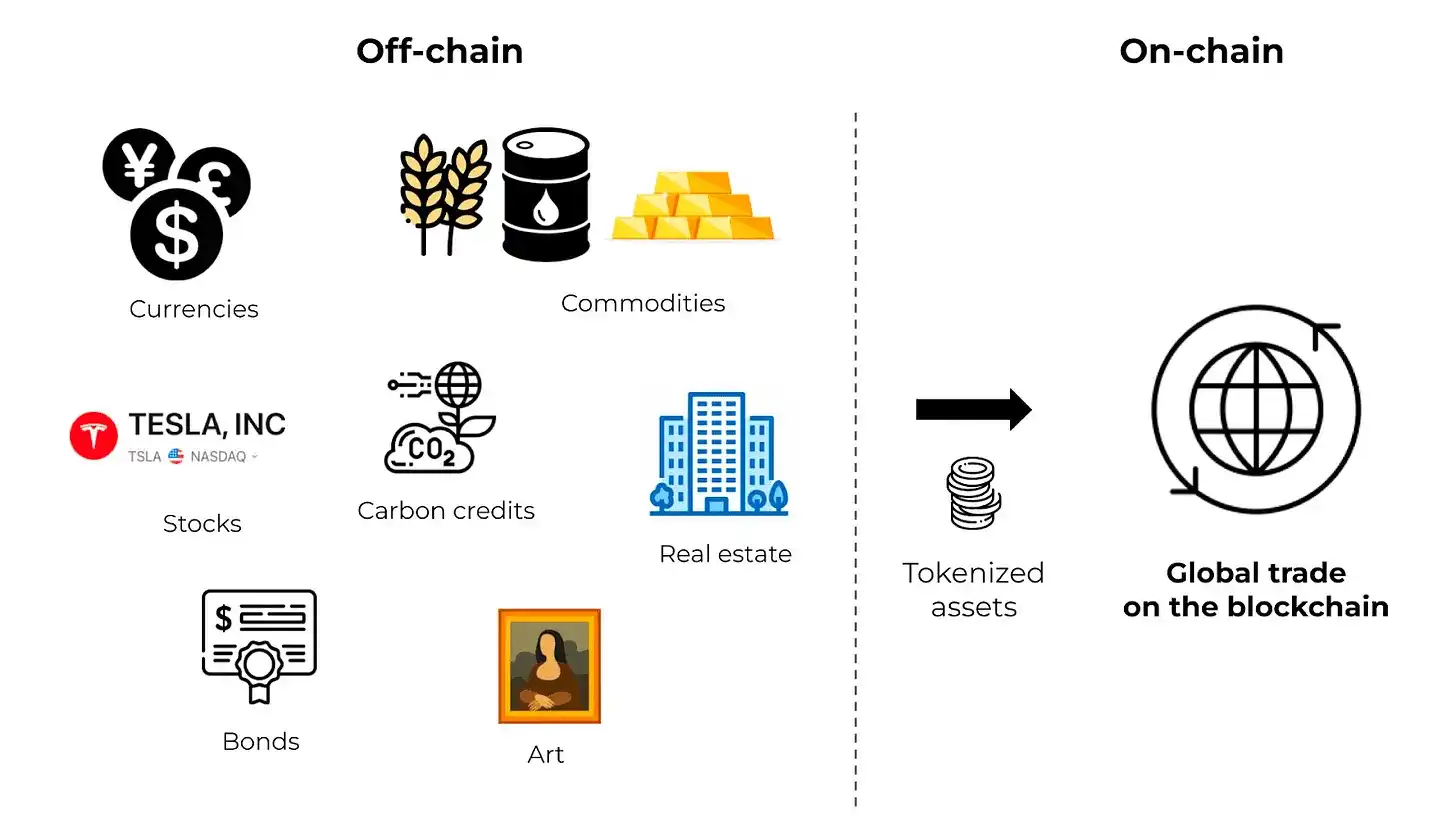
In just two years, perpetuals have gone from a crypto hack to a financial instrument that can reference any asset in the world, trade 24/7, and have no expiration date or clearing intermediary. Traditional derivatives were designed for a world where markets closed at night and made sense in an era of physical exchange floors and paper-based settlement.

But in today's global digital infrastructure, where assets trade around the clock, session-based markets can create gaps. For instance, an oil trader looking to position ahead of a geopolitical event over the weekend has nowhere to go on any regulated exchange. On Hyperliquid, that trade is already possible. The CFTC acknowledges this. The agency's staff advisory on 24/7 trading explicitly states: "Derivatives on crypto assets may be particularly well-suited for 24/7 trading due to digital infrastructure and global reach."

Now the real competition is whether U.S.-regulated platforms can change quickly enough to make a difference. For example, the average fee for futures on centralized exchanges is about 4 basis points, while Hyperliquid's fee is just 2 basis points. The gap is even wider for spot trading: 15 basis points vs. 5 basis points. Since switching platforms takes minutes, traders will simply go where fees are lower.

Compass Point analysts gave Coinbase a sell rating the week the CFTC approved its derivatives listing, citing a wave of competition in derivatives markets that would erode its pricing power and squeeze margins. Coinbase's perpetuals revenue in Q1 2026 was $50 million, while retail trading revenue fell to its lowest level since Q3 2024. The perpetuals business, while growing, is also cannibalizing the more profitable spot trading market.

Indeed, this compression manifests in many ways. If you can get leveraged directional exposure to any asset anytime, anywhere, with no expiration date, then traditional derivatives seem trivial. For example, why roll over quarterly futures contracts when perpetuals offer continuous exposure? Granted, funding rates can exceed rollover costs during crowded trades, sometimes adding 2% every eight hours. Exchanges also have every incentive to keep quarterly contracts alive because rolling over means two extra trades and two rounds of extra fees. But most retail traders hold positions for hours or days. For them, a contract with no expiration is simply easier.

Why buy short-term options when perps can offer similar directional leverage? True, options have limited downside to the premium paid. But look at the actual volume. In 2025, average daily volume for 0-day-to-expire S&P 500 options was 2.3 million contracts, most of which were pure directional bets. For that use case, perps are simpler.

I'm not saying perpetuals will completely replace options or traditional futures, as options offer defined risk and convex payoffs that perps cannot replicate. However, for the vast majority of trading activity that is purely about directional leverage, perpetuals are the better, more economical option. Ultimately, the product has proven its success, with at least $90 trillion in annual volume as evidence.


Related Questions

QWhat is the significance of the CFTC's approval of the first regulated Bitcoin perpetual futures contracts in the United States?

AIt marks the first time a U.S. institution can legally trade perpetual futures contracts, which are fundamental tools for risk management and price discovery in the global crypto market. It legitimizes a major product class that has been largely inaccessible to U.S. investors, previously forcing them to use offshore platforms.

QHow does the mechanism of a perpetual futures contract differ from a traditional futures contract?

ATraditional futures contracts have a fixed expiration date, requiring holders to roll over their positions to a new contract, incurring fees and creating gaps. Perpetual futures contracts have no expiry date, allowing positions to remain open indefinitely until closed. They use a funding rate mechanism, paid periodically between traders, to keep their price anchored to the underlying spot market price.

QWhy did Hyperliquid's HYPE token price surge following the CFTC's approval announcement, according to the article?

AThe approval validated the product category that Hyperliquid, the largest on-chain perps exchange, specializes in. It confirmed the legitimacy of its business model. Furthermore, the products offered by regulated U.S. platforms (like 10x leverage on Bitcoin) are targeted at a different, more conservative institutional audience, not the core users of platforms like Hyperliquid (who seek high leverage on various assets), so it was seen as an affirmation of Hyperliquid's value rather than direct competition.

QWhat broader trend does the article suggest regarding perpetual futures beyond the cryptocurrency market?

AThe article suggests that perpetual futures are expanding beyond crypto to trade a wide range of assets including commodities (gold, oil), equities (like NVIDIA, Tesla), pre-IPO companies, and prediction markets. It argues they are becoming a superior, more efficient financial instrument for providing leveraged directional exposure to any global asset on a 24/7 basis, potentially compressing the market for traditional time-bound derivatives like quarterly futures and short-dated options used for directional bets.

QWhat competitive challenge do regulated U.S. exchanges like Coinbase face in the perpetual futures market, as mentioned in the article?

AThey face intense competition on fees and product offering. For example, offshore/on-chain exchanges like Hyperliquid charge significantly lower fees (e.g., 2 bps for futures vs. 4 bps on centralized exchanges). Also, while U.S. platforms start with limited offerings (like Bitcoin with 10x leverage), their competitors offer higher leverage (50-100x) on a vast array of assets. This competition is expected to compress profit margins and pricing power for incumbents like Coinbase, whose spot trading revenues are already being cannibalized by its growing but lower-margin perpetuals business.

Related Reads

Y Combinator Co-founder: How to Make a Billion Dollars?

The Y Combinator co-founder argues that becoming a billionaire by founding a successful startup is not only possible but demonstrably achievable without unfair or unethical practices. He disputes a politician's claim to the contrary, using the example of a founder whose company grew at 93% monthly solely through creating a product users loved and recommended. The core mechanism is exponential growth. A conservative 15% monthly growth rate compounds to a 4384x increase over five years, which can easily lead to billion-dollar valuations and founder wealth. The process depends on two key variables: the growth rate and the duration it can be sustained. A high growth rate stems from a great product that users naturally promote, while a long duration requires a large enough market. For aspiring founders, especially young ones, the simplest path is to build something they and their friends genuinely need. Young people's current needs often predict future mass-market trends. He advises against actively "searching" for ideas, as this tends to filter out unconventional but promising ones. Instead, inspiration should come from working on interesting projects with friends, as many iconic companies (e.g., Apple, Facebook) started this way. Ultimately, building a massively valuable startup is not about exploitation but empathy: deeply understanding a user group and building a product that significantly improves their lives. This, powered by exponential growth in a large market, is the legitimate path to immense wealth creation.

Foresight News5m ago

Y Combinator Co-founder: How to Make a Billion Dollars?

Foresight News5m ago

The 800V Voltage Standard Championed by Nvidia: Which Infrastructure Providers Stand to Benefit?

NVIDIA is actively promoting the 800VDC architecture as a key direction for its next-generation AI factories and high-power racks, particularly for the upcoming Rubin and Kyber platforms. The primary driver is the rapidly increasing power density of AI racks, with designs like GB200/GB300 NVL72 reaching 120-140kW and future systems potentially hitting 180-220kW. At such high power levels, traditional low-voltage power delivery becomes inefficient due to massive current, leading to significant copper use, cable bulk, heat, and power loss. The 800VDC standard aims to increase efficiency by transmitting power at higher voltage and lower current to the rack before stepping it down locally for GPUs. NVIDIA claims this can improve efficiency by up to 5%, reduce total cost of ownership (TCO) by up to 30%, and cut copper usage by approximately 45%. This shift redefines infrastructure roles, pushing power engineering to the forefront alongside GPU performance. Key beneficiaries and ecosystem partners highlighted include: 1. **Power Infrastructure Providers:** Companies like Vertiv, Schneider Electric, Delta Electronics (台达电), and Korean firms LS Electric and HD Hyundai Electric are involved in designing next-gen AI factory power distribution, rack power supplies, and backup systems. 2. **Power Semiconductors:** Suppliers of SiC/GaN devices, such as Infineon and STMicroelectronics, are better suited for high-voltage, high-efficiency conversion in this new architecture. 3. **Connectivity & Structure:** The focus shifts to high-reliability components like busbars, high-voltage connectors, and advanced PCBs that meet stricter insulation and safety requirements. 4. **Liquid Cooling & Rack ODM:** As power and heat density rise, liquid cooling becomes critical. Full-rack system integrators (e.g., Dell, Wiwynn, Wistron) must now demonstrate robust pre-delivery testing capabilities, including burn-in testing under full load, requiring significant power and cooling infrastructure in their factories. The transition is not immediate for all data centers but is targeted at high-density AI factories. NVIDIA’s 800VDC ecosystem is in a preparatory phase, with full-scale production expected to align with the 2027 launch of Kyber rack-scale systems. The investment thesis revolves around which companies can demonstrate proven product integration, customer validation, and reliable delivery of complete, high-power AI rack systems, making power, cooling, and testing capabilities new critical variables in the AI infrastructure value chain alongside GPUs.

marsbit25m ago

The 800V Voltage Standard Championed by Nvidia: Which Infrastructure Providers Stand to Benefit?

marsbit25m ago

Did 'Unlimited Minting' Actually Happen? Zcash Founder Responds to Four Major Market Concerns

The Orchard shielding pool in the privacy cryptocurrency Zcash was recently found to have contained a critical counterfeiting vulnerability that existed for four years. This discovery caused significant market panic and a sharp drop in the price of ZEC, though it has since recovered partially. Zcash founder Zooko Wilcox addressed four key questions raised by the vulnerability. First, while it's unknown if the bug was exploited, he believes it likely was not, citing advanced, targeted discovery methods, a rapid response to freeze the pool, and the typical "smash-and-grab" nature of past crypto exploits. Second, he states that if no exploitation occurred, all legitimate user funds in Orchard are recoverable. However, cautious users moving funds should be aware of privacy trade-offs and other risks involved in transferring to transparent or Sapling pools. Third, users currently cannot independently verify that the total ZEC supply hasn't been inflated due to this bug. However, the proposed "Ironwood" network upgrade will restore this ability by permanently sealing the Orchard pool. This will prevent any counterfeit funds from circulating and allow anyone running a node to cryptographically verify that the supply cap has not been breached. Finally, regarding other undiscovered vulnerabilities, Wilcox notes that intensive ongoing audits by multiple teams, including using advanced AI-assisted tools, have so far found no other counterfeiting bugs. This provides increased, though not absolute, confidence. In conclusion, while assessments suggest the bug was likely unused and funds are safe, the core issue was the loss of user-verifiable supply integrity. The Ironwood upgrade is presented as the solution, aiming to restore trust by allowing users to independently verify Zcash's supply security without relying on third-party assurances.

marsbit26m ago

Did 'Unlimited Minting' Actually Happen? Zcash Founder Responds to Four Major Market Concerns

marsbit26m ago

The First Prediction Market Stock Has Emerged!

"Prediction Market Unicorn Emerges!" While the World Cup drives record trading volumes in prediction markets, the industry leader Kalshi faces a new threat from a former key ally. In March 2025, Kalshi partnered with online broker Robinhood to offer prediction market services, allowing users to bet on events. This deal was mutually beneficial: Kalshi gained access to Robinhood's massive retail user base, with an estimated 25-35% of its volume coming through this channel, while Robinhood earned significant fees, reporting a 320% year-over-year increase in "other transaction revenue" to $147 million in Q1 2026, largely fueled by prediction markets. However, Robinhood's ambitions have grown. Recognizing that its user base and distribution power are the scarcest resources, it initiated a plan to bring operations in-house. In late 2025, Robinhood partnered with Susquehanna to acquire CFTC-regulated exchange MIAXdx, renaming it Rothera Exchange. By June 2026, Robinhood launched its own prediction market product on Rothera, strategically using the World Cup as a launchpad. Initial data shows Rothera processing tens of millions of contracts within days, directly siphoning volume away from Kalshi. This shift marks a pivotal moment: control is moving from the market infrastructure provider (Kalshi) to the entity controlling user distribution (Robinhood). The story illustrates a recurring internet era dynamic: "He who controls distribution controls everything." As more platforms with large user bases recognize the value of prediction markets, the industry's future competition may center less on which platform has the best market technology and more on which one owns the user gateway.

marsbit38m ago

The First Prediction Market Stock Has Emerged!

marsbit38m ago

More Popular Than SpaceX, Oversubscribed Over 6,586 Times, What's the Meme Power Behind Liuliu Mei (06658.HK)?

Liumeimei, a popular Chinese snack brand known as "Liuliumei" in China, listed on the Hong Kong Stock Exchange (stock code: 06658.HK). On its debut, the stock price surged dramatically, opening 116% above the issue price and peaking with gains over 190%. This surge is widely attributed not to its traditional consumer goods business, but to a "Meme stock" phenomenon. Its stock ticker abbreviation "LLM" coincidentally matches the acronym for "Large Language Model," the core technology of the ongoing AI boom. This association, coupled with a strong same-day performance by another AI-related stock, triggered a massive wave of speculative retail investment. The IPO itself saw extreme oversubscription in the public offering segment, exceeding 6,586 times, though retail investors were allocated only 10% of shares. Analysts and the article frame this event as part of a broader "stock Meme-ification" trend in global markets, where stocks can experience volatile price movements based on viral narratives, wordplay (like homophones or abbreviations), celebrity mentions, or fleeting social media attention—similar to dynamics seen in the cryptocurrency meme coin sector. Examples cited include the 2021 GameStop saga, stocks linked to political figures like Donald Trump, and other companies benefiting from AI hype or谐音梗 (homophone puns). While such trends can create significant short-term wealth for some, the article notes they also carry risks of market manipulation, "pump and dump" schemes, and investments detached from fundamental business value. The Liumeimei listing is presented as a prime example of how attention and internet culture are increasingly driving capital flows in modern financial markets.

marsbit41m ago

More Popular Than SpaceX, Oversubscribed Over 6,586 Times, What's the Meme Power Behind Liuliu Mei (06658.HK)?

marsbit41m ago

Trading

Spot
Futures
活动图片