Authored by: Castle Labs
Compiled by: AididiaoJP, Foresight News
Solana's Privacy Ecosystem is Still in Its Early Stages
We previously spoke with Helius CEO @mert, asking his perspective on Solana's privacy. In his own words, Solana is "a bit behind" on privacy.
So, what should a mature privacy ecosystem look like?
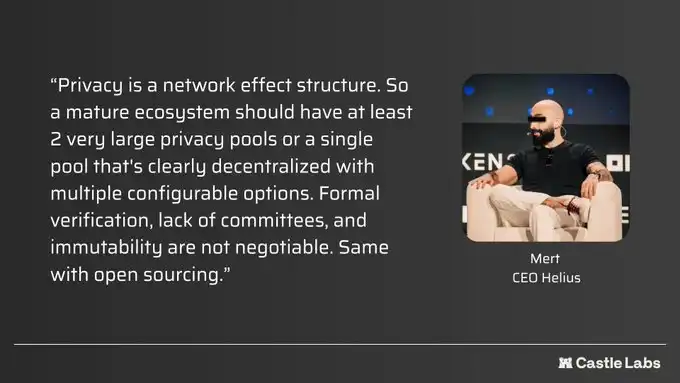
Essential elements include:
- Formal verification
- No committee
- Immutability
- Open source code
Solana's unique architecture also leads to different privacy priorities compared to EVM chains. Mert specifically mentioned ZK compression: "We can achieve mass-scale and composable privacy protocols on Solana without persistent Rollups, at least not when based rollups can be used."
In Solana's specific context, the two most relevant verticals for privacy development are Neobanks and Private DeFi. However, in terms of tooling and user experience, Solana still has a significant gap to reach a fully functional, composable privacy ecosystem.
We also asked Mert about his view on the privacy tech stack. As the report emphasizes, privacy should not be seen as a single technology, but as a "final privacy stack" where all primitives will eventually work together. For Mert, the endgame is a combination of FHE (Fully Homomorphic Encryption) and ZK (Zero-Knowledge proofs). TEE and MPC are practical for certain use cases but cannot provide sufficient guarantees in adversarial systems.
Finally, we asked him about Helius Privacy.
Helius Privacy will be developed as a ZK-based UTXO privacy layer on Solana. It will utilize "Zones," allowing individual companies to choose their own trade-offs.
It will also provide a public Zone for all ordinary users to use, offering full anonymity in an immutable, formally verified manner. More details will be announced soon.
Against this backdrop, this article focuses on how the Solana privacy ecosystem is addressing various privacy challenges.
Private Compute
Currently, there are mainly two providers in this space: @Arcium and @magicblock.
Both are tackling a similar problem: private computation.
Arcium processes arbitrary data via MPC (Multi-Party Computation). It splits data and distributes it across independent node clusters, which collectively compute a result without seeing individual inputs. Meanwhile, Arcium operates as an independent compute network, with final settlement on Solana, which handles task ordering, network security, and fee payments.
All this private computation happens within Multi-Party eXecution Environments (MXEs)—customizable, parallelizable execution environments.
Beyond solving the computation problem, Arcium's product also serves Solana's broader privacy ecosystem. They are building the Confidential SPL (C-SPL) token standard, enabling confidential tokens, transfers, and transactions on Solana.
We asked the Arcium team about the source of demand. Unsurprisingly, it primarily comes from payments and crypto data analytics, while institutional demand is growing, especially in healthcare—enabling models to be trained on encrypted datasets. C-SPL also enables seamless private transfers, further attracting institutional interest.
In terms of data, since the Alpha mainnet launch in early February 2026, Arcium has processed over 900,000 computations and 3.5 million+ transactions, with most growth occurring in early May.

Currently, most demand comes from early applications like Umbra. In the coming weeks, applications like ZINC and Crafts will also go live, and we expect demand to increase further.
ZINC is working on encrypted proof-of-work mining, while Crafts uses Arcium for sealed-bid auction fundraising, allowing startups to tokenize part of their equity with fair price discovery.
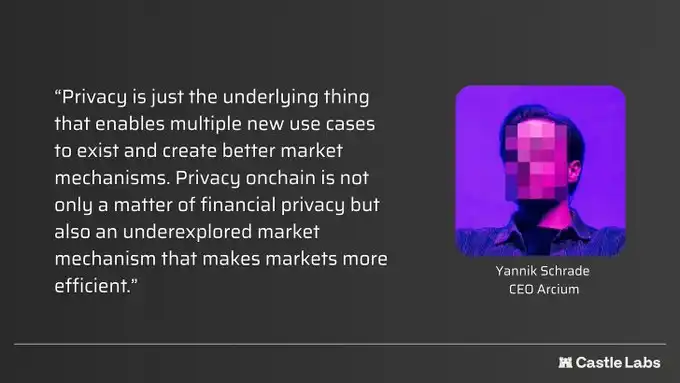
"Some exciting new things being built on Arcium include: capital formation using sealed bids, opportunity markets, encrypted settlement in prediction markets, and other financial privacy applications."
Many of these use cases are creating new or improved markets where users may not even be aware of the privacy involved.
Magic Block tackles private computation via TEE (Trusted Execution Environments), whereas Arcium relies on cryptographic guarantees from MPC. Its product works by: Intel TDX creating a hardware-verified black box—the Private Ephemeral Rollup (PER), where transactions are aggregated and processed before being submitted back to Solana.
MagicBlock helps developers preserve these properties across the entire stack, including: confidentiality (protected state), scalability (high throughput), composability (still interoperable with other Solana programs), and compliance (an access control layer).
Although their approaches differ, both can generate deployable private order books, dark pools, and private DeFi rails with minimal code changes. This is already evident in the ecosystem built on Arcium, spanning DeFi, prediction markets, Neobanks, and more.
Private Transfers and Balances
As private compute infrastructures like Arcium and MagicBlock gradually mature, use cases built on these foundations are also growing, including private transfers.
@UmbraPrivacy is the first, built on Arcium's MPC infrastructure. Umbra introduces Encrypted Token Accounts (ETAs), the direct counterpart to Solana's standard Associated Token Accounts, but with balances stored encrypted, providing:
- Amount Privacy: Transaction amounts are encrypted using Rescue cipher
- Balance Privacy: Balances are stored as ciphertext
- Association Privacy: Complete on-chain dissociation between sender and receiver via shielding pools + ZK proofs
Additionally, Umbra offers compliance features, allowing users to grant selective viewing permissions to auditors and compliance systems without exposing full transaction history. This is crucial for institutional workflows and users who want to prove fund holdings without revealing detailed transaction histories.
In the privacy wallet space, @theprivacycash and Hush are two others.
Privacy Cash uses Tornado-style shielding pools for SOL: users deposit SOL to generate a commitment added to a Merkle tree, then use a ZK proof to withdraw to any recipient, completely severing the on-chain link between deposit and withdrawal addresses.
Hush is inspired by Zcash but adds DeFi utility. Users deposit SOL into Hush's shielding pool, which is automatically converted to jitoSOL, passively earning staking yield and MEV revenue while remaining private. Inside the pool, users can transfer to other Hush participants, receive funds, and transact multiple times without touching Solana's public ledger. Upon exiting the pool, withdrawals are mixed to unbind from the original deposit. In-pool transfers cost 0.01 jitoSOL, and withdrawals incur a 50 bps fee. Hush also integrates Jupiter for private swaps and performs geographic blocking for sanctioned regions, giving it a good compliance profile among institutional users.
No Onchain Trail
Private transfers solve the problem of companies and institutions paying employee salaries or conducting private transactions on-chain. But to go further, we need to embed privacy into everyday on-chain activities, especially trading.
Every order placed on a public AMM is a signal that front-runners, copy-traders, and MEV bots can read and exploit. Several protocols on Solana are already addressing this.
@encifherio is a privacy-first DeFi interface that routes trades through Jupiter while keeping transaction details private. The team states: "Execution quality remains the same because we don't add custom routing; we use the same routes and liquidity provided by Jupiter."
It wraps the tokens a user wants to swap and encrypts swap details using ElGamal. On-chain records only show state changes of wrapped asset types, enough for Jupiter to know the correct tokens are being routed. Trade counts, counterparties, participants, and even whether a trade was executed, are all handled within a TEE environment (AWS Nitro Enclaves) and never broadcast publicly. This enables large-scale private swaps.
@VanishTrade approaches this from a different layer. They are building private trading infrastructure using shielded transaction routing to protect trading strategies from leaving on-chain traces. Unlike encifherio wrapping tokens, Vanish routes trades through shielded liquidity. Additionally, Vanish has launched the Vanish Integrity Framework (VIF), powered by Elliptic and Range, embedding safeguards to prevent routing of any illicit transactions.
Darklake is another contender in this category, building ZK-native liquidity infrastructure and dark pools. Its zk-AMM is called the "Blind Slippage Pool," a commitment layer added atop an AMM to hide slippage data before execution. Searchers cannot read order intent before a trade lands but can verify the outcome afterward. This delay asymmetry prevents sandwich attacks while preserving verifiability. They've extended this model to private perpetual contracts (zk-Perps) using Arcium's compute layer, and an inference framework called Zyga, which abstracts proof complexity, providing a foundation of secure logic and coordination for builders. Recently, they've also expanded into an infrastructure protocol, allowing apps and users to privately verify, connect, and compute using a "Proof as Intelligence" model.
Private Prediction Markets
Private prediction markets are a more advanced privacy application, as user strategies can easily be copied, leading to a loss of edge. To address this, protocols are using Arcium infrastructure to build specialized dark pools for prediction markets.
@meleemarkets is building prediction markets supporting private order flow. They encrypt the order book via Arcium's MPC infrastructure. Participants can place orders without exposing their direction on the public market until settlement.
The Private AI
As AI agents increasingly operate on-chain, will every query and every piece of PII they consume be permanently public?
Loyal answers this with its decentralized, censorship-resistant smart protocol. Built using Magic Block's ephemeral rollup execution and Arcium's encrypted compute, they are building on-chain AI that protects user data: conversations, queries, preferences, and activity—all encrypted on Solana with strict access rules. Users own and can export their encrypted conversation history and can self-host the frontend without losing any data. Additionally, Loyal supports private trading and treasury management, allowing depositors to earn yield in a private state.