The Calculation Behind Plasma's U Card with Free Claude Membership

Foresight NewsPublished on 2026-06-16Last updated on 2026-06-16

Abstract

Plasma has launched a three-tiered "U Card" (Visa stablecoin debit card) system, introducing a new demand mechanism for its XPL token through membership lock-ups. The cards offer increasing benefits: * **Lite:** Free, 2% cashback, no lock-up. * **Core:** Costs $120/year or requires locking 10,000 XPL for 12 months. Offers 3% cashback, 5% AI spending cashback (on up to $500/month), and a ChatGPT Go subscription. * **Platinum:** Requires locking 100,000 XPL for 12 months. Offers 4% cashback, 10% AI cashback, Claude Pro & ChatGPT Plus subscriptions, and extensive travel/insurance benefits. The analysis suggests Lite is for trialing, Core's value depends on substantial AI spending, and Platinum is mainly for existing large XPL holders due to the significant lock-up value and price volatility risk. The primary impact is creating a non-speculative use case for XPL. Locking XPL for card tiers can reduce circulating supply, helping counter future token unlocks and inflation. However, the system's success depends on real user adoption for daily spending, not just acquiring cards for rewards. The program expands Plasma's reach from a pure stablecoin transfer chain into consumer finance, tying XPL's utility to real-world payment frequency.


By: KarenZ, Foresight News


As the U Card trend extends to AI subscriptions, Plasma has found a new avenue for asset staking.


On June 12th, Plasma launched three tiers of U Cards, which will become available to all users this week.


On the surface, this is a stablecoin debit card membership system. What users see are base cashback, AI benefits, airport rebates, and Visa spending scenarios. What the project is focused on is longer-term spending frequency, token holdings, and staking.


How are the three tiers differentiated: Lite for onboarding, Core targets AI users, Platinum locks in large holders


Before dissecting the benefits, it's necessary to clarify the product scope of Plasma One. According to the official website, the Plasma One global account service is provided by Bridge, while the Plasma One card is issued by Rain, a principal member of Visa, under Visa's authorization, and is usable in countries and with merchants that accept Visa. In other words, Bridge focuses more on the account service layer, Rain on card issuance and the Visa payment channel layer, and the end-user experience is a stablecoin spending card connected to the Visa network.


Lite is the lowest barrier to entry. The website states the Lite card cost is $0, with a base cashback of 2% and 1 free virtual card. It's suitable for users who just want to try a stablecoin card and are not ready to buy or stake XPL yet.


Core targets regular AI users. It offers 3% base cashback, 5% AI spending cashback, a ChatGPT Go subscription, and up to 2 free virtual cards. Core is accessible through an annual fee of $120 or by staking 10,000 XPL for 12 months. It's important to note: The Core page specifies the 5% AI cashback applies to up to $500 in AI spending per month. This $500 is the spending cap for the cashback calculation, not the cashback amount cap.


Platinum is more akin to a premium spending card. The official page states it's designed for major XPL holders, accessible by staking 100,000 XPL for 12 months, with no additional fee. Benefits include 4% base cashback, 10% AI spending cashback, Claude Pro and ChatGPT Plus subscriptions, up to $600/year in flight ticket rebates, lounge access, Visa concierge service, car rental insurance, travel insurance, baggage delay & loss coverage, and global eSIM, among others.


The Platinum product page also promotes annual cashback and benefit values exceeding $10,000, including $7,500 in base cashback, $1,400 in AI credit, $600 in airline credit, etc. However, these are closer to marketing assumptions and do not equate to guaranteed, unconditional maximums for users.


Is it worth it: Lite is for trying, Core depends on AI spending, Platinum depends on tolerance for asset volatility


First, Lite. Its advantage is simplicity: $0 card fee, 2% base cashback, no staking. Its disadvantage is also clear: no additional category bonuses, no AI subscriptions, and no travel benefits. For most regular users, Lite is the most suitable tier for testing the waters, as it doesn't immediately expose you to XPL price volatility.


The key question for Core is: Can the $120 annual fee or the staking of 10,000 XPL be covered by actual spending? Calculating based on XPL at $0.088 (as of writing on June 15th), 10,000 XPL is roughly $880.


If not staking XPL, one needs $120 to register for the Core card. Comparing only ordinary spending between Lite and Core, Core offers 3% base cashback vs. Lite's 2%, a difference of 1 percentage point. To cover the $120 annual fee with this 1% difference, requires approximately $12,000 in annual eligible spending.


If focusing primarily on AI spending, Core's benefits should be calculated separately: The website states Core offers 5% AI cashback, applicable to up to $500 in AI spending per month; Lite explicitly has no AI cashback. Therefore, based on this specific AI cashback, covering the $120 annual fee requires $2,400 in annual eligible AI spending, roughly $200 per month. If maxing out the monthly $500 AI spending cap, Core can yield about $25 monthly in AI cashback, or $300 annually. Combined with the ChatGPT Go subscription benefit, Core is more suitable for users who already have ongoing AI tool expenses.


However, if a user chooses to stake 10,000 XPL instead of paying the annual fee, the calculation changes. The real cost of the staking-based Core version comes from XPL price volatility and the 12-month liquidity lockup; it shouldn't be simply viewed as getting the card for free.


Platinum's threshold is higher. 100,000 XPL is approximately $8,800 and requires a 12-month lockup. It suits three types of people: users already heavily invested in XPL, those with high AI and travel spending, and large holders who can accept a one-year lockup and price volatility.


Platinum's AI benefits are also weightier: Beyond 10% AI spending cashback, it includes Claude Pro and ChatGPT Plus subscriptions. For users already long-term subscribers of Claude Pro and ChatGPT Plus, these subscriptions can be considered as actual cost offsets. But for those staking temporarily just to get the card, they are more like add-on benefits that don't offset the price volatility risk associated with locking up 100,000 XPL for a year.


To achieve the advertised $7,500 value from the 4% base cashback alone requires about $187,500 in eligible spending; the maximum $600 flight ticket rebate, calculated at 10%, also corresponds to roughly $6,000 in eligible flight ticket spending. For an ordinary user buying 100,000 XPL temporarily just for the benefits, the risk-reward ratio isn't attractive.


Another layer of risk comes from the terms. Plasma One cashback is first denominated in USD, then converted to XPL at the XPL/USD price at the time of distribution. Rewards may undergo a pending period, and transactions involving refunds, chargebacks, abnormal spending, or arbitrage-like card usage may trigger forfeiture or clawbacks. The terms also state that Plasma may adjust reward rates, monthly caps, eligibility, excluded transactions, distribution cycles, and referral reward structures. Before valuing benefits at their full-cash hypotheticals, it's wise to discount these variables.


What is the impact on XPL?


The most direct impact of Plasma U Cards on XPL is adding a membership qualification attribute to the token. Previously, XPL's narrative primarily stemmed from the Plasma chain itself and zero-fee USDT transfers. Now, Core and Platinum tie XPL to spending benefits, motivating users to hold XPL for AI subscriptions, cashback, travel perks, and card tier status.


Plasma documentation shows an initial XPL supply of 10 billion, with 10% public sale, 40% ecosystem & growth, 25% team, and 25% investors. Within the ecosystem & growth portion, 800 million tokens unlock at the Mainnet Beta on September 25, 2025, with the remaining 3.2 billion released linearly over 3 years.


Let's examine staking effects with a few scenarios:
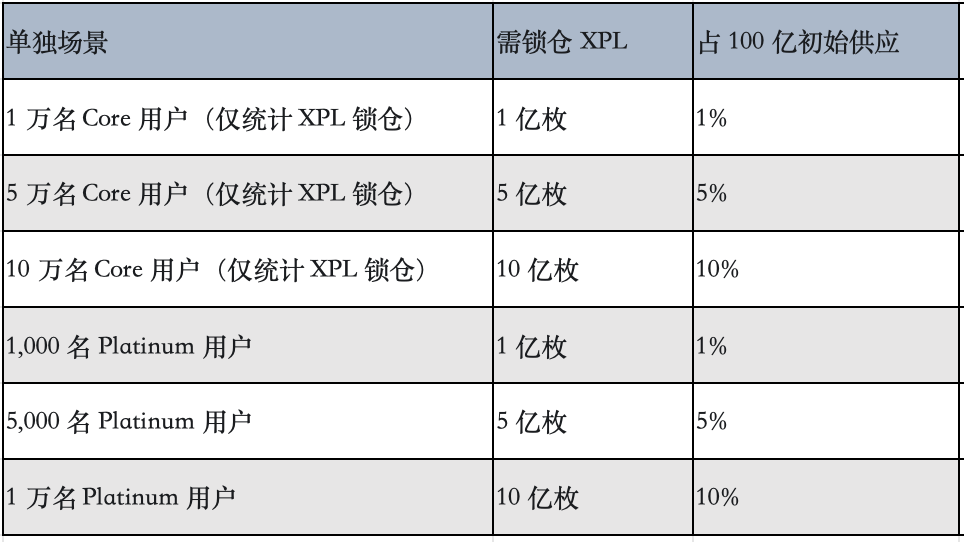


The implication of this table is straightforward: Core needs scale, Platinum needs large holders. With just 1,000 Platinum users, 100 million XPL can be locked; with 10,000 Platinum users, 1 billion XPL can be locked, accounting for 10% of the total initial supply.


More crucially, compare this to the unlock schedule. From the ecosystem & growth allocation, the remaining 3.2 billion tokens will be released over 3 years (fully unlocked by September 25, 2028), averaging about 88.89 million per month. To absorb one month's ecosystem release, approximately 8,889 Core users staking XPL, or 889 Platinum users, would be needed.


The team and investor allocations total 5 billion tokens, with a one-year cliff unlocking one-third (~1.667 billion) on September 25, 2026. To fully offset this amount with card staking would require about 166,667 Core users staking XPL, or 16,667 Platinum users. This number is already substantial, indicating that Plasma One card tiers can improve the circulating structure but are unlikely to single-handedly absorb future large-scale unlocks.


Another variable is inflation. Plasma plans to initiate validator rewards after external validators and delegated staking go live, starting with 5% annual inflation, decreasing by 0.5 percentage points each year until reaching a long-term baseline of 3%; simultaneously, a base fee burn mechanism similar to EIP-1559 aims to counteract new issuance.


Roughly calculating based on the 10 billion initial supply, 5% annual inflation corresponds to 500 million XPL. Covering this annually would require staking from 50,000 Core users or 5,000 Platinum users.


Data from a Dune dashboard built by Sumcap shows Plasma One currently has 24,000 cardholders, with 8,884 cards activated.
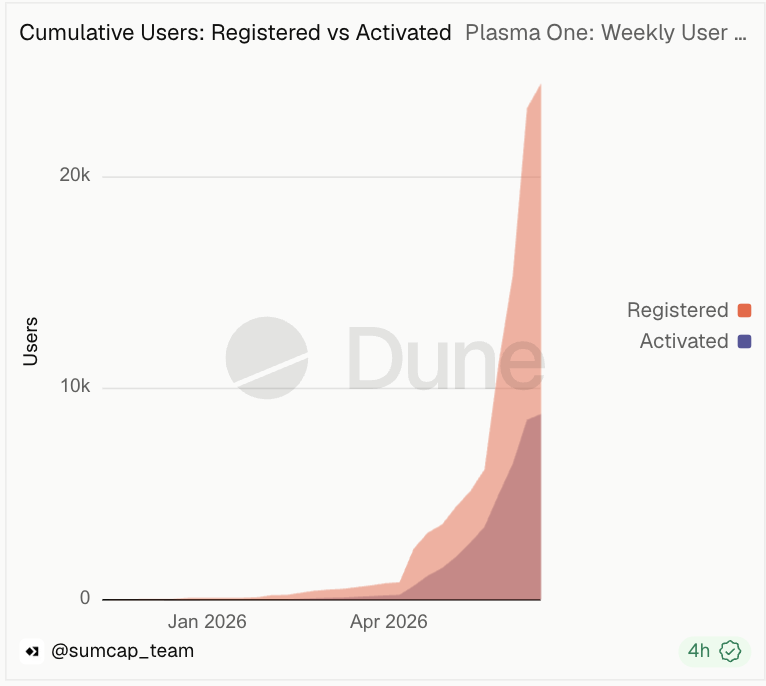


The positive effect of Plasma's latest move on the token lies in: Adding non-speculative reasons to hold XPL, reducing part of the circulating supply, and expanding XPL's reach.


The negative effects are also clear: Cashback is distributed in XPL, and if users treat it as cash-equivalent, they might sell immediately upon receipt. Of course, this is digested gradually.


Another point is that the official sources have not yet disclosed the specific origin of the reward XPL, which determines whether it ultimately constitutes a net buy pressure, a net distribution, or a mix of both.


Plasma's Real Experiment


The counter-intuitive aspect of Plasma is here: The smoother the zero-fee USDT transfers, the less ordinary users need to actively hold XPL to pay for Gas. The membership staking adds another demand curve for XPL. It brings users from exchanges, airdrops, and staking pages into more everyday scenarios: swiping a Visa card, receiving cashback, subscribing to AI tools, etc.


This is good for the project itself. Stablecoin Layer 1s are easily evaluated by the market based on TVL and subsidies. Plasma One provides it with a consumer finance entry point and also links XPL to real-world payment frequency. However, this path is also more challenging. Users won't swipe their cards daily because of a Layer 1 narrative; they will stay for fees, currency exchange, risk controls, customer service, regional coverage, and benefit fulfillment.


For XPL, Plasma One Tiers is a useful experiment for staking and distribution, but it cannot replace real transaction volume, stablecoin liquidity, and subsequent unlock management.


It's more like a door, handing on-chain assets to everyday spending. The door is open; the next step is to see how many people actually walk through it every day.

Related Questions

QWhat are the three tiers of Plasma U Card and their primary target audiences?

AThe Plasma U Card has three tiers: 1) Lite Card, designed for users who want to try stablecoin cards without buying or staking XPL. 2) Core Card, targeting daily AI users, requiring an annual fee of $120 or staking 10,000 XPL for 12 months. 3) Platinum Card, aimed at high-consumption users and XPL whales, requiring the staking of 100,000 XPL for 12 months.

QAccording to the article, is the Platinum Card's advertised annual value of over $10,000 guaranteed for users?

ANo, the advertised annual value of over $10,000 for the Platinum Card is not guaranteed. The article states this figure is closer to a marketing assumption and does not equal an unconditional payout. It's based on hypothetical maximum spending levels for cashback and benefits, which most users are unlikely to fully achieve.

QWhat is the main financial consideration for a user choosing the Core Card via XPL staking instead of paying the annual fee?

AThe main financial consideration is not just the cashback benefits but the real cost associated with locking 10,000 XPL for 12 months. This cost stems from the potential price volatility of XPL and the loss of liquidity for one year, meaning it cannot be simply viewed as getting the card for free.

QWhat potential impact does the Plasma U Card program have on the XPL token's circulating supply?

AThe Plasma U Card program adds a membership utility to XPL, creating a new demand curve by incentivizing users to hold and stake XPL for card benefits. This can potentially lock up a portion of the circulating supply. For example, 1,000 Platinum users would lock 100 million XPL. However, the article suggests the program alone is unlikely to fully absorb future large token unlocks from the team and investors.

QWhat does the article identify as the broader strategic significance of the Plasma U Card for the Plasma project?

AThe article identifies that the Plasma U Card provides a consumer finance gateway for the project, moving beyond typical blockchain metrics like TVL. It connects the XPL token to real-world payment frequency and daily spending scenarios (like using a Visa card, getting cashback, subscribing to AI tools), which is a more sustainable but challenging path that depends on user experience with fees, exchange rates, and customer service.

Related Reads

Xpeng and NIO Compete on Computing Power, Li Auto Shifts Architecture

On June 15, 2026, Li Auto unveiled details of its self-developed chip, Mahe M100, for its new L9 Livis model. CTO Xie Yan stated the goal was not just a faster chip, but a fundamentally different one, targeting the chip architecture itself. While competitors like NIO, Xpeng, and Huawei highlight TOPS (computing power) figures for their self-developed chips, Li Auto’s Mahe M100 focuses on redesigning the underlying architecture. It employs a "dynamic data flow architecture" to address memory bandwidth bottlenecks in large model inference, claiming up to 3x the effective computing power of Nvidia's Thor U for its specific workloads and a 40% reduction in latency. The chip's design was peer-reviewed and accepted at ISCA 2026. However, this performance is highly optimized for Li Auto's own VLA2.1 algorithm, meaning it may not generalize as well to other tasks. Li Auto aims to achieve full-stack in-house development with Mahe M100, covering chip, compiler, OS, AI algorithms, and domain controller—a level of vertical integration few competitors match. Beyond the chip, CEO Li Xiang introduced a new strategic narrative: the "embodied intelligent vehicle," defined as an integration of an EV, a professional driver, an AI computer, and a life assistant. This shifts competition from features like large screens to systemic AI capabilities. A key commitment was that Li Auto's Mahe VLA autonomous driving model will match Tesla's FSD V14 by Q4 2026, with specific OTA milestones set for July, September, and December. Financially, Li Auto faces pressure with declining revenue and vehicle gross margins since Q4 2025, while maintaining high R&D investment (approx. ¥12B in 2026, 50% AI-related). Its 2026 sales target is 550,000 vehicles, up from 406,000 in 2025. The new L9 Livis garnered over 10,000 pre-orders in two weeks. The effectiveness of these strategic moves—new products, OTAs, and the novel chip architecture—will begin to show in Q3 2026 financial results, with the year-end FSD V14 benchmark being the ultimate test.

marsbit50m ago

Xpeng and NIO Compete on Computing Power, Li Auto Shifts Architecture

marsbit50m ago

The Year of AI Applications: Saying 'Yes' While Ignoring Risks? A Comprehensive Open Source Log of Software Development's Journey

The Year of AI Applications: Blindly Saying "Yes" While Ignoring Risks? A Software Development Log Goes Fully Open Source. AI-generated code harbors risks hidden within seemingly correct programs, potentially leading to data leaks or asset loss. The open-source project "Narwhal AI Code Risks," from Peking University's Narwhal-Lab, compiles real-world cases, early warning signs, and typical risk pathways. Its goal is to help developers identify potential hazards early and avoid repeating past mistakes. In 2026, code is generated faster than ever but deployed with less scrutiny. The danger often lies not in glaring errors, but in code that appears normal—syntactically correct, passing all checks—yet introduces subtle but critical flaws like non-existent dependencies, excessive permissions, or exposed databases. A stark example is the Moonwell cbETH oracle incident. A configuration file error, where a cryptocurrency price was set to ~$1.12 instead of ~$2,200, slipped through 28 checks and a pull request signed by both AI (Claude, Copilot) and human developers. This "semantic deviation" resulted in a loss of $1.78 million. The risk is that AI can produce functionally valid code that is semantically wrong for the business context. As AI moves beyond simple code completion to modifying configurations, installing dependencies, and operating via autonomous agents, it traverses longer, less traceable paths within software engineering, blurring traditional boundaries and oversight points. The Narwhal AI Code Risks project structures information into three layers: `/cases` for documented real-world incidents, `/inferred` for early warning signals, and `/scenarios` for clear, generalized risk patterns not yet tied to specific events. This aims to create a lasting, public record to prevent collective amnesia about past AI-coding pitfalls. Risks are categorized into seven areas: Software Supply Chain (e.g., recommending fake packages), Code-Level Vulnerabilities (e.g., reintroducing path traversal bugs), Cloud & Infrastructure Misconfiguration (e.g., overly permissive settings), Agent Risks (from autonomous tool execution), Vertical Domain Risks (e.g., in finance, healthcare), Intellectual Property & Compliance issues, and Human Factors (like over-reliance on AI output). The project's core value is transforming isolated incidents into reusable knowledge—a foundational resource for developers to spot similar issues, for security researchers to build upon, for toolmakers to create detection rules, and for the community to contribute new findings. As AI integration accelerates, this open-source "logbook" serves as a crucial navigational aid, charting past errors to help future projects steer clear of the same traps.

marsbit50m ago

The Year of AI Applications: Saying 'Yes' While Ignoring Risks? A Comprehensive Open Source Log of Software Development's Journey

marsbit50m ago

The Foundation of SpaceX's Trillion-Dollar Valuation: Who is Dividing Up Musk's Annual Tens of Billions in Capital Expenditure?

SpaceX's trillion-dollar valuation is built on its three core businesses: Starlink (profitable, 60% of revenue), rockets (driving down launch costs), and AI (a major investment area). This creates a financial cycle: Starlink funds rocket development, which enables low-cost launches for AI hardware, generating future revenue. This cycle fuels annual capital expenditures of tens of billions, flowing to a vast supply chain. Suppliers are categorized by their replaceability. The first group includes irreplaceable players like NVIDIA (GPU/CUDA ecosystem), Eutelsat (critical radio spectrum), Filtronic (specialized amplifiers), Materion (strategic beryllium), and STMicroelectronics (antenna chips). The second group consists of hard-to-replace suppliers due to high switching costs, such as Honeywell (flight control), Carpenter Technology (specialty alloys), Hexcel (carbon fiber), Broadcom (data exchange), and Linde (industrial gases). The third group comprises high-volume, cost-critical suppliers for mass-produced items like Starlink terminals. Key names include Wistron NeWeb (primary manufacturer) and several A-share companies like Shenzhen Sunway (connectors), Pies New Materials (forgings), Western Superconducting (alloys), and Yingliu (castings). Other niche players include Trimble (timing), Astronics (power distribution), and CTS (thermal management). The article argues that investing in these suppliers, rather than SpaceX stock directly, offers an alternative opportunity. The rationale is threefold: procurement is just beginning to scale, SpaceX's IPO brings new transparency to its supply chain, and the situation mirrors early stages of past "super terminal" ecosystems like Apple or Tesla. While risks exist (commodity cycles, geopolitical factors, technology shifts), the core thesis is that SpaceX's massive, ongoing procurement will translate into reliable revenue for its key suppliers, regardless of its own stock price volatility.

marsbit1h ago

The Foundation of SpaceX's Trillion-Dollar Valuation: Who is Dividing Up Musk's Annual Tens of Billions in Capital Expenditure?

marsbit1h ago

SpaceX's Trillion-Dollar Valuation Base: Who's Sharing in Musk's Annual Tens of Billions in Capital Expenditure?

**Title: The Foundation of SpaceX's Trillion-Dollar Valuation: Who Benefits from Musk's Annual $100 Billion Capital Expenditure?** This article argues that investors seeking to benefit from SpaceX's growth might find greater opportunities in its supply chain rather than directly investing in the company itself, drawing parallels to historical successes with Apple, Tesla, and NVIDIA suppliers. **SpaceX's Business Model & Cash Flow:** SpaceX generates revenue from three main areas: 1. **Starlink:** Its profitable core, earning $11.3B in 2023 (60% of revenue), funding other ventures. 2. **Rockets (Falcon/Starship):** Requires $3B+ in annual R&D but achieves the world's lowest launch costs. 3. **AI:** Currently unprofitable (-$6B+ in 2023), investing heavily in ground-based supercomputers (220,000 GPUs) and future orbital data centers. The cycle is: Starlink profits → fund cheaper rockets → low-cost launches deploy AI hardware → AI compute rentals generate future revenue. This cycle drives annual procurement spending of tens of billions of dollars. **The Supply Chain Beneficiaries:** Suppliers are categorized by their replaceability: **1. Nearly Irreplaceable (High Barriers to Entry):** * **NVIDIA:** Powers the Colossus supercomputer; its CUDA ecosystem creates immense switching costs. * **Eutelsat (SATS):** Controls critical radio spectrum for satellite communications; holds a ~3% stake in SpaceX. * **Filtronic (FTC):** Supplies millimeter-wave signal amplifiers for Starlink satellites; SpaceX constitutes 83% of its revenue. * **Materion (MTRN):** Global leader in beryllium production, a strategic material used in Starship structures. * **STMicroelectronics (STM):** Supplies phased-array antenna chips for Starlink satellites. **2. Replaceable, but Switching Cost is Prohibitively High:** * **Honeywell (HON):** Provides flight control and inertial navigation systems with decades of certification. * **Carpenter Technology (CRS):** Manufactures ultra-pure specialty steel alloys for Raptor engines. * **Hexcel (HXL):** Supplies custom carbon fiber composites developed over a decade with SpaceX. * **Broadcom (AVGO):** Manages high-speed data switching. * **Linde Group:** Supplies industrial gases (liquid oxygen/nitrogen) from facilities built near SpaceX launch sites. **3. High-Volume, Cost-Critical Manufacturing:** Focuses on mass-producing components like Starlink user terminals (target: 30 million units). * **Key Players:** Wistron NeWeb (6285, primary terminal manufacturer), several Chinese A-share companies (e.g., Sunway Communication, PAX New Materials, Western Metal Materials, Yingliu Co.), and smaller US firms like Trimble (TRMB, timing systems). **Why Now?** Three factors make the supply chain opportunity timely: 1. **Volume Ramp-Up:** SpaceX plans 100 launches in 2026, aims for 30 million Starlink terminals, and will deploy AI data centers, meaning procurement will accelerate. 2. **Increased Transparency:** The IPO provides public financial data, allowing investors to track supplier order growth. 3. **Historical Precedent:** The current phase is likened to Tesla's early mass-production stage (circa 2018), suggesting a long growth runway for suppliers. **Conclusion:** The article posits that while investing in SpaceX stock is betting on Elon Musk's ambitious vision at a high valuation, investing in its established suppliers is a bet on the tangible, recurring revenue from its massive procurement budget, which is largely decoupled from day-to-day stock price volatility.

链捕手1h ago

SpaceX's Trillion-Dollar Valuation Base: Who's Sharing in Musk's Annual Tens of Billions in Capital Expenditure?

链捕手1h ago

Trading

Spot
Futures

Hot Articles

What is SONIC

Sonic: Pioneering the Future of Gaming in Web3 Introduction to Sonic In the ever-evolving landscape of Web3, the gaming industry stands out as one of the most dynamic and promising sectors. At the forefront of this revolution is Sonic, a project designed to amplify the gaming ecosystem on the Solana blockchain. Leveraging cutting-edge technology, Sonic aims to deliver an unparalleled gaming experience by efficiently processing millions of requests per second, ensuring that players enjoy seamless gameplay while maintaining low transaction costs. This article delves into the intricate details of Sonic, exploring its creators, funding sources, operational mechanics, and the timeline of significant events that have shaped its journey. What is Sonic? Sonic is an innovative layer-2 network that operates atop the Solana blockchain, specifically tailored to enhance the existing Solana gaming ecosystem. It accomplishes this through a customised, VM-agnostic game engine paired with a HyperGrid interpreter, facilitating sovereign game economies that roll up back to the Solana platform. The primary goals of Sonic include: Enhanced Gaming Experiences: Sonic is committed to offering lightning-fast on-chain gameplay, allowing players and developers to engage with games at previously unattainable speeds. Atomic Interoperability: This feature enables transactions to be executed within Sonic without the need to redeploy Solana programmes and accounts. This makes the process more efficient and directly benefits from Solana Layer1 services and liquidity. Seamless Deployment: Sonic allows developers to write for Ethereum Virtual Machine (EVM) based systems and execute them on Solana’s SVM infrastructure. This interoperability is crucial for attracting a broader range of dApps and decentralised applications to the platform. Support for Developers: By offering native composable gaming primitives and extensible data types - dining within the Entity-Component-System (ECS) framework - game creators can craft intricate business logic with ease. Overall, Sonic's unique approach not only caters to players but also provides an accessible and low-cost environment for developers to innovate and thrive. Creator of Sonic The information regarding the creator of Sonic is somewhat ambiguous. However, it is known that Sonic's SVM is owned by the company Mirror World. The absence of detailed information about the individuals behind Sonic reflects a common trend in several Web3 projects, where collective efforts and partnerships often overshadow individual contributions. Investors of Sonic Sonic has garnered considerable attention and support from various investors within the crypto and gaming sectors. Notably, the project raised an impressive $12 million during its Series A funding round. The round was led by BITKRAFT Ventures, with other notable investors including Galaxy, Okx Ventures, Interactive, Big Brain Holdings, and Mirana. This financial backing signifies the confidence that investment foundations have in Sonic’s potential to revolutionise the Web3 gaming landscape, further validating its innovative approaches and technologies. How Does Sonic Work? Sonic utilises the HyperGrid framework, a sophisticated parallel processing mechanism that enhances its scalability and customisability. Here are the core features that set Sonic apart: Lightning Speed at Low Costs: Sonic offers one of the fastest on-chain gaming experiences compared to other Layer-1 solutions, powered by the scalability of Solana’s virtual machine (SVM). Atomic Interoperability: Sonic enables transaction execution without redeployment of Solana programmes and accounts, effectively streamlining the interaction between users and the blockchain. EVM Compatibility: Developers can effortlessly migrate decentralised applications from EVM chains to the Solana environment using Sonic’s HyperGrid interpreter, increasing the accessibility and integration of various dApps. Ecosystem Support for Developers: By exposing native composable gaming primitives, Sonic facilitates a sandbox-like environment where developers can experiment and implement business logic, greatly enhancing the overall development experience. Monetisation Infrastructure: Sonic natively supports growth and monetisation efforts, providing frameworks for traffic generation, payments, and settlements, thereby ensuring that gaming projects are not only viable but also sustainable financially. Timeline of Sonic The evolution of Sonic has been marked by several key milestones. Below is a brief timeline highlighting critical events in the project's history: 2022: The Sonic cryptocurrency was officially launched, marking the beginning of its journey in the Web3 gaming arena. 2024: June: Sonic SVM successfully raised $12 million in a Series A funding round. This investment allowed Sonic to further develop its platform and expand its offerings. August: The launch of the Sonic Odyssey testnet provided users with the first opportunity to engage with the platform, offering interactive activities such as collecting rings—a nod to gaming nostalgia. October: SonicX, an innovative crypto game integrated with Solana, made its debut on TikTok, capturing the attention of over 120,000 users within a short span. This integration illustrated Sonic’s commitment to reaching a broader, global audience and showcased the potential of blockchain gaming. Key Points Sonic SVM is a revolutionary layer-2 network on Solana explicitly designed to enhance the GameFi landscape, demonstrating great potential for future development. HyperGrid Framework empowers Sonic by introducing horizontal scaling capabilities, ensuring that the network can handle the demands of Web3 gaming. Integration with Social Platforms: The successful launch of SonicX on TikTok displays Sonic’s strategy to leverage social media platforms to engage users, exponentially increasing the exposure and reach of its projects. Investment Confidence: The substantial funding from BITKRAFT Ventures, among others, emphasizes the robust backing Sonic has, paving the way for its ambitious future. In conclusion, Sonic encapsulates the essence of Web3 gaming innovation, striking a balance between cutting-edge technology, developer-centric tools, and community engagement. As the project continues to evolve, it is poised to redefine the gaming landscape, making it a notable entity for gamers and developers alike. As Sonic moves forward, it will undoubtedly attract greater interest and participation, solidifying its place within the broader narrative of blockchain gaming.

1.7k Total ViewsPublished 2024.04.04Updated 2024.12.03

What is SONIC

What is $S$

Understanding SPERO: A Comprehensive Overview Introduction to SPERO As the landscape of innovation continues to evolve, the emergence of web3 technologies and cryptocurrency projects plays a pivotal role in shaping the digital future. One project that has garnered attention in this dynamic field is SPERO, denoted as SPERO,$$s$. This article aims to gather and present detailed information about SPERO, to help enthusiasts and investors understand its foundations, objectives, and innovations within the web3 and crypto domains. What is SPERO,$$s$? SPERO,$$s$ is a unique project within the crypto space that seeks to leverage the principles of decentralisation and blockchain technology to create an ecosystem that promotes engagement, utility, and financial inclusion. The project is tailored to facilitate peer-to-peer interactions in new ways, providing users with innovative financial solutions and services. At its core, SPERO,$$s$ aims to empower individuals by providing tools and platforms that enhance user experience in the cryptocurrency space. This includes enabling more flexible transaction methods, fostering community-driven initiatives, and creating pathways for financial opportunities through decentralised applications (dApps). The underlying vision of SPERO,$$s$ revolves around inclusiveness, aiming to bridge gaps within traditional finance while harnessing the benefits of blockchain technology. Who is the Creator of SPERO,$$s$? The identity of the creator of SPERO,$$s$ remains somewhat obscure, as there are limited publicly available resources providing detailed background information on its founder(s). This lack of transparency can stem from the project's commitment to decentralisation—an ethos that many web3 projects share, prioritising collective contributions over individual recognition. By centring discussions around the community and its collective goals, SPERO,$$s$ embodies the essence of empowerment without singling out specific individuals. As such, understanding the ethos and mission of SPERO remains more important than identifying a singular creator. Who are the Investors of SPERO,$$s$? SPERO,$$s$ is supported by a diverse array of investors ranging from venture capitalists to angel investors dedicated to fostering innovation in the crypto sector. The focus of these investors generally aligns with SPERO's mission—prioritising projects that promise societal technological advancement, financial inclusivity, and decentralised governance. These investor foundations are typically interested in projects that not only offer innovative products but also contribute positively to the blockchain community and its ecosystems. The backing from these investors reinforces SPERO,$$s$ as a noteworthy contender in the rapidly evolving domain of crypto projects. How Does SPERO,$$s$ Work? SPERO,$$s$ employs a multi-faceted framework that distinguishes it from conventional cryptocurrency projects. Here are some of the key features that underline its uniqueness and innovation: Decentralised Governance: SPERO,$$s$ integrates decentralised governance models, empowering users to participate actively in decision-making processes regarding the project’s future. This approach fosters a sense of ownership and accountability among community members. Token Utility: SPERO,$$s$ utilises its own cryptocurrency token, designed to serve various functions within the ecosystem. These tokens enable transactions, rewards, and the facilitation of services offered on the platform, enhancing overall engagement and utility. Layered Architecture: The technical architecture of SPERO,$$s$ supports modularity and scalability, allowing for seamless integration of additional features and applications as the project evolves. This adaptability is paramount for sustaining relevance in the ever-changing crypto landscape. Community Engagement: The project emphasises community-driven initiatives, employing mechanisms that incentivise collaboration and feedback. By nurturing a strong community, SPERO,$$s$ can better address user needs and adapt to market trends. Focus on Inclusion: By offering low transaction fees and user-friendly interfaces, SPERO,$$s$ aims to attract a diverse user base, including individuals who may not previously have engaged in the crypto space. This commitment to inclusion aligns with its overarching mission of empowerment through accessibility. Timeline of SPERO,$$s$ Understanding a project's history provides crucial insights into its development trajectory and milestones. Below is a suggested timeline mapping significant events in the evolution of SPERO,$$s$: Conceptualisation and Ideation Phase: The initial ideas forming the basis of SPERO,$$s$ were conceived, aligning closely with the principles of decentralisation and community focus within the blockchain industry. Launch of Project Whitepaper: Following the conceptual phase, a comprehensive whitepaper detailing the vision, goals, and technological infrastructure of SPERO,$$s$ was released to garner community interest and feedback. Community Building and Early Engagements: Active outreach efforts were made to build a community of early adopters and potential investors, facilitating discussions around the project’s goals and garnering support. Token Generation Event: SPERO,$$s$ conducted a token generation event (TGE) to distribute its native tokens to early supporters and establish initial liquidity within the ecosystem. Launch of Initial dApp: The first decentralised application (dApp) associated with SPERO,$$s$ went live, allowing users to engage with the platform's core functionalities. Ongoing Development and Partnerships: Continuous updates and enhancements to the project's offerings, including strategic partnerships with other players in the blockchain space, have shaped SPERO,$$s$ into a competitive and evolving player in the crypto market. Conclusion SPERO,$$s$ stands as a testament to the potential of web3 and cryptocurrency to revolutionise financial systems and empower individuals. With a commitment to decentralised governance, community engagement, and innovatively designed functionalities, it paves the way toward a more inclusive financial landscape. As with any investment in the rapidly evolving crypto space, potential investors and users are encouraged to research thoroughly and engage thoughtfully with the ongoing developments within SPERO,$$s$. The project showcases the innovative spirit of the crypto industry, inviting further exploration into its myriad possibilities. While the journey of SPERO,$$s$ is still unfolding, its foundational principles may indeed influence the future of how we interact with technology, finance, and each other in interconnected digital ecosystems.

54 Total ViewsPublished 2024.12.17Updated 2024.12.17

What is $S$

What is AGENT S

Agent S: The Future of Autonomous Interaction in Web3 Introduction In the ever-evolving landscape of Web3 and cryptocurrency, innovations are constantly redefining how individuals interact with digital platforms. One such pioneering project, Agent S, promises to revolutionise human-computer interaction through its open agentic framework. By paving the way for autonomous interactions, Agent S aims to simplify complex tasks, offering transformative applications in artificial intelligence (AI). This detailed exploration will delve into the project's intricacies, its unique features, and the implications for the cryptocurrency domain. What is Agent S? Agent S stands as a groundbreaking open agentic framework, specifically designed to tackle three fundamental challenges in the automation of computer tasks: Acquiring Domain-Specific Knowledge: The framework intelligently learns from various external knowledge sources and internal experiences. This dual approach empowers it to build a rich repository of domain-specific knowledge, enhancing its performance in task execution. Planning Over Long Task Horizons: Agent S employs experience-augmented hierarchical planning, a strategic approach that facilitates efficient breakdown and execution of intricate tasks. This feature significantly enhances its ability to manage multiple subtasks efficiently and effectively. Handling Dynamic, Non-Uniform Interfaces: The project introduces the Agent-Computer Interface (ACI), an innovative solution that enhances the interaction between agents and users. Utilizing Multimodal Large Language Models (MLLMs), Agent S can navigate and manipulate diverse graphical user interfaces seamlessly. Through these pioneering features, Agent S provides a robust framework that addresses the complexities involved in automating human interaction with machines, setting the stage for myriad applications in AI and beyond. Who is the Creator of Agent S? While the concept of Agent S is fundamentally innovative, specific information about its creator remains elusive. The creator is currently unknown, which highlights either the nascent stage of the project or the strategic choice to keep founding members under wraps. Regardless of anonymity, the focus remains on the framework's capabilities and potential. Who are the Investors of Agent S? As Agent S is relatively new in the cryptographic ecosystem, detailed information regarding its investors and financial backers is not explicitly documented. The lack of publicly available insights into the investment foundations or organisations supporting the project raises questions about its funding structure and development roadmap. Understanding the backing is crucial for gauging the project's sustainability and potential market impact. How Does Agent S Work? At the core of Agent S lies cutting-edge technology that enables it to function effectively in diverse settings. Its operational model is built around several key features: Human-like Computer Interaction: The framework offers advanced AI planning, striving to make interactions with computers more intuitive. By mimicking human behaviour in tasks execution, it promises to elevate user experiences. Narrative Memory: Employed to leverage high-level experiences, Agent S utilises narrative memory to keep track of task histories, thereby enhancing its decision-making processes. Episodic Memory: This feature provides users with step-by-step guidance, allowing the framework to offer contextual support as tasks unfold. Support for OpenACI: With the ability to run locally, Agent S allows users to maintain control over their interactions and workflows, aligning with the decentralised ethos of Web3. Easy Integration with External APIs: Its versatility and compatibility with various AI platforms ensure that Agent S can fit seamlessly into existing technological ecosystems, making it an appealing choice for developers and organisations. These functionalities collectively contribute to Agent S's unique position within the crypto space, as it automates complex, multi-step tasks with minimal human intervention. As the project evolves, its potential applications in Web3 could redefine how digital interactions unfold. Timeline of Agent S The development and milestones of Agent S can be encapsulated in a timeline that highlights its significant events: September 27, 2024: The concept of Agent S was launched in a comprehensive research paper titled “An Open Agentic Framework that Uses Computers Like a Human,” showcasing the groundwork for the project. October 10, 2024: The research paper was made publicly available on arXiv, offering an in-depth exploration of the framework and its performance evaluation based on the OSWorld benchmark. October 12, 2024: A video presentation was released, providing a visual insight into the capabilities and features of Agent S, further engaging potential users and investors. These markers in the timeline not only illustrate the progress of Agent S but also indicate its commitment to transparency and community engagement. Key Points About Agent S As the Agent S framework continues to evolve, several key attributes stand out, underscoring its innovative nature and potential: Innovative Framework: Designed to provide an intuitive use of computers akin to human interaction, Agent S brings a novel approach to task automation. Autonomous Interaction: The ability to interact autonomously with computers through GUI signifies a leap towards more intelligent and efficient computing solutions. Complex Task Automation: With its robust methodology, it can automate complex, multi-step tasks, making processes faster and less error-prone. Continuous Improvement: The learning mechanisms enable Agent S to improve from past experiences, continually enhancing its performance and efficacy. Versatility: Its adaptability across different operating environments like OSWorld and WindowsAgentArena ensures that it can serve a broad range of applications. As Agent S positions itself in the Web3 and crypto landscape, its potential to enhance interaction capabilities and automate processes signifies a significant advancement in AI technologies. Through its innovative framework, Agent S exemplifies the future of digital interactions, promising a more seamless and efficient experience for users across various industries. Conclusion Agent S represents a bold leap forward in the marriage of AI and Web3, with the capacity to redefine how we interact with technology. While still in its early stages, the possibilities for its application are vast and compelling. Through its comprehensive framework addressing critical challenges, Agent S aims to bring autonomous interactions to the forefront of the digital experience. As we move deeper into the realms of cryptocurrency and decentralisation, projects like Agent S will undoubtedly play a crucial role in shaping the future of technology and human-computer collaboration.

730 Total ViewsPublished 2025.01.14Updated 2025.01.14

What is AGENT S

Discussions

Welcome to the HTX Community. Here, you can stay informed about the latest platform developments and gain access to professional market insights. Users' opinions on the price of S (S) are presented below.

活动图片