XRP Ledger DEX Metrics Flash Strong Growth As Activity Touches New Key Levels

bitcoinistPublished on 2026-01-31Last updated on 2026-01-31

Abstract

The XRP Ledger's decentralized exchange (DEX) activity has surged to a 13-month high, with its 14-day moving average of transactions reaching approximately 1.014 million, breaking previous records. This growth reflects sustained user engagement and increased liquidity, signaling deeper adoption beyond speculative spikes. The milestone coincides with the rollout of the new Lending Protocol (XLS-66), which introduces institutional-grade credit capabilities to the network, including fixed-term, fixed-rate, and uncollateralized loans held in risk-isolated vaults. The protocol has already gained institutional support, with companies like Evernorth backing it to transition a $100 billion market into a yield-bearing ecosystem, further establishing the XRP Ledger as a growing hub for decentralized finance.

Even years after its inception, the XRP Ledger, one of the leading networks in the crypto space, continues to attract robust adoption and real-world usage. With thousands of transactions being conducted on the leading network’s DEX on a daily basis, it has now reached a historical level that marks its growing role in decentralized trading.

Decentralized Trading On XRP Ledger Accelerates

XRP is experiencing heightened interest not just in buying activity from traders; the XRP Ledger has been seeing significant usage over the past few weeks. While adoption has increased toward the network, the Ledger’s Decentralized Exchange (DEX) activity is breaking past prior highs.

Xaif Crypto, a market expert and investor on the X platform, reported that the Ledger DEX activity has surged to new levels. Specifically, data shows that the activity recently reached a 13-month high, signaling a sharp uptick in on-chain trading across the network.

As more liquidity and transactions move over XRPL’s native DEX infrastructure, the increase is indicative of increasing user involvement. Sustained growth in DEX activity frequently indicates deeper adoption and expanding use cases, in contrast to brief spikes caused solely by speculation.

According to the chart shared by the expert, the number of transactions on the 14-day MA rose to approximately 1.014 million, breaking the ceiling that held throughout all of 2025. With this level of DEX transactions, the XRP Ledger is becoming a more active center for decentralized trade within the larger cryptocurrency ecosystem.
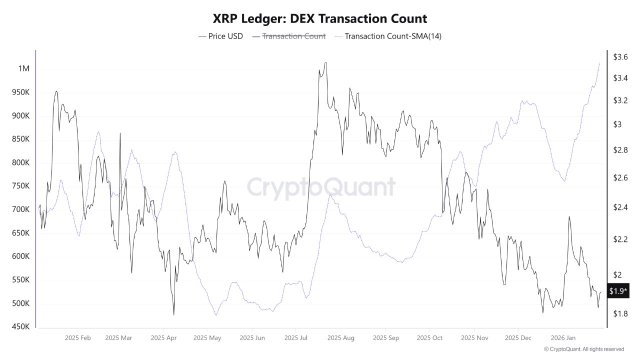
Source: Chart from Xaif Crypto on X

Xaif Crypto stated that this massive transaction count is not just a mere spike; it signals sustained momentum for the Ledger. Currently, the network is witnessing a fresh wave of liquidity and real user engagement. As a result, the expert declares that the Ledger is heating up in 2026.

This milestone comes as the XRP Ledger rolls out a new Lending Protocol (XLS-66), which is attracting institutional-grade credit to the network. With the new Lending Protocol, the Ledger is now evolving into a full financial layer with Rippled 3.1.0.

The protocol includes the ability to create loans on the Ledger, with loan brokers being able to generate fixed-term and fixed-rate, uncollateralized loans. These loans are predictable for professional use.

In addition, these loans are held in a Single Asset Vault, allowing risk-isolated liquidity. Another feature is the off-chain underwriting for uncollateralized options. It boasts native efficiency, which offers low-cost lending without a middleman or intermediaries. In the meantime, Decentralized Finance (DeFi) on the Ledger has just undergone a boost.

The Lending Protocol Gains Institutional Support

Following its historical launch a few days ago, the new XRP Lending Protocol is now experiencing significant support from institutional-level investors. One of the earliest companies to interact with the new protocol is Evernorth, a leading public treasury company.

According to BankXRP, the company is backing the native lending protocol to help transition a $100 billion market cap into a productive, yield-bearing ecosystem. These kinds of moves are an indication that the future of institutional DeFi is becoming native-driven.

XRP trading at $1.75 on the 1D chart | Source: XRPUSDT on Tradingview.com

Related Questions

QWhat key milestone did the XRP Ledger DEX recently achieve according to the article?

AThe XRP Ledger DEX activity recently reached a 13-month high, with the number of transactions on the 14-day moving average rising to approximately 1.014 million, breaking the ceiling that held throughout all of 2025.

QWho reported the surge in XRP Ledger DEX activity and on which platform?

AThe surge was reported by Xaif Crypto, a market expert and investor, on the X platform.

QWhat major new protocol has the XRP Ledger recently rolled out that is attracting institutional interest?

AThe XRP Ledger has rolled out a new Lending Protocol (XLS-66), which is attracting institutional-grade credit to the network.

QWhat is one of the key features of the new XRP Lending Protocol mentioned in the article?

AOne key feature is the ability to create fixed-term and fixed-rate, uncollateralized loans that are held in a Single Asset Vault, allowing for risk-isolated liquidity.

QWhich company was mentioned as one of the earliest institutional supporters of the new XRP Lending Protocol?

AEvernorth, a leading public treasury company, was one of the earliest companies to interact with and back the new XRP Lending Protocol.

Related Reads

From Cash to Crypto: Towards a Consistent Regulatory Approach to Illicit Payments

"From Cash to Crypto: Towards a Consistent Regulatory Approach to Illicit Payments" by Andrea Minto et al. (BIS) examines the challenges for Anti-Money Laundering and Countering the Financing of Terrorism (AML/CFT) regulation posed by the diversification of payment instruments, from cash and bank deposits to cryptoassets and CBDCs. The paper introduces a conceptual framework centered on the degree of intermediary involvement in a payment tool. It identifies a "waterbed effect": as regulators tighten AML/CFT rules on one type of instrument (e.g., bank transfers), illicit activity may shift to less-regulated alternatives with lower detection probabilities (e.g., self-hosted crypto wallets). This regulatory arbitrage undermines overall effectiveness. The framework categorizes payment tools as either intermediary-dependent (e.g., bank deposits, e-money, custodial wallets) where regulated entities perform checks, or non-intermediated (e.g., cash, self-hosted wallets, offline CBDCs) which offer higher anonymity and pose greater detection challenges. Malicious actors are assumed to choose tools that minimize their risk of detection. A case study of the EU's evolving AML/CFT regime illustrates this dynamic, showing how regulation has expanded over time to cover new entities like Crypto-Asset Service Providers (CASPs). However, inconsistencies remain, such as transaction limits for cash but not yet for self-hosted wallets or offline digital euro transactions. The paper concludes by proposing a dual regulatory approach: a *lex generalis* establishing a unified baseline of core obligations for all intermediated tools, and a *lex specialis* with tailored rules for non-intermediated instruments (e.g., transaction limits for cash and offline CBDCs, enhanced "touch point" monitoring for self-hosted wallets). This aims to create a more effective, consistent, and forward-looking framework that balances financial integrity with considerations for user privacy and innovation.

marsbit3h ago

From Cash to Crypto: Towards a Consistent Regulatory Approach to Illicit Payments

marsbit3h ago

Trading

Spot
Futures

Hot Articles

How to Buy T

Welcome to HTX.com! We've made purchasing Threshold Network Token (T) simple and convenient. Follow our step-by-step guide to embark on your crypto journey.Step 1: Create Your HTX AccountUse your email or phone number to sign up for a free account on HTX. Experience a hassle-free registration journey and unlock all features.Get My AccountStep 2: Go to Buy Crypto and Choose Your Payment MethodCredit/Debit Card: Use your Visa or Mastercard to buy Threshold Network Token (T) instantly.Balance: Use funds from your HTX account balance to trade seamlessly.Third Parties: We've added popular payment methods such as Google Pay and Apple Pay to enhance convenience.P2P: Trade directly with other users on HTX.Over-the-Counter (OTC): We offer tailor-made services and competitive exchange rates for traders.Step 3: Store Your Threshold Network Token (T)After purchasing your Threshold Network Token (T), store it in your HTX account. Alternatively, you can send it elsewhere via blockchain transfer or use it to trade other cryptocurrencies.Step 4: Trade Threshold Network Token (T)Easily trade Threshold Network Token (T) on HTX's spot market. Simply access your account, select your trading pair, execute your trades, and monitor in real-time. We offer a user-friendly experience for both beginners and seasoned traders.

10.0k Total ViewsPublished 2024.03.29Updated 2025.03.21

How to Buy T

Discussions

Welcome to the HTX Community. Here, you can stay informed about the latest platform developments and gain access to professional market insights. Users' opinions on the price of T (T) are presented below.

活动图片