Backpack Surges Over 150% in Half a Month

marsbitPublished on 2026-06-15Last updated on 2026-06-15

Abstract

BP, the token of the Backpack exchange, has surged over 150% since early June, driven by the platform's expansion into regulated US stock brokerage and asset tokenization services. On June 2nd, Backpack announced Backpack Securities, offering traditional stock trading and tokenization, causing BP's price to jump over 80%. Momentum continued on June 12th with the launch of SPCX, a tokenized product for SpaceX stock on Solana, facilitating seamless conversion between traditional securities and on-chain assets. This aligns with the RWA (Real World Assets) narrative, creating a bridge between traditional finance and Solana DeFi. The token's unique economics also support its growth. All 2.5 billion initially circulating tokens were airdropped to the community, with zero allocation to the team or investors at launch. A key feature allows users who stake BP for at least one year to gain the right to convert tokens into company equity upon an IPO or acquisition. Despite some initial community controversy over airdrop distribution, focus is shifting to BP's long-term utility and value alignment as real products launch.

Author: Ma He, Foresight News

On June 15, the Backpack exchange token BP surged over 30% again within 24 hours, currently quoted at $0.475 with a market cap of $118.48 million and a fully diluted valuation (FDV) of $473.94 million. Since early June this year, BP has skyrocketed from around $0.16, breaking through a high of $0.48.
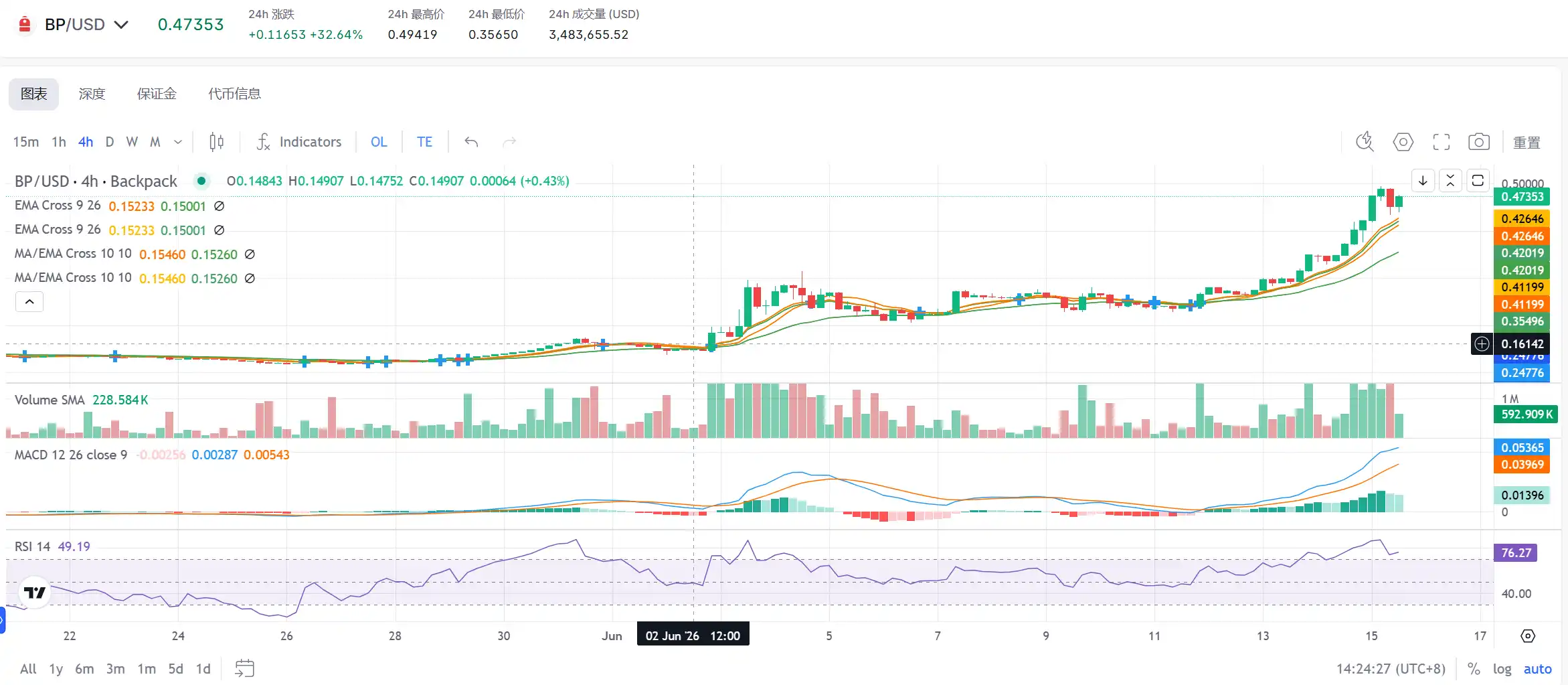
The direct catalyst for this market surge stems from the platform's latest breakthroughs in traditional U.S. stock brokerage and asset tokenization services.

Venturing into U.S. Stock Brokerage and Tokenization Business

In March 2026, BP completed its Token Generation Event (TGE) on Solana with a total supply of 1 billion tokens and an initial circulating supply of 250 million. After listing, the token price briefly touched a high point before rapidly declining, with a single-day drop exceeding 40% at its worst, as the market was once filled with profit-taking pressure. For several weeks thereafter, the price consolidated at lower levels until a turning point emerged in early June.

On June 2, Backpack announced the launch of the Backpack Securities platform, which will provide regulated U.S. stock brokerage services while also supporting the tokenization of traditional stocks for circulation on the blockchain, enabling seamless conversion between traditional securities and on-chain assets. The brokerage service is planned to launch gradually in June, with initial tokenized products rolled out in the Solana ecosystem through a partnership with Sunrise. BP skyrocketed over 80% in a single day, rapidly climbing from the $0.14-$0.15 range to around $0.27, with its market cap approaching $70 million at one point.

On June 12, coinciding with SpaceX's listing on NASDAQ, its tokenized product SPCX launched on Solana. In the subsequent 24 hours, BP rose approximately 27% further, pushing its price above $0.347. This token is pegged 1:1 to real SpaceX shares, supports 24/7 on-chain trading, and can be redeemed through a Backpack brokerage account into a traditional securities account, achieving interoperability between on-chain and off-chain assets. On its first day of launch, the product generated around $35-38 million in on-chain trading volume across DEXs like Jupiter and Raydium. According to the latest official data, the total on-chain SPCX trading volume exceeds $86 million.
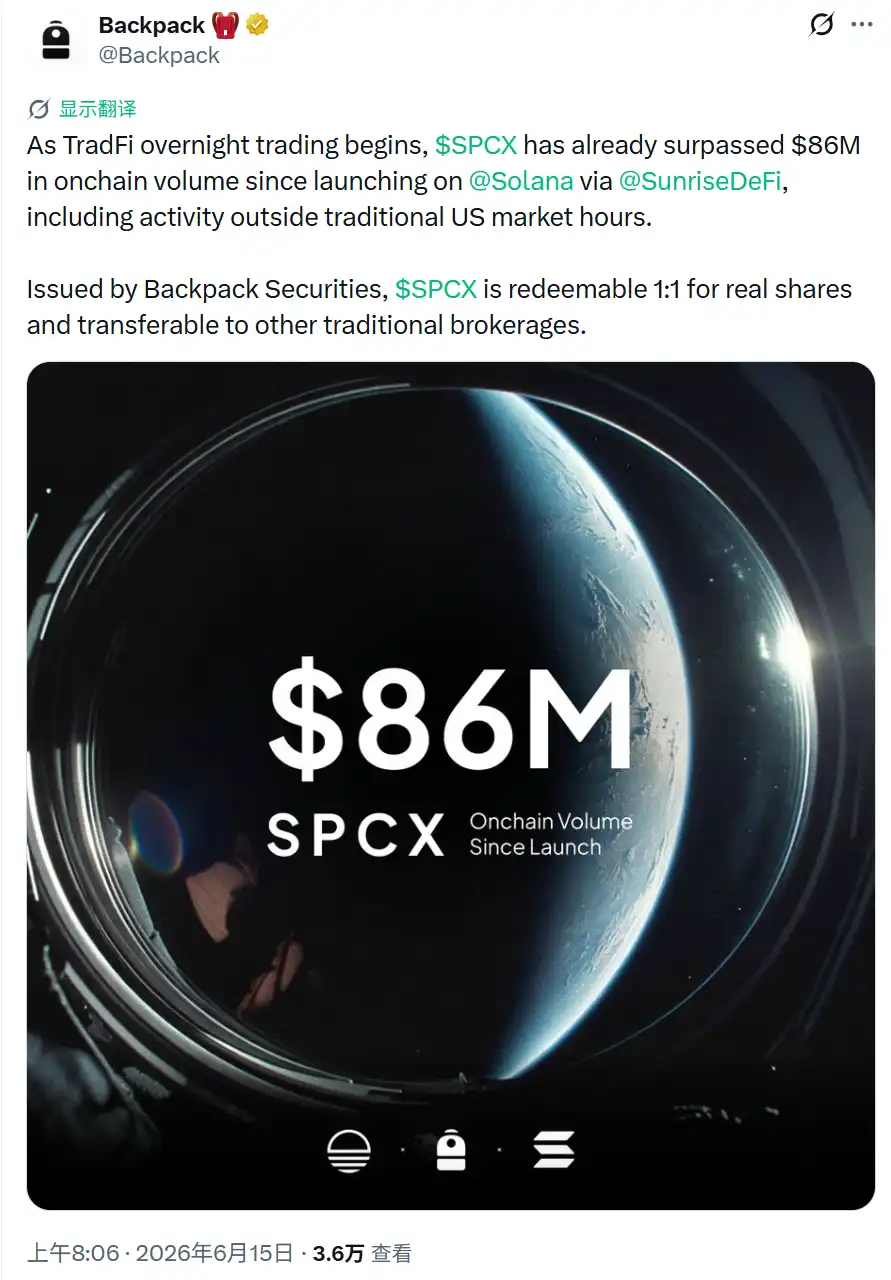
Backpack is building a bridge between traditional U.S. stocks and Solana DeFi. Users can not only trade crypto assets within the platform but also access real stocks through the same account and tokenize portions of their assets for use, trading, or composition on-chain. This pathway aligns highly with the current RWA (Real World Assets) narrative and provides the BP token with clearer use cases and demand support.

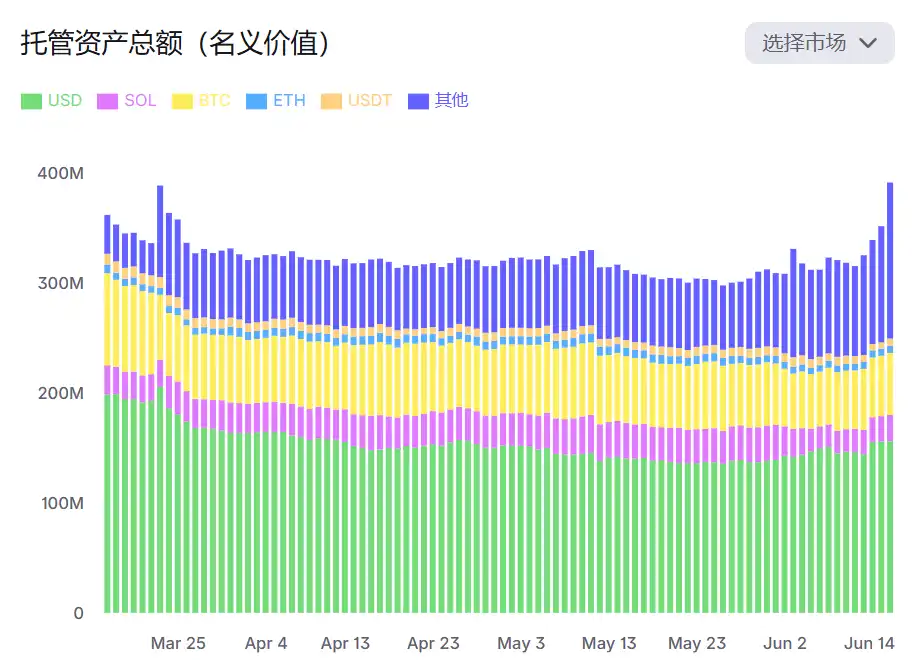
BP's recent surge stems more from substantial platform business expansion than short-term speculation. Currently, its official website shows that Backpack's total custodied assets (nominal value) have rebounded to $390 million.
No Tokens for the Team Unless the Company Goes Public

Supporting the above business development is the BP token and its unique economic structure launched as early as March. The total supply of 1 billion tokens is divided into three phases: 25% (250 million) at TGE was entirely airdropped to community users, with approximately 240 million allocated to participants in the points program and 10 million to Mad Lads NFT holders. At launch, the team, founders, and investors received 0 token allocation; 37.5% in the Pre-IPO phase is tied to growth triggers such as regulatory milestones and product launches, continuing to be distributed to users upon unlocking; 37.5% in the Post-IPO phase enters the company treasury, locked for at least one year after an IPO, with the team benefiting only through equity, not directly through tokens.
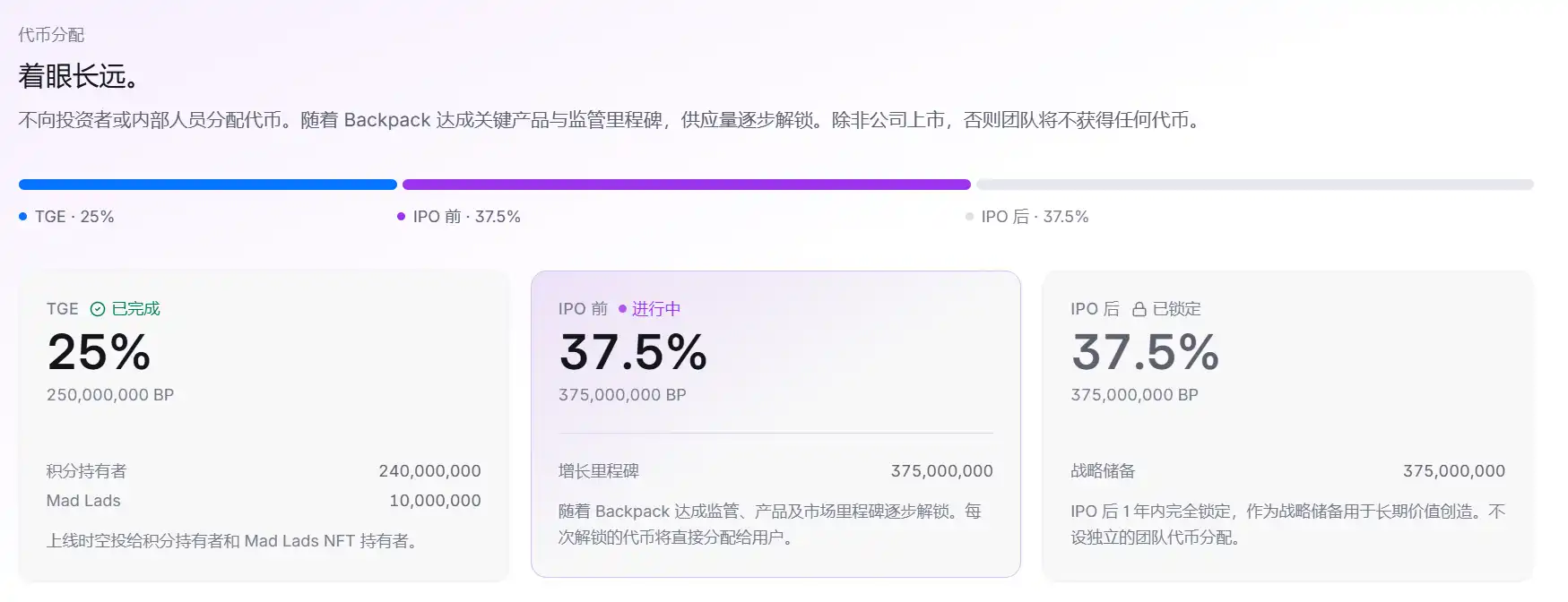
The most attention-grabbing mechanism is the equity conversion design: users who stake BP for at least 1 year gain the right to convert their tokens into company equity upon an IPO or acquisition, with the bonus increasing with holding time up to the 4th year based on the initial unlock.

Additionally, staking provides benefits such as tiered trading fee discounts, extra yield on USD collateral, free wire transfers, and priority access to the Backpack Card. Currently, about 66% (approximately 165 million) of the circulating supply is staked.

While the airdrop process was technically smooth, it also sparked community discussion. Supporters argue that the "no insider TGE allocation" model is quite radical, and the points system genuinely rewarded trading and ecosystem participation. Criticism focused on the relatively strict Sybil filtering mechanism, which led to some long-term users having their points removed, resulting in lower-than-expected allocations, as well as noticeable profit-taking during the post-listing price correction. CEO Armani Ferrante publicly denied allegations of team OTC sales.

These controversies temporarily affected market sentiment, but as tangible products like Backpack Securities were launched, the focus is gradually shifting from allocation details to the platform's long-term growth and the token's actual utility. Against the backdrop of the platform's expansion into U.S. stock brokerage and tokenization services, the long-term alignment value of BP's staking and equity mechanisms is being reevaluated.

Related Questions

QWhat is the key factor driving the recent sharp increase in the price of Backpack's BP token?

AThe key driver is Backpack's expansion into traditional U.S. stock brokerage and asset tokenization services through its new Backpack Securities platform, starting with the tokenized SpaceX (SPCX) offering on Solana.

QWhat is the unique feature of BP's tokenomics regarding team and investor allocation?

AAt TGE, 0 tokens were allocated to the team, founders, or investors. 100% of the initial circulating supply (25% of total) was airdropped to the community. Team members can only benefit through company equity (via a token conversion option post-IPO), not through direct token holdings.

QWhat significant milestone for Backpack occurred on June 12 alongside SpaceX's NASDAQ IPO?

AOn June 12, the tokenized product for SpaceX, SPCX, was launched on Solana. It is a 1:1 tokenized representation of real SpaceX stock, facilitating 24/7 on-chain trading.

QWhat major benefit can BP stakers obtain, and what percentage of the circulating supply is currently staked?

AStakers who lock BP for at least one year gain the right to convert their tokens into company equity upon an IPO or acquisition. Currently, approximately 66% (about 165 million) of the circulating supply is staked.

QWhat criticism did the BP token airdrop face from parts of the community?

ACriticism focused on the Sybil filtering mechanism being overly strict, which led to some long-term users having their points invalidated and receiving fewer tokens than expected. There were also accusations of team OTC selling, which the CEO denied.

Related Reads

Will the Next Crypto Bull Run Start with On-Chain Trading of SpaceX?

This article presents a scenario-based forecast for the crypto industry from 2026 to 2029, arguing that the next major cycle will be driven not by technological narratives but by legal access to real-world assets. The author predicts that by mid-2026, pre-IPO perpetual contracts for top private companies like SpaceX, OpenAI, and Anthropic on platforms like Hyperliquid will become the primary gateway for accessing quality assets, as most crypto-native tokens fail to capture real value. The much-hyped AI x Crypto intersection largely fails except for prediction markets, which thrive on betting on AI model supremacy. By 2027, public blockchain foundations are forced to choose between catering to retail speculation or building compliant infrastructure for institutions, with many opting for the latter. Growth in stablecoins and tokenized private credit/equity hits a "triple ceiling" due to regulatory and political uncertainty rather than market demand. The pivotal shift is forecast for 2028. A major liquidation event in pre-IPO perpetuals exposes the structural flaw of synthetic markets lacking a real underlying asset anchor. In response, regulatory changes finally allow the public solicitation of private securities resales to verified accredited investors. This creates a legitimate secondary market for real company equity, which then becomes the core asset class of the new bull market, relegating synthetic perps to a niche role. By 2029, the industry becomes "boring" but foundational. Tokens without claims on real cash flows or assets cease trading. Stablecoin growth is steady but politically capped. Crypto infrastructure fades from view as it gets absorbed into traditional finance backends. The article's central thesis is that the key bottleneck for crypto's next phase is legal and regulatory channels for real asset ownership, not technology.

marsbit33m ago

Will the Next Crypto Bull Run Start with On-Chain Trading of SpaceX?

marsbit33m ago

The Value Distribution of Stablecoins

**Summary: The Value Distribution of Stablecoins** The article argues that stablecoins are evolving from mere trading tools into broader channels for dollar access. It divides the stablecoin ecosystem into four layers to analyze how value is distributed: 1. **Issuance Layer:** Mints stablecoins, holds reserve assets, and captures the spread between reserve yield and user costs (e.g., Tether, Circle). This layer currently earns the largest profit margin. 2. **Infrastructure Layer:** Connects stablecoins to the traditional financial system, handling fiat on/off-ramps, banking integration, compliance (KYC/AML), and asset management (e.g., Bridge, BVNK). This is the "unglamorous" but critical work, building the essential bridges between crypto and real-world finance. 3. **Acquiring/Distribution Layer:** Integrates stablecoins into merchant systems, manages payment flows, and provides enterprise financial software (e.g., Stripe, Coinbase). They act as the access point for businesses. 4. **Application Layer:** The end-users and businesses that ultimately use stablecoins for payments, settlements, or as a store of value. They benefit from convenience but have little pricing power. The core thesis is that while the issuance layer currently dominates profits, the often-overlooked **infrastructure layer holds significant long-term potential**. The real challenge and barrier to mass adoption is not the on-chain transfer of stablecoins (which is simple), but the complex "last mile" integration into existing business workflows, banking systems, and regulatory frameworks across different countries. Companies in this layer are currently in a "land grab" phase, investing heavily to build networks, secure bank partnerships, and establish compliance pathways. While their position is currently pressured by the profitable issuers above and distribution platforms below, the article suggests that if stablecoins become a default financial rail for businesses, the infrastructure providers who have done the hard work of integration will ultimately gain strong pricing power and become entrenched, essential players.

marsbit7h ago

The Value Distribution of Stablecoins

marsbit7h ago

The Value Distribution of Stablecoins

The Value Distribution of Stablecoins The article argues that stablecoins are evolving from a mere trading tool into a broad "dollar channel." It analyzes the industry's value chain through four layers: 1. **Issuance Layer (e.g., Tether, Circle):** The top layer that mints stablecoins, holds reserve assets, and captures the thickest interest rate spread. 2. **Infrastructure Layer (e.g., Bridge, BVNK):** Connects stablecoins to the traditional financial system, handling critical but complex "dirty work" like fiat on/off-ramps, banking integration, compliance (KYC/AML), and cross-border settlement. 3. **Acquiring/Distribution Layer (e.g., Stripe, Coinbase):** Embeds stablecoins into merchant systems, manages payment flows, and integrates with enterprise software. 4. **Application Layer:** End-users and businesses that ultimately use stablecoins for payments, settlement, or storing value. The author posits that while the issuance layer currently captures the most profit, the most overlooked and potentially critical layer is infrastructure. The core challenge for stablecoin adoption isn't the on-chain transfer (which is simple), but bridging the gap between blockchain and the real-world financial system. This involves solving practical problems for businesses: fiat conversion, reconciliation, tax handling, and user onboarding. Infrastructure companies are currently in a difficult "land-grab" phase—building networks, securing banking relationships, and achieving compliance country-by-country. They face pressure from both the profitable issuance layer above and distribution platforms below. However, the author suggests this layer is building a crucial moat. Once stablecoins become a default business rail, the infrastructure players who have done the hard work of integration may gain significant, durable value and pricing power.

链捕手7h ago

The Value Distribution of Stablecoins

链捕手7h ago

Trading

Spot
Futures
活动图片