Just now, Lin Junyang, the former technical lead of Alibaba's Tongyi Qianwen, announced his new entrepreneurial move: he has founded a new AI company in Shanghai called Pragmatik Labs, abbreviated as p7k. The direction was also officially revealed for the first time: to research the next generation of Agents spanning the digital and physical worlds.
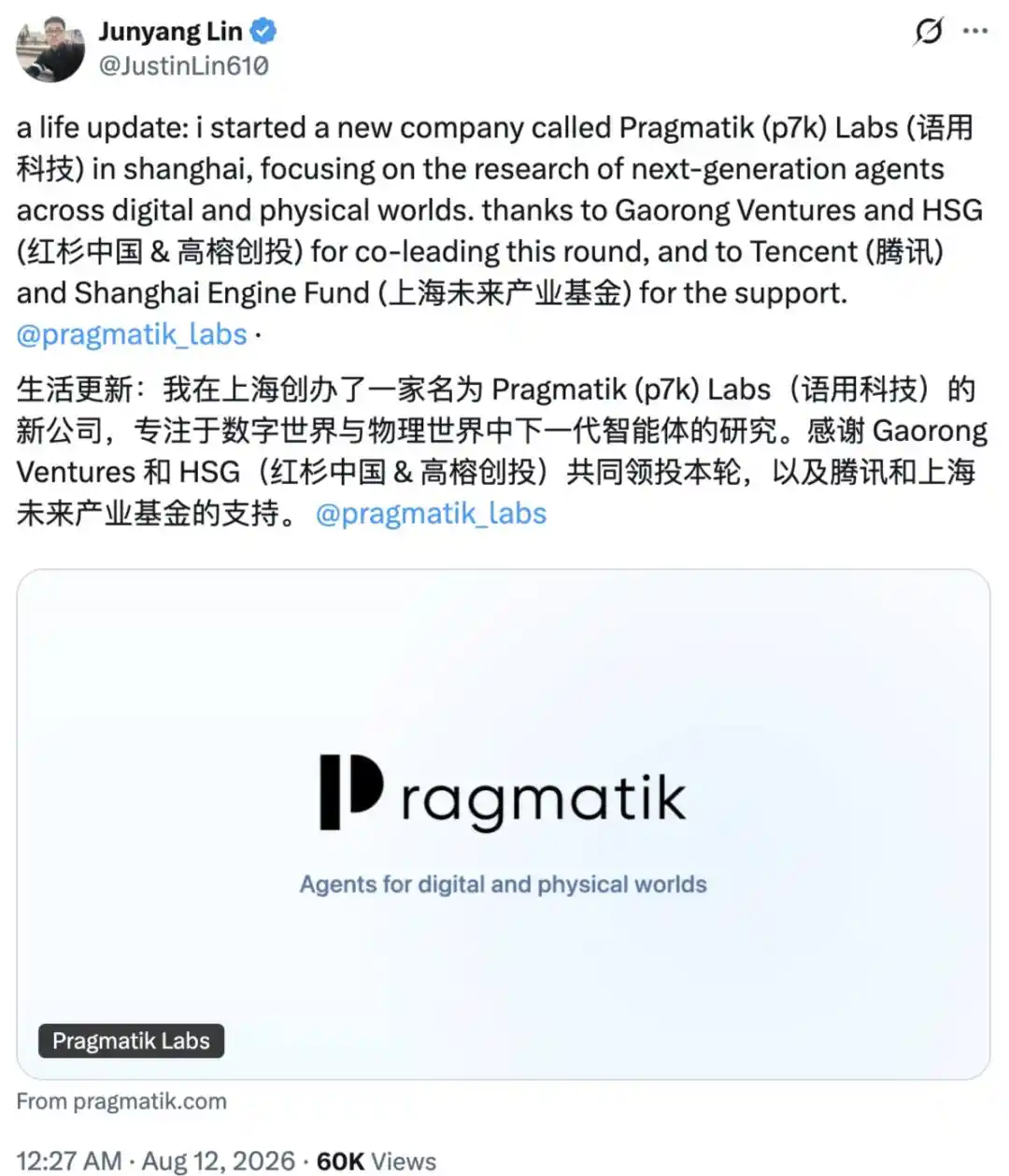

At the same time, Pragmatik Labs's investor lineup also surfaced. Lin Junyang revealed that Gaorong Capital and HSG (Sequoia Capital China) co-led this round of financing, with Tencent and the Shanghai Future Industry Fund providing support.
There were previously reports indicating that Pragmatik Labs's financing round reached several hundred million US dollars, with Gaorong Capital and HSG each investing approximately $100 million, Tencent investing about $20 million, and the company's post-money valuation reaching about $2 billion.
This also means that even before its official debut, Pragmatik Labs's valuation has already entered the tens of billions of RMB range.
Thus, the speculation surrounding Lin Junyang's whereabouts, which lasted nearly half a year from his departure from Tongyi Qianwen in March this year, to rumors of entrepreneurship in May and financing progress in June, has finally been answered.
The technical lead who once drove Qwen into the global top tier of large models did not stay at a large tech company, nor did he simply limit his new company's goal to foundational models.
He has placed his next bet on Agents.
Currently, the new company's official website has also surfaced, but the disclosed information is very limited, with no model parameters announced nor specific products released. However, the company's technical blueprint is already quite clear.
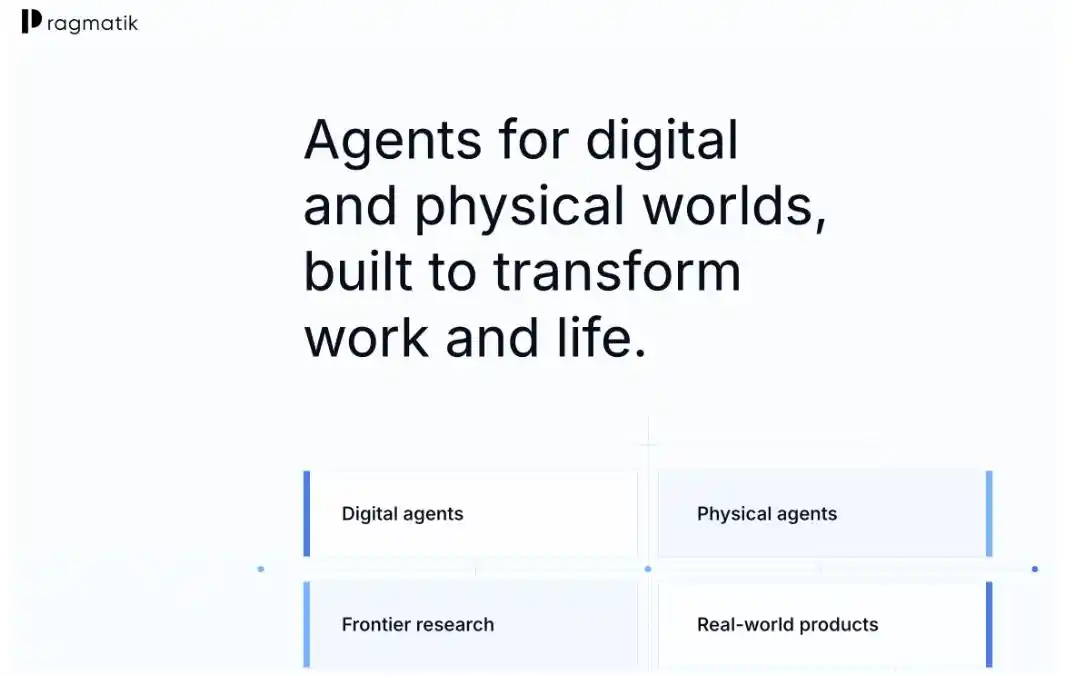
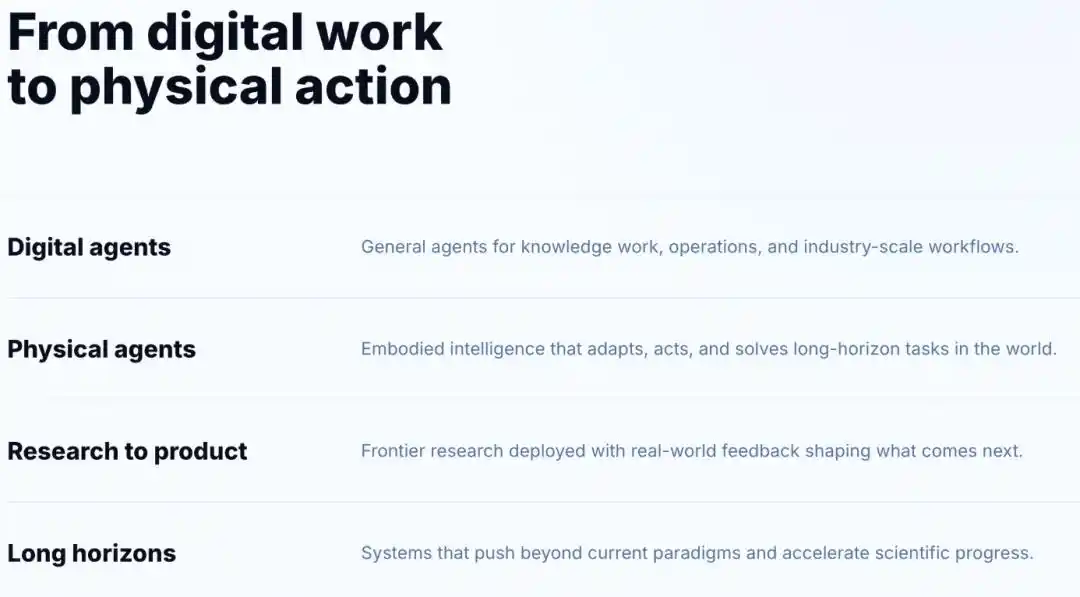
Pragmatik has clearly divided its research direction into two areas: Digital Agents + Physical Agents. Based on this, it is refined into four parts:
Digital Agents: General-purpose agents for knowledge work, business operations, and industry-level workflows.
Physical Agents: Embodied intelligence capable of adapting to environments, taking actions, and completing long-horizon tasks in the real world.
From Research to Product: Transforming cutting-edge research into real products and continuously shaping the next research directions through real-world feedback.
Long-term Exploration: Building systems that break through existing paradigms to accelerate scientific progress.
In fact, this choice of technical direction was not without warning. As early as March this year, Lin Junyang published an article titled "From 'Reasoning' Thinking to 'Agentic' Thinking," proposing that the focus of the next stage of AI will further shift from 'training models' to 'training agents, and even training systems composed of multiple agents.'
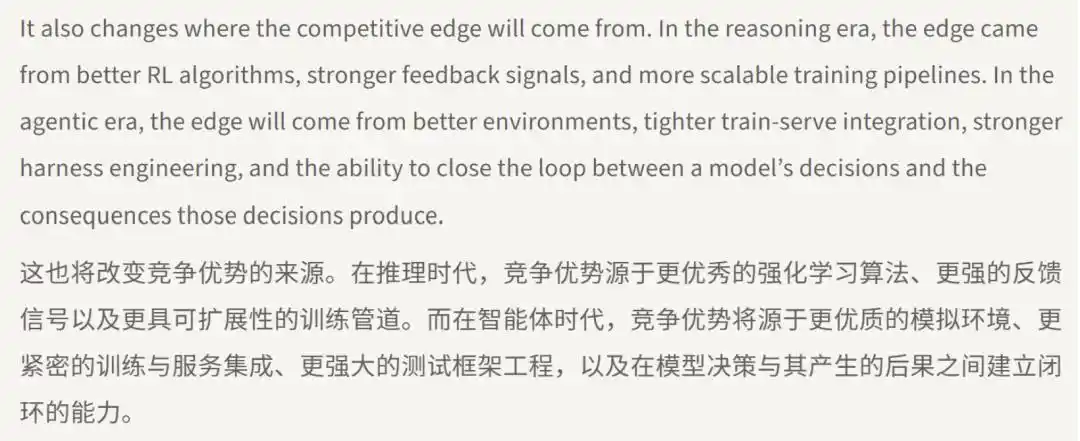
Article link: https://justinlin610.github.io/blog/from-reasoning-to-agentic-thinking/
Lin Junyang's definition of 'Agent' goes a step further.
In his vision, what truly needs to be trained in the Agent era is the complete system composed of 'model + environment,' including the Harness, training environment, evaluators, and even the collaboration methods between multiple Agents.
This might be what Pragmatik Labs refers to as the "next generation of Agents."
When discussing the new company's name, Lin Junyang explained: "I originally studied linguistics because a friend recommended pragmatics to me. Later, I turned to computational linguistics and natural language processing (NLP).
This name, on one hand, means returning to where everything truly happens; on the other hand, it also points to pragmaticism — we believe this is the direction AGI should pursue."

Speaking of this, we cannot help but review Lin Junyang's impressive resume once more.
Lin Junyang was born in 1993. He completed his undergraduate studies in the English Department at the University of International Relations, concurrently studying Japanese, Russian, German, and French. He pursued a master's degree in Foreign Linguistics and Applied Linguistics at Peking University. His deep linguistic background laid the foundation for his future understanding of the underlying logic of large language models, giving him deeper insights and accumulation in the direction of machines understanding human language and intent.
Information shows that during university, Lin Junyang conducted tests using an English-German vocabulary database containing over 3 million samples. He found that the accuracy rate of normal machine translation was only about 23%, while an early version of Transformer could achieve 27%. This seemingly minor data comparison allowed him to keenly capture the future explosive potential of large models.
After graduating with a master's degree in 2019, Lin Junyang joined the Alibaba DAMO Academy Intelligent Computing Lab as a senior algorithm engineer, researching natural language processing, officially entering the frontier field of AI.
Afterwards, in just over 6 years, he embarked on a fast-track promotion path......
At the end of 2022, Alibaba merged the AI teams for language, vision, etc., from DAMO Academy into Alibaba Cloud, establishing the Tongyi Lab. Lin Junyang officially took over the Tongyi Qianwen series of large models, shouldering the banner of technical lead.
Under his leadership, Alibaba launched the Qwen series of open-source models covering various parameter scales, truly pushing Alibaba's AI technology more widely into the industry ecosystem.
In August 2024, after the former head of Tongyi Qianwen, Zhou Chang, left to join ByteDance, Alibaba conducted a general salary adjustment for core department employees, and Lin Junyang was promoted to P9 as a result.
In May 2025, based on the outstanding achievements led by his team, Lin Junyang jumped to P10, becoming the youngest P10-level technical lead at Alibaba.
In October 2025, Lin Junyang personally formed a robotics and embodied intelligence group within Qwen, seen by the outside world as one of Alibaba's most explicit strategic explorations into physical AI systems. At that time, he stated in an X post that he was attempting to let models step out of the virtual screen, to truly understand space and learn to operate with hands, pushing intelligence into the real physical world.
Then, in early March this year, Lin Junyang posted a tweet announcing his departure from the Qwen team.

And just now, Lin Junyang officially announced his new entrepreneurial direction — Pragmatik Labs, choosing to bet on "the next generation of Agents spanning the digital and physical worlds."
Lin Junyang once participated in building one of China's most globally influential large model systems. Now, choosing to include both the digital and physical worlds in the company's research objectives at the very first moment of announcing the new company's name is itself a noteworthy industry signal.
The "war" of foundational models is far from over, but more and more top researchers are already asking the next-level question: The models can already think, so how do we make them actually get things done next?
Perhaps this is precisely the question Pragmatik Labs aims to answer.
Reference Links:
https://x.com/JustinLin610/status/2087214239643730227
https://pragmatik.com/
This article is from the WeChat public account "Almost Human" (ID: almosthuman2014), author: Almost Human focusing on Agents, editors: Youli, Shan Hui