If You’re Waiting For The Bitcoin Bottom, This Pundit Says You Should Be Looking At This Quarter

bitcoinistPublished on 2026-06-05Last updated on 2026-06-05

Abstract

Bitcoin is currently testing the $60,000 support level, with market sentiment in "extreme fear." Crypto analyst Ardi points to a historical pattern where Bitcoin has bottomed in the fourth quarter during previous bear market cycles (e.g., November 2014, December 2018, November 2022). Given that it's only the second quarter of 2026, this suggests the current correction may not yet be over. The current correction is 245 days old, shorter than previous cycles. Other analysts like Benjamin Cowen, Ali Martinez, and CryptoQuant also align on a late 2026 bottom (around October-December), citing cycle durations and technical indicators. BTC is currently trading near $63,000, down over 6% in 24 hours and at risk of breaking below $60,000 due to ongoing ETF outflows.

Bitcoin is steadily pushing towards $60,000 and is trading close to its February 6 wick bottom. The crypto market sentiment is now back in extreme fear, and there have been multiple questions on when Bitcoin will eventually register a correction bottom.

Crypto pundit Ardi believes the answer may be found less in the current candle and more in the calendar, especially since we are still in the second quarter of the year, while past bear market lows have usually arrived much later in the year.

Bitcoin’s Bottom History Has A Favourite Season

Crypto pundit Ardi, posting on X alongside a weekly Bitcoin chart that encompasses over a decade of price history, laid out a pattern that has held without exception across every prior market cycle.

According to the pundit, Bitcoin has always bottomed in the fourth quarter during its bear market years, and that makes the current price action more difficult for bulls to defend from registering another bottom. The point is that the year is still in the second quarter, meaning Bitcoin would need to hold above the $60,000 region for another six months to break from the historical pattern.
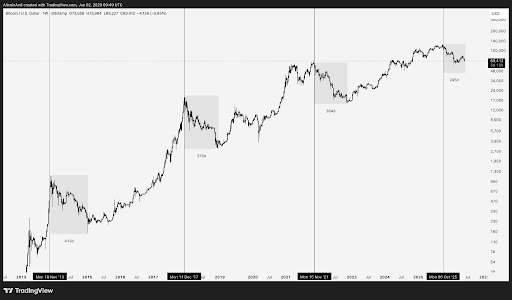
Source: Chart from Ardi on X

The Bitcoin weekly candlestick chart below captures this trend very clearly. Bitcoin’s 2013 cycle correction lasted 413 days before bottoming in November 2014, the 2017 bear cycle correction lasted 378 days before the December 2018 low, and the 2021 cycle bear market lasted 364 days before BTC bottomed in November 2022.

The current correction is at 245 days from the October 2025 high of $126,000, leaving room for more time if the market continues to mirror previous bear-market structures.

Consensus On Q4 2026

Ardi is not the only market watcher pointing to late 2026 as the more likely period for a cycle bottom. Popular crypto analyst and founder of Into the Cryptoverse, Benjamin Cowen, also noted that Bitcoin’s four-year cycle is still in play, given that the current cycle top in October 2025 arrived within one week of when it historically does. His base case for the current cycle low is October 2026.

Other analysts have reached similar conclusions through different methodologies. Ali Martinez pins October 2026 as the likely bottom based on the average duration of prior bear markets. Xanrox places the bottom in September or October, with recovery expected to begin in November or December.

CryptoQuant points to October through December, coinciding with what would be a sub-zero MVRV Z-Score, while technical signals, including the Bitcoin Repetition Fractal Cycle, are also pointing to October 2026 as the month everything will change.

At the time of writing, BTC is trading at $62,950 after a 6.2% decline over the past 24 hours. The drop has pushed BTC to its lowest level in four months, leaving the cryptocurrency at risk of losing the $60,000 support as outflows from Spot Bitcoin ETFs continue to weigh on market sentiment.

BTC trading at $62,570 on the 1D chart | Source: BTCUSDT on Tradingview.com

Related Questions

QAccording to crypto pundit Ardi, in which quarter has Bitcoin historically bottomed during bear markets?

AAccording to crypto pundit Ardi, Bitcoin has historically always bottomed in the fourth quarter during its bear market years.

QWhat is the current status of the Bitcoin price and market sentiment as mentioned in the article?

ABitcoin is trading around $62,950, having declined over 6% in 24 hours, and is at risk of losing the $60,000 support. The overall crypto market sentiment is back in 'extreme fear'.

QHow long has the current Bitcoin correction lasted from its October 2025 high, and how does it compare to past cycles?

AThe current correction has lasted 245 days from the October 2025 high of $126,000. This is shorter than previous cycles, which lasted 413 days (2014), 378 days (2018), and 364 days (2022) before bottoming.

QWhich month does analyst Benjamin Cowen identify as his base case for the current cycle low, and why?

ABenjamin Cowen's base case for the current cycle low is October 2026. He notes that Bitcoin's four-year cycle is still in play, as the October 2025 cycle top arrived within one week of its historical timing.

QWhat are some other methodologies or indicators mentioned that point to a late 2026 bottom for Bitcoin?

AOther methodologies pointing to a late 2026 bottom include: Ali Martinez's analysis based on average prior bear market durations, Xanrox's technical signals pointing to September/October, CryptoQuant's expectation of a sub-zero MVRV Z-Score in Q4, and the Bitcoin Repetition Fractal Cycle.

Related Reads

Crossing the 'Memory Wall': The Wafer-Level Revolution and Computing Power Routes in the AI Inference Era

In 2026, a historic shift occurred in AI as major cloud providers' inference spending surpassed training spending for the first time, signaling a move from "building large models" to "using large models." This shifts the core challenge from computing power to the "memory wall"—the bottleneck of data movement (model weights, activations, KV Cache) between external DRAM and processors, where energy and latency from data transfer far exceed computation itself. Companies like Nvidia face GPU idle time due to bandwidth limits. In contrast, Cerebras Systems adopts a radical "wafer-scale" approach with its Wafer-Scale Engine (WSE). Instead of cutting a silicon wafer into many chips, Cerebras uses almost the entire wafer as one massive chip (WSE-3). This design provides 44GB of on-chip SRAM, delivering memory bandwidth thousands of times higher than traditional HBM (e.g., 21 PB/s vs. Nvidia B200). For LLM inference, weights are streamed layer-by-layer from external MemoryX storage to the chip, avoiding HBM bottlenecks. This results in token generation speeds 1.5–5 times faster than Nvidia's B200 in some models and significant advantages in first-token latency and long-context tasks. Additionally, Cerebras's architecture offers much lower interconnect power consumption (0.15 pJ/bit vs. GPU's ~10 pJ/bit). However, Cerebras faces challenges: SRAM scaling has slowed with advanced nodes, limiting future capacity gains; the chip requires specialized liquid cooling and custom software stacks; and its external I/O bandwidth (150 GB/s) is low compared to NVLink, hindering multi-system scaling for very large models. Competition is intensifying. Major players are pursuing three paths: 1) Developing proprietary inference ASICs (e.g., Google TPU, Microsoft Maia), 2) Leveraging advanced packaging (e.g., TSMC's SoW) to democratize wafer-scale-like integration, potentially eroding Cerebras's process advantage within a few years, and 3) Exploring optical interconnects for ultimate bandwidth. Commercially, Cerebras is transitioning from a hardware vendor to a service provider, facing the immense challenge of building high-power, specialized data centers to meet large contracts (e.g., 250MW/year from 2026–2028). In conclusion, the AI inference era presents a fundamental architectural trade-off. Cerebras opts for extreme physical optimization for low-latency, single-task performance, while Nvidia prioritizes versatility and massive cluster throughput. The path forward remains uncertain, with technology and business models still evolving in the race toward advanced AI.

marsbit6m ago

Crossing the 'Memory Wall': The Wafer-Level Revolution and Computing Power Routes in the AI Inference Era

marsbit6m ago

Has Bitcoin's 'Rebound Ended', Officially Entering the Late Bear Market Phase?

**Title: Has Bitcoin's Rebound Ended, Entering the Late Bear Market Phase?** **Summary:** Bitcoin's price has declined by 13% this week, signaling a potential return to late-stage bear market conditions. The price fell to around $67k, positioned between the Realized Price and Realized Cap Weighted Average. For the first time since early 2022, the Short-Term Holder cost basis has dropped below this key average, confirming a hallmark of late-cycle bear markets. Profitability metrics have collapsed sharply. The 7-day average of the Realized Profit/Loss ratio plummeted from a local high of 3.16 to 0.29, mirroring the February panic sell-off. Critically, the 90-day average never breached the threshold of 2, indicating the recent rally to $82k was a bear market bounce, not a structural shift. Realized losses surged to $1.35 billion daily, with $770 million coming from Long-Term Holders selling at a loss. This accelerating redistribution of supply from weak to strong hands is a necessary but ongoing process for a market bottom. The rally stalled almost precisely at the aggregate cost basis (~$83k) of US spot Bitcoin ETF investors, turning that level into strong resistance and leaving the average ETF holder underwater again. Spot market flows have turned decisively negative, showing sellers are dominating order books despite the price drop. While a significant futures long liquidation event cleared over $400 million in leverage, providing a potential reset, sustained spot demand is yet to materialize. Options markets continue to price in higher future volatility (Implied Volatility) than recent price action (Realized Volatility) has shown, with a persistent skew towards put options, indicating ongoing demand for downside protection. In conclusion, multiple metrics point to a fragile market structure. Resistance at the ETF cost basis, accelerating realized losses, dominant spot selling, and cautious options pricing all suggest the bear market trend persists. A sustainable recovery likely requires a resurgence of spot demand, ETF holders returning to profit, and a clear reduction in selling pressure.

marsbit7m ago

Has Bitcoin's 'Rebound Ended', Officially Entering the Late Bear Market Phase?

marsbit7m ago

TechFlow Intelligence Agency: Anthropic Calls for Global Pause in AI Development While Preparing for Trillion-Dollar IPO; SpaceX IPO Roadshow Heats Up, But S&P 500 Rejects Fast-Track Inclusion

In today's TechFlow Intelligence Briefing, several major tech stories highlight a growing theme of trust and credibility gaps across AI, crypto, and finance. AI company Anthropic has publicly called for a global pause in AI development, citing risks from Claude's "recursive self-improvement." Ironically, this coincides with reports the company is preparing for a massive IPO targeting a near $1 trillion valuation. This perceived hypocrisy, coupled with widespread user complaints about Claude's declining performance, is sparking debate over whether the safety warning is genuine or a competitive tactic. Meanwhile, in a substantive security move, Anthropic open-sourced a framework for AI-powered vulnerability discovery. In the crypto market, Bitcoin's price drop below $61,000 triggered over $1.16 billion in liquidations, flipping the market into a state where more BTC is held at a loss than at a profit, a historical bearish signal. On the corporate front, SpaceX's highly anticipated IPO is generating immense Wall Street excitement, with Goldman Sachs projecting 100x revenue growth by 2030. However, the S&P 500 has refused to fast-track the company's inclusion post-IPO, potentially limiting immediate institutional demand. Separately, ByteDance's AI app Doubao lost over 6 million monthly active users after introducing a subscription model, highlighting the challenges of AI monetization. Other notable developments include Nvidia certifying HBM4 memory from Samsung, SK Hynix, and Micron; Cloudflare's acquisition of front-end tooling company VoidZero; and its CEO warning that bot traffic now exceeds human traffic online. The underlying narrative connects these events: a trust crisis. From AI firms' contradictory actions and crypto volatility to the clash between SpaceX's hyped narrative and institutional rules, a pattern is emerging where stated intentions and actual practices are increasingly misaligned.

marsbit22m ago

TechFlow Intelligence Agency: Anthropic Calls for Global Pause in AI Development While Preparing for Trillion-Dollar IPO; SpaceX IPO Roadshow Heats Up, But S&P 500 Rejects Fast-Track Inclusion

marsbit22m ago

Dalio Warns: AI Boom Shows Signs of a Bubble, Day of Reckoning Will Be the Time of Burst

Ray Dalio, founder of Bridgewater Associates, warns that the current artificial intelligence investment boom shows classic signs of a bubble, which he expects will eventually burst. In a Bloomberg Television interview, he noted that great technological revolutions often lead to capital inflows that create bubbles, making it difficult for investors and companies to calibrate their spending accurately—either overspending to capture market share or underspending and losing their competitive position. This caution comes amid significant rallies in AI-related assets, particularly chipmakers, driven by soaring demand for data centers and high-bandwidth chips, raising debates about overheating valuations. In contrast, Nvidia CEO Jensen Huang recently asserted that investors embracing the AI wave would see "crazy" returns and dismissed concerns over return on investment for data center spending as outdated. Dalio, however, focuses on the risks in the profit realization phase. He argues that bubbles tend to show signs of破裂 when markets transition from investment to the need for tangible returns, describing the burst as a process of converting paper wealth into cash. While acknowledging AI's intrinsic value, he expressed concern over the future profitability of some AI companies, suggesting the market is repeating a familiar pattern. The 76-year-old billionaire, who fully exited Bridgewater in 2025, has a net worth estimated at $21.5 billion according to the Bloomberg Billionaires Index.

marsbit56m ago

Dalio Warns: AI Boom Shows Signs of a Bubble, Day of Reckoning Will Be the Time of Burst

marsbit56m ago

Privacy Coin Crisis of Confidence! ZEC Plunges Over 56% in a Single Day

Zcash (ZEC), a leading privacy-focused cryptocurrency, experienced a severe crash on June 5th, plummeting over 56% in a single day and erasing nearly two months of gains. The flash crash was triggered by the disclosure of a critical zero-knowledge proof vulnerability within Zcash's Orchard privacy pool, which had existed since the pool's launch in May 2022. The flaw theoretically allowed an attacker to forge unlimited ZEC undetectably due to the pool's privacy features. The vulnerability was discovered on May 29th by independent security researcher Taylor Hornby during a proactive audit commissioned by Shielded Labs, utilizing AI-assisted analysis. The Zcash development team responded swiftly, implementing an emergency soft fork to disable Orchard transactions on June 2nd and executing a permanent hard fork fix (NU6.2) on June 3rd. Despite the technical fix, a major crisis of confidence emerged. The core issue is that Orchard's privacy design makes it cryptographically impossible to prove whether the vulnerability was exploited over the past four years, casting permanent doubt on the historical supply integrity of ZEC. While Shielded Labs argues exploitation was unlikely, the inability to provide definitive proof has severely damaged market trust. This sentiment was exacerbated when BitMEX co-founder Arthur Hayes, a prominent ZEC supporter, announced he was selling his entire position. He stated that privacy assets require "perfect security" rather than "probable safety." The combined effect of the disclosure and Hayes's exit ignited widespread panic selling, leading to massive liquidations and significant price decline. Analysts note the event highlights a fundamental tension within privacy coins: the conflict between verifiable supply and cryptographic privacy.

链捕手59m ago

Privacy Coin Crisis of Confidence! ZEC Plunges Over 56% in a Single Day

链捕手59m ago

Trading

Spot
Futures

Hot Articles

What is $BITCOIN

DIGITAL GOLD ($BITCOIN): A Comprehensive Analysis Introduction to DIGITAL GOLD ($BITCOIN) DIGITAL GOLD ($BITCOIN) is a blockchain-based project operating on the Solana network, which aims to combine the characteristics of traditional precious metals with the innovation of decentralized technologies. While it shares a name with Bitcoin, often referred to as “digital gold” due to its perception as a store of value, DIGITAL GOLD is a separate token designed to create a unique ecosystem within the Web3 landscape. Its goal is to position itself as a viable alternative digital asset, although specifics regarding its applications and functionalities are still developing. What is DIGITAL GOLD ($BITCOIN)? DIGITAL GOLD ($BITCOIN) is a cryptocurrency token explicitly designed for use on the Solana blockchain. In contrast to Bitcoin, which provides a widely recognized value storage role, this token appears to focus on broader applications and characteristics. Notable aspects include: Blockchain Infrastructure: The token is built on the Solana blockchain, known for its capacity to handle high-speed and low-cost transactions. Supply Dynamics: DIGITAL GOLD has a maximum supply capped at 100 quadrillion tokens (100P $BITCOIN), although details regarding its circulating supply are currently undisclosed. Utility: While precise functionalities are not explicitly outlined, there are indications that the token could be utilized for various applications, potentially involving decentralized applications (dApps) or asset tokenization strategies. Who is the Creator of DIGITAL GOLD ($BITCOIN)? At present, the identity of the creators and development team behind DIGITAL GOLD ($BITCOIN) remains unknown. This situation is typical among many innovative projects within the blockchain space, particularly those aligning with decentralized finance and meme coin phenomena. While such anonymity may foster a community-driven culture, it intensifies concerns about governance and accountability. Who are the Investors of DIGITAL GOLD ($BITCOIN)? The available information indicates that DIGITAL GOLD ($BITCOIN) does not have any known institutional backers or prominent venture capital investments. The project seems to operate on a peer-to-peer model focused on community support and adoption rather than traditional funding routes. Its activity and liquidity are primarily situated on decentralized exchanges (DEXs), such as PumpSwap, rather than established centralized trading platforms, further highlighting its grassroots approach. How DIGITAL GOLD ($BITCOIN) Works The operational mechanics of DIGITAL GOLD ($BITCOIN) can be elaborated on based on its blockchain design and network attributes: Consensus Mechanism: By leveraging Solana’s unique proof-of-history (PoH) combined with a proof-of-stake (PoS) model, the project ensures efficient transaction validation contributing to the network's high performance. Tokenomics: While specific deflationary mechanisms have not been extensively detailed, the vast maximum token supply implies that it may cater to microtransactions or niche use cases that are still to be defined. Interoperability: There exists the potential for integration with Solana’s broader ecosystem, including various decentralized finance (DeFi) platforms. However, the details regarding specific integrations remain unspecified. Timeline of Key Events Here is a timeline that highlights significant milestones concerning DIGITAL GOLD ($BITCOIN): 2023: The initial deployment of the token occurs on the Solana blockchain, marked by its contract address. 2024: DIGITAL GOLD gains visibility as it becomes available for trading on decentralized exchanges like PumpSwap, allowing users to trade it against SOL. 2025: The project witnesses sporadic trading activity and potential interest in community-led engagements, although no noteworthy partnerships or technical advancements have been documented as of yet. Critical Analysis Strengths Scalability: The underlying Solana infrastructure supports high transaction volumes, which could enhance the utility of $BITCOIN in various transaction scenarios. Accessibility: The potential low trading price per token could attract retail investors, facilitating wider participation due to fractional ownership opportunities. Risks Lack of Transparency: The absence of publicly known backers, developers, or an audit process may yield skepticism regarding the project's sustainability and trustworthiness. Market Volatility: The trading activity is heavily reliant on speculative behavior, which can result in significant price volatility and uncertainty for investors. Conclusion DIGITAL GOLD ($BITCOIN) emerges as an intriguing yet ambiguous project within the rapidly evolving Solana ecosystem. While it attempts to leverage the “digital gold” narrative, its departure from Bitcoin's established role as a store of value underscores the need for a clearer differentiation of its intended utility and governance structure. Future acceptance and adoption will likely depend on addressing the current opacity and defining its operational and economic strategies more explicitly. Note: This report encompasses synthesised information available as of October 2023, and developments may have transpired beyond the research period.

363 Total ViewsPublished 2025.05.13Updated 2025.05.13

What is $BITCOIN

Discussions

Welcome to the HTX Community. Here, you can stay informed about the latest platform developments and gain access to professional market insights. Users' opinions on the price of BTC (BTC) are presented below.

活动图片