Twenty One Plunges Nearly 20% on Debut: The Valuation Mystery of the Third-Largest Bitcoin DAT

Odaily星球日报Published on 2025-12-10Last updated on 2025-12-10

Abstract

Twenty One Capital (NYSE: XXI), a Bitcoin-focused asset reserve company backed by Tether and SoftBank, debuted on the New York Stock Exchange on December 9. Despite its strong backing and large Bitcoin holdings, its stock plunged nearly 20% on the first trading day. The company holds 43,514 BTC, making it the third-largest corporate Bitcoin holder globally, yet its market valuation sits at just $186 million—a mere 4.6% of its Bitcoin's market value. This extreme discount stems from its reliance on "shareholder injections" rather than open-market purchases. Most of its Bitcoin came directly from Tether, raising transparency and sustainability concerns. The broader Digital Asset Treasury (DAT) model is under pressure, with most major Bitcoin-holding companies trading below their net asset value. While proponents like Michael Saylor argue Bitcoin will become a foundational asset in the digital economy, the market remains skeptical in the short term, demanding more proof of the model’s resilience.

Original | Odaily Planet Daily (@OdailyChina)

Author | Ding Dang (@XiaMiPP)
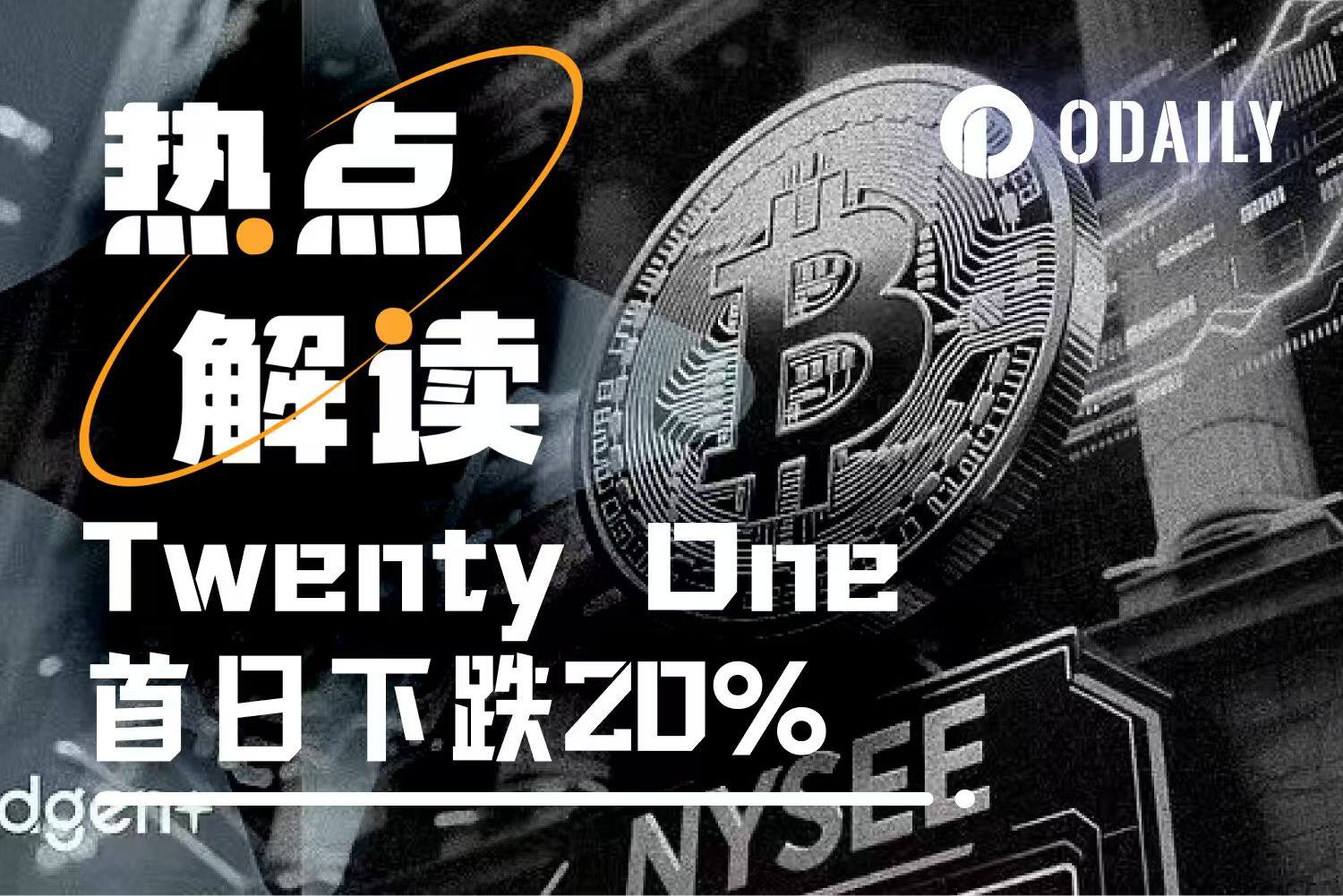
Twenty One Capital (NYSE: XXI), a "Bitcoin asset reserve company" backed by stablecoin giant Tether and Japanese conglomerate SoftBank Group, officially listed on the New York Stock Exchange on December 9. However, in stark contrast to its resource advantages of "heavy assets" and "strong backing," the stock price plummeted immediately after the first day's opening, with a intraday drop of nearly 20%. The capital market's initial report card was not friendly.

Twenty One was founded in early 2025 and is led by Strike founder and CEO Jack Mallers. It is positioned as a company with Bitcoin as its core asset allocation. It has strong backing from stablecoin issuer Tether, Japan's SoftBank Group, and Wall Street investment bank Cantor Fitzgerald.

It is important to note that Twenty One did not undergo a traditional IPO but instead completed a backdoor listing by merging with Cantor Equity Partners (a SPAC), officially listing on the NYSE on December 9. Cantor Equity Partners is a key platform under Cantor Fitzgerald. The company is headed by Brandon Lutnick, son of the U.S. Secretary of Commerce, who personally led this merger. He emphasized in the announcement that Cantor's partnership was key to engaging innovative participants like Tether and SoftBank. This relationship adds a "dimension of institutional prestige" to Twenty One Capital, especially in the context of the Trump administration's promised crypto-friendly policies.

But market sentiment is clearly more complex. The company initially under the ticker CEP saw its stock price surge from $10.2 to a high of $59.6 after the announcement, a gain of nearly 6 times. The initial enthusiasm for the "Bitcoin reserve company" narrative was almost written on the K-line chart. However, as speculative sentiment faded, the price quickly fell back and is currently hovering around $11.4, erasing almost all of the premium.

This forms an extremely strong contrast with its massive Bitcoin holdings. As of the listing, Twenty One held 43,514 BTC, with a market value of approximately $4.03 billion, ranking third in the global corporate Bitcoin holdings list, behind only Strategy and MARA Holdings.

Valuation Puzzle: Causes Behind the Extreme Discount

What truly puzzles the market is its valuation structure. At the current stock price level, Twenty One's overall market capitalization is only about $186 million, with a market multiple (mNAV) as low as 0.046. This means the capital market is only willing to price its Bitcoin assets at about 4.6% of their book value. Why such an extreme discount?

A deep dive into its asset acquisition method reveals that Twenty One's Bitcoin reserves were not primarily formed through long-term purchases on the open market but highly relied on a "shareholder infusion" model: its initial reserve of approximately 42,000 BTC came from a direct capital injection by Tether. Subsequently, on May 14, 2025, the company added 4,812 BTC through Tether, costing about $458.7 million at the time, corresponding to a cost of about $95,300 per coin; and before the listing, it completed an additional plan to acquire about 5,800 BTC through PIPE financing and convertible bond mechanisms.

The advantage of this model is its high efficiency, avoiding the lengthy process of building positions in the secondary market and allowing for scaled-up reserves in a short time; but the cost is equally obvious: assets are highly concentrated from a few related parties, making it difficult for investors to fully penetrate its internal transaction structure, custody form, and potential agreement constraints. Transparency and sustainability naturally become important discount factors in market pricing.

Collective Dilemma of the "Digital Asset Reserve Company" Model

From an industry perspective, Twenty One's problem is no longer an isolated case. According to defillama.com data, there are currently over 70 "crypto-stock companies" (i.e., listed companies holding crypto assets) globally. Among the top 20 holders, the mNAV of most companies has fallen below 1, including Strategy, which pioneered this model.
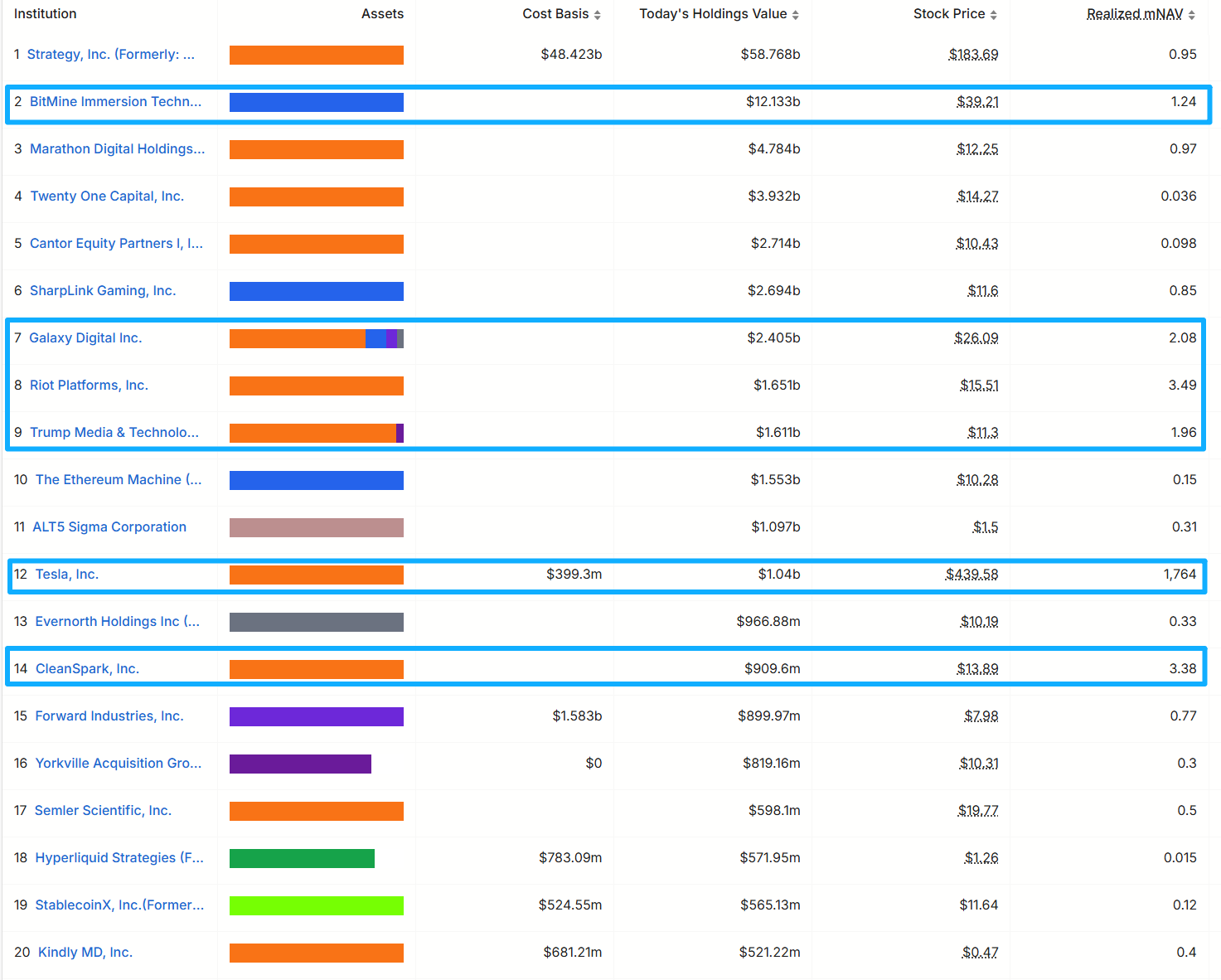
As the overall crypto market retreats, these "crypto-stock companies" have gradually retreated from being the core of the narrative to marginal assets in risk models. The current valuation of these crypto asset reserve companies has generally turned cautious.

However, there is an order of magnitude difference between Strategy and Twenty One. Strategy currently holds about 660,600 Bitcoin, accounting for about 3% of the total Bitcoin supply, a scale more than 15 times that of Twenty One. This size not only gives it stronger market influence but also a certain symbolic meaning of "systemic anchoring." When Strategy's mNAV falls below 1, the market naturally raises deeper questions: Will it be forced to sell coins? Could its debt structure trigger a stampede? Has the DAT model lost its logical foundation in the face of the macro cycle?

In fact, with the significant retreat of the crypto market in 2025, the DAT model faces severe tests. The core of this model is to accumulate Bitcoin through debt and equity financing, treating it as the "ultimate asset" to hedge against inflation and currency devaluation. But when Bitcoin's price volatility significantly amplifies, the stability of this model begins to waver. Some companies, despite holding large amounts of BTC, face valuation pressure due to operational costs and market sentiment. Twenty One's extreme discount, while related to its asset acquisition method, is also a concentrated reflection of the market's risk pricing for the entire DAT model.

Conclusion: The Narrative Remains, But the Market Needs Time

At the Binance Blockchain Week on December 4, Michael Saylor provided a broader perspective. In his speech titled "Why Bitcoin Remains the Ultimate Asset: The Next Chapter of Bitcoin," he reiterated his core judgment about Bitcoin's next decade: Bitcoin is transitioning from an investment product to the "basic capital" of the global digital economy, and the rise of the digital credit system will reshape the traditional $300 trillion credit market. From policy shifts and changes in bank attitudes, to the institutional absorption of ETFs, and the explosive growth of digital credit tools, Saylor描绘s a new financial order accelerating into being: digital capital provides energy, digital credit provides structure, and Bitcoin will become the underlying asset supporting it all.

From this perspective, companies like Twenty One do possess a potential for being "correct in the long term"—if Bitcoin ultimately completes its migration from a high-risk asset to "digital gold," then these companies may become core carriers in this migration process.

But the problem is, "correct in the long term" does not automatically equate to "reasonably priced in the present." The market still needs time to verify Bitcoin's true role in the macro system, and it also needs time to reassess the resilience of the DAT model under different cycle conditions.

Related reading: "Full Text of Saylor's Dubai Speech: Why Bitcoin Will Become the Underlying Asset of Global Digital Capital"


Related Questions

QWhat was the stock performance of Twenty One Capital (NYSE: XXI) on its first day of trading?

AThe stock of Twenty One Capital experienced a significant decline on its first day, with the price falling nearly 20%.

QWho are the major backers of Twenty One Capital?

ATwenty One Capital is backed by stablecoin issuer Tether, the Japanese conglomerate SoftBank Group, and the Wall Street investment bank Cantor Fitzgerald.

QHow did Twenty One Capital acquire the majority of its Bitcoin reserves?

AThe majority of its Bitcoin reserves were acquired through 'shareholder infusions,' primarily a direct capital injection of approximately 42,000 BTC from Tether, rather than through gradual purchases on the open market.

QWhat is the market's valuation (mNAV) of Twenty One Capital's Bitcoin holdings, and what does this indicate?

AThe market is valuing Twenty One Capital's Bitcoin holdings at a significant discount, with a market multiple (mNAV) of just 0.046, meaning the market is pricing its Bitcoin assets at only about 4.6% of their book value. This indicates deep market skepticism and a discount due to concerns over transparency and the sustainability of its asset acquisition model.

QAccording to the article, what is the broader challenge facing the Digital Asset Treasury (DAT) company model?

AThe broader challenge for the DAT model is that as the crypto market has experienced a major pullback, the core premise of using debt and equity to accumulate Bitcoin as a hedge is being tested. Market volatility has shaken the model's stability, leading to widespread discounted valuations (mNAV below 1) for many companies in this sector, reflecting a market-wide repricing of risk for the entire DAT model.

Related Reads

Can Alibaba Cloud Rewrite Itself?

Over the past five months, Alibaba Cloud's MaaS (Model as a Service) revenue has surged 15x, marking a strategic overhaul where the company is shifting its 17-year-old system designed for "humans using cloud" to a new paradigm centered on "Agents consuming Tokens." At its recent summit, Alibaba Cloud announced a full-stack upgrade encompassing "chip-cloud-model-inference," all optimized for AI Agents. Key launches include the new AI product portal "QianWen Cloud," hyper-node servers powered by the in-house AI chip Zhenwu M890, and the latest flagship model, Qwen3.7-Max. Senior VP Liu Weiguang described this as building "China's largest AI factory," where chips are raw materials, the cloud is the workshop, models are machines, and the inference platform is the assembly line, with Tokens as the final product. The company is now emphasizing its chip strategy, unveiling the Zhenwu M890 and a two-year roadmap for future chips. With over 560,000 chips deployed across 400+ clients, Alibaba Cloud aims to control the marginal cost per Token, mirroring Google's integration of TPU and Gemini for optimal cost-performance. The cloud infrastructure itself is being rewritten. Traditional cloud interfaces are being transformed into standardized, Agent-callable Skills. A new scheduling logic focuses on "task scheduling" over "resource scheduling" to handle the unpredictable, elastic workloads of Agents. Liu noted that AI applications now automatically provision cloud resources, with one customer's daily automated provisioning equaling two weeks of manual work. For models, the focus has shifted from conversational prowess to execution capability. Qwen3.7-Max demonstrated this by autonomously writing and optimizing a production-grade AI compute kernel for the new Zhenwu M890 chip over 35 hours, achieving a 10x performance improvement. The underlying Bailian platform was upgraded for efficiency, and it maintains an open ecosystem, hosting third-party models. This restructuring extends beyond technology to sales, organization, and metrics. Alibaba Cloud has established dedicated MaaS sales teams, separated from traditional IaaS, with new KPIs focusing on high-quality Tokens that solve real problems, the number of core business systems integrated with models, and the efficiency of Agent task completion. The underlying bet is clear: AI represents an opportunity orders of magnitude larger than before. Despite the uncertainty, Alibaba Cloud is aggressively rebuilding its entire system, betting on an AI-driven future where Tokens could become its largest product line.

marsbit14m ago

Can Alibaba Cloud Rewrite Itself?

marsbit14m ago

Warsh's First Conundrum: Rate Cuts, Inflation, and a Fractured Fed

Walsh's First Dilemma: Rate Cuts, Inflation, and a Divided Fed Kevin Warsh officially assumed the Fed Chairmanship on May 15th, inheriting a central bank deeply divided over inflation. Contrary to market expectations of a dovish stance due to his appointment by President Trump, Warsh's historical record shows early and consistent hawkish concerns about inflation. The Fed he leads is fractured, with three FOMC members recently dissenting against even hinting at future rate cuts. The immediate challenge is surging inflation. While the Iran-related oil shock is a temporary factor, core CPI and services inflation are accelerating, showing signs of becoming entrenched—echoing the Fed's 2022 "transitory" misstep. Warsh faces the task of building consensus within a committee where several members believe policy may not be restrictive enough, especially if the neutral interest rate (r-star) is higher than currently estimated. Politically, Warsh is caught between Trump's desire for rate cuts and the economic reality of persistent price pressures. Any move perceived as bowing to political pressure could undermine Fed independence. Market implications are significant. Long-term Treasury yields (e.g., 30-year at 5.19%) could rise further, especially if the June FOMC statement hints at possible tightening. Tech stocks face continued valuation pressure from higher rates. The key variable is progress in Iran negotiations; a breakthrough before the June meeting could temporarily ease oil-driven inflation, but stubborn services inflation would remain. All eyes are on Warsh's first post-FOMC press conference on June 17th. His wording on inflation and policy will reveal how much the market has mispriced his stance and the Fed's likely path forward.

marsbit35m ago

Warsh's First Conundrum: Rate Cuts, Inflation, and a Fractured Fed

marsbit35m ago

Trading

Spot
Futures

Hot Articles

What is $BITCOIN

DIGITAL GOLD ($BITCOIN): A Comprehensive Analysis Introduction to DIGITAL GOLD ($BITCOIN) DIGITAL GOLD ($BITCOIN) is a blockchain-based project operating on the Solana network, which aims to combine the characteristics of traditional precious metals with the innovation of decentralized technologies. While it shares a name with Bitcoin, often referred to as “digital gold” due to its perception as a store of value, DIGITAL GOLD is a separate token designed to create a unique ecosystem within the Web3 landscape. Its goal is to position itself as a viable alternative digital asset, although specifics regarding its applications and functionalities are still developing. What is DIGITAL GOLD ($BITCOIN)? DIGITAL GOLD ($BITCOIN) is a cryptocurrency token explicitly designed for use on the Solana blockchain. In contrast to Bitcoin, which provides a widely recognized value storage role, this token appears to focus on broader applications and characteristics. Notable aspects include: Blockchain Infrastructure: The token is built on the Solana blockchain, known for its capacity to handle high-speed and low-cost transactions. Supply Dynamics: DIGITAL GOLD has a maximum supply capped at 100 quadrillion tokens (100P $BITCOIN), although details regarding its circulating supply are currently undisclosed. Utility: While precise functionalities are not explicitly outlined, there are indications that the token could be utilized for various applications, potentially involving decentralized applications (dApps) or asset tokenization strategies. Who is the Creator of DIGITAL GOLD ($BITCOIN)? At present, the identity of the creators and development team behind DIGITAL GOLD ($BITCOIN) remains unknown. This situation is typical among many innovative projects within the blockchain space, particularly those aligning with decentralized finance and meme coin phenomena. While such anonymity may foster a community-driven culture, it intensifies concerns about governance and accountability. Who are the Investors of DIGITAL GOLD ($BITCOIN)? The available information indicates that DIGITAL GOLD ($BITCOIN) does not have any known institutional backers or prominent venture capital investments. The project seems to operate on a peer-to-peer model focused on community support and adoption rather than traditional funding routes. Its activity and liquidity are primarily situated on decentralized exchanges (DEXs), such as PumpSwap, rather than established centralized trading platforms, further highlighting its grassroots approach. How DIGITAL GOLD ($BITCOIN) Works The operational mechanics of DIGITAL GOLD ($BITCOIN) can be elaborated on based on its blockchain design and network attributes: Consensus Mechanism: By leveraging Solana’s unique proof-of-history (PoH) combined with a proof-of-stake (PoS) model, the project ensures efficient transaction validation contributing to the network's high performance. Tokenomics: While specific deflationary mechanisms have not been extensively detailed, the vast maximum token supply implies that it may cater to microtransactions or niche use cases that are still to be defined. Interoperability: There exists the potential for integration with Solana’s broader ecosystem, including various decentralized finance (DeFi) platforms. However, the details regarding specific integrations remain unspecified. Timeline of Key Events Here is a timeline that highlights significant milestones concerning DIGITAL GOLD ($BITCOIN): 2023: The initial deployment of the token occurs on the Solana blockchain, marked by its contract address. 2024: DIGITAL GOLD gains visibility as it becomes available for trading on decentralized exchanges like PumpSwap, allowing users to trade it against SOL. 2025: The project witnesses sporadic trading activity and potential interest in community-led engagements, although no noteworthy partnerships or technical advancements have been documented as of yet. Critical Analysis Strengths Scalability: The underlying Solana infrastructure supports high transaction volumes, which could enhance the utility of $BITCOIN in various transaction scenarios. Accessibility: The potential low trading price per token could attract retail investors, facilitating wider participation due to fractional ownership opportunities. Risks Lack of Transparency: The absence of publicly known backers, developers, or an audit process may yield skepticism regarding the project's sustainability and trustworthiness. Market Volatility: The trading activity is heavily reliant on speculative behavior, which can result in significant price volatility and uncertainty for investors. Conclusion DIGITAL GOLD ($BITCOIN) emerges as an intriguing yet ambiguous project within the rapidly evolving Solana ecosystem. While it attempts to leverage the “digital gold” narrative, its departure from Bitcoin's established role as a store of value underscores the need for a clearer differentiation of its intended utility and governance structure. Future acceptance and adoption will likely depend on addressing the current opacity and defining its operational and economic strategies more explicitly. Note: This report encompasses synthesised information available as of October 2023, and developments may have transpired beyond the research period.

363 Total ViewsPublished 2025.05.13Updated 2025.05.13

What is $BITCOIN

Discussions

Welcome to the HTX Community. Here, you can stay informed about the latest platform developments and gain access to professional market insights. Users' opinions on the price of BTC (BTC) are presented below.

活动图片