Jito Seizes User Traffic with JTX, Why Is It Still Undervalued by the Market?

marsbitPublished on 2026-07-28Last updated on 2026-07-28

Abstract

Jito, a Solana infrastructure provider, has launched a new product called JTX, which is shifting its business model from being a price-taker on Solana block space to becoming a price-setter for user transaction flow. Despite this strategic shift aimed at capturing and monetizing user traffic, the market continues to undervalue its native token, JTO. Analysts present a valuation case for JTO, arguing the market still prices it as backend infrastructure. Their base case scenario assumes JTX captures 15% of Solana DEX volume by Q2 2027, generating significant annualized revenue. Applying a conservative 30x P/S multiple to this revenue implies a JTO price of $1.18, representing ~57% upside from current levels (~$0.75). A probability-weighted target, including bullish (40% probability, 25% market share) and bearish (10% probability, 5% share) scenarios, points to a target of $2.75, suggesting ~267% potential upside. The thesis hinges on JTX's early positive performance data and its potential to benefit from the expected growth of on-chain trading, particularly from tokenized stocks and real-world assets. Furthermore, an estimated 80% of JTX's net revenue is slated for JTO buybacks, creating a potential value-accrual flywheel. The report concludes that Jito's transformation via JTX is not yet reflected in its valuation.

Authors: Jake Koch-Gallup & Sam Schubert

Compiled by: AididiaoJP, Foresight News

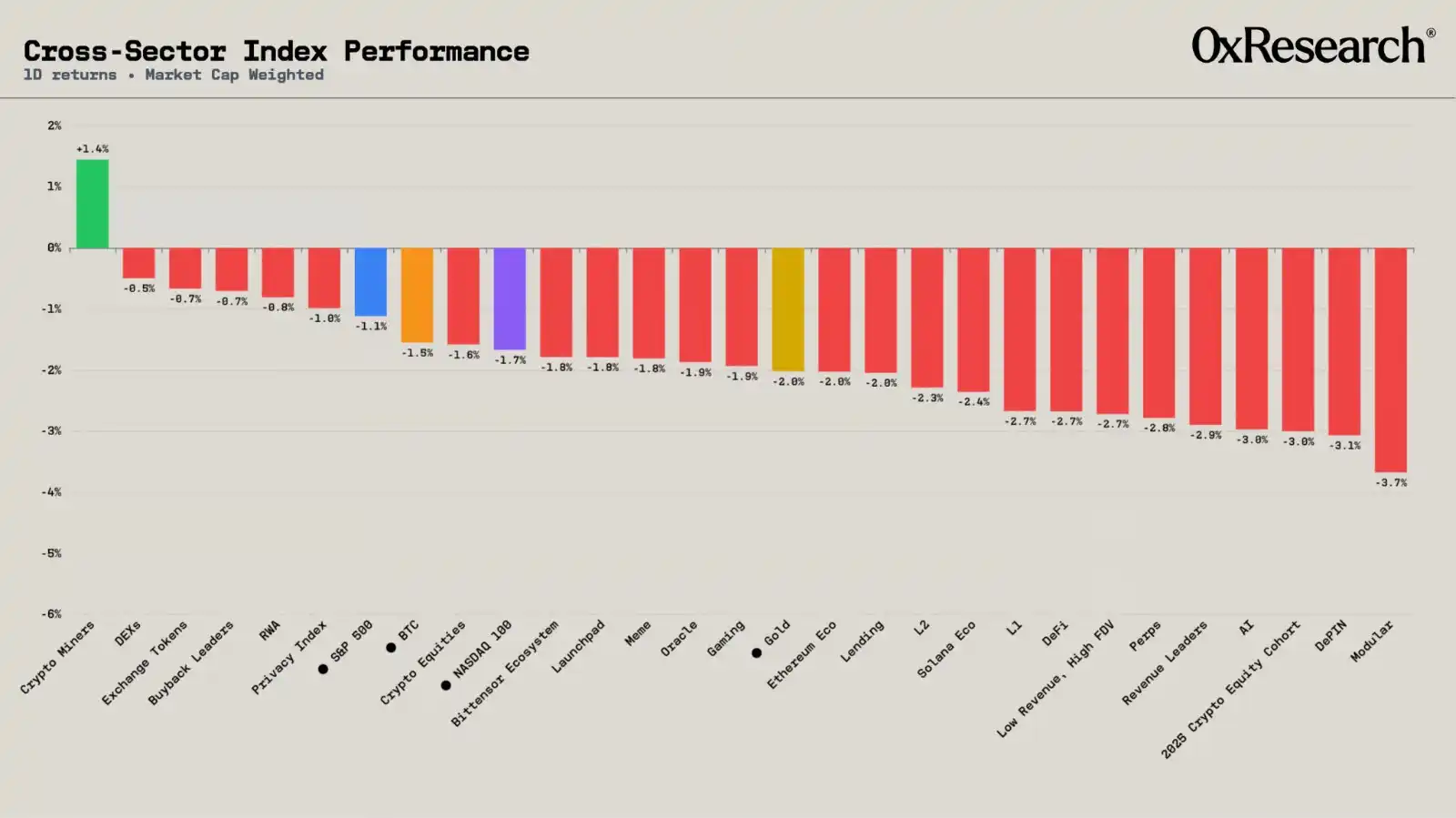
Following JTX's launch on July 14, how should we value JTO? This product is reshaping Jito's business model: it's no longer just a price-taker on Solana block space, but has begun pricing user traffic. Our base case implies 57% upside, while our probability-weighted target points to a potential gain of 267%. Meanwhile, the broader crypto market has pulled back, with only the crypto miner sector closing in the green, driven by a wave of AI data center trades.

Zooming out, one trend remains prominent: over the past week, the crypto miner sector surged 27.0%, significantly outperforming all other crypto sectors. It was followed by DEX (+4.6%), Bittensor Ecosystem (+4.3%), and Ethereum Ecosystem (+3.9%). The broader equity market was almost flat over the same period.
This rally has been fueled by a series of AI infrastructure announcements, indicating a shift in how investors value Bitcoin mining companies. On July 20, Hut 8 announced another 15-year, $9.8 billion lease for its Beacon Point campus, covering 352 megawatts. This deal doubles its contracted capacity to 704 MW, bringing the total base contract value to $19.6 billion. On the same day, IREN secured another $2.8 billion in AI cloud contracts, raising its year-end run-rate target from $3.7 billion to over $4.0 billion, with about 85% of its capacity already contracted to clients like Microsoft, NVIDIA, and Perplexity.
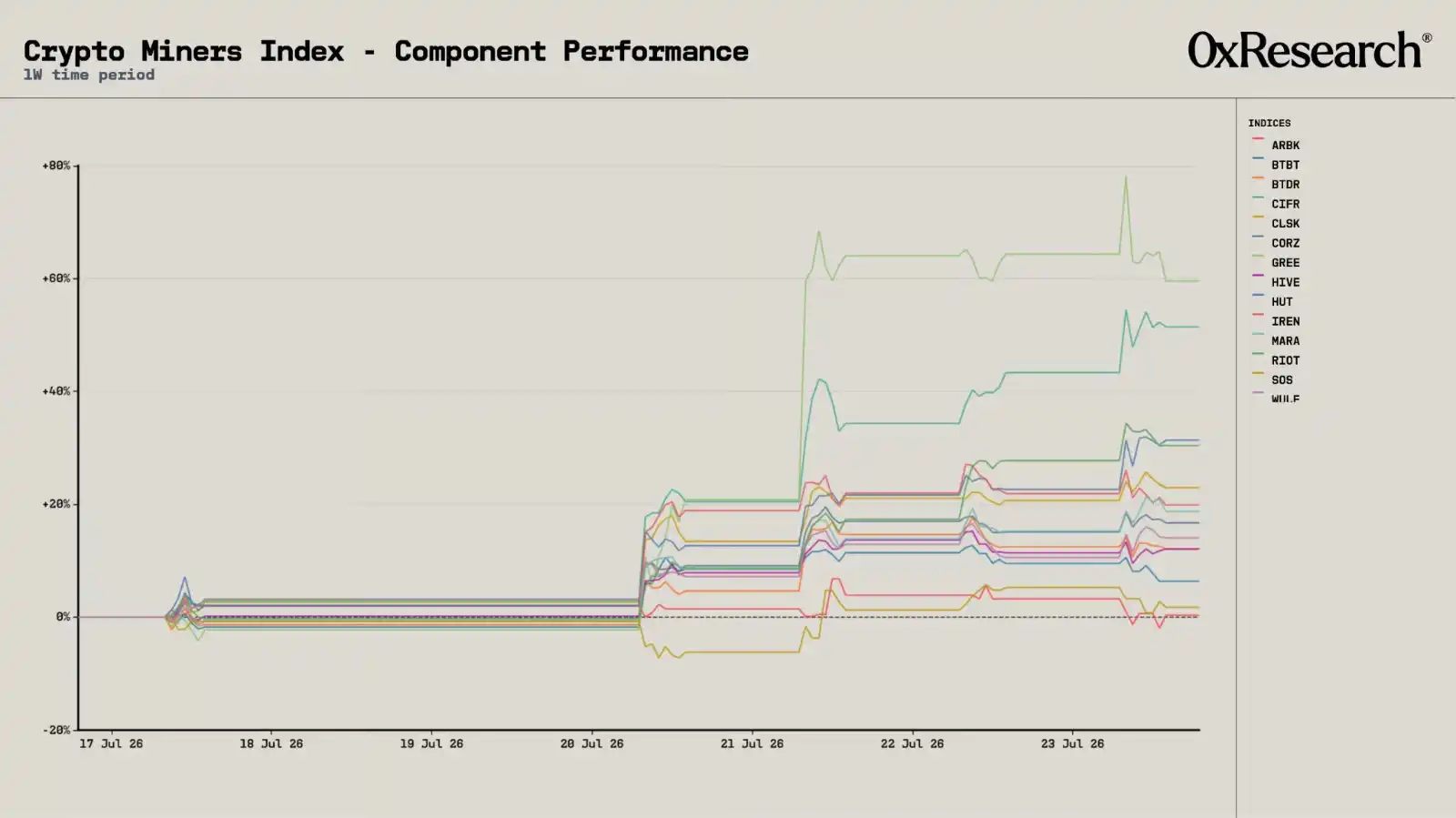
The market reacted swiftly. Over the past week, Greenidge gained 59.6%, followed by Cipher (+51.4%), Hut 8 (+31.4%), Riot (+30.4%), and CleanSpark (+22.9%). The common thread is that investors are increasingly viewing these companies as owners of scarce power and data center infrastructure, not just Bitcoin miners. As long as demand for AI compute continues to outpace supply, this narrative is likely to remain a primary catalyst for the sector, even as Bitcoin itself trades sideways.

Valuing Jito's JTX

Today, we dig deeper into valuing JTO. JTX's progress is redefining what the company is. The market still prices it as Solana backend infrastructure—a price-taker dependent on block space activity—whereas JTX (launched July 14) has effectively turned it into a price-setter for user traffic. Our buy thesis hinges on Jito's ability to truly capture this traffic, not a rebound in its traditional business.

While still early, JTX's execution data shows positive signs. Among the over 77,000 trades since launch, the median execution price deviated from the oracle mid-price by just 5.5 basis points, with 77.6% of trades within 25 bps and 29.1% even beating the oracle quote. Execution quality correlates strongly with liquidity: SOL had a median deviation of 3.9 bps, JitoSOL only 0.5 bps, while illiquid long-tail assets showed wider spreads. BAM's advantage is not yet pronounced: 4.6 bps in BAM-dominated blocks vs. 4.8 bps in others.

This structure exists because Jito deliberately sacrificed short-term revenue for long-term optimization of Solana's market structure—it shut down predatory MEV traffic and prioritized BAM, directly cutting into the high-margin Jito tip revenue that once contributed significantly.

Our model remains conservative on the legacy business: no assumption of tip revenue returning to peak levels, no assumption of JitoSOL LST recovery, and no assumption of BAM being fully monetized. The base case instead assumes JTX captures 15% of Solana DEX volume by Q2 2027, generating quarterly net revenue of $5.8 million and total revenue of $8.2 million, annualizing to about $32.7 million, with JTX accounting for roughly 72%. This implies a treasury-adjusted price-to-sales ratio of less than 15x based on Q2 2027 annualized revenue.
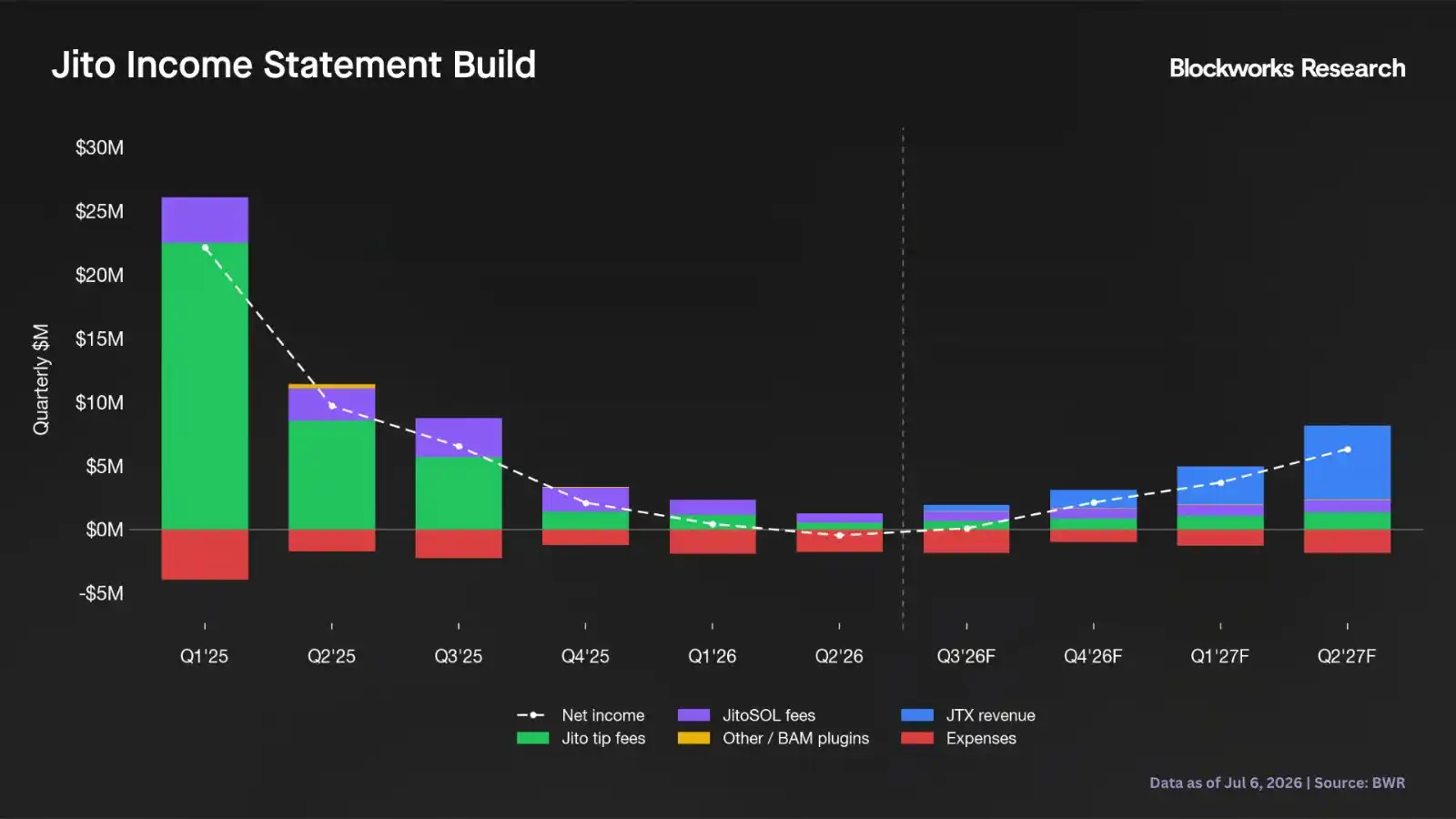
Historical context suggests this is cheap: even with declining revenue, the backend infrastructure business has traded at an average P/S of about 38x since early 2025. Applying a conservative 30x multiple to the base case annualized revenue yields a JTO price of $1.18, implying about 57% upside. A 30x multiple is not unreasonable for a growing business with a superior front-end economic model, especially compared to a shrinking business trading at 38x.
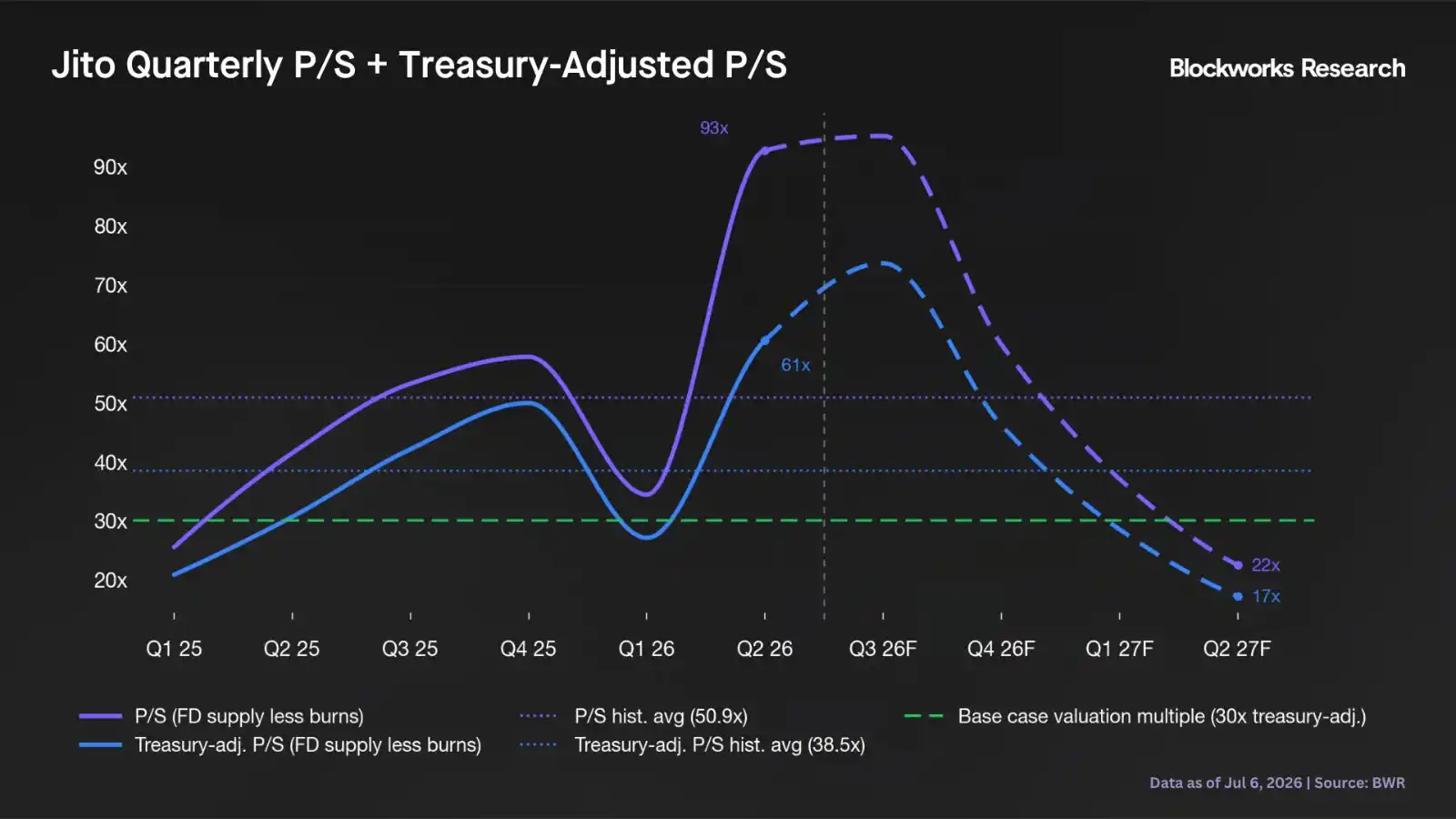
The scenario range is wide. The bull case (40% probability) assumes a 25% JTX market share and a 45x multiple, leading to a price of $5.31, a 600% gain. The bear case (10% probability) assumes market share stagnates at 5% and the P/S compresses to a commoditized 15x, leading to a price of $0.36, a 52% decline. The probability-weighted price target across the three scenarios is $2.75, implying about 267% upside from the current ~$0.75. The valuation is highly sensitive to Solana DEX volume, and our weighting leans optimistic because we believe tokenized stocks and real-world assets will scale on-chain, simultaneously boosting trading volume and JTX's market share.

JTX also makes JTO's value capture clearer: an estimated 80% of its revenue is earmarked for buybacks. The base case implies ~$8.6 million in buybacks over the next 12 months, retiring ~1.5% of the treasury-adjusted supply (bull case: ~5.7%). While the flywheel remains small today, it will scale directly with JTX's success.

Related Questions

QWhat is JTX, and how is it changing Jito's business model?

AJTX is a new product launched by Jito on July 14. It is shifting Jito's business model from being a price taker dependent on Solana block space activity to becoming a price setter for user traffic. It allows Jito to capture and monetize this traffic directly.

QWhat is the market's recent trend regarding the crypto miner sector?

AOver the past week, the crypto miner sector has surged 27.0%, significantly outperforming all other crypto sectors. This rally is largely driven by announcements related to AI infrastructure, leading investors to value these companies more as owners of scarce electricity and data center infrastructure rather than just Bitcoin miners.

QAccording to the analysis, what is the potential upside for JTO based on the base case scenario?

AAccording to the base case scenario analysis, applying a conservative 30x P/S multiple to Jito's projected annualized revenue gives a target price of $1.18 for JTO, implying an approximate 57% upside from the current price.

QWhat is the probability-weighted target price for JTO and the implied potential upside?

AThe probability-weighted target price for JTO is $2.75, which implies a potential upside of approximately 267% from the current price of around $0.75. This target is derived from a weighted average of optimistic, base, and pessimistic scenarios.

QHow does JTX plan to create value for JTO token holders?

AJTX is expected to direct approximately 80% of its revenue towards buybacks of the JTO token. In the base case scenario, this would amount to about $8.6 million in buybacks over the next 12 months, potentially retiring around 1.5% of the treasury-adjusted token supply.

Related Reads

The Fed's Interest Rate Decision is Inevitable! Former Senior Fed Advisor Reveals His Forecast for Today!

Former Federal Reserve senior advisor John Faust stated he does not expect the Fed to raise interest rates at the FOMC meeting concluding today. He argued the Fed will not try to win credibility by deliberately surprising markets. In his assessment, Faust noted that Fed Chairman Kevin Warsh has used strong rhetoric on restoring price stability but largely failed to share details on how he plans to achieve it. This information gap has led to various market scenarios. However, Faust believes the reality is simpler: Warsh positions himself as a pragmatic, tough-minded policymaker, placing high importance on monetary policy communication while showing flexibility regarding balance sheet reduction. Faust compared Warsh's approach to the "refined intuitive approach" used by former Chairman Alan Greenspan. Faust stated that, unlike strict policy rules, this approach does not yield clear-cut answers on rate decisions. In current conditions, both a 25-basis-point hike and waiting for the next meeting could be reasonably justified. Aligning with market expectations, Faust predicts the Fed will choose to wait today. He believes the benefit of waiting outweighs the negatives, partly because he agrees that deliberately surprising markets to boost credibility is not a valid factor. Faust also argued there is no substantial macroeconomic difference between hiking today and holding steady, as a 25-basis-point move over eight weeks alone is not economically decisive. He emphasized that the important aspect will not be the decision itself, but how it is explained to markets. Warsh has so far advocated forward-looking policy without clear guidance on economic forecasts or the likely rate path. Faust warned that if the Fed does not explicitly state grounds for a hike and opts to wait for more data, markets may misinterpret the decision's meaning. Regardless of today's outcome, how Warsh explains the policy decisions at the meeting and press conference may be the most critical information for investors.

cryptonews.ru3m ago

The Fed's Interest Rate Decision is Inevitable! Former Senior Fed Advisor Reveals His Forecast for Today!

cryptonews.ru3m ago

SUI Faces Daily $15 Million Token Unlock, While BEAT Leads $81 Million Token Release Wave This Week

The article discusses significant token unlocks planned for this week in the crypto market. According to Cryptorank, seven assets, including $SUI and $BEAT, are set for major releases. Analyst account Top7 estimates a $74.9 million one-time unlock for $BEAT on August 1, constituting about 2.12% of its circulating supply. $EIGEN and $KITE will also unlock on the same day for $7.65M and $6.08M respectively, with $BTW and $ZAMA following on August 2 for a combined $13.24M. In contrast to these large, concentrated unlocks, the $SUI token follows a different, continuous daily vesting mechanism, distributing approximately $15.4 million worth of tokens weekly into circulation among community reserves, early contributors, and the Mysten Labs treasury. This gradual release is seen as less likely to cause immediate selling pressure compared to one-time events. As of July 29, $SUI trades at $0.69 with a market cap of around $2.78 billion. The piece explains that large unlocks are important for traders as they increase the pool of tokens available for sale, potentially creating downward price pressure if supply outpaces demand. This effect is considered strongest for "cliff" unlocks like $BEAT's. Despite being a regular feature on unlock trackers due to its volume and vesting schedule, $SUI's ecosystem has shown independent growth, including a reported influx of $65 billion in stablecoin volume following a recent fee reduction. A key test will be whether $SUI's price holds steady from August 1-2 amidst the concentrated unlocks of other tokens.

cryptonews.ru14m ago

SUI Faces Daily $15 Million Token Unlock, While BEAT Leads $81 Million Token Release Wave This Week

cryptonews.ru14m ago

Trading

Spot
活动图片