Growing federal interest expenses could put pressure on financial markets even without an economic downturn or new emergencies, Devere Group CEO Nigel Green warned on August 24. He argued that borrowing to fund current interest costs creates larger future obligations as older, cheaper debt matures and gets refinanced at higher rates.
Green explained:
"This is arithmetic, not sentiment. Interest is compounding faster than the economy generates income to pay it, so every dollar borrowed to cover last year's interest payments leads to larger interest payments this year, regardless of who is in the White House or what the Federal Reserve decides next."
Treasury Department data shows total outstanding public debt stood at roughly $40.03 trillion as of August 20. About $32.28 trillion was held by the public, including investors and institutions, while approximately $7.75 trillion represented intragovernmental holdings tied to federal accounts and trust funds.
CBO Raises 2026 Deficit Forecast
The federal budget outlook has deteriorated since the Congressional Budget Office (CBO) published its baseline in February. The agency now estimates the fiscal year 2026 deficit at $2.1 trillion, $200 billion above the $1.9 trillion forecast published on February 11, after lowering its revenue estimate due to lower customs duty receipts.
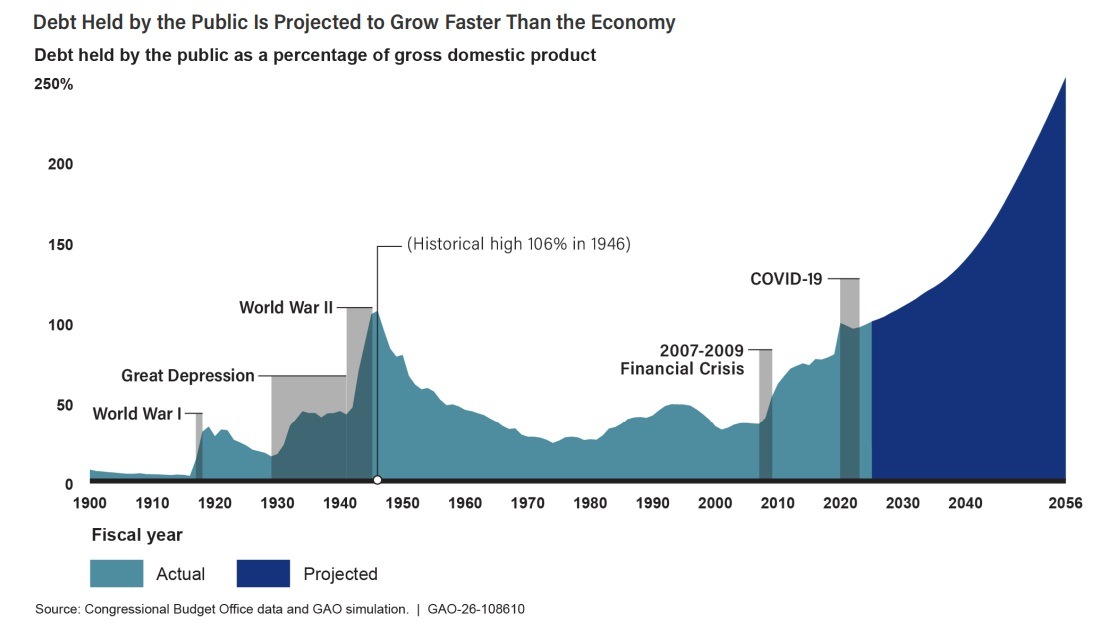
On August 20, the CBO said trade policy changes enacted through July 31 would add $0.9 trillion to the projected cumulative deficit from 2027 through 2036. Under February's baseline forecast, public debt held by the public was projected to rise from 101% of gross domestic product this year to 120% by 2036, with the annual deficit reaching $3.1 trillion; the agency has not yet revised those figures.
A June 11 report from the Government Accountability Office (GAO) projected that under current revenue and spending policies, debt held by the public would reach 123% of GDP in 2036 and 251% by 2056.
Rising benchmark yields also affect households through mortgages and other long-term credit. According to Freddie Mac, the average rate for a 30-year fixed mortgage was 6.65% on August 20, compared to a record low of 2.65% in January 2021. Mortgage rates do not follow Treasury yields exactly, but both respond to inflation expectations, monetary policy, and investor demand for long-term debt.
Foreign Investors Share Treasury Market Risks
International investors remain exposed to U.S. yield fluctuations through their extensive portfolios of Treasuries and other dollar-denominated assets. Treasury International Capital data released on August 17 showed foreign residents were net buyers of $207.1 billion in long-term U.S. securities in June. The Treasury cautions that due to the nature of custody arrangements, the data does not perfectly identify ultimate owners by country.
Recent Treasury intervention signals pressure on longer-dated government securities as borrowing needs grow. The department increased the size of certain buyback operations for debt maturing in 10 to 30 years from $2 billion to at least $4 billion per operation, starting September 9 through November 4. These purchases can support liquidity and reduce short-term yield pressure, but they do not cancel debt and are not Federal Reserve quantitative easing.
Rising Yields Pressure Stocks and Bonds
This debt feedback loop extends beyond government finance, as Treasury yields set a baseline for mortgages, commercial loans, and corporate bonds. Hitting the $40 trillion debt milestone has heightened concerns that higher refinancing costs could lead to rising interest expenses, larger deficits, and the need for further Treasury issuance. New government borrowing must also compete with corporate debt for investor capital.
Higher discount rates may lower the present value investors assign to companies whose expected earnings lie further in the future. Recent volatility in bitcoin, stocks, gold, and bonds has shown how changes in long-term yields can simultaneously impact multiple asset classes. Green warned:
"Portfolios built around low, stable yields now carry risk most investors have not yet priced into their valuations."
Bitcoin Enters the Debt Debate
Some investors are responding to fiscal and monetary policy concerns by considering scarce assets alongside traditional holdings. Bridgewater Associates founder Ray Dalio has warned U.S. debt could reach $55 to $60 trillion within a decade. He favors gold and a small allocation to bitcoin while recommending reduced exposure to debt assets, though his projection is an estimate, not an official government forecast.
Bitcoin's programmed scarcity supports its case as a long-term hedge against currency debasement, but its short-term performance remains highly volatile. The fixed supply of 21 million BTC distinguishes it from state-issued currencies. However, its track record during inflationary shocks has been mixed, making the asset more acceptable as a long-term store of value than a reliable short-term haven.