Understanding the Q2 Crypto Market in 5 Charts: RWA Booms, Fundamentals Continue to Improve

marsbitPublished on 2026-07-16Last updated on 2026-07-16

Abstract

"5 Charts to Decrypt the Crypto Market in Q2: RWA Explosion and Fundamentals Rebound" In Q2 2026, the crypto market presented a complex picture. While major cryptocurrencies fell 36% in H1, underperforming most major asset classes except gold, crypto-related equities surged 23%, doubling the S&P 500's return. This highlights diverse investment opportunities within the sector, from AI-benefiting miners to Wall Street-linked tokenization platforms. Key takeaways from five crucial charts: 1. **Divergence:** A significant performance gap emerged between crypto assets and publicly traded crypto companies. 2. **Robust Fundamentals:** The top 10 crypto applications generated $5.9B in revenue over the past year, with leaders like PancakeSwap nearing $1B, demonstrating real business traction. 3. **RWA Boom:** Tokenized real-world assets (RWA) reached a record $33B, up 12% QoQ and 45% YTD, fueled by tokenized treasuries, credit, and equities. 4. **Prediction Market Growth:** Prediction market open interest hit a new high of $1.8B, with Q2 volume reaching $43B, driven largely by sports and upcoming political events. 5. **Attractive Correlations:** The Bitwise Crypto Innovators 30 Index showed low or negative 90-day rolling correlations with most major assets (like stocks, bonds, gold), offering potential diversification benefits alongside high returns. Overall, despite bearish price action, the data reveals resilient industry fundamentals with continued growth in users, revenue,...

Written by: Ryan Rasmussen, Head of Research at Bitwise

Compiled by: Luffy, Foresight News

Each quarter, we publish the "Bitwise Crypto Market Review," a report containing over 50 charts covering market performance, on-chain fundamentals, institutional adoption, and other comprehensive data.

Data always sketches the industry's full picture. Sometimes it shows purely bullish or bearish signals; more often, bullish and bearish information intertwine, with highlights and negatives coexisting, worthy of in-depth analysis. The second quarter was such a case, with fundamentals like crypto business revenue, real-world asset adoption, and institutional deployment all improving significantly. Crypto-themed stocks surged, yet mainstream crypto asset prices declined overall. How should we understand this divergent market?

If you want to quickly grasp the core conclusions, here are the five most important charts I believe.

Crypto Stocks and Crypto Currencies Show Severe Divergence

In the first half of 2026, crypto assets fell by 36% overall; only gold fell concurrently, down 7%, while all other major asset classes rose. This is a key reason why this crypto bear market has been particularly difficult: only the crypto sector has been under pressure alone.

But in stark contrast, crypto-themed stocks rose 23% cumulatively in the first half, outperforming all mainstream assets except emerging market stocks. The Bitwise Crypto Innovators 30 Index, which tracks 30 leading publicly traded crypto companies, delivered returns more than double that of the S&P 500.

This data conveys a key signal: even in a bear market, the crypto industry is still full of investment opportunities. Bitcoin mining companies benefit from the AI industry boom; stablecoin issuers and asset tokenization platforms continue to onboard Wall Street business; the integration between traditional finance and crypto markets is deepening. I predict cryptocurrency prices will see a recovery in the second half, but the first half's performance has already confirmed one fact: crypto is not a single category of assets; the sector is diverse and dynamic, requiring a broader perspective.
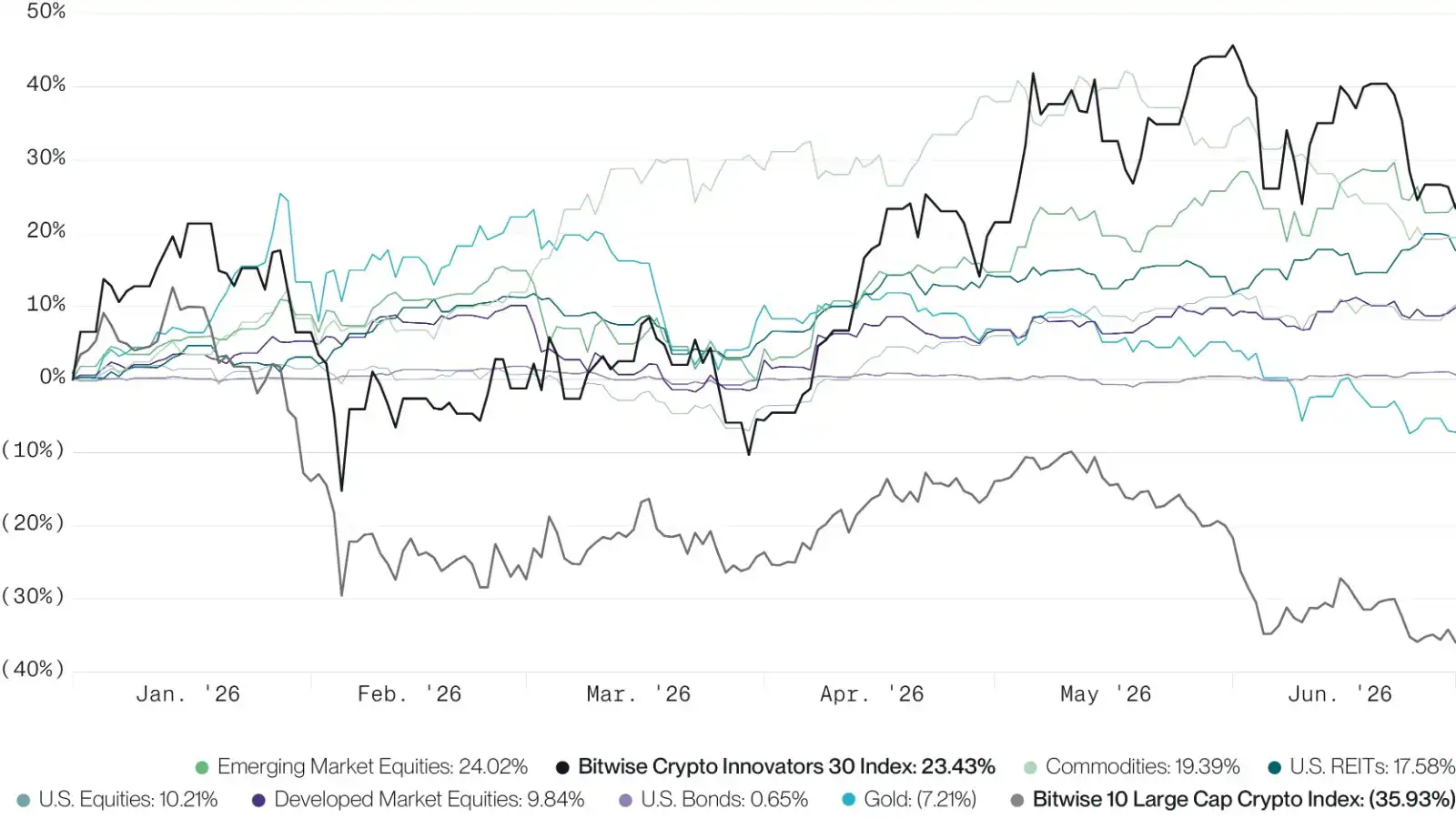
Performance Comparison: Cryptocurrencies vs. Major Asset Classes. Data source: Bitwise, Bloomberg; Statistics as of June 30, 2026.

Crypto Applications Generate Significant Revenue Scale

Over the past 12 months, the top ten crypto applications globally have generated a combined $5.9 billion in revenue; the top three—PancakeSwap, Hyperliquid, Aave—each have revenues approaching $1 billion.

Even in a bear market, these products are still commercial entities with stable cash flows, earning revenue from trading fees, lending interest, and staking rewards. Whenever someone questions whether the crypto industry has real fundamentals, I pull out this chart.
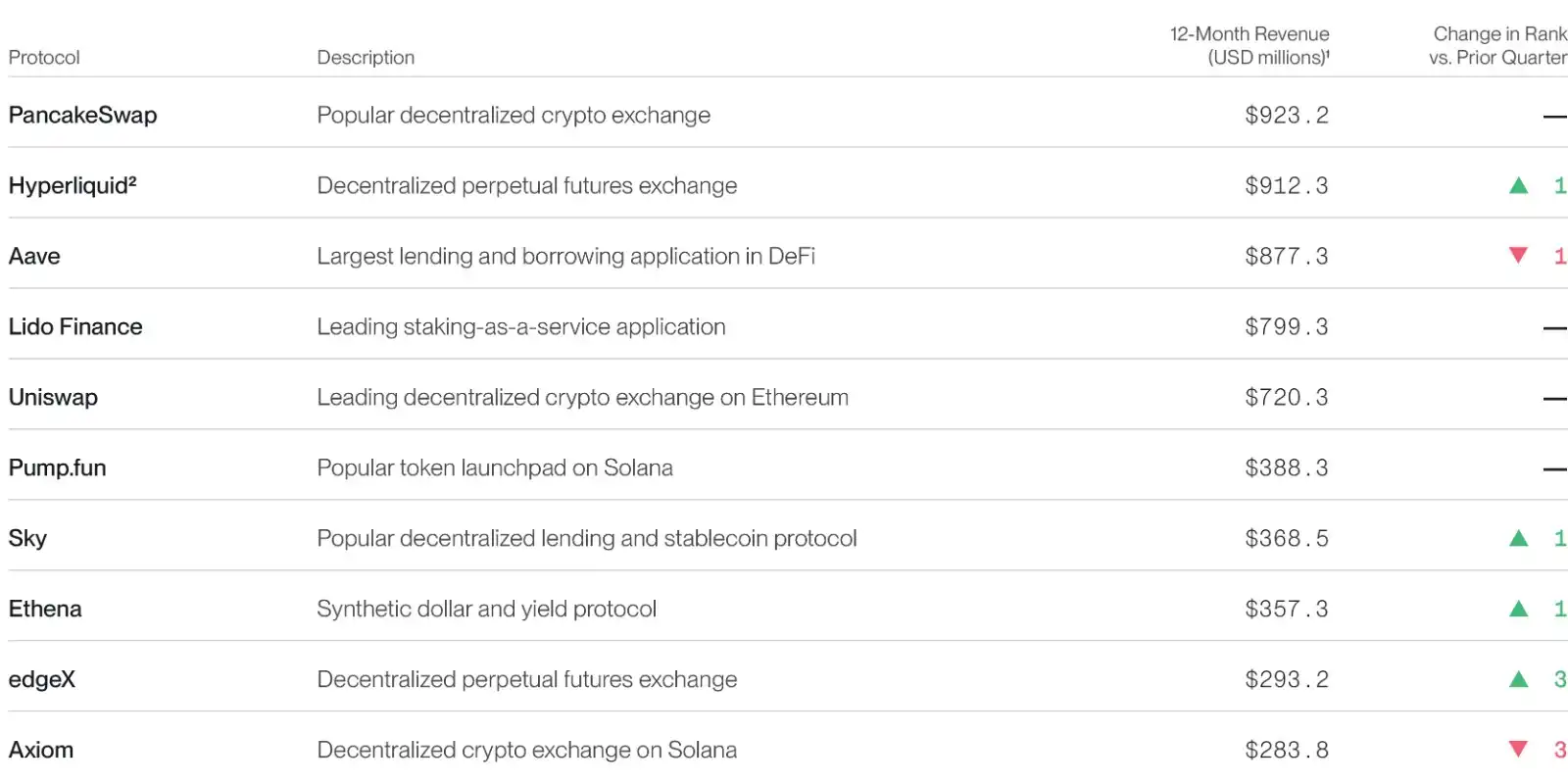
Top Ten Crypto Applications by Revenue. Data source: Bitwise, Token Terminal; Statistics timeframe: Jan 1, 2025 – Jun 30, 2026.

Real World Asset (RWA) Tokenization Enters a Bull Market

U.S. Treasury Secretary Scott Bessent publicly stated weeks ago: "Digital assets, stablecoins, asset tokenization, and new payment systems will collectively shape the future of the monetary system."

In a sense, the future he described is already here. In Q2, the total value of tokenized real-world assets reached a record high of $33 billion, up 12% quarter-over-quarter and 45% year-to-date; growth was mainly driven by tokenized U.S. Treasuries, corporate credit, stocks, and venture capital shares.

This chart clearly shows that global leading asset management firms are moving real-world assets onto the blockchain on a large scale—a trend worth continuous tracking.
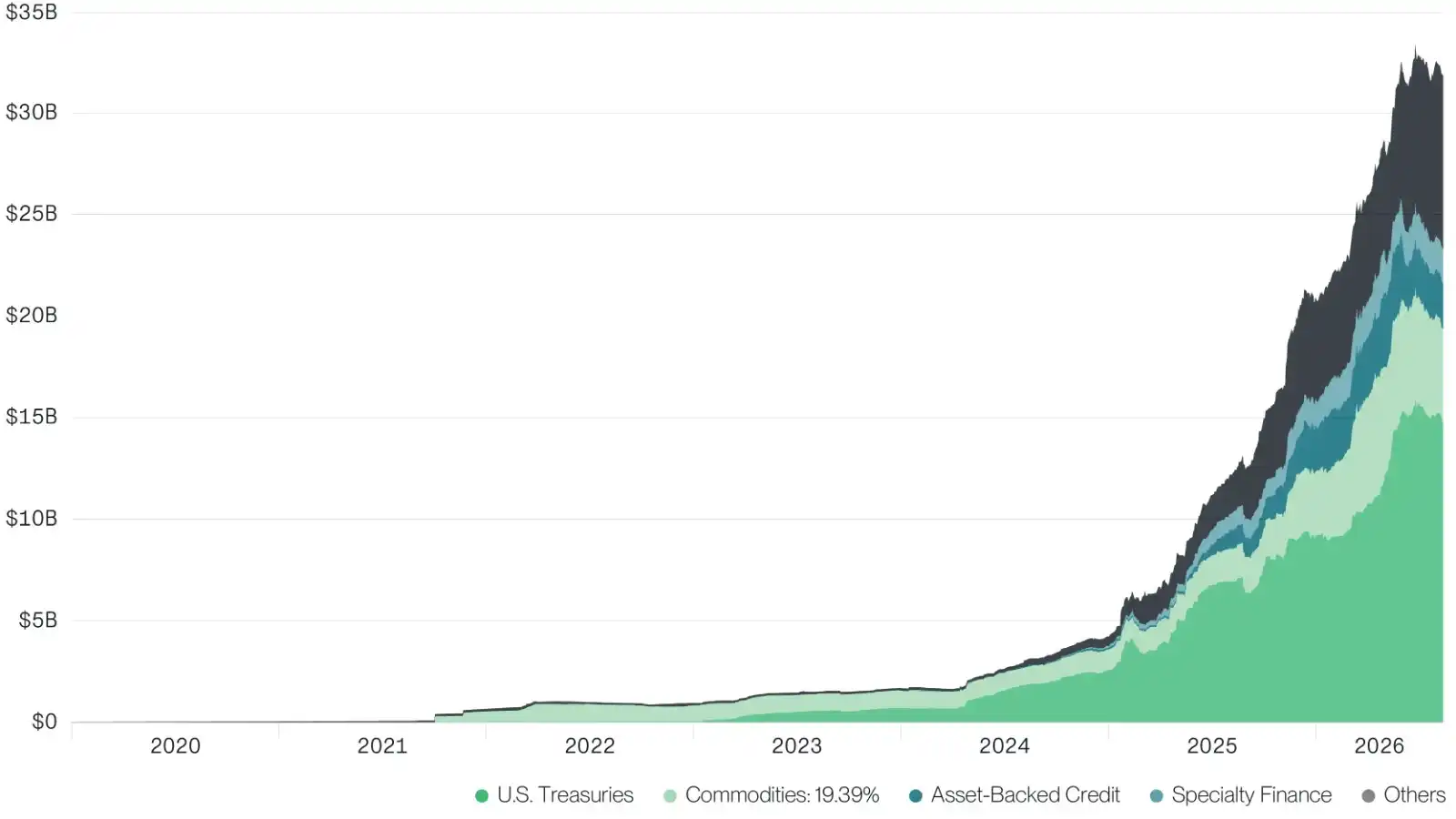
Value of Tokenized Real World Assets (RWA). Data source: Bitwise Asset Management, RWA.xyz; Statistics timeframe: Jan 1, 2020 – Jun 30, 2026.

Prediction Markets Continue to Expand

In Q2, prediction market open interest hit a record high of $1.8 billion, with sports events becoming a core trading category; total quarterly trading volume also hit a record, reaching $43 billion.

Platforms like Polymarket reflect a hidden side of crypto retail adoption: millions of users use underlying crypto tools to bet on real-world event outcomes, but the vast majority of users are unaware of and indifferent to the underlying blockchain technology.

As the U.S. midterm elections approach, I predict prediction market trading volume and open interest will hit new all-time highs multiple times this year. The 2024 election cycle brought prediction markets into the public eye, after which the industry's size directly tripled.
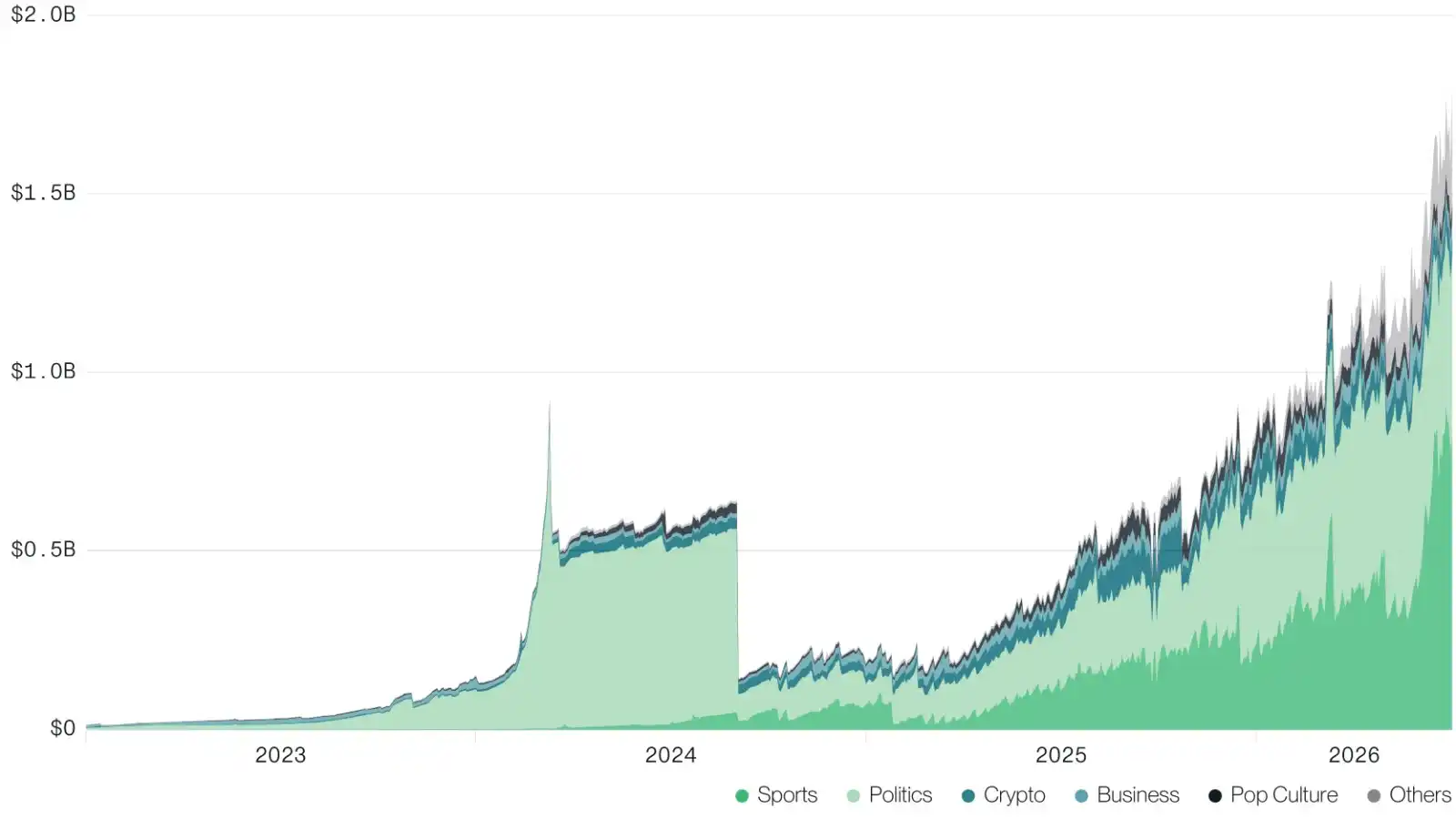
Prediction Market Open Interest Changes. Data source: Bitwise, Blockworks; Statistics timeframe: Jan 1, 2023 – Jun 30, 2026.

Low Correlation Between Crypto Stocks and Mainstream Assets

Returning to crypto-themed stocks, the most valuable chart shows the 90-day rolling correlation between the Bitwise Crypto Innovators 30 Index and various assets. The key highlight is that compared to the broader U.S. stock market, this index has a lower correlation with the vast majority of assets—developed market stocks, emerging market stocks, U.S. REITs, U.S. Treasuries, and gold are all examples. The sole exception is commodities, where correlations are negative.

In short, in the first half of 2026, crypto stock returns were double those of the U.S. stock market, while also being weakly correlated with most assets in an investment portfolio. This combination of high returns and risk dispersion is precisely what institutional investors seek in allocation targets.
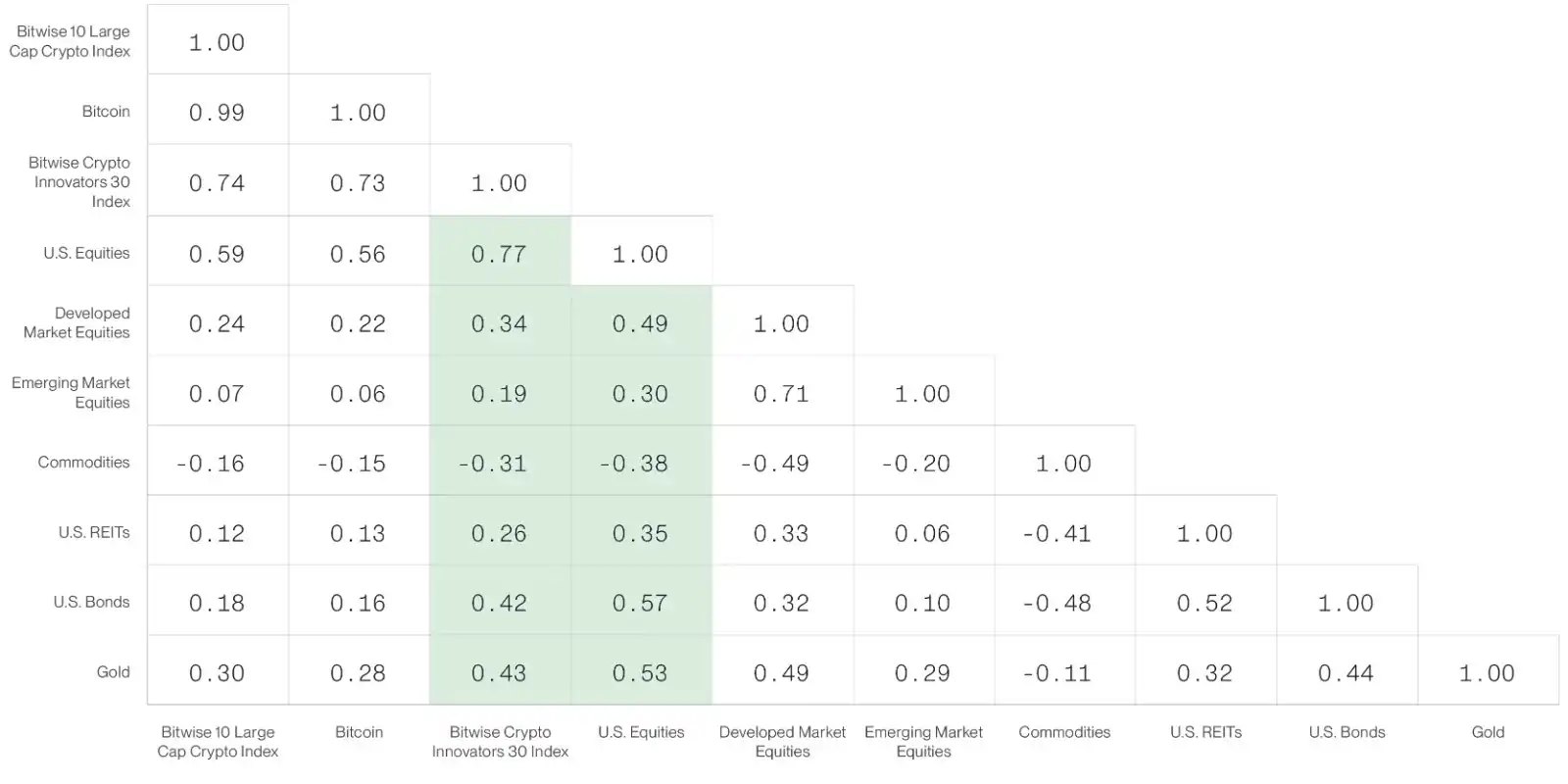
90-Day Rolling Correlation Comparison Across Asset Classes. Data source: Bitwise, Bloomberg; Statistics as of June 30, 2026.

Summary

That concludes my complete interpretation of the Q2 market. The over 50 charts in the report cannot directly answer the market's most pressing question: Have crypto prices bottomed? However, all the data collectively prove that the crypto industry's fundamentals are extremely resilient. Even during bear market cycles, user scale, business revenue, and institutional adoption continue to grow.

The current stage of the industry is highly valuable for research and forms the underlying foundation for the next bull market.


Related Questions

QAccording to the article, what was a key signal from the significant divergence between crypto stock performance and cryptocurrency prices in H1 2026?

AThe divergence signaled that despite a bear market, the crypto industry was still full of investment opportunities, with opportunities in areas like Bitcoin mining benefiting from AI, stablecoin issuers, and tokenization platforms. It showed that crypto is not a single asset class and needs to be viewed from a broader perspective.

QWhat is the combined revenue of the top ten crypto applications over the past 12 months, and what does this data counterargue?

AThe top ten crypto applications generated a combined revenue of $5.9 billion over the past 12 months. This data is used to counter the argument that the crypto industry lacks real fundamental business activity, showing these products are profitable commercial entities.

QWhat milestone did tokenized real-world assets (RWA) reach in Q2, and what were the main drivers of its growth?

ATokenized RWA reached a record high of $33 billion in total value in Q2. The main growth drivers were tokenized U.S. Treasuries, corporate credit, stocks, and venture capital shares.

QWhat record did prediction markets set in Q2, and what upcoming event is predicted to further boost their activity?

APrediction markets set records in Q2 with $1.8 billion in open interest and $43 billion in trading volume. The upcoming U.S. midterm elections are predicted to drive activity and push these metrics to new highs.

QWhat makes the Bitwise Crypto Innovators 30 Index an attractive portfolio component for institutional investors, based on its performance and correlation data from H1 2026?

AThe index offered double the returns of the S&P 500 while exhibiting low correlation with most other major asset classes (developed/emerging market stocks, U.S. REITs, Treasuries, gold) and negative correlation with commodities. This combination of high returns and diversification benefits makes it attractive to institutional investors.

Related Reads

Gold Rush Handbook | Rialto Teams Up with Robinhood Crypto, Targeting Order Routing Rights

**Summary** Rialto is positioning itself as an on-chain spot exchange focused on order routing and execution quality for a range of assets, including cryptocurrencies and tokenized stocks/ETFs. It operates primarily on the Robinhood Chain network. Its core mechanism revolves around **propAMMs** – on-chain market makers that use proprietary inventory and pricing logic, referencing external markets (like underlying stock exchanges for tokenized equities) rather than relying solely on automated market maker (AMM) formulas. For each user order, Rialto's aggregator solicits real-time quotes from multiple liquidity sources, including its own propAMM (Rivo Altus) and traditional DEX pools. It then selects and atomically executes the path offering the best net output after costs, potentially splitting orders across sources. Rialto's key competitive claim is turning **order routing control into a service for better execution**. Instead of users manually finding the best liquidity, the system automatically compares and routes to the optimal source(s) for each trade. It has launched a partner program for integrations and its swap API is already used by several protocols. Challenges ahead include expanding the asset base on Robinhood Chain, ensuring Rivo Altus's price competitiveness, attracting diverse external liquidity, and consistently delivering superior net execution compared to manual routing. Success in these areas would see Rialto competing for the crucial "order routing right" in the emerging on-chain market for tokenized real-world assets.

Foresight News18m ago

Gold Rush Handbook | Rialto Teams Up with Robinhood Crypto, Targeting Order Routing Rights

Foresight News18m ago

Bitwise: RWA and Prediction Markets Continue to Gain Momentum, Crypto is Bottoming Out

Bitwise's Q2 2026 report highlights a challenging crypto market. The Bitwise 10 Crypto Index fell 15.4%, and spot Bitcoin ETFs saw a record $4.9 billion in quarterly outflows as Bitcoin dropped below $60,000. Overall sentiment is described as one of the worst in eight years. Despite the downturn, key sectors show resilience and growth. Real-World Asset (RWA) tokenization reached a record $33 billion, up 45% year-to-date. Prediction markets also hit new highs, with open interest at $1.8 billion and quarterly volume hitting $43 billion, driven partly by political events. Crypto equities outperformed, with the Bitwise Crypto Innovators 30 Index rising 30.6%, largely fueled by AI-related Bitcoin miners. These stocks exhibited low correlation with other major asset classes. Major DeFi protocols like Aave demonstrated strong revenue generation, with the top ten crypto applications collectively earning $5.9 billion over the past year. The report notes that while prices and on-chain activity are down from peaks, fundamental metrics like stablecoin supply (~$300B) and Ethereum transaction activity are significantly higher than at the 2022 bear market bottom. Key Q3 factors include the fate of the CLARITY Act, final rules for the GENIUS stablecoin act, and policy signals from the new Fed Chair. The conclusion is that the industry is building a stronger foundation—with greater adoption, institutional involvement, and real utility—even at depressed prices, setting the stage for the next cycle.

Odaily星球日报43m ago

Bitwise: RWA and Prediction Markets Continue to Gain Momentum, Crypto is Bottoming Out

Odaily星球日报43m ago

Bitcoin Shifts to Building a Bottom, with Selling Pressure from Long-Term Holders Significantly Easing

Bitcoin is transitioning into a basing phase, with significant selling pressure from long-term holders showing signs of easing. The market is testing overhead resistance, with Bitcoin responding more positively to favorable macro data like soft inflation reports than major equity indices. Its correlation with stocks is weakening while its inverse relationship with the US dollar strengthens, indicating a shift in primary drivers towards liquidity factors rather than risk sentiment. On-chain analysis reveals that long-term holder profit-taking has largely dried up, and the wave of capitulation selling from this cohort has peaked and begun to recede. Buyers successfully absorbed selling pressure at the June lows. Bitcoin currently trades between the network's average realized price (a support floor) and the short-term holder cost basis near $69k, which will be a key resistance level. A breakout above this level is needed to signal a more sustained recovery. In derivatives markets, traders are unwinding bearish bets, with put/call ratios falling and crash protection premiums declining. However, this futures and options positioning adjustment has not been accompanied by significant spot buying. US spot ETF outflows have slowed but not reversed. Volatility has compressed to low levels. In summary, the foundations for a bottom are forming: long-term holder selling is subsiding, demand absorbed the recent low, and the market is reacting to positive catalysts. However, confirmation is still lacking, requiring a spot-driven breakout and hold above the short-term holder cost basis around $69k.

Foresight News51m ago

Bitcoin Shifts to Building a Bottom, with Selling Pressure from Long-Term Holders Significantly Easing

Foresight News51m ago

Trading

Spot
活动图片