Ethereum Remains Under Pressure as Price Consolidates Near $2,000

TheNewsCryptoPublished on 2026-02-10Last updated on 2026-02-10

Abstract

Ethereum (ETH) is trading near $2,012, down 4.40%, after failing to sustain a recovery above $2,140. The price is consolidating near $2,000, with the broader trend remaining bearish as it trades below all major moving averages. Key support lies at $1,950, followed by the $1,800–$1,700 zone, while resistance is near $2,140 and $2,200. Momentum indicators like RSI and MACD signal continued bearish pressure. Despite analyst Tom Lee's optimistic outlook, technical weakness persists. Meanwhile, the Ethereum Foundation is supporting initiatives to enhance security, and developers are planning upgrades to improve network efficiency.

Ethereum (ETH) is trading near $2,012 on Tuesday after extending recent losses. The latest daily candle shows a 4.40% decline, with price ranging between a high of $2,144.98 and a low of $1,995.65. The move reflects continued pressure following a volatile week for the asset.

Last week, Ethereum dropped sharply to the $1,700 area before staging a recovery. The rebound pushed the price back toward $2,140, but buying interest faded near that level. ETH failed to hold above $2,100, and selling pressure returned, driving the price back toward the $2,000 zone, where it is currently consolidating.

On the ETH/USDT daily chart, Ethereum remains in a downward trend. Price continues to form lower highs and lower lows and is trading below all major moving averages. The 50-day MA is near $2,858, the 100-day MA near $2,983, and the 200-day MA around $3,590, keeping the broader structure bearish. These levels represent key resistance zones if price attempts another recovery.
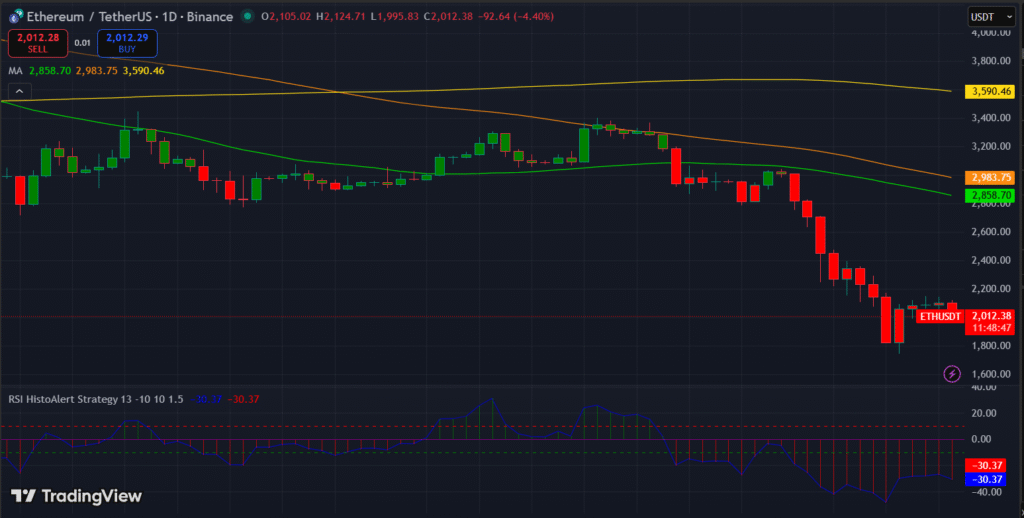
Looking further, the momentum indicators also remain weak. The RSI histogram is currently near -30, indicating bearish momentum and suggesting the market is closer to oversold conditions. The MACD remains in negative territory, with no bullish crossover in place, pointing to continued downside risk despite the recent slowdown in selling.

On the downside, $1,950 is acting as immediate support, followed by the $1,800–$1,700 area from last week’s low. On the upside, resistance is seen near $2,140, followed by $2,200.

Analyst Views and Network Developments on Ethereum

Beyond price action, Fundstrat’s Tom Lee stated that Ethereum could recover “as fast as it fell,” though the comment has drawn mixed reactions as some analysts point to current technical weakness.

Separately, the Ethereum Foundation has backed SEAL, an initiative aimed at reducing losses from wallet drainers targeting users. In addition, Ethereum developers are planning a major upgrade using zero-knowledge proofs to improve block validation efficiency.

Overall, Ethereum’s price action shows consolidation near $2,000 after a failed recovery, with broader direction still dependent on whether support can hold and momentum improves.


TagsAltcoinCrypto MarketETHETHEREUM

Related Questions

QWhat is the current trading price of Ethereum and what was its recent daily decline percentage?

AEthereum is currently trading near $2,012 after a recent daily decline of 4.40%.

QWhat are the key resistance levels for Ethereum according to the daily chart analysis?

AThe key resistance levels are near $2,140, followed by $2,200, with the major moving averages (50-day at $2,858, 100-day at $2,983, and 200-day at $3,590) acting as significant resistance zones.

QWhat do the momentum indicators (RSI and MACD) suggest about Ethereum's current market condition?

AThe RSI histogram is near -30, indicating bearish momentum and approaching oversold conditions. The MACD remains in negative territory with no bullish crossover, pointing to continued downside risk.

QWhat initiative has the Ethereum Foundation backed to address security concerns?

AThe Ethereum Foundation has backed SEAL, an initiative aimed at reducing losses from wallet drainers that target users.

QWhat major technical upgrade are Ethereum developers planning to implement?

AEthereum developers are planning a major upgrade using zero-knowledge proofs to improve block validation efficiency.

Related Reads

XChat Is Here: Musk's Super App Plan Is Reshaping the Encrypted Social Landscape

Elon Musk’s X (formerly Twitter) is launching XChat, an encrypted communication tool supporting text, file sharing, and voice/video calls, on April 17. This move is part of a broader strategy to transform X into a global super-app similar to WeChat, integrating social, payment, and financial services. XChat aims to address Twitter’s historical weakness in private messaging and relationship-building, shifting from a public square to a closed-loop ecosystem. By retaining user relationships within X, the platform can enhance engagement and pave the way for commercial and financial activities. Encrypted messaging is not just a privacy feature but a foundational layer for trust, enabling future payment integrations. X may explore traditional payment systems, stablecoins, or even direct Bitcoin transactions. This could significantly impact the crypto industry by introducing mainstream users to encrypted payments and SocialFi concepts. While XChat may boost adoption and attract attention to crypto narratives, it also poses a threat to existing Web3 social projects that lack scale. Infrastructure projects like wallets and stablecoins may benefit, but consumer-facing decentralized social platforms could face intense competition from X’s vast user base. In summary, XChat represents a structural shift toward integrating social, informational, and financial flows, positioning X as a key player in the future of encrypted communications and digital payments.

marsbit21m ago

XChat Is Here: Musk's Super App Plan Is Reshaping the Encrypted Social Landscape

marsbit21m ago

Franklin Templeton's Latest Research: How to Understand RWA Tokenization

Franklin Templeton's research explores the rapid growth and structural evolution of real-world asset (RWA) tokenization, which has expanded from $5 billion in 2023 to over $25 billion by early 2026. This surge is driven by clearer regulations and greater trust in blockchain technology. RWA tokenization covers assets like stocks, bonds, commodities, and real estate, distinguishing them from native cryptocurrencies. The market saw a turning point as tokenization expanded from government bonds to equities, with early movers like Robinhood, Kraken, and Ondo launching tokenized stock offerings. Traditional institutions, including DTCC, NYSE, and Nasdaq, have since announced significant tokenization initiatives, signaling a major shift in securities processing. The article identifies three tokenization models: 1. **Digital Native Tokens**: Direct ownership of the underlying asset with on-chain settlement (e.g., Franklin Templeton’s money market fund). 2. **Synthetic Asset Tokens**: Indirect economic exposure via special purpose vehicles, allowing broader DeFi utility but limited investor rights. 3. **Digital Mirror Tokens**: Tokenized receipts of off-chain assets, with legacy settlement systems and restricted transferability. Synthetic tokens are permissionless, requiring only KYT checks, while digital native and mirror tokens require full KYC/AML compliance. Each model offers distinct advantages in transparency, utility, and efficiency compared to traditional systems. Tokenization is driving convergence between crypto and traditional finance, with wallets emerging as a universal financial interface.

marsbit1h ago

Franklin Templeton's Latest Research: How to Understand RWA Tokenization

marsbit1h ago

Trading

Spot
Futures

Hot Articles

Discussions

Welcome to the HTX Community. Here, you can stay informed about the latest platform developments and gain access to professional market insights. Users' opinions on the price of ETH (ETH) are presented below.

活动图片