For Hedging, Buy Gold and Oil; For Explosive Growth, Buy AI; Bitcoin, the 'Outdated' Asset, Enters a Bear Market

marsbitPublished on 2026-06-03Last updated on 2026-06-03

Abstract

Bitcoin’s price has recently fallen sharply, hitting a two-month low near $66,000, with Ethereum also dropping to a three-month low. While surface explanations point to ETF outflows, geopolitical tensions, and corporate selling, a deeper issue is emerging: Bitcoin is losing a crucial asset competition. For years, Bitcoin thrived in a low-rate environment where investors sought alternatives amid inflation fears and dissatisfaction with traditional options. Now, the market landscape has shifted, leaving Bitcoin stuck in an "awkward middle ground," facing challenges on three fronts: 1. **As an inflation hedge, gold is winning.** Investors worried about persistent inflation are turning to tangible assets like gold, energy stocks, and commodity producers, which offer more direct pricing power and physical backing. 2. **For growth exposure, AI is winning.** Those seeking high growth now favor AI-related companies with actual revenues and profits, an area where Bitcoin's lack of cash flow puts it at a disadvantage. 3. **Within crypto, infrastructure and stablecoins are winning.** Even investors wanting crypto exposure have alternatives like exchanges, stablecoin issuers, and tokenization firms, whose performance is directly tied to real-world adoption and offers clearer operational leverage. The recent market reaction to inflation warnings highlights this shift. Instead of boosting Bitcoin as "digital gold," such news now drives flows toward traditional inflation-sensitive ass...

Author: Wall Street News

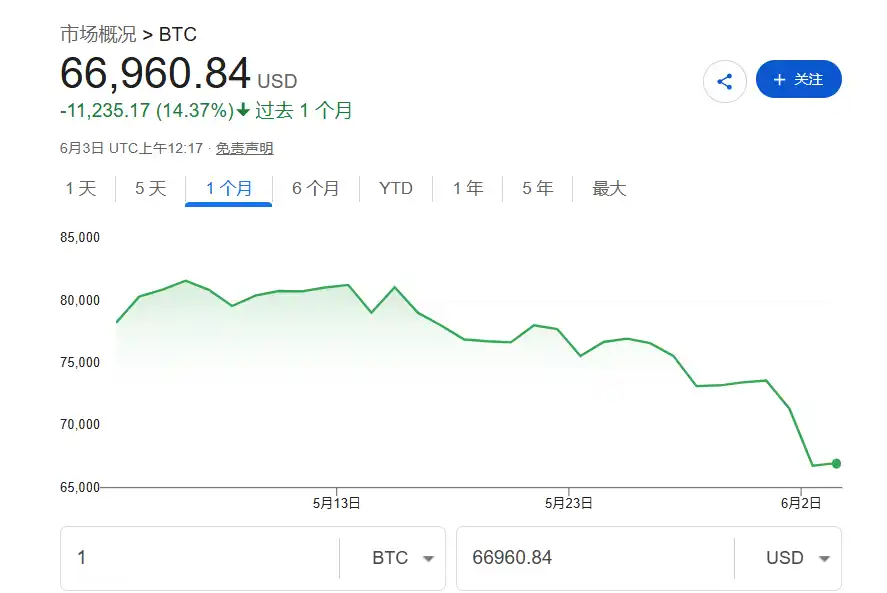
Bitcoin has continued to fall recently. It once dropped to $66,123 during the session, hitting a two-month low, and is currently trading at $66,620; Ethereum fell to $1,837 in the same period, a three-month low, and is currently at $1,855.

There are various explanations circulating in the market: ETF outflows, heightened geopolitical tensions, unexpected selling by Strategy (formerly MicroStrategy). According to analysis by Bloomberg analyst Sid Verma, these explanations are all correct, but may only be symptoms. The real problem is deeper—Bitcoin is losing an asset competition.

For a long time, interest rates were near zero, leaving cash idle meant depreciation; stock valuations were too high; AI was still just a concept; and gold's gains were limited. Analysis points out that Bitcoin's competitors back then weren't specific assets, but rather "investor dissatisfaction"—fear of inflation, dissatisfaction with existing options.

But now, the market has changed.
Three Fronts, Bitcoin Losing on All

The analyst describes Bitcoin's situation bluntly: it's now stuck in an "awkward middle ground," being attacked from three sides.

Hedging inflation? Gold wins. Investors worried about inflation are now more inclined to buy gold, energy stocks, and commodity producers, rather than Bitcoin. These assets have physical backing, pricing power, and a more straightforward logic.

Chasing growth? AI wins. Investors seeking high growth can now buy AI beneficiary companies with real revenues and real profits. Bitcoin doesn't generate cash flow and has no advantage in this race.

Gaining crypto exposure? Stablecoins and infrastructure win. Even investors who want crypto exposure don't necessarily have to buy Bitcoin. They can buy exchanges, stablecoin businesses, payment networks, tokenized finance companies—these assets are directly linked to the actual adoption rate of the crypto industry, have operating leverage, and their logic is clearer.

In one sentence: Bitcoin is neither the best safe-haven asset, nor the best growth asset, nor the only crypto asset anymore.

Inflation Has Arrived, but Bitcoin Hasn't Risen

A detail is quite telling.

Cleveland Fed President Beth Hammack warned this week that inflation risks may be becoming "more persistent." A few years ago, such a statement would almost certainly have been interpreted by the market as bullish for Bitcoin—high inflation, fiat currency depreciation, buy Bitcoin as a hedge.

But this time, the market didn't react that way.

Investors' response to inflation has changed now—they are more inclined to buy assets with direct exposure to energy, commodities, and pricing power. Bitcoin's "digital gold" narrative is being eroded by real gold and energy stocks.

ETF Outflows and Strategy Selling

Back to the direct triggers of this recent decline.

ETF outflows, Strategy selling—these events themselves are real. But Bloomberg's analysis suggests that treating them as the "cause" is a misreading—they are more like "symptoms," reflecting the same underlying reality: capital has more options, and investors' demands on Bitcoin are also higher.

Investors are becoming more selective: they don't just want "crypto exposure," they want to know what return this exposure brings, why Bitcoin and not something else.

The logic of Bitcoin's bear market is no longer "it's a scam," "it's a bubble," or "it's a failed technology." The new bear market logic is—scarcity alone is no longer enough.


Related Questions

QAccording to the article, what are the three areas where Bitcoin is described as losing ground?

ABitcoin is described as losing ground in three areas: 1) Hedging against inflation (gold wins), 2) Pursuing growth (AI wins), and 3) Gaining crypto exposure (stablecoins and infrastructure win). It is caught in an 'awkward middle ground,' being neither the best safe-haven asset, the best growth asset, nor the only crypto asset.

QWhat key change in investor behavior does the article highlight in response to inflation fears, and what assets are now preferred?

AThe article highlights that investors are no longer automatically buying Bitcoin to hedge against inflation. Instead, they are now more inclined to purchase assets with direct exposure to energy, commodities, and pricing power, such as gold, energy stocks, and commodity producers, as these assets are seen as having more straightforward logic and tangible backing.

QWhat is the new bear market logic for Bitcoin, as presented in the article, compared to the old logic?

AThe new bear market logic for Bitcoin is that 'scarcity itself is no longer enough.' This contrasts with the old logic which focused on criticisms like Bitcoin being a 'scam,' a 'bubble,' or a 'failed technology.' The new argument is that investors now have better, more logical alternatives for different investment goals.

QHow does the article interpret the recent events of ETF outflows and Strategy (MicroStrategy) selling Bitcoin?

AThe article interprets the recent ETF outflows and Strategy's Bitcoin sales not as the root 'cause' of the price decline, but rather as 'symptoms.' These events reflect an underlying reality where capital has more places to go and investors are becoming more discerning, demanding clearer value propositions from their investments, including Bitcoin.

QAccording to the analyst's view in the article, what was Bitcoin's primary 'competitor' during the period of near-zero interest rates, and how has that changed?

ADuring the period of near-zero interest rates, Bitcoin's primary competitor was described as 'investor dissatisfaction'—the fear of inflation and discontent with existing investment options like cash and overvalued stocks. This has now changed, as investors have tangible alternatives: gold/commodities for hedging, AI stocks for growth, and other crypto infrastructure for crypto exposure.

Related Reads

When Google Also 'Prints Stocks' to Build AI, Whose Narrative is Shattering the High Valuations of Neocloud?

Google has announced its first equity financing since 2005, a series of moves totaling $80 billion that signal a strategic challenge to Nvidia's GPU dominance in the AI compute market. This impacts "Neocloud" companies like CoreWeave, Nebius, and IREN, whose valuations are heavily tied to Nvidia's perceived uniqueness. Google's three-part strategy involves: launching new TPU chips (TPU 8t/8i) and selling them to third parties for the first time; forming a $25 billion compute-as-a-service joint venture with Blackstone; and raising ~$50 billion in new equity (part of an $80B package) to fund AI infrastructure, underscoring the massive capital demands even for tech giants. This marks a divergence from Microsoft's path. Microsoft, lacking a mature in-house AI chip, relies heavily on outsourcing to Neocloud providers using Nvidia GPUs. Google, with its proprietary TPU, is pursuing vertical integration—building its own data centers, selling chips, and competing directly with Neocloud services. While Neocloud firms have strong near-term revenue from locked-in Nvidia GPU contracts (e.g., CoreWeave's ~$100B backlog), Google's moves undermine their long-term valuation narrative based on Nvidia's sole supremacy and perpetual supply shortage. TPU performance claims and adoption by firms like Anthropic add credibility to Google's alternative. The AI compute market is transitioning from a uniform seller's market to a layered one: top AI labs are diversifying their hardware stacks; hyperscalers are pursuing different chip strategies; and financing costs will become a critical differentiator, favoring players like Google with lower capital costs. Key metrics to watch include the progress of the Google-Blackstone JV, expansion of the TPU customer base beyond Anthropic, and potential shifts in Microsoft's sourcing strategy. If Google succeeds on these fronts, the Neocloud investment thesis will require significant reassessment.

marsbit16m ago

When Google Also 'Prints Stocks' to Build AI, Whose Narrative is Shattering the High Valuations of Neocloud?

marsbit16m ago

Trading

Spot
Futures

Hot Articles

What is $BITCOIN

DIGITAL GOLD ($BITCOIN): A Comprehensive Analysis Introduction to DIGITAL GOLD ($BITCOIN) DIGITAL GOLD ($BITCOIN) is a blockchain-based project operating on the Solana network, which aims to combine the characteristics of traditional precious metals with the innovation of decentralized technologies. While it shares a name with Bitcoin, often referred to as “digital gold” due to its perception as a store of value, DIGITAL GOLD is a separate token designed to create a unique ecosystem within the Web3 landscape. Its goal is to position itself as a viable alternative digital asset, although specifics regarding its applications and functionalities are still developing. What is DIGITAL GOLD ($BITCOIN)? DIGITAL GOLD ($BITCOIN) is a cryptocurrency token explicitly designed for use on the Solana blockchain. In contrast to Bitcoin, which provides a widely recognized value storage role, this token appears to focus on broader applications and characteristics. Notable aspects include: Blockchain Infrastructure: The token is built on the Solana blockchain, known for its capacity to handle high-speed and low-cost transactions. Supply Dynamics: DIGITAL GOLD has a maximum supply capped at 100 quadrillion tokens (100P $BITCOIN), although details regarding its circulating supply are currently undisclosed. Utility: While precise functionalities are not explicitly outlined, there are indications that the token could be utilized for various applications, potentially involving decentralized applications (dApps) or asset tokenization strategies. Who is the Creator of DIGITAL GOLD ($BITCOIN)? At present, the identity of the creators and development team behind DIGITAL GOLD ($BITCOIN) remains unknown. This situation is typical among many innovative projects within the blockchain space, particularly those aligning with decentralized finance and meme coin phenomena. While such anonymity may foster a community-driven culture, it intensifies concerns about governance and accountability. Who are the Investors of DIGITAL GOLD ($BITCOIN)? The available information indicates that DIGITAL GOLD ($BITCOIN) does not have any known institutional backers or prominent venture capital investments. The project seems to operate on a peer-to-peer model focused on community support and adoption rather than traditional funding routes. Its activity and liquidity are primarily situated on decentralized exchanges (DEXs), such as PumpSwap, rather than established centralized trading platforms, further highlighting its grassroots approach. How DIGITAL GOLD ($BITCOIN) Works The operational mechanics of DIGITAL GOLD ($BITCOIN) can be elaborated on based on its blockchain design and network attributes: Consensus Mechanism: By leveraging Solana’s unique proof-of-history (PoH) combined with a proof-of-stake (PoS) model, the project ensures efficient transaction validation contributing to the network's high performance. Tokenomics: While specific deflationary mechanisms have not been extensively detailed, the vast maximum token supply implies that it may cater to microtransactions or niche use cases that are still to be defined. Interoperability: There exists the potential for integration with Solana’s broader ecosystem, including various decentralized finance (DeFi) platforms. However, the details regarding specific integrations remain unspecified. Timeline of Key Events Here is a timeline that highlights significant milestones concerning DIGITAL GOLD ($BITCOIN): 2023: The initial deployment of the token occurs on the Solana blockchain, marked by its contract address. 2024: DIGITAL GOLD gains visibility as it becomes available for trading on decentralized exchanges like PumpSwap, allowing users to trade it against SOL. 2025: The project witnesses sporadic trading activity and potential interest in community-led engagements, although no noteworthy partnerships or technical advancements have been documented as of yet. Critical Analysis Strengths Scalability: The underlying Solana infrastructure supports high transaction volumes, which could enhance the utility of $BITCOIN in various transaction scenarios. Accessibility: The potential low trading price per token could attract retail investors, facilitating wider participation due to fractional ownership opportunities. Risks Lack of Transparency: The absence of publicly known backers, developers, or an audit process may yield skepticism regarding the project's sustainability and trustworthiness. Market Volatility: The trading activity is heavily reliant on speculative behavior, which can result in significant price volatility and uncertainty for investors. Conclusion DIGITAL GOLD ($BITCOIN) emerges as an intriguing yet ambiguous project within the rapidly evolving Solana ecosystem. While it attempts to leverage the “digital gold” narrative, its departure from Bitcoin's established role as a store of value underscores the need for a clearer differentiation of its intended utility and governance structure. Future acceptance and adoption will likely depend on addressing the current opacity and defining its operational and economic strategies more explicitly. Note: This report encompasses synthesised information available as of October 2023, and developments may have transpired beyond the research period.

363 Total ViewsPublished 2025.05.13Updated 2025.05.13

What is $BITCOIN

Discussions

Welcome to the HTX Community. Here, you can stay informed about the latest platform developments and gain access to professional market insights. Users' opinions on the price of BTC (BTC) are presented below.

活动图片