2026 Crypto Financing Reshuffle: Gaming and DePIN Are Dead, Two Prediction Market Deals Gobble Up 18% of Yearly Funding

marsbitPublished on 2026-05-09Last updated on 2026-05-09

Abstract

Crypto Funding Shakeup in 2026: Gaming & DePIN Fade, Prediction Markets Dominate Analysis of crypto funding from January 1 to May 6, 2026, reveals a major sectoral shift. The industry raised $8.65 billion across 305 deals. However, a March surge to $4.57 billion was largely due to two mega-deals: BVNK's $1.8 billion acquisition and a $1 billion raise by Kalshi. Excluding these, monthly funding is a sluggish ~$1 billion. Capital concentration is extreme. The Payments ($3.74B) and Consumer ($2.48B) sectors absorbed 72% of all funds. Within Consumer, prediction markets were dominant: Kalshi's $1B and Polymarket's $600M raises together accounted for 18% of the year's total, surpassing all 47 DeFi deals combined ($1.06B). In contrast, Gaming and DePIN sectors saw funding nearly vanish. A strategic pivot is underway. Merger & Acquisition (M&A) activity reached 48 deals, nearly matching the 57 seed-stage rounds. This indicates capital is increasingly flowing toward acquiring established leaders rather than betting on new ideas. The most active investors so far in 2026 are Coinbase Ventures (18 deals), Tether (13 deals), Animoca Brands (11 deals), and GSR (11 deals). Notably, a16z's pace has slowed significantly compared to its 2021-2026 average.

Author: Memento Research

Compilation: TechFlow Deep Tides

Deep Tides Intro: Crypto financing data from the first four months of 2026 reveals a brutal reality: funding for the gaming and DePIN sectors has nearly dried up, while Kalshi and Polymarket, two prediction market companies, have taken more money than all DeFi projects combined for the entire year. More alarmingly, the number of M&A deals has caught up with seed rounds, indicating that capital is shifting from betting on new ideas to acquiring existing industry leaders.

Financing Overview: The March Surge Was Just an Illusion

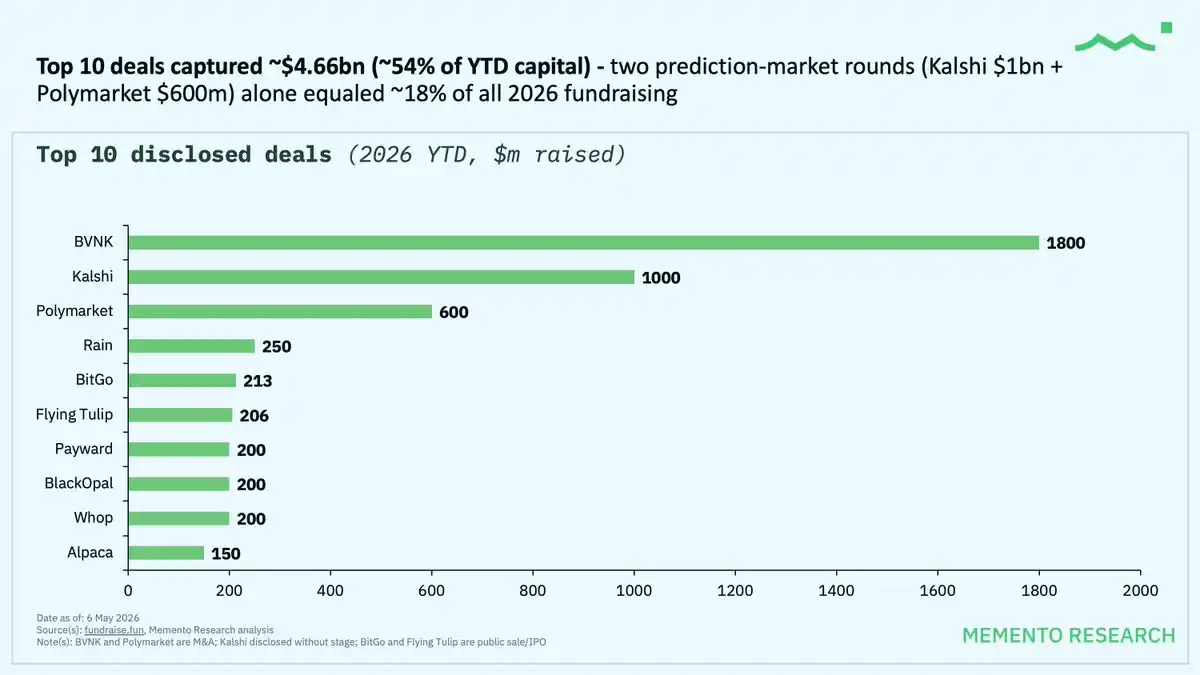
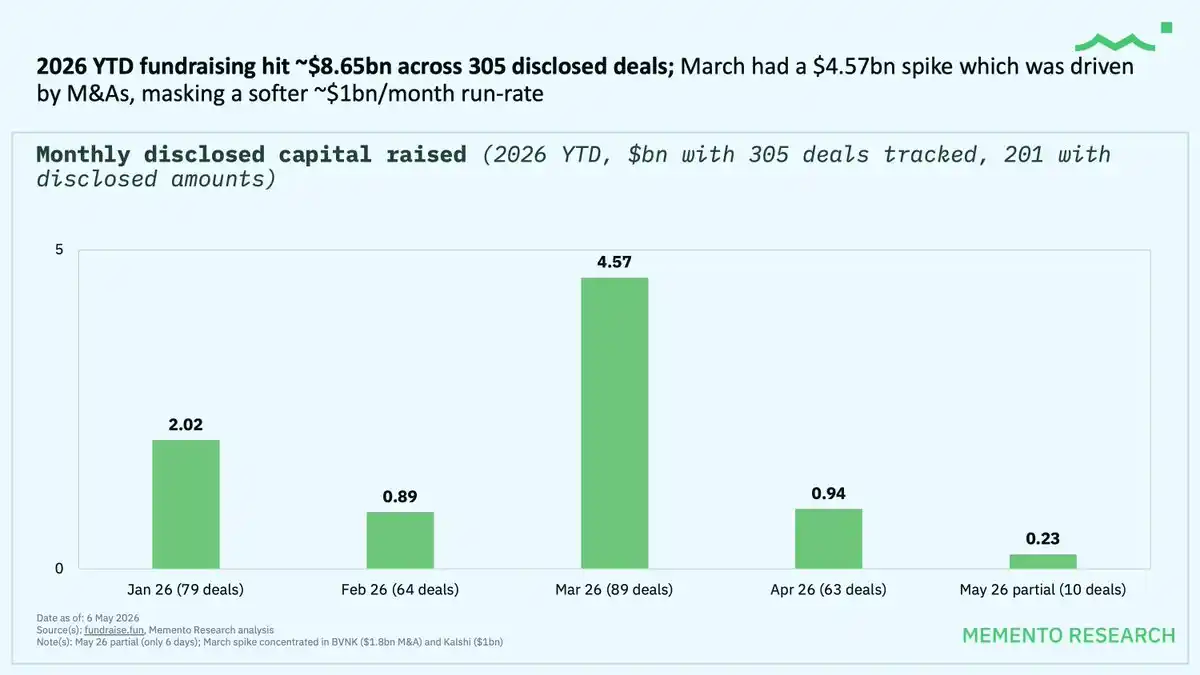
From January 1 to May 6, 2026, the crypto industry completed 305 financing rounds, totaling $8.65 billion. However, the "surge" of $4.57 billion in March was essentially just two mega M&A deals: BVNK's $1.8 billion and Kalshi's $1 billion.

Excluding these two, the real financing pace is about $1 billion per month, which is even weaker than at the end of 2025.

Fund Flow: Payments and Consumer Gobble Up 72%

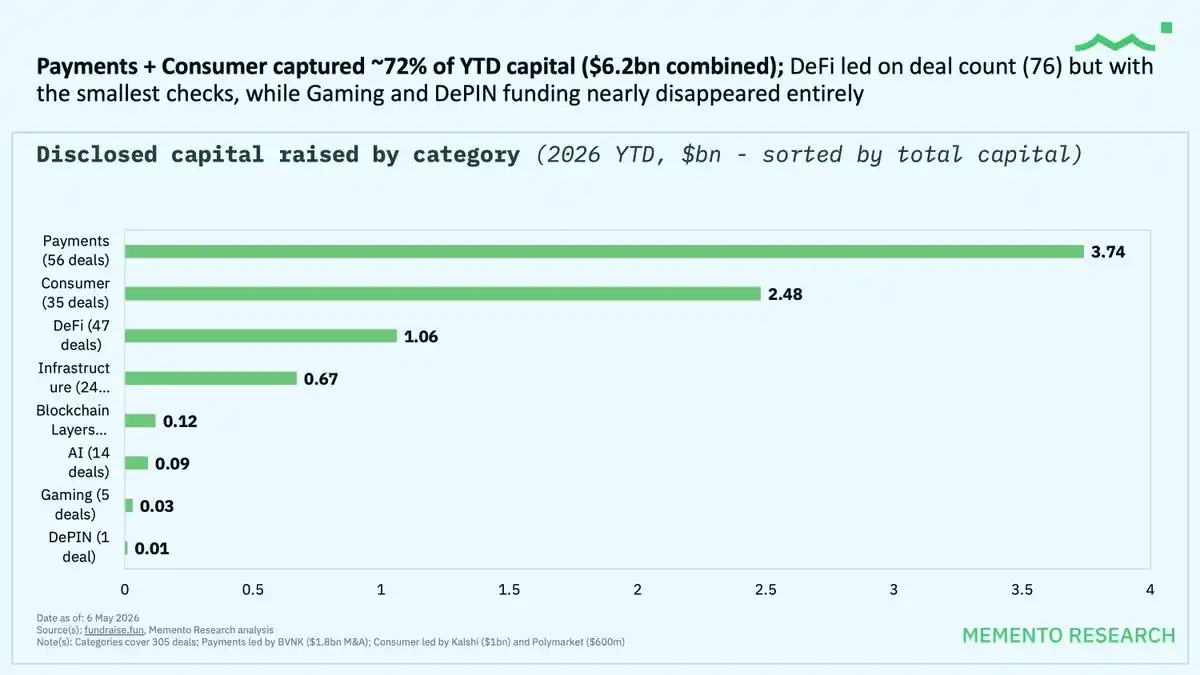
By sector:

Payments: $3.74 billion (56 deals)

Consumer: $2.48 billion (35 deals)

DeFi: $1.06 billion (47 deals, the highest number of transactions)

The payments and consumer sectors together account for 72% of the year's funding. Financing for gaming and DePIN has almost vanished.

Prediction Markets Dominate the Consumer Sector

The two prediction market companies accounted for 18% of the year's total funding:

Kalshi: $1 billion

Polymarket: $600 million

These two deals total $1.6 billion, exceeding the combined total of all 47 DeFi financing rounds.

M&A Becomes Mainstream

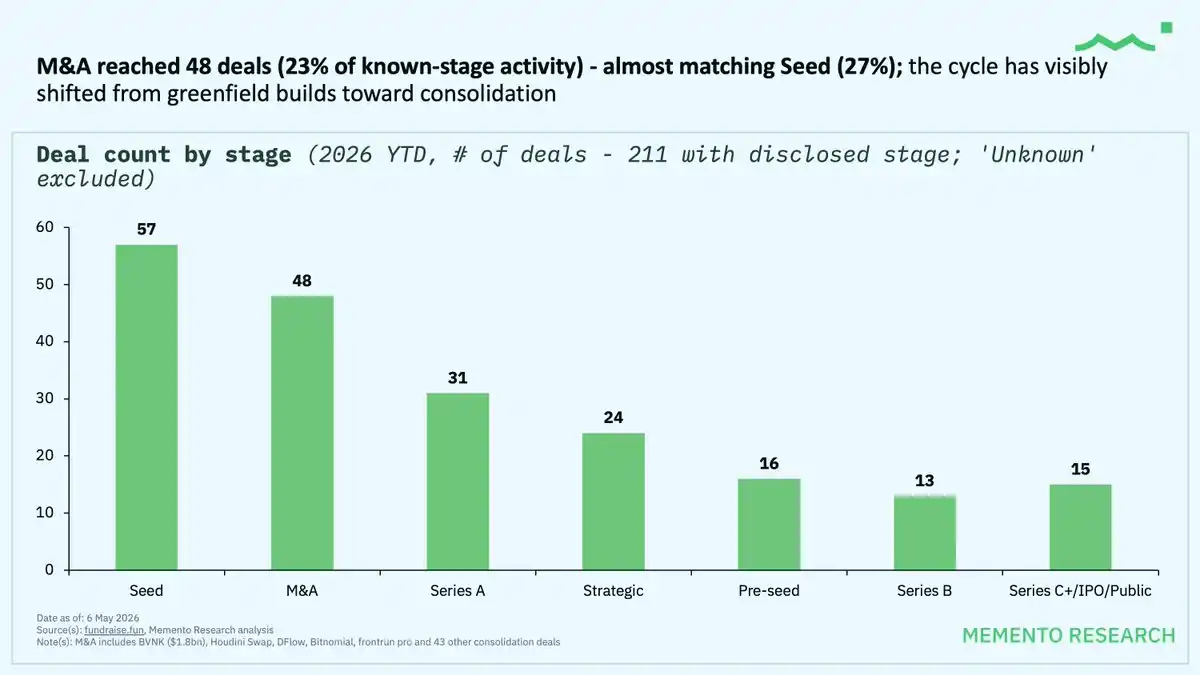
M&A deals reached 48 (23% of known-stage transactions), almost on par with 57 seed rounds (27%). This cycle has shifted from the early stage of investing in new ideas to acquiring industry leaders.
Investor Rankings Reshuffled

Most active funds in 2026:

Coinbase Ventures: 18 deals (Ranked 2nd during 2021-26)

Tether: 13 deals (New top lead investor)

Animoca Brands: 11 deals (Ranked 1st during 2021-26)

GSR: 11 deals

a16z: 7 deals (Significantly down from ~200 deals during 2021-26)

Related Questions

QWhat were the two major M&A deals that dominated the funding figures for March 2026, and what were their values?

AThe two major M&A deals were BVNK, which raised $1.8 billion, and Kalshi, which raised $1 billion.

QWhich two sectors accounted for 72% of total funding in early 2026, and what were the respective funding amounts?

AThe Payments and Consumer sectors accounted for 72% of total funding. Payments raised $3.74 billion across 56 deals, while Consumer raised $2.48 billion across 35 deals.

QHow much funding did the prediction market companies Kalshi and Polymarket receive collectively, and what percentage of the year's total funds does this represent?

AKalshi and Polymarket collectively received $1.6 billion in funding, which represents 18% of the total funds raised in early 2026.

QWhat significant trend is highlighted by the number of M&A transactions (48) nearly matching the number of seed rounds (57) in early 2026?

AThe trend highlights a market shift where capital is moving away from funding new ideas (seed-stage investments) and towards acquiring existing market leaders (M&A).

QAccording to the article, which were the most active investment funds in early 2026 by number of deals?

AThe most active funds were Coinbase Ventures with 18 deals, Tether with 13 deals, and Animoca Brands and GSR with 11 deals each.

Related Reads

The Next Generation of Payments Lies Not in the Payment Layer

The Next-Generation of Payment is Not in the Payment Layer This is the second piece in a series analyzing Stripe's AI strategy. The series stems from Stripe's vision of becoming the economic infrastructure for the AI Agent era, announced at Stripe Sessions 2026. A key debate centers on whether Know Your Agent (KYA) is merely an upgrade to existing payment systems. The author argues the opposite: payment will become a subsystem of KYA, not the other way around. Historically, major payment innovations (online banking, mobile wallets, QR codes) emerged from new transaction scenarios that broke the underlying assumptions of old systems, not from optimization within the payment layer itself. Agent economy is that new scenario, and KYA is the foundational infrastructure growing to support it. KYA's proposed five layers—Agent Identity, Authorization Scope, Intent Signing, Liability Chain Auditing, and Credit Rating—extend far beyond payments. Only authorization and auditing directly touch the payment链路. Identity, intent, and credit layers serve broader needs like cross-platform calls, AI alignment, and permission management. Stripe's strategic moves validate this view. Its focus on "economic infrastructure for AI," investments in protocols like Agentic Commerce Protocol (an identity/session protocol), Shared Payment Tokens, stablecoin infrastructure, embedded wallets, and its own Tempo blockchain for settlement, all point to building the KYA layer, not just optimizing payments. Data shows the core challenge in AI commerce has shifted upstream: determining "who this is, what they intend to do, and if they deserve resources" happens long before checkout. This is why Stripe is moving its Radar fraud prevention from the transaction moment to the entire user lifecycle—a KYA-layer concern. Legally, ultimate responsibility will still fall on a human, as laws like AB 316 dictate. However, in a distributed,网状 liability chain involving users, Agent platforms, model providers, and payment protocols, KYA's role is to use cryptography to make every entity's actions and roles verifiable and traceable. This enables accountability where it was previously impossible to pinpoint evidence, fundamentally changing责任追溯, not just payment efficiency. The next-generation payment形态 will not be designed within the payment layer. It will emerge from the Agent economy scenario after the KYA infrastructure is established.

marsbit1h ago

The Next Generation of Payments Lies Not in the Payment Layer

marsbit1h ago

The Next Generation of Payments Is Not in the Payment Layer

The next generation of payments won't be designed within the payment layer itself. This article argues that historical payment innovations (e.g., online banking, mobile wallets) emerged from new transactional scenarios, not from optimizing existing payment systems. The new scenario is the Agent economy. Know Your Agent (KYA) is not merely a payment-layer upgrade for efficiency. It is the foundational infrastructure layer for the Agent economy. KYA’s five layers—Agent identity, authorization scope, intent signature, accountability chain audit, and credit rating—primarily serve broader needs like cross-platform identification, AI alignment, and permission management. Payment is just one application built on top of this KYA foundation. Stripe’s strategy exemplifies this shift. Its focus on "economic infrastructure for AI," investments in protocols like the Agentic Commerce Protocol (identity/session layer), stablecoin infrastructure, embedded wallets, and moving risk management (Radar) to the user lifecycle all indicate it is building the KYA layer, not just optimizing payments. While ultimate legal liability remains with a human (as laws like AB 316 stipulate), KYA enables traceability in a distributed,网状 responsibility chain involving multiple entities (user, Agent platform, model provider, etc.). It makes accountability verifiable where previously it was opaque. The conclusion: A new class of economic actors (Agents) forces a new infrastructure layer (KYA) to emerge. This layer redefines identity, authorization, and accountability. On top of it, the next generation of payment will reorganize and emerge from the demands of the scenario, not from within the traditional payment system.

链捕手1h ago

The Next Generation of Payments Is Not in the Payment Layer

链捕手1h ago

The "Big Short" Prototype Makes a Major Bet: Shorting Nvidia, Going Long on Software Stocks 'Scared Away' by AI

'The Big Short' Legend Michael Burry Doubles Down on AI Bet: Shorts Nvidia, Buys Beaten-Down Software Stocks As the Nasdaq hits record highs and Nvidia's market cap nears $5.3 trillion, Michael Burry—famed for his 2008 subprime mortgage bet—is making a major contrarian move. He is significantly expanding his bearish wagers against the AI frenzy while buying traditional software stocks he believes have been unfairly punished. Burry's latest portfolio adjustments, revealed in his Substack column, include maintaining and increasing put options on Nvidia and Palantir. He has also initiated new short positions on Palantir and expanded bearish bets on the semiconductor ETF (SOXX), the Nasdaq 100 ETF (QQQ), and Oracle. Simultaneously, he is buying shares of software companies like Adobe, Autodesk, Salesforce, and Veeva Systems. He argues these stocks have been sold off due to "AI disruption" fears and technical selling pressure from private credit funds, not deteriorating fundamentals. Their valuations have fallen to multi-year lows. This creates a complete hedge: short the perceived "AI winners" and long the oversold "AI losers." Burry believes the current AI infrastructure spending boom mirrors the late-1990s internet bubble, with inflated demand projections and questionable accounting practices by large cloud customers extending GPU depreciation schedules. While his Palantir short is currently profitable, his Nvidia put options are deeply underwater as the stock trades near all-time highs. Burry remains steadfast, comparing Nvidia to Cisco during the dot-com era. He anticipates a broad repricing of the AI bubble, where overvalued beneficiaries fall and unfairly battered companies rebound.

marsbit1h ago

The "Big Short" Prototype Makes a Major Bet: Shorting Nvidia, Going Long on Software Stocks 'Scared Away' by AI

marsbit1h ago

Trading

Spot
Futures
活动图片