Bitcoin Crash Says Liquidity Is Dying As May Job Report Comes Back With Staggering Numbers

bitcoinistPublished on 2026-06-08Last updated on 2026-06-08

Abstract

Bitcoin fell below $60,000 over the weekend, a drop linked to a stronger-than-expected May 2026 U.S. jobs report. The report showed 172,000 jobs added, far exceeding estimates, which reduced expectations for Federal Reserve rate cuts and tightened market liquidity. This hurt risk assets like Bitcoin, which is already in a bear market, down over 50% from its 2025 high. Spot Bitcoin ETFs have seen heavy outflows, removing a key source of demand. However, Bitcoin's breach of its 200-week moving average, a historical bear-market bottom indicator, offers some hope for bulls that the downturn may be nearing its end.

Bitcoin’s weekend crash below $60,000 can be linked to a deeper meaning relating to the May 2026 jobs report that came in far stronger than expected.

The report from the US Department of Labor shows a resilient labor market, but it also complicated the liquidity that risk assets had been trying to price in, leaving Bitcoin exposed at a time when confidence across crypto is already very low.

May Jobs Report Lands Very Strong

The Bureau of Labor Statistics reported on Friday that US employers added 172,000 jobs in May, more than double the consensus estimate of 85,000 from economists polled by LSEG.

The unemployment rate held steady at 4.3%, which would have been enough to rattle rate-cut expectations. Interestingly, there were revisions to the job numbers in prior months, which added a further 93,000 jobs to the March and April tallies combined, with March revised up to 214,000 and April revised up to 179,000.

The print was the second-strongest in over a year, and investment markets adjusted immediately. Following the release, Polymarket increased the probability of a Federal Reserve rate increase before year-end to 53%, while the CME FedWatch tool shows a 42.7% chance that rates will be higher by December. As it stands, prediction markets are pricing roughly a 68.8% probability of zero rate cuts in 2026.

Goldman Sachs Asset Management’s Lindsay Rosner, head of multi-sector fixed income investing, called the report a Payroll Blowout, and said the Fed has gained more and more confidence that it does not need to worry about the labor market.

Bitcoin’s Liquidity Is Braking Down

The Kobeissi Letter captured the scale of the reaction by noting that the S&P 500 erased nearly $2 trillion in market cap just hours after what it described as the third-strongest US jobs report in 18 months. The same post also noted that Bitcoin is now down more than 50% from its October 2025 record high, with the bear market gaining momentum this week and crushing risk appetite.
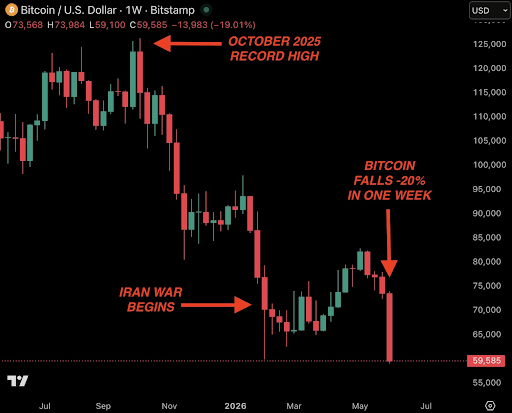
Source: Chart from The Kobeissi Letter on X

The brief crash below $60,000 over the weekend also showed that traders are reacting to a broader message that liquidity is drying up. Spot Bitcoin ETFs have been dealing with heavy outflows in recent weeks, reducing one of the most important sources of marginal demand that supported the cryptocurrency during its rally in early May.

However, Bitcoin bulls may still have one reason to stay hopeful. Bitcoin slipped through its 200-week moving average over the weekend, which currently sits at $61,000, leading to its first major interaction with the level since 2022.

Data from Coinglass shows that Bitcoin has historically found bear-market bottoms around the 200-week moving average across major cycles between 2015 and 2020. The last time Bitcoin tested this line was in June 2022, making the latest breach, almost four years later, a notable moment in the current downturn.

Standard Chartered’s global head of digital assets research, Geoff Kendrick, told clients on June 4 that the bear market may be in its final stages, noting that the recent painful week of price action might be the buying zone we all wanted when Bitcoin returns to $100,000 and Ethereum returns to $4,000.

BTC trading at $63,319 on the 1D chart | Source: BTCUSDT on Tradingview.com

Related Questions

QAccording to the article, what is the primary reason given for Bitcoin's crash below $60,000 over the weekend?

AThe primary reason given is a stronger-than-expected May 2026 jobs report, which complicated liquidity expectations and reduced the likelihood of Federal Reserve rate cuts, causing risk assets like Bitcoin to suffer.

QWhat were the key figures in the May 2026 US jobs report mentioned in the article?

AThe report showed that US employers added 172,000 jobs in May, significantly above the consensus estimate of 85,000. The unemployment rate held steady at 4.3%, and prior months' job numbers were revised upward by a combined 93,000.

QHow did the strong jobs report impact market expectations for Federal Reserve interest rate policy in 2026?

AFollowing the report, prediction markets dramatically reduced expectations for rate cuts. The probability of zero rate cuts in 2026 increased to roughly 68.8%, and the probability of a rate *increase* before year-end rose to 53% on Polymarket and 42.7% on the CME FedWatch tool.

QWhat technical indicator did Bitcoin breach over the weekend, and why is it historically significant according to the article?

ABitcoin breached its 200-week moving average, which was around $61,000. This is historically significant because data shows Bitcoin has historically found bear-market bottoms around this moving average in major cycles between 2015 and 2020.

QWhat two factors does the article cite as contributing to the drying up of liquidity for Bitcoin?

AThe article cites two main factors: 1) The strong jobs report reducing expectations for Fed rate cuts, which tightens financial conditions, and 2) Heavy outflows from spot Bitcoin ETFs in recent weeks, reducing a key source of marginal demand.

Related Reads

Huang Renxun Dramatically 'Saves' South Korean Stock Market

In early June, South Korea's stock market experienced a sharp decline, with the KOSPI index dropping over 5% and triggering a trading halt. Amid this volatility, NVIDIA CEO Jensen Huang's visit to Seoul provided a dramatic boost to market sentiment. During his trip, Huang held a dinner meeting with SK Group Chairman Chey Tae-won and SK Hynix CEO Kwak Noh-Jung. He announced that NVIDIA's new Vera CPU would utilize SK Hynix DRAM and confirmed a multi-year technical collaboration between the two companies. This partnership aims to co-develop next-generation memory for NVIDIA's AI infrastructure roadmap, covering products from data center supercomputers to personal AI devices. Huang also publicly commented that AI company stocks were attractively priced. A key announcement was that NVIDIA's upcoming Vera Rubin AI supercomputer systems will use HBM4 memory, with supply qualifications granted to all three major suppliers: SK Hynix, Samsung Electronics, and Micron Technology. Despite this multi-sourcing strategy, Huang warned that the industry-wide chip shortage, affecting everything from wafers to packaging, is expected to persist for several years due to relentless demand from global AI factory construction. The collaboration extends beyond memory supply. SK Hynix will employ NVIDIA's AI platforms and Omniverse digital twin technology to enhance its own semiconductor design, simulation, and manufacturing processes, aiming for more autonomous factory operations. This visit builds upon a prior October 2025 agreement for SK Group to build a large-scale AI data center using over 50,000 NVIDIA GPUs. Huang's itinerary also included meetings with other Korean giants like Hyundai, LG, and Samsung, indicating NVIDIA's broader strategy to deepen ties with South Korea's tech industry.

链捕手1h ago

Huang Renxun Dramatically 'Saves' South Korean Stock Market

链捕手1h ago

When Inference Becomes a Scarce Resource, Who Captures the Value?

When Inference Becomes the Scarce Resource, Who Captures the Value? The core AI bottleneck has shifted from model training to inference (runtime execution). While concerns persisted about an "AI compute gap"—initially a $200B, now a $600B problem—the market is now recognizing that the solution and value lie in the inference layer. Nvidia's financial restructuring around "serving tokens" and Cerebras's successful IPO highlight this shift. Inference is a recurring, usage-based cost, estimated to be 10-50x larger than the one-time training market, especially with the rise of agentic AI. The inference stack spans six layers: silicon (e.g., Nvidia), bare metal (e.g., CoreWeave), GPU rental/aggregation, deployment/optimization, model APIs, and end applications. Most companies operate in one layer. However, Hyperbolic uniquely spans three layers (GPU rental, deployment, and model APIs) without owning any hardware. It aggregates fragmented GPU supply from multiple cloud providers into a standardized pool, offering developers the cheapest available compute through intelligent routing. Its multi-cloud aggregation creates a data moat and a flywheel: more supply leads to better pricing data and liquidity, attracting more developers and providers. In contrast, applications like Venice operate at the top of the stack, reselling privacy-wrapped inference but remaining dependent on and constrained by the underlying compute costs they purchase. As inference demand explodes, value accrues not just to consumer applications but increasingly to the aggregation and routing layer that captures their cost of revenue. The coming potential GPU oversupply reinforces this dynamic. While hardware owners may suffer from depreciation, asset-light aggregators like Hyperbolic benefit from price arbitrage, routing workloads to the cheapest available capacity. The ultimate winner in the inference economy may not be the entity with the most GPUs, but the one that can most efficiently discover, aggregate, and route the world's fragmented compute.

链捕手2h ago

When Inference Becomes a Scarce Resource, Who Captures the Value?

链捕手2h ago

Trading

Spot
Futures

Hot Articles

What is $BITCOIN

DIGITAL GOLD ($BITCOIN): A Comprehensive Analysis Introduction to DIGITAL GOLD ($BITCOIN) DIGITAL GOLD ($BITCOIN) is a blockchain-based project operating on the Solana network, which aims to combine the characteristics of traditional precious metals with the innovation of decentralized technologies. While it shares a name with Bitcoin, often referred to as “digital gold” due to its perception as a store of value, DIGITAL GOLD is a separate token designed to create a unique ecosystem within the Web3 landscape. Its goal is to position itself as a viable alternative digital asset, although specifics regarding its applications and functionalities are still developing. What is DIGITAL GOLD ($BITCOIN)? DIGITAL GOLD ($BITCOIN) is a cryptocurrency token explicitly designed for use on the Solana blockchain. In contrast to Bitcoin, which provides a widely recognized value storage role, this token appears to focus on broader applications and characteristics. Notable aspects include: Blockchain Infrastructure: The token is built on the Solana blockchain, known for its capacity to handle high-speed and low-cost transactions. Supply Dynamics: DIGITAL GOLD has a maximum supply capped at 100 quadrillion tokens (100P $BITCOIN), although details regarding its circulating supply are currently undisclosed. Utility: While precise functionalities are not explicitly outlined, there are indications that the token could be utilized for various applications, potentially involving decentralized applications (dApps) or asset tokenization strategies. Who is the Creator of DIGITAL GOLD ($BITCOIN)? At present, the identity of the creators and development team behind DIGITAL GOLD ($BITCOIN) remains unknown. This situation is typical among many innovative projects within the blockchain space, particularly those aligning with decentralized finance and meme coin phenomena. While such anonymity may foster a community-driven culture, it intensifies concerns about governance and accountability. Who are the Investors of DIGITAL GOLD ($BITCOIN)? The available information indicates that DIGITAL GOLD ($BITCOIN) does not have any known institutional backers or prominent venture capital investments. The project seems to operate on a peer-to-peer model focused on community support and adoption rather than traditional funding routes. Its activity and liquidity are primarily situated on decentralized exchanges (DEXs), such as PumpSwap, rather than established centralized trading platforms, further highlighting its grassroots approach. How DIGITAL GOLD ($BITCOIN) Works The operational mechanics of DIGITAL GOLD ($BITCOIN) can be elaborated on based on its blockchain design and network attributes: Consensus Mechanism: By leveraging Solana’s unique proof-of-history (PoH) combined with a proof-of-stake (PoS) model, the project ensures efficient transaction validation contributing to the network's high performance. Tokenomics: While specific deflationary mechanisms have not been extensively detailed, the vast maximum token supply implies that it may cater to microtransactions or niche use cases that are still to be defined. Interoperability: There exists the potential for integration with Solana’s broader ecosystem, including various decentralized finance (DeFi) platforms. However, the details regarding specific integrations remain unspecified. Timeline of Key Events Here is a timeline that highlights significant milestones concerning DIGITAL GOLD ($BITCOIN): 2023: The initial deployment of the token occurs on the Solana blockchain, marked by its contract address. 2024: DIGITAL GOLD gains visibility as it becomes available for trading on decentralized exchanges like PumpSwap, allowing users to trade it against SOL. 2025: The project witnesses sporadic trading activity and potential interest in community-led engagements, although no noteworthy partnerships or technical advancements have been documented as of yet. Critical Analysis Strengths Scalability: The underlying Solana infrastructure supports high transaction volumes, which could enhance the utility of $BITCOIN in various transaction scenarios. Accessibility: The potential low trading price per token could attract retail investors, facilitating wider participation due to fractional ownership opportunities. Risks Lack of Transparency: The absence of publicly known backers, developers, or an audit process may yield skepticism regarding the project's sustainability and trustworthiness. Market Volatility: The trading activity is heavily reliant on speculative behavior, which can result in significant price volatility and uncertainty for investors. Conclusion DIGITAL GOLD ($BITCOIN) emerges as an intriguing yet ambiguous project within the rapidly evolving Solana ecosystem. While it attempts to leverage the “digital gold” narrative, its departure from Bitcoin's established role as a store of value underscores the need for a clearer differentiation of its intended utility and governance structure. Future acceptance and adoption will likely depend on addressing the current opacity and defining its operational and economic strategies more explicitly. Note: This report encompasses synthesised information available as of October 2023, and developments may have transpired beyond the research period.

363 Total ViewsPublished 2025.05.13Updated 2025.05.13

What is $BITCOIN

Discussions

Welcome to the HTX Community. Here, you can stay informed about the latest platform developments and gain access to professional market insights. Users' opinions on the price of BTC (BTC) are presented below.

活动图片