The Powell Era Concludes: Warsh Takes Over the Fed, What It Means for Global Finance and the Crypto Market?

marsbitPublished on 2026-05-23Last updated on 2026-05-23

Abstract

The podcast discusses the implications of Jerome Powell's departure and Kevin Warsh's appointment as Federal Reserve Chair for global markets and crypto. It highlights a significant divergence between bond markets, which price in global tightening and persistent inflation, and equity markets, driven by AI hype—a disparity reminiscent of the dot-com bubble. The analysis introduces the "Bliss Trade" concept, a structural expectation of government stimulus during crises, which underpins risk asset valuations and currency debasement trades. Inflation is seen as sticky, driven by deglobalization and further complicated by geopolitical tensions, unlikely to fall quickly even if immediate crises subside. Powell's tenure is critiqued for misjudging inflation and overseeing the de-banking of crypto firms, despite defending Fed independence. Regarding crypto, Bitcoin is viewed as a macro asset and a hedge against currency debasement, but its current muted performance stems from competition with higher-beta assets like AI stocks. The potential Clarity Act is seen as more beneficial for Ethereum than Bitcoin, with concerns about tokenization innovation leading to pure speculation. A key warning signal is the widening gap between the market-cap-weighted and equal-weighted S&P 500 indices, suggesting underlying market fragility.

Compiled & Edited by: Deep Chao TechFlow
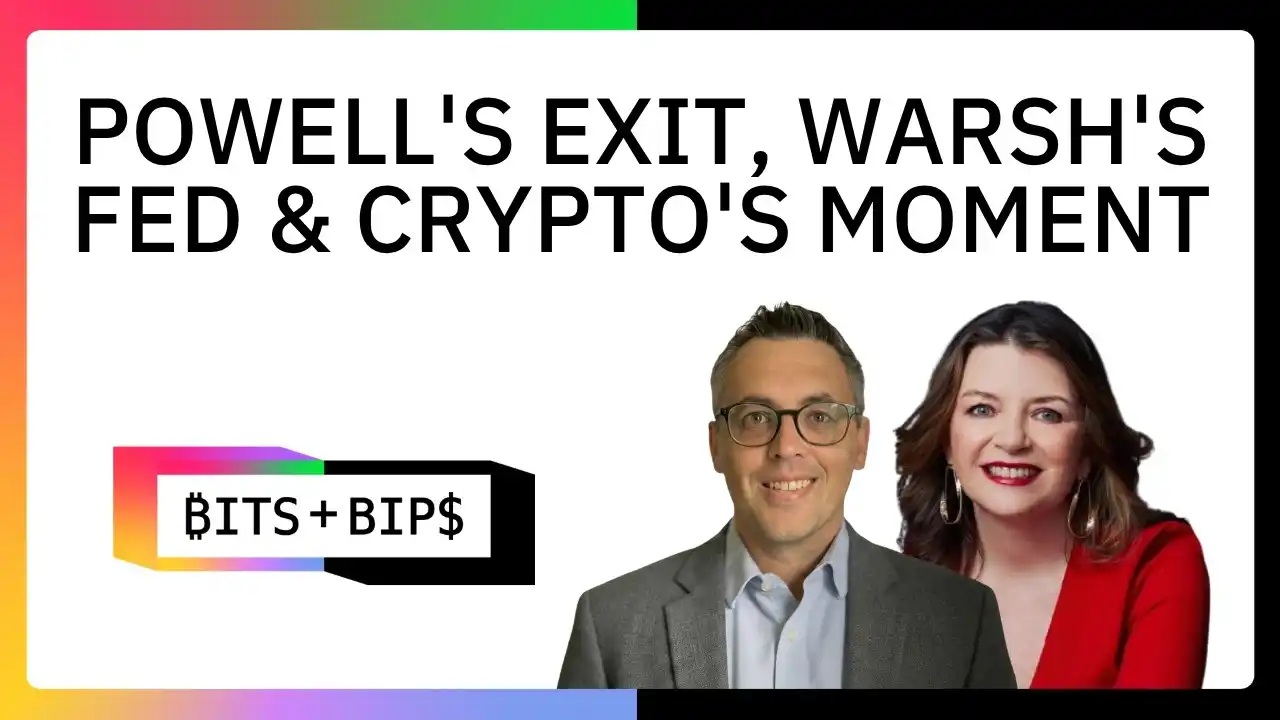
Guest:Noelle Acheson

Host:Steve Ehrlich

Podcast Source:Unchaind

Original Title:Powell Is Out, Warsh Is In: What It Means for Crypto

Release Date:May 22

Editor's Note

The 'Bliss Trade' (large, lasting stimulus expectations) proposed by former IMF chief economist Gita Gopinath in the FT is replacing the 'Taco Trade' as the underlying market logic. This is a structural, cross-party, cross-regime fiscal backstop expectation, forming the true moat for current risk asset valuations and the core rationale for currency depreciation trades.

Crypto is Macro Now newsletter author Noelle Acheson made three core judgments in the podcast: First, there is extreme divergence between stocks and bonds. The bond market is pricing in global tightening, while the stock market is driven by AI hype, similar to the divergence between the equal-weighted S&P 500 and the market-cap-weighted S&P 500 before the 1999 internet bubble. Second, Powell's tenure should acknowledge his defense of the Fed's independence, but one must not forget he led the 2023 shutdown of Silvergate and the de-banking of crypto firms. Finally, inflation won't fall quickly. Even if the Strait of Hormuz crisis ended tomorrow, energy price transmission and consumer expectations would take months to repair. Moreover, the uptrend in inflation predates Trump's tariffs and is driven by the long-term trend of deglobalization.

Key Quotes

Stock-Bond Divergence, 'Bliss Trade' & Systemic Fragility

  • "Global bond yields are rising, this is global tightening, and it's not good for markets. But stocks always dance to a different beat; that's not new. What's new is the scale of the divergence - it's massive."
  • "The bond market is traditionally called 'smart money' because they look only at macro data, narratives, and trends; while the stock market gets swept up in hype cycles. The current situation is that stocks follow the hype, bonds follow the macro indicators - two completely different stories with different beats, but they don't need to be the same."
  • "The essence of the 'Bliss Trade' is structural, unlike the 'Taco Trade' which was limited to Trump's term. It means that no government today will choose not to spend money to bail people out when they're in trouble, whether it's a market crash, a banking crisis, or high oil prices. It's not about party, or even about being a democracy - we've seen this too many times south of the equator."
  • "The 'backstop' is now part of the system, and of course this adds another layer of fragility. It's also one reason why risk appetite remains so strong in such an uncertain environment."
  • "Historically, market tops are often triggered by an extremely large IPO."
  • "The contrarian indicator I'm watching most closely is everyone cheering for the S&P 500 hitting new highs while ignoring the widening gap between the S&P 500 and its equal-weighted index. The last time it widened at this rate was 1999. Anything top-heavy, by the laws of physics, will eventually topple."

Inflation Won't Fall Quickly

  • "I have to push back on one assumption: inflation is not falling as much as many people think. Since 2024, core CPI has been ranging between 2.6% and 3%, not declining at all."
  • "The real driver of higher inflation is deglobalization, a trend that started even before the Trump administration, during Biden's term. Trump is just accelerating it, turbocharging it. Tariffs zigzag, and the Hormuz crisis lit a match underneath it all."
  • "Even if the Hormuz crisis ended tomorrow, it would take time for energy prices to fall back, and even longer for that to transmit to inflation indices and expectations. So the inflation story won't end anytime soon, regardless of what happens in Hormuz."
  • "A target rate of 3% is actually reasonable, and many Fed officials privately think so. But they can't change the target because a big part of the Fed's job is managing trust. If they change the target, they're telling the market 'we can't meet the old one,' and that damages the Fed's entire credibility system."

Powell's Tenure: Achievements and Failures

  • "Powell looks like a grandfatherly uncle you'd want to get a cotton candy latte with, but we must not forget he was also the driving force behind the de-banking of crypto firms, the leader of the Silvergate shutdown and the March 2023 events, and he completely misread inflation."
  • "The word 'independence' itself is worth questioning. He did stand up and push back when the Justice Department subpoena arrived, and that deserves credit; but in shutting down crypto-related banking, there was no independent thinking to be seen - that was politically influenced. Does independence mean being unaccountable for decisions? Does it mean ignoring subpoenas?"
  • "He wants to shrink the balance sheet, but the market won't let him. It's that simple. The bond market is the boss here. The Fed cannot let the Treasury market become disorderly, because that affects the dollar and price stability. So he can wish for it, but it won't happen. I also wish I were a professional pianist, but that won't happen either."

The Cost of Bitcoin's Macro-Assetification & Prospects for the Clarity Act

  • "Bitcoin is a hedge against currency depreciation. During the 2023 banking crisis, Bitcoin surged. Everyone said, 'because people realized the banking system is corrupt and fragile.' I said back then, no, it was because people expected central banks to step in and provide liquidity. That's what Bitcoin really reacts to."
  • "Bitcoin becoming a macro asset is a good thing, but it has a cost: it's now just one among many macro assets. And investors seeking volatility will choose higher-volatility assets, which currently is not Bitcoin. Right now, there are endless AI narratives to play, and prediction markets, so many things to play with."
  • "Even if the Clarity Act passes this year, it won't have much impact on Bitcoin. Bitcoin doesn't lack regulatory clarity. The real beneficiary is ETH, and when ETH rises, it often pulls Bitcoin up because they frequently move together."
  • "I'm worried about the details of the tokenization innovation exemption. If it allows third parties to issue tokens representing a company's stock without the company's knowledge or consent, that's purely a derivative speculation market, not a capital formation market. This contradicts the fundamental purpose of markets and is also detrimental to the crypto industry's existing 'purely speculative' stigma."

Steve Ehrlich: Hello everyone, welcome to Bits and Bips, where we explore the intersection of macro and crypto. I'm Steve Ehrlich, Research Director at SharpLink and your host today. This is a fantastic episode. The macro world is busy: stocks and bonds are moving in opposite directions, and crypto is caught in the middle. A new Fed Chair takes over tomorrow, and there's much more to discuss.

Let me introduce our guest. Formerly with Genesis, ex-Research Director at CoinDesk, and currently the author of the highly influential newsletter Crypto is Macro Now, Noelle Acheson. Noelle, welcome.

Noelle Acheson: Hi Steve, great to chat with you again.

Steve Ehrlich: How are you doing today?

Noelle Acheson: I'm recovering from near 35-degree heat in Philadelphia - this hot in May.

Steve Ehrlich: Got it, you'll probably have to get used to that. Like many watching today, I'm also trying to figure out what's going on with the markets. As the intro said, equities are still strong.

Noelle Acheson: Yes, but there are some warning signs emerging.

Steve Ehrlich: Right, Nvidia delivered another very strong earnings report, but the market reaction was muted. There's quite a bit of panic in the bond market, with 10-year and 30-year yields rising, a direction you've been closely watching. Adding fuel to the fire, we got our first inflation data since the Iran war started. No one knows what's coming next. Powell steps down as Fed Chair on Thursday, though he'll stay on the Board and vote for the foreseeable future. Crypto is caught up in it too, with Bitcoin hitting the 80k-83k range recently, ETH reaching around 2400, and both have pulled back.

So let's take them one by one. First question, how do you read the panic in the bond market? Yields are being pushed higher, 10-year, 30-year are up - to me these are concerning signals, but equities are largely ignoring them.

Stock-Bond Divergence & the Bond Market's 'Smart Money' Narrative

Noelle Acheson: You're right, these are concerning signals, and they are global warnings. Global bond yields are rising, this is global tightening, and it's not good for markets. But equities always dance to a different beat; that's not new. What's new is the scale of the divergence.

You probably remember the 60/40 portfolio used to be highly praised, where stocks and bonds were supposed to move inversely. We are seeing inverse movement now, but the scale is startling.

Equities are currently driven by internal, temporary factors, mainly AI enthusiasm - just look at the chip sector; while the bond market looks at the macro outlook, at the future. The bond market is traditionally called 'smart money' because they focus only on macro data, narratives, and trends; while equities can get caught up in hype cycles, and increasingly so.

So the current situation is that stocks follow the hype, which may or may not have a basis - we can discuss that later; bonds follow macro indicators, which currently do not look good. That's why the two beats tell completely different stories, but they don't need to be the same.

Steve Ehrlich: Let's talk about those macro indicators. Inflation data is on everyone's mind, and PPI (Producer Price Index) is also starting to tick up. What else are you seeing? How do you interpret these inflation signals? I don't want to use the word 'transitory,' but theoretically, if the Strait reopens, if there's any resolution with Iran, energy markets should at least return to pre-February 28 airstrike levels, things should calm down.

Noelle Acheson: Things will calm down, at least in oil prices. But that doesn't mean inflation will fall immediately, for two reasons. First, inflation transmission is slow. We've already seen the Fed's preferred core index ticking up, though not by much, because while oil prices affect everything, it takes time to transmit.

Second, we will see expectations become more volatile. This is interesting, especially in the US economy, where gasoline prices have a huge impact on inflation expectations. When you see the numbers tick up at the gas station, it feels like money is being siphoned from your bank account. So even if gas prices don't enter core inflation, consumers already feel inflation rising. This affects their expectations, which affects behavior, and ultimately affects actual inflation.

So even if the Hormuz crisis ended tomorrow, it would take quite a while for energy prices to fall back, and even longer for that to transmit to inflation indices and expectations. In other words, the inflation story won't end anytime soon, regardless of what happens in Hormuz, because this isn't new - inflation was building even before the Hormuz crisis.

Steve Ehrlich: Can you elaborate on that? I know you're in Spain, a European perspective; I'm American. Since inflation retreated from the post-COVID peak, the Fed has been raising rates to push it down, not to the 2% target, but it has been falling. What do you mean by 'building even before'?

Noelle Acheson: I have to push back on that assumption: it's not falling as you think. Look at the chart since 2024: core CPI has been ranging between 2.6% and 3%, not declining at all.

Actually, a year or even a year and a half ago, many said, 'Okay, the inflation story is over, the disinflation process is done, we'll range here for a while before moving up again.' Why expect inflation to continue upward? Because of deglobalization, a trend that started even before the Trump administration, during Biden's term. So it's a long-term trend; Trump is just accelerating it, turbocharging it. Tariffs zigzag - we don't know about refund situations yet, but prices have already gone up due to tariffs; the Hormuz crisis lit a match underneath. But honestly, if you look at the chart, inflation hasn't been falling for a long time.

Steve Ehrlich: You're right. I remember discussions about whether the Fed's 2% target should be raised, recalibrating the neutral rate.

Noelle Acheson: 3% is actually a reasonable target. Many discuss this, and many Fed officials privately think so, but they can't change the target. The reason is the Fed's fundamental problem is credibility. A big part of what the Fed does is managing trust. If they suddenly say, 'We can't achieve 2%, so we're changing the target,' they're undermining the market's trust in the Fed's ability to meet its own goals.

Steve Ehrlich: Understood. We'll talk more about the Fed and trust in about ten minutes.

From Taco Trade to Structural Backstop Expectations

Steve Ehrlich: I want to ask you more about this 'unstoppable force vs. immovable object' of stocks vs. bonds. In your newsletter this week, you pointed to a very interesting op-ed by a former IMF Deputy Managing Director about the so-called 'Bliss Trade,' which might be a more sustainable extension of the Taco Trade, part of the same family as Fed backstop expectations. I read a book a few months ago about the rise of the carry trade, arguing there will always be a backstop, turbocharged during COVID because global central banks had to flood with support for the shutdown economy. Can you explain this Bliss Trade? Which side do you think breaks first?

Noelle Acheson: The Bliss Trade comes from a very interesting FT op-ed a few weeks ago by Gita Gopinath, former IMF Chief Economist and Deputy Managing Director, now a Harvard professor. Read it from her IMF background perspective, but she makes a brilliant point: the market's expectation of a 'backstop,' a 'safety net,' is no longer just the Taco Trade. The Taco Trade is part of it, of course; Trump provided countless events for the market to believe 'he'll eventually step back,' but her point is that it's broader.

The Taco Trade is temporary, limited to Trump's term; but Bliss Trade stands for 'big, large and lasting stimulus or support,' and it's structural. Her argument is that no government today will choose not to spend money to bail people out when they're in trouble, whether it's a market crash, a banking crisis, or high oil prices. We saw it in 2020, again in 2022 due to energy prices, and now in Europe because of the Hormuz crisis. Governments don't get voted out for not bailing people out.

It's not about party, or even about being a democracy - we've seen coups south of the equator too many times. But this is crucial for the currency depreciation outlook. Where does the stimulus money come from? They'll always find a way; their toolbox is deep.

Long-term, this does add moral hazard, adds froth to the speculative side of the market. It's also a reason why we see such strong risk appetite in such an uncertain environment. But it is structural; the 'backstop' is now part of the system, and this of course adds another layer of fragility.

Steve Ehrlich: I'm curious about when this systemic fragility might break. Because anyone who dares to short the 'doom loop' ends up being run over by the market, which always recovers, usually in a K-shape, V-shape, or some letter.

Before we move to the next topic, I want to ask about AI stocks. OpenAI is reportedly planning to confidentially file for an IPO as soon as tomorrow, and Anthropic is rumored to go public later this year. These companies need to raise hundreds of billions to build infrastructure, buy Nvidia chips. I hear Anthropic achieved quite impressive operational profits this quarter; but OpenAI is still burning massive amounts of money, using debt to build the future. Yet this is the engine driving the stock market higher. What's your take?

Noelle Acheson: Many reports out there insist that current P/E ratios, forward P/E ratios are actually quite reasonable. What drives me crazy is that everyone assumes earnings expectations will be met or exceeded. Historically, that's often the case, but we can't assume it will always be so. Because what are these earnings expectations based on? Often, it's company guidance; often, it's simple demand extrapolation. We're assuming massive demand for chips and AI infrastructure, and that may not materialize.

It might materialize; I don't claim to be an AI expert. But historically, technological innovations have their own hype cycles, where expectations outrun reality and eventually face a correction. Could this be the first exception in history? Possibly, but it's reckless to bet your entire portfolio on that exception. And the market is currently betting entirely on it; this is an underlying fragility that is severely overlooked.

You mentioned Nvidia's great earnings but stock pullback. Actually, for the past eight quarters, every time Nvidia reports, the pattern is the same. Everyone says, 'The AI story is over.' It's not; it's a classic 'sell the news' effect. Expectations run up before earnings, earnings are delivered, people exit. So I wouldn't read too much into this reaction, but your point is correct: there will be a moment of reversal. I want to add another point: historically, market tops are often triggered by an extremely large IPO.

Steve Ehrlich: That's a good one to watch. Nvidia is also an interesting case; I read they've beaten analyst expectations for 14 or 15 consecutive quarters. But analyst expectations should theoretically have a basis in reality, while the Twitter hype machine can extrapolate arbitrarily, and that's where momentum traders' money goes.

What I find interesting is that Jensen Huang and Nvidia themselves emphasize concerns about 'inbreeding' among AI companies, the tangled web between chipmakers and clients. They try to alleviate concentration worries by saying about half their customers aren't large cloud providers.

Noelle Acheson: The problem of high customer concentration is real, and these customers themselves face rising costs and debt interest rates. How can we be sure about the health of these clients to sustain the earnings expectations that these cloud and chip companies are selling to the market? Okay, I admit I might be wrong; I've been expecting a market correction for a while and have been wrong on timing. So take this with a big grain of salt.

Powell's Departure: Achievements, Crypto De-banking & Independence Debate

Steve Ehrlich: Powell's tenure as Fed Chair spans almost the entire maturation of the crypto industry. And Bitcoin and crypto were originally designed as a counterforce to everything the Fed does. Can you talk about what his tenure meant for the industry?

Noelle Acheson: The cult of personality around Powell is easy to get swept into. He does seem like a grandfatherly uncle you'd want to get a cotton candy latte with. But we must not forget he was also the driving force behind the de-banking of crypto firms, the leader of the Silvergate shutdown and the March 2023 events (referring to the Silvergate, SVB, Signature Bank chain of collapses). He did a lot of damage to the reputation of US banking regulation. He also completely misread inflation.

So while I admit a personal fondness for him - I watch FOMC press conferences, and he communicates Fed goals and internal workings well - many things he was aware of and supported ended up hurting the crypto industry and the overall reputation of US banking; other things he simply didn't know about, which is also on him. This is before even getting into the credibility of the DOJ case itself. His non-response, non-compliance with those subpoenas suggests a certain arrogance and uncooperativeness. Even if you disagree with the premise behind the White House's moves, for precedent and procedural reasons, you at least go through the motions. So it's a mixed review overall. He certainly had a lot to deal with - repo crisis, pandemic, inflation.

Steve Ehrlich: Right, I forgot he was Fed Chair during the 2019 repo crisis too.

Noelle Acheson: He did have a lot on his plate. But for me, fondness doesn't equal exoneration.

Steve Ehrlich: I'm probably in a similar camp. I'm an institutionalist; listeners know I've worked in the US government, the US military. I have a strong belief in the objectivity and non-partisanship of key government institutions. Powell's insistence on defending Fed independence is very commendable to me; he clearly faced immense pressure. And I think that pressure wasn't just from the White House; Congress has somewhat abdicated its responsibility for fiscal policy in recent years, forcing the Fed to pick up the slack. Kevin Warsh actually wants to push back on that; he wants to shrink the Fed's balance sheet, refocus the Fed on monetary policy. So I get it. But if the first line of Powell's 'obituary' as Chair is 'he defended independence,' the second line must be 'he misjudged inflation.' We all got sick of the word 'transitory' in 2021, 2022. There was some logic then; COVID looked like a one-off tail event, and things should normalize post-reopening. But they didn't, and as you said, deglobalization etc. changed supply chains. He misread it, leading to the highest inflation in decades that had to be crushed; which led to the banking crisis you mentioned, some banks trapped by the bonds they held in this rate cycle, leading to an unprecedented bailout. These two things are hard to reconcile.

Noelle Acheson: Even his reputation for 'independence' itself is worth questioning. He did stand up and push back when the DOJ subpoena arrived; that moment was striking and necessary. A big part of his job is communicating and fostering trust in the institution, and he did that well here. But we must also remember that in shutting down crypto-related banking, there was no independent thinking to be seen; that was politically influenced.

We must also ask ourselves: does independence mean being unaccountable for all decisions? Does it mean you can simply ignore subpoenas? So what exactly does 'independence' mean? Is it possible that this Fed truly exhibited that independence? There's room for debate. And this opens a fascinating topic: what exactly do we mean when we say 'central bank independence'? When does it become a drawback rather than a virtue?

Steve Ehrlich: For me, he's more Paul Volcker (Fed Chair famous for raising rates to crush inflation in the late 70s/80s) than Arthur Burns (Fed Chair in the 70s accused of political subservience). But indeed, independence has many definitions.

Kevin Warsh's Inauguration: Balance Sheet, Forward Guidance & Rate Cut Expectations

Steve Ehrlich: Let's talk about his successor. Kevin Warsh has undergone his own evolution between 'dove vs. hawk.' He clearly stated in hearings that he wants the Fed to stay away from fiscal policy. His phrasing was something like 'fiscal policy is more about picking winners and losers, monetary policy is more democratic, affecting the whole economy' - that's where the Fed Chair should sit. He also wants to create new inflation measurement methods to make the Fed more precise, more forward-looking. Powell provided a lot of forward guidance; Warsh doesn't want to do that. What are your expectations of him?

Noelle Acheson: He can say he wants a smaller balance sheet, but the market won't let him achieve it. It's that simple. The bond market is the boss here; this is closely tied to price stability. The Fed cannot let the Treasury market become disorderly because that affects the dollar, affects price stability. So it's a wish. I also wish I were a professional pianist, but that won't happen either.

Regarding forward guidance, I wouldn't be surprised if there are fewer FOMC press conferences, fewer dot plots. There will be big debates about whether this is good or bad. This relates to what the SEC is doing; they're also discussing reducing annual disclosure frequency. Will the market accept less information? Or will it increase volatility? Does it mean analysts actually have to think rather than being spoon-fed data on a schedule? I don't know. It's a huge change. We've gotten used to a certain rhythm, being fed data on a schedule; if that's taken away, will it disrupt markets so much he has to put it back, or will it be a healthy shift, lowering costs and reintroducing original thinking? I don't know. I wouldn't be surprised if he tries, but whether the market lets him succeed, I'm not sure. That's probably all he can do. He certainly can't change inflation measurement methods; that's not his purview. He can influence what people focus on, but people will judge what's important themselves. And he certainly won't have the ability to cut rates.

Steve Ehrlich: On that note, the Fed released the April meeting minutes yesterday. One revelation was that there were more hawkish voices in the meeting than the final vote (to hold rates steady) suggested. This is the environment he's stepping into: higher inflation, but a President who wants lower rates, believing AI productivity will suppress inflation. And then Warsh has to prove himself 'independent of the President.' What are your expectations for the next few Fed meetings?

Noelle Acheson: Right now, the first thing to watch is what Trump says. He publicly said, 'Warsh can do what he wants, I have full confidence in him.' That's a pretty stunning statement given the environment Warsh is walking into. We know Warsh can't cut rates. First, he only has one vote, and almost no one will vote with him. Second, Trump can't turn around and attack him so soon after appointing him. So there will be a truce period.

There's one thing I think the market is misreading right now: rate hike expectations. I've been saying 'no rate cuts' for a long time, and it's comforting to see that consensus form; but now it's swung to the other extreme - a rate hike this year. I think that's going too far. He can't cut, but few will have the courage to vote for a hike when the 'transitory vs. persistent' inflation debate isn't even settled. So it will be 'no change.' That will keep Trump comfortable, maybe not completely happy, but he'll be quiet. This gives the Fed some breathing room, gives Warsh time to build his relationships, because ultimately it depends on the FOMC members' trust in the Chair - whether they'll follow his recommendations - which influences subsequent monetary policy.

Steve Ehrlich: I find that somewhat reassuring. Before dissenting votes started appearing last year, there hadn't been a dissent in decades. I actually think dissents are good because in a room with so many people, different backgrounds, overseeing different regions, there *should* be different opinions economically, moving away from groupthink. I'm looking forward to a potential Saturday Night Live sketch in season 52 about an FOMC meeting; the characters are distinct enough to be recognizable.

Noelle Acheson: That would be amazing. Think about it from another angle: what if the next dissent comes from the Chair himself?

Steve Ehrlich: That would be interesting. I'm not sure there's a historical precedent.

Noelle Acheson: I doubt he would; his top priority now is to earn the trust of the FOMC members.

Steve Ehrlich: Right, at least not in the first meeting. But who knows later.

The Cost of Bitcoin's Macro-Assetification

Steve Ehrlich: We've talked a lot about macro. Let's talk crypto. Bitcoin and ETH got caught up again over the weekend. Reports on Sunday of a possible new strike on Iran, then on Tuesday Trump said several Gulf countries asked for more negotiation time, things were put on hold. But crypto hasn't recovered. I hear some Chinese tankers passed through the Strait, reports say they paid some kind of 'fee' to Iran. Not sure if that becomes a pattern. But crypto is stuck again. Is it a high-beta risk asset, or will currency depreciation trades in a higher-inflation world make Bitcoin and crypto dominant again? Or will it lose out to gold again? How do you view the performance of major crypto assets now?

Noelle Acheson: Possibly all of the above, honestly. I don't see any catalyst to push it out of the current range, at least not a positive one. Negative risks are always there: a stock market crash would drag down major crypto assets; even if correlations weaken in the short term, gravity will exert itself. But will the stock market actually crash? That's uncertain.

The depreciation trade thread is always there. Bitcoin is a hedge against currency depreciation. When people worry about currency depreciation, Bitcoin tends to perform better. During the 2023 banking crisis, Bitcoin surged. Everyone said, 'because people realized the banking system is corrupt and fragile.' I said back then, no, it was because people expected central banks to step in and provide liquidity. That's what Bitcoin really reacts to. If there is genuine market deterioration, signals of stimulus measures (what we called the Bliss Trade earlier), that could potentially jolt crypto out of its slumber.

But given current risk appetite, Bitcoin isn't moving because there are too many other options. Countless AI narratives, prediction markets - so many things to play with. That's the cost of Bitcoin becoming a macro asset. I've been watching this for a long time. Bitcoin becoming a macro asset is a good thing; it's increasingly finding a place in macro portfolios. But the cost is that it's now just one among many macro assets. Investors seeking high volatility will choose higher-volatility assets, which currently is not Bitcoin. So in summary: there's no catalyst now to push it out of the range until it breaks out on its own and momentum takes over.

Steve Ehrlich: A potential future catalyst is the Clarity Act (market structure bill). We don't have time to dive deep today, but it's a topic that's been beaten to death. Can you give a brief comment? Both on the bill itself and the likelihood of it being signed into law?

Noelle Acheson: I hope the Clarity Act passes this year. But confidence isn't high; maybe it's just wishful thinking. I don't think it will impact Bitcoin much; Bitcoin doesn't lack regulatory clarity. The real lack is for ETH, and ETH might benefit; and when ETH rises, it often pulls Bitcoin up. Overall, regulatory clarity might make some investors more comfortable allocating to Bitcoin, but Bitcoin itself doesn't lack regulatory clarity today.

Steve Ehrlich: Right. I've written a few Twitter threads about this; Bitcoin and ETH already have a fair degree of clarity. The SEC even issued guidance saying many staking activities are not securities, a complete reversal from the Gary Gensler-era SEC stance. For DeFi, it could be an unlock, as it gives some TradFi companies more certainty to participate; DAOs won't be treated as general partnerships with massive liability risks; FinCEN and AML compliance boundaries will be clearer. These are unlocks Clarity could bring. But you're right, Bitcoin, ETH, including XRP, Solana, even without formal legislation declaring them commodities, have enough traditional rulings, not to mention the SEC has already approved ETFs under the '33 Act, essentially packaging commodities into ETFs.

Noelle Acheson: It is indeed very complex. Let me ask you a question: Is the potential passage of the Clarity Act already priced into the market? In other words, if it doesn't pass, would crypto crash? Or do people already not care?

Steve Ehrlich: Hard to say, likely depends on the asset. I tend to think it's not fully priced in because crypto has been subdued for months. If there is real momentum to push it through in the coming weeks, it has to happen by early summer, otherwise I think it won't. Even if passed, it doesn't necessarily mean Bitcoin instantly hits 140k, ETH automatically 5000. It would take longer. But I also don't think it's fully priced in because people understand that crossing so many hurdles in such a short time - like reconciling Senate versions with each other, then with the House version, writing in ethics provisions acceptable to the White House, then signing - is tough. I hear the target is July 4th, that's only about six weeks away, quite tight.

Noelle Acheson: The devil is in the details. Legislation is one thing; subsequent rulemaking is another. But I keep thinking, if it doesn't pass, it's not the end of the world for crypto. The SEC is already on board, most financial regulators are on board; they can keep rulemaking until the end of Trump's term. Even if an anti-crypto party enters the White House in 2028, by then crypto will probably be too big to dismantle.

Steve Ehrlich: Right. Crypto has proven to be a very powerful lobbying group, interest group. I believe any successor, even a Democrat, would be less hostile than the Gensler-era stance because that posture didn't yield much political gain.

Tokenization Innovation Exemption, Indicators to Watch & Contrarian View

Steve Ehrlich: One last small topic: What are your thoughts on the tokenization innovation exemption regarding interaction between crypto and traditional markets?

Noelle Acheson: The devil is in the details again. One thing I'm worried about is rumors that it would allow third-party issuance. In other words, anyone could issue a token representing a stock, with no relation to the company, even rumors say without the company's consent. I think that's insane.

To me, the essence of markets is capital formation. Derivatives support capital formation by creating more liquid markets, giving investors who put money into a stock a form of insurance. But if you create a market purely for derivative speculation, like tokenized stocks, that subverts the fundamental idea of markets. It's also not favorable for crypto, which already gets slapped with the 'only good for speculation' label - we've heard that too many times. Of course, not you or I think that, but the label exists.

So that's my concern. But if the details aren't that bad in the end, the tokenization innovation exemption is actually good news. It encourages experimentation. Regulators will be careful, won't let just anyone in, won't allow unlimited scale. But it will encourage entrepreneurs, market participants, and innovators to experiment with this new market architecture. We know tokenization will be a significant part of markets in the next five, ten years. Regulators giving confidence that 'you won't be punished for experimenting with new asset forms' is a big step forward.

Steve Ehrlich: Final question, two choices: One chart/indicator you're watching most closely in the coming weeks/months? Or, one contrarian view you'd like to share?

Noelle Acheson: I love your questions; you don't dodge, you pick up overlooked stories. For the indicator, I choose 'inflation.' If we lose sight of it, there's a very bad script ahead. Inflation will drive the bond market, dominate monetary policy, and have a huge impact on fiscal policy at a global level. So inflation is unavoidable. You can change index calculations as the new Chair says, but it's useless; inflation is unavoidable.

For the contrarian view, I'll pick something overlooked. Everyone is cheering for the S&P 500 hitting new highs, but ignoring the widening gap between the S&P 500 and its equal-weighted index. The market-cap-weighted index we all watch is hitting new highs; the equal-weighted index is not. This gap is getting larger. The last time it widened at this rate was 1999.

Steve Ehrlich: Followed by the dot-com bust.

Noelle Acheson: Yes. Anything top-heavy, by the laws of physics, will eventually topple.

Steve Ehrlich: Totally agree. Noelle, we'll have you on again. Thanks everyone for watching.

Related Questions

QAccording to the article, what is the 'Bliss Trade' and how does it differ from the 'Taco Trade'?

AAccording to Noelle Acheson, the 'Bliss Trade' refers to the market's structural expectation of persistent, large-scale government stimulus or support ('big, large and lasting stimulus or support'), regardless of which political party is in power. It differs from the 'Taco Trade', which was seen as a temporary phenomenon specific to the Trump administration. The 'Bliss Trade' is based on the belief that no government today would fail to provide fiscal support to citizens in distress, be it from market crashes, bank crises, or high energy prices, as doing so would be politically untenable.

QWhat is the core argument regarding why inflation is not likely to fall quickly, even if the Hormuz crisis ends?

AThe core argument is two-fold. First, the transmission of energy prices into inflation indices and consumer expectations is slow. Even if the Hormuz crisis ended, it would take time for energy prices to fall and even longer for this to be reflected in inflation data and expectations. Second, and more fundamentally, the trend of rising inflation predates the crisis and is driven by deglobalization, which began under the Biden administration and has been accelerated by Trump's policies. This is a long-term structural trend.

QWhat are Noelle Acheson's main criticisms of Jerome Powell's tenure as Fed Chair, particularly regarding the crypto industry?

ANoelle Acheson's main criticisms are: 1) He was the driving force behind the 'de-banking' of crypto companies, specifically orchestrating the shutdown of Silvergate and the events of March 2023 involving SVB and Signature Bank. 2) He completely misjudged inflation, famously labeling it 'transitory'. 3) While she acknowledges his defense of Fed independence against the Justice Department, she questions the true nature of that independence, pointing out that the crackdown on crypto banking seemed politically motivated rather than an independent policy decision.

QWhat is the primary 'cost' or downside mentioned for Bitcoin becoming a mainstream macro asset?

AThe primary 'cost' of Bitcoin becoming a mainstream macro asset is that it is now just one macro asset among many. Investors seeking high volatility have numerous other options, such as various AI-related stocks and prediction markets. Consequently, in the current risk-on environment driven by these alternatives, Bitcoin lacks a catalyst to move significantly out of its current trading range, as it no longer holds a unique position for volatility chasers.

QWhat is the key divergence in the stock market that Noelle Acheson identifies as a worrying signal, comparing it to 1999?

AThe key divergence she identifies is the growing gap between the S&P 500 market-cap weighted index (which is hitting new highs) and the S&P 500 equal-weight index (which is not). She notes that the last time this gap widened at such a pace was in 1999, prior to the dot-com bubble burst. This indicates a market that is 'top-heavy' and, based on the laws of physics, prone to eventually tipping over.

Related Reads

Why Did Zhipu Surge Nearly 30% in a Single Day?

"Global AI Model Unicorn" Zhipu's stock surged nearly 30% in a single day, reaching a new market cap high. The catalyst was the launch of its GLM-5.1-highspeed API, boasting a generation speed of **400 tokens per second**, setting a new global benchmark. This speed, roughly 3-5 times faster than industry leaders like OpenAI's GPT-4o and Anthropic's Claude, is achieved **without compromising the full-scale model's capabilities**. In the era of AI Agents requiring dozens of self-calls, such latency reduction is critical, transforming speed from a system metric into a determinant of intelligence limits. The breakthrough stems from a three-layer technical overhaul: 1. **TileRT Inference Engine**: Compiles the entire model into a continuous, always-on computation pipeline using "Warp Specialization," minimizing GPU idle time by having different processor groups handle data loading, computation, and communication in parallel. 2. **Heterogeneous Parallelism for MLA**: To efficiently run the GLM-5.1 model using the MLA attention mechanism, TileRT employs a heterogeneous strategy. One GPU handles sparse indexing/routing, while the others perform dense computation, optimizing for MLA's unique workflow. 3. **ZCube Network Architecture**: Replaces the standard Spine-Leaf (ROFT) network topology with a flat, dual-group interconnect. This design creates a single optimal path between any two GPUs, eliminating network congestion at scale and reducing latency. The business impact is significant: a 15% increase in cluster throughput (free extra capacity), a 40.6% reduction in tail latency (improved stability), and a one-third cut in networking hardware costs. Long-term, this innovation challenges the dominance of NVIDIA's integrated hardware-software stack (GPU+NVLink+InfiniBand), potentially benefiting manufacturers of high-density Leaf switches and optical modules while lowering the software barrier for domestic AI chips like Huawei's Ascend. The innovation proves that more can be achieved with the same compute, reshaping the infrastructure beyond just GPUs.

marsbit48m ago

Why Did Zhipu Surge Nearly 30% in a Single Day?

marsbit48m ago

Bidding Farewell to the 'Gray Gambling Game'! Polymarket Charges into the Compliance Track—How Will This Impact the Entire Crypto Industry?

From Gray to Regulated: How Polymarket’s Compliance Journey Reshapes Crypto The evolution of Polymarket, a decentralized prediction market platform, illustrates a critical trend in crypto: innovative, high-value sectors ultimately integrate into regulatory frameworks. Founded in 2020, Polymarket quickly gained traction by leveraging low-cost Layer 2 blockchain technology for event-based trading, notably during the 2024 US presidential election where its markets outperformed traditional polls. However, its "build first, comply later" approach led to a 2022 CFTC enforcement action, resulting in a $1.4 million fine and a ban from the US market. A pivotal shift occurred in 2025 under a new US administration. Polymarket strategically acquired CFTC-licensed derivatives exchange QCX for $112 million, securing a regulated pathway back into the US. This move coincided with a regulatory reversal, as the CFTC withdrew a prior proposal to ban political event contracts. The platform’s successful "regulatory acquisition" strategy, avoiding a lengthy independent licensing process, highlights a viable compliance path for crypto-native projects. Its journey from regulatory target to a CFTC-recognized entity—bolstered by a major data partnership and investment from Intercontinental Exchange (ICE)—signals the maturation of prediction markets from a "crypto novelty" into acknowledged financial infrastructure. The story underscores that genuine utility provides negotiating power with regulators and that embracing compliance does not necessarily mean sacrificing core technological advantages.

marsbit1h ago

Bidding Farewell to the 'Gray Gambling Game'! Polymarket Charges into the Compliance Track—How Will This Impact the Entire Crypto Industry?

marsbit1h ago

Trading

Spot
Futures

Hot Articles

What is LINON

Linde plc Tokenized Stock (Ondo): Revolutionizing Traditional Equity Access Through Blockchain Innovation The emergence of Linde plc Tokenized Stock (Ondo), represented by the ticker $LINON, signifies a monumental shift in the fusion of traditional financial structures and decentralized finance (DeFi). This innovative financial instrument showcases the tremendous potential of blockchain technology to democratize access to traditional equity markets while ensuring the security and regulatory compliance necessary for institutional-grade financial products. Through Ondo Finance's pioneering tokenization platform, $LINON provides a seamless pathway for global investors to engage with one of the world's leading industrial gas companies, Linde plc, creating a blockchain-native representation of the underlying equity. Introduction to Linde plc Tokenized Stock The landscape of financial markets is witnessing a groundbreaking transformation through the tokenization of real-world assets. Linde plc Tokenized Stock (Ondo) epitomizes this revolutionary approach by bridging the gap between conventional stock ownership and blockchain-enabled financial infrastructure. The $LINON token allows investors to gain exposure to one of the prominent industrial companies worldwide through decentralized technology. Operating within Ondo Finance's comprehensive ecosystem, $LINON symbolizes a practical application of tokenization technology that enhances accessibility, efficiency, and global connectivity in traditional financial markets. By leveraging blockchain infrastructure, this tokenized stock enables international investors to participate in U.S. equity markets, overcoming traditional barriers associated with cross-border investing. The significance of $LINON goes beyond technological innovation; it represents a fundamental shift in asset structuring, distribution, and trading in the digital age. This tokenized stock maintains all the economic benefits associated with traditional Linde plc shares while offering improved liquidity, programmable compliance features, and seamless integration with decentralized finance protocols. The development of $LINON indicates a growing acceptance of blockchain technology as a viable means for traditional finance, exemplifying how even well-established assets like Linde plc can integrate into blockchain systems. This approach preserves the core attributes that appeal to investors while introducing advanced capabilities that enhance the overall investment proposition. Project Overview and Objectives Linde plc Tokenized Stock (Ondo) encapsulates a strategic effort to democratize access to traditional equity markets through advanced blockchain technologies. The primary objective of $LINON is to provide approved global investors seamless access to the economic exposure associated with Linde plc shares, furthering an effort to create a more inclusive financial ecosystem. Beyond the digital representation of traditional assets, $LINON endeavors to eliminate barriers of geography and time zones that limit investor participation. Its design ensures that blockchain technology can elevate traditional investment vehicles without undermining the security or compliance requirements expected by investors. Key goals of the project include enhanced liquidity provision, programmable compliance mechanisms, and interoperability with other blockchain networks. Each $LINON token is fortified by actual Linde plc securities housed at U.S.-registered broker-dealers, allowing holders to reap economic advantages akin to traditional stockholders, such as dividend reinvestment. Furthermore, $LINON aims to establish new industry standards for institutional-grade tokenized securities, paving the way for traditional assets to embrace blockchain technology while remaining compliant with regulatory frameworks. By associating itself with a company as reputable as Linde plc, the project opens avenues for exploring tokenized equities catering to both conservative institutional players and daring retail investors. Project Creator and Development Team The vision for Linde plc Tokenized Stock (Ondo) comes from Nathan Allman, founder and CEO of Ondo Finance. His background in traditional finance coupled with expertise in blockchain technology positions him uniquely to navigate the complexities of asset tokenization. Allman's academic journey began at Brown University, focusing on Economics and Biology, equipping him with valuable analytical skills. His time at Goldman Sachs in the Digital Assets division strengthened his understanding of the interplay between financial institutions and emerging technologies, laying the groundwork for his later endeavors in alternative investment strategies. Under Allman's guidance, Ondo Finance has emerged as a leader in asset tokenization, launching $LINON as a flagship example of the company's larger mission towards revolutionizing traditional financial systems using blockchain technology. His commitment to leveraging blockchain for creating institutional-grade financial products has shaped the landscape of real-world asset tokenization. Investment and Funding Structure The growth of Ondo Finance, the platform powering Linde plc Tokenized Stock (Ondo), is bolstered by robust financial backing from prestigious venture capital firms and strategic investors. This strong investment foundation underpins the development of the key infrastructure essential for compliant tokenized securities like $LINON. In August 2021, Ondo Finance secured $4 million in seed funding led by a major venture capital firm, which enabled the company to commence platform development and establish the necessary regulatory processes for tokenizing real-world assets. This early investment cemented Ondo Finance's credibility within the industry. The Series A funding round followed, garnering $20 million with participation from renowned firms committed to transformative technology companies. This backing demonstrated substantial institutional confidence in Ondo Finance's vision, allowing it to hone its approach to asset tokenization through mechanisms that ensure compliance and accessibility. Noteworthy contributors, including institutional investors and experienced partners, have added significant value to Ondo Finance’s development efforts. Their involvement underscores the confidence across sectors in Ondo Finance's approach to bridging traditional finance with blockchain innovations. Technical Infrastructure and Innovation The technical architecture that underpins Linde plc Tokenized Stock (Ondo) represents a sophisticated melding of traditional finance systems and cutting-edge blockchain technology. The architecture's foundation is built on the Ethereum network, renowned for its security and programmability—both critical for intricate financial instruments. The $LINON tokenization process comprises creating a blockchain-native representation of Linde plc shares that preserves economic benefits while augmenting investor capabilities. Each token corresponds to actual shares held at U.S.-registered broker-dealers, creating a compliant custody structure that legitimizes the asset's existence and value. Automated compliance systems are integrated into the tokenization process, managing critical components such as know-your-customer (KYC) verification and anti-money laundering (AML) protocols. This incorporation of programmable compliance empowers $LINON to uphold regulatory standards essential for institutional proliferation. Cross-chain interoperability characterizes the advanced technical features of $LINON. While initially deployed on Ethereum, the framework is designed for expansion to other networks such as Solana and BNB Chain. This adaptability enhances liquidity and accessibility, allowing investors to select their preferred blockchain ecosystems. Historical Timeline and Development Crafting the history of Linde plc Tokenized Stock (Ondo) unfolds in parallel with the evolution of Ondo Finance's tokenization platform. The timeline's inception dates back to March 2021 when Nathan Allman laid the foundations for creating institutional-grade financial products on blockchain infrastructure. The initial funding round in August 2021 provided crucial resources for developing the platform and establishing partnerships necessary for effective tokenization. By January 2023, Ondo Finance launched its tokenized treasury products, establishing mechanisms that would facilitate future tokenized equities such as $LINON. A pivotal milestone arose in February 2025 when Ondo Chain—a Layer 1 blockchain designed specifically for asset tokenization—was introduced. This infrastructure enhances capabilities vital for institutional markets, demonstrating Ondo Finance's long-term commitment to tokenization. Subsequently, the launch of Ondo Global Markets in September 2025 marked the official debut of $LINON. This milestone showcased the successful transition from development to active trading, enabling investors around the world to access American financial markets seamlessly. Ongoing development plans include a targeted expansion of available tokenized assets to over 1,000 by the end of 2025, pointing to a bright future for Ondo Finance's ecosystem and its mission to broaden tokenized equity accessibility. Regulatory Compliance and Legal Framework The legal architecture governing Linde plc Tokenized Stock (Ondo) emphasizes a sophisticated approach to regulatory compliance, allowing tokenized securities to be implemented within a blockchain-based framework. The legal structure governing $LINON spans multiple jurisdictions while maintaining a robust legal footing. Compliance systems ensure that only eligible investors can access the token, enforced through automated verification that aligns with international regulations. This innovative regulatory technology promises real-time enforcement of complex requirements, considerably enhancing efficiency in operating within the regulatory landscape. The custody framework undergirding $LINON ensures that the underlying shares are securely held at U.S.-registered broker-dealers, complying with necessary regulations while delivering blockchain-driven access to investors. The token maintains its economic equivalency and security through this carefully structured custody arrangement. KYC and AML compliance systems are embedded within the smart contract architecture, ensuring integrity and adherence to regulatory practices while fostering transparency for investors. The jurisdictional restrictions mark a commitment to navigating the evolving landscape of international securities laws. Market Impact and Industry Significance The advent of Linde plc Tokenized Stock (Ondo) holds profound implications for the broader financial landscape, symbolizing a clear shift towards blockchain-enabled markets. $LINON serves as a proof-of-concept for integrating traditional companies into blockchain ecosystems, showcasing the potential benefits such as broader accessibility and improved efficiency. The market's response to $LINON indicates a growing acceptance of tokenization among institutional investors, contributing to the emergence of an expanding sector wherein traditional assets can be interconnected with blockchain innovations. The success of $LINON further solidifies market confidence, indicating an overarching shift towards recognizing asset tokenization as a transformative force in finance. Future Development and Expansion Plans The future trajectory for Linde plc Tokenized Stock (Ondo) centers around the expansion of the tokenization ecosystem and enhanced infrastructure supporting blockchain-enabled financial services. Plans for cross-chain integration usher in new opportunities for liquidity and flexibility within the investment framework, with existing capabilities poised for continuous enhancement. With the introduction of Ondo Chain, Ondo Finance aims to transition $LINON to an optimized blockchain environment specifically designed for asset tokenization. This new infrastructure heralds exciting prospects for the development of institutional-grade financial products, ensuring ongoing compatibility with contemporary investment strategies. Further integration with decentralized finance protocols signifies a commitment to empowering $LINON holders through advanced financial strategies. The anticipated expansion of available tokenized assets promises to broaden investor access, enhancing the utility and appeal of the platform. In alignment with ambitions for regulatory expansion, ongoing efforts to secure approvals for new jurisdictions will enhance investor access, further positioning $LINON at the forefront of the burgeoning tokenization market. Conclusion Linde plc Tokenized Stock (Ondo), as represented by the $LINON token, stands at the intersection of traditional finance and blockchain innovation. It embodies a transformative milestone in how financial assets are structured, distributed, and engaged within modern investment ecosystems. The technical sophistication behind $LINON, combined with its regulatory compliance framework, illustrates that asset tokenization can improve financial infrastructure rather than simply digitizing existing products. This pioneering effort not only enhances investor access to U.S. equity markets but also signifies an evolution of how traditional financial services can integrate blockchain technology. As the asset tokenization market grows exponentially, with prospects suggesting significant valuation increases, $LINON paves the way for a future where tokenized securities become standard fixtures in the financial landscape. The trajectory of $LINON will undoubtedly influence how traditional finance adapts to a transformed, blockchain-powered world.

2.8k Total ViewsPublished 2025.12.05Updated 2025.12.05

What is LINON

What is CRMON

Salesforce Tokenized Stock (Ondo): Revolutionising Traditional Equity Access Through Blockchain Innovation The emergence of Salesforce Tokenized Stock (CRMON) marks a pivotal advancement in integrating traditional financial markets with blockchain technology. This innovative approach offers investors unprecedented access to equity exposure through tokenisation. Developed by Ondo Finance, CRMON provides tokenholders with economic exposure equivalent to holding Salesforce stock (CRM) while automatically reinvesting dividends. This effectively bridges the gap between conventional equity markets and decentralised finance (DeFi). Introduction and Comprehensive Overview of Salesforce Tokenized Stock In recent years, the financial landscape has dramatically transformed due to blockchain technology, fundamentally altering how investors access and interact with traditional assets. The development of Salesforce Tokenized Stock (CRMON) is a prime example of this evolution, representing a sophisticated fusion of conventional equity markets with cutting-edge distributed ledger technology. CRMON is a tokenised version of Salesforce stock, emerging from the innovative work of Ondo Finance, a leading platform in the real-world asset tokenisation sector that positions itself as a bridge between traditional finance and decentralised systems. Designed to provide tokenholders with economic exposure that mirrors the performance of the underlying Salesforce stock, CRMON incorporates automatic dividend reinvestment mechanisms. This eliminates many traditional barriers associated with international equity investment, such as complex brokerage relationships, currency conversion challenges, and restricted trading hours. The tokenisation process reimagines stock ownership as a blockchain-native asset while maintaining its economic equivalence with the underlying security, offering enhanced portability and integration capabilities within decentralised finance ecosystems. CRMON transcends its individual utility as an investment instrument to represent a fundamental shift in how financial markets can operate in an increasingly digital world. By maintaining full backing through U.S.-registered broker-dealers and implementing robust compliance frameworks, CRMON demonstrates that tokenised securities can achieve the regulatory standards necessary for institutional adoption while delivering the technological advantages of blockchain infrastructure. Understanding Tokenized Real-World Assets and CRMON's Strategic Position Tokenised real-world assets signify one of the most significant innovations in modern finance, fundamentally reimagining how traditional securities are represented, traded, and utilised within digital ecosystems. CRMON operates as a tokenised equity instrument correlating directly with Salesforce stock while optimising accessibility and efficiency. This aligns with Ondo Finance's broader mission to democratise access to institutional-grade financial products through innovative tokenisation strategies. The tokenisation process guarantees complete economic equivalence with the underlying Salesforce equity. Each CRMON token represents a proportional claim on Salesforce stock held by qualified custodians, with dividend payments automatically reinvested to maintain continuous exposure to total return performance. This structure simplifies dividend management and ensures that tokenholders receive the full economic benefit of their equity exposure, encompassing both capital appreciation and income generation. Ondo Finance's strategy in tokenising Salesforce stock demonstrates its expertise in creating compliant, institutional-grade products that meet traditional financial markets' stringent requirements. The platform’s focus on merging regulatory compliance with blockchain benefits positions it at the forefront of decentralised finance, captivating both institutional and retail investors seeking blockchain-native solutions. The Technology and Innovation Framework Behind CRMON The technological infrastructure supporting CRMON integrates blockchain technology with traditional financial mechanisms, delivering institutional-grade security and compliance while maintaining the operational advantages of decentralised systems. Built on the Ethereum blockchain, CRMON utilises robust smart contract capabilities to ensure transparent, secure operations. The smart contract architecture incorporates layered security and compliance mechanisms, enabling automated compliance checks and real-time asset backing verification. Integration with oracle services maintains accurate pricing and dividend information, ensuring CRMON reflects the underlying Salesforce stock's accurate performance. This architecture delivers automated dividend reinvestments and other corporate actions, eliminating manual processing requirements and directly enhancing tokenholder benefits. Ondo Finance ensures CRMON's security structure includes daily third-party verification of holdings, independent collateral agents, and a multiple-layer custody system through partnerships with established financial institutions. This framework safeguards tokenholder interests against operational risks while providing robust asset backing. The user interface enhances integration capabilities, allowing seamless interaction between CRMON and various decentralised finance protocols, as well as cryptocurrency exchanges. This interoperability enables users to leverage their tokenised equity across multiple platforms, creating sophisticated investment strategies that marry traditional equity characteristics with blockchain-native innovation. Leadership and Corporate Structure of Ondo Finance The leadership team behind CRMON and Ondo Finance blends expertise from traditional finance and blockchain technology, presenting a robust combination of skills essential for successfully bridging conventional markets with decentralised finance. Nathan Allman, the founder and CEO, emerged from a distinguished financial background before establishing Ondo Finance in 2021. Allman's experience includes notable roles at major financial institutions, including significant contributions to developing cryptocurrency market services. His insights into regulatory compliance were paramount in developing products like CRMON that successfully unify traditional securities with blockchain technology. With a team of professionals boasting substantial experience in both conventional finance and blockchain sectors, Ondo Finance's leadership comprises diverse expertise that covers every aspect of tokenised asset development. Justin Schmidt serves as President and COO, contributing unique operational expertise, while Chris Tyrell brings essential compliance knowledge. Investment Landscape and Funding History The investment landscape surrounding Ondo Finance reflects significant institutional confidence in its mission to tokenise real-world assets. The company has raised substantial funds through various investment rounds, attracting leading venture capital firms and strategic investors that recognise the transformative potential of tokenised securities like CRMON. Notably, Ondo Finance completed a successful Series A funding round in 2022, led by well-known venture capital firms. This funding success validates Ondo Finance's innovative approach to creating compliant, institutional-grade tokenised products. In total, Ondo Finance has successfully secured substantial funding, raising significant capital for product development and market expansion, including a noteworthy token sale that reinforced its governance structure through the establishment of the ONDO token. The diverse composition of investors reflects broad market confidence in Ondo Finance's business model, demonstrating support from both traditional and blockchain-native organisations. Operational Mechanics and Technical Implementation The operational framework supporting CRMON exemplifies sophisticated integration of traditional financial mechanisms with blockchain technology. The technical implementation introduces multiple layers of security, compliance, and operational efficiency to meet institutional standards while enhancing accessibility. The tokenisation process begins by acquiring actual Salesforce stock through U.S.-registered broker-dealers, ensuring each CRMON token maintains direct correlation with the underlying equity performance. Smart contracts automate operational processes, including dividend reinvestment and corporate action processing, facilitating a streamlined user experience. The Minting and redemption processes allow authorised participants to manage CRMON tokens effectively. During U.S. trading hours, institutions can mint new tokens by depositing stablecoins that are used to purchase corresponding Salesforce equity. This structure maintains a tight correlation with underlying assets, enhancing liquidity and price discovery. Additionally, the infrastructure supports twenty-four-hour token transfer capabilities, providing CRMON holders with operations outside traditional market hours. This represents a significant advantage over conventional securities ownership, thus promoting integration with decentralised finance applications. Plans for cross-chain compatibility through partnerships signal further ambitions for CRMON's market reach. By expanding to other blockchain networks, Ondo Finance aims to enhance accessibility and user engagement with tokenised equity products. Timeline and Historical Development of Tokenized Equity Innovation The timeline of CRMON's development and Ondo Finance's broader tokenised capabilities demonstrates a systematic innovation process beginning with the company's founding in 2021. 2021: Ondo Finance is founded by Nathan Allman and co-founders, launching initial products focused on structured vault offerings on the Ethereum blockchain. 2022: The company completes substantial funding rounds—both equity and token sales—totaling significant capital and launching initial tokenised U.S. Treasury products. 2023-2024: Ondo Finance experiences substantial growth, establishing partnerships with major financial institutions while expanding its product offerings beyond fixed-income securities. February 2025: Ondo Global Markets is announced, marking the transition into equity tokenisation with plans for accessing over one hundred U.S. stocks and ETFs. September 2025: The official launch of Ondo Global Markets includes CRMON alongside other tokenised equity offerings, marking a significant evolution in Ondo Finance's product ecosystem. This timeline highlights the organisation's rapid growth and its capability to adapt its technological and compliance frameworks to accommodate different asset classes effectively while maintaining security and regulatory integrity. Regulatory Framework and Compliance Approach Ondo Finance's regulatory framework showcases a sophisticated compliance strategy, essential for achieving institutional adoption in the tokenised securities market. The company's strong partnerships with U.S.-registered broker-dealers promote adherence to Securities and Exchange Commission regulations and apply robust investor protections. Acquisitions, such as Oasis Pro—a registered broker-dealer—significantly enhance Ondo Finance's compliance capabilities, ensuring thorough alignment with existing regulatory structures. The company employs independent verification procedures that foster transparency, aiming for a solid performance standards reputation. Furthermore, Ondo Finance's commitment extends to international regulatory compliance, ensuring token access remains restricted to eligible investors while adhering to pertinent cross-border securities regulations. Comprehensive attention to tax implications and reporting requirements fortifies the security and compliance landscape of CRMON, ensuring that investor obligations remain manageable. Future Prospects and Market Positioning The forward-looking landscape for CRMON and Ondo Finance illustrates substantial growth opportunities driven by institutional adoption of blockchain technology and escalating demand for efficient alternatives to conventional securities ownership. Market projections indicate the tokenised asset sector could value multiple trillion dollars by 2030. With plans to scale CRMON offerings significantly and integrate it with a dedicated blockchain infrastructure—Ondo Chain—Ondo Finance aims to elevate its institutional-grade tokenised asset operations. Additionally, the development of strategic partnerships enhances distribution capabilities while establishing the company's credibility in the financial market. Furthermore, the integration of tokenised equity with decentralised finance protocols offers new potential for innovative financial products and strategies previously impossible with traditional securities. These factors underscore CRMON's positioning to effectively capture increased market share and deliver innovative solutions for international investment exposure. Conclusion Salesforce Tokenized Stock (CRMON) symbolises a transformative development within financial markets, successfully bridging traditional equity ownership with blockchain technology to create unprecedented accessibility for global investors. Through Ondo Finance's sophisticated tokenisation framework, CRMON provides complete economic exposure to Salesforce equity performance while enhancing operational advantages that exceed traditional ownership. The launch of CRMON reflects the broader evolution of financial markets towards blockchain infrastructures that maintain regulatory compliance while delivering increased efficiency. Ondo Finance's extensive approach to regulatory adherence, institutional-grade security, and technological innovation solidifies CRMON as a model for future tokenised securities, delivering access previously unattainable in conventional brokerage structures. As the tokenised asset sector continues to develop, CRMON is well-positioned to address historical inefficiencies in capital markets while providing investors with innovative solutions for accessing traditional securities. The outlook for CRMON looks exceptionally promising, supported by ambitious expansion plans, technological innovations, and strategic partnerships, thereby representing a pioneering model of modern financial infrastructure evolving through blockchain integration.

2.9k Total ViewsPublished 2025.12.05Updated 2025.12.05

What is CRMON

What is SHOPON

Shopify Tokenized Stock (Ondo): A Comprehensive Analysis of Real-World Asset Tokenization in Web3 This article delves into the Shopify Tokenized Stock (Ondo), recognised by its ticker symbol $SHOPON, exploring its implications at the intersection of traditional finance and blockchain technology. As a part of Ondo Finance's tokenized securities platform, Shopify’s tokenized stock exemplifies advancements in democratizing access to global capital markets through innovative digital assets. Introduction and Overview of Shopify Tokenized Stock (Ondo) Shopify Tokenized Stock (Ondo), or $SHOPON, portrays a pivotal innovation in the realm of tokenized securities, allowing investors to gain economic exposure akin to directly owning shares of Shopify Inc. This token, developed under the umbrella of Ondo Finance, not only provides investors with the ability to hold digital representations of the company’s stock but also integrates features such as automatic reinvestment of dividends. This advancement represents a substantial shift in the landscape of decentralized finance (DeFi), linking conventional equity markets with blockchain solutions designed to enhance accessibility, transparency, and liquidity. By eliminating geographical barriers and enabling 24/7 trading capabilities, $SHOPON is positioned as a bridge connecting traditional financial instruments and the emerging Web3 ecosystem. What is Shopify Tokenized Stock (Ondo), $SHOPON? The $SHOPON token serves as a digital manifestation of Shopify Inc.'s shares, engineered to provide a direct correlation to the underlying asset's performance. Through the utilization of blockchain technology, the token gives holders a mechanism to participate in the economic benefits associated with equity ownership, including capital appreciation and dividend distribution. The unique aspect of $SHOPON lies in its automatic dividend reinvestment mechanism, which allows returns to compound without necessitating active management by the investor. This feature inherently enhances its attractiveness as an investment vehicle, particularly for individuals seeking passive income growth alongside exposure to high-performing equities. The tokenization process is facilitated by the custody of actual Shopify shares through regulated intermediaries, ensuring that every $SHOPON token is verifiably backed by real equity. This structure empowers investors with the dual advantages of both traditional financial characteristics and the innovative benefits tied to blockchain technology. Who is the Creator of Shopify Tokenized Stock (Ondo)? The creator of Shopify Tokenized Stock (Ondo), Nathan Allman, is an experienced figure in the finance sector, formerly associated with Goldman Sachs. His rich background includes significant expertise in digital asset development, bridging the gap between traditional finance and cryptocurrencies. Allman’s educational journey, marked by studies at Brown University, provided him with a deep understanding of economics and biology, equipping him with analytical skills that inform his strategic vision. In 2021, he founded Ondo Finance, committing to developing tokenized securities that meet institutional-grade standards while leveraging blockchain's transformative capabilities. Under Allman's leadership, Ondo Finance has focused on creating compliant and innovative financial products that empower a diverse investor base. Who are the Investors of Shopify Tokenized Stock (Ondo)? The investment landscape surrounding Shopify Tokenized Stock (Ondo) is notably robust, underpinned by significant institutional support. Primarily, Pantera Capital stands out as a strategic partner through the Ondo Catalyst initiative, a $250 million commitment aimed at accelerating the development of on-chain capital markets. This partnership not only signifies institutional confidence in the potential of tokenized assets but also reinforces Ondo Finance's operational capabilities and market positioning. The funding pathways have included earlier rounds that amassed millions in seed funding and further structural investments, solidifying relationships with both venture capital firms and private investors. Moreover, the financial framework is complemented by strategic partnerships with established financial institutions and technology companies, enhancing Ondo’s infrastructure and operational expertise. How Does Shopify Tokenized Stock (Ondo), $SHOPON Work? At the core of $SHOPON's operational framework is a sophisticated system integrating traditional finance mechanisms with blockchain technology. The custody of actual Shopify shares ensures that token holders retain authentic economic exposure, safeguarding their investments in line with recognized legal structures. The smart contracts employed in managing $SHOPON handle various functions, including automatic dividend reinvestment and ownership transfer, offering instant settlement and increased liquidity, marking a significant departure from conventional trading systems plagued by multi-day settlement delays. By providing interoperability with other decentralized finance applications, $SHOPON empowers holders with potentially lucrative opportunities for advanced investment strategies, including lending and automated market making. This complex integration presents a unique value proposition, catering to both traditional and crypto-native investors. The innovative structure of $SHOPON also allows for real-time settlements and transactions documented on the blockchain, delivering unparalleled transparency and security—a major advancement over standard equity trading practices. Timeline of Shopify Tokenized Stock (Ondo) March 2021: Nathan Allman establishes Ondo Finance, initially focusing on decentralized finance yield optimization. August 2021: Completion of a $4 million seed funding round led by Pantera Capital. January 2023: Launch of initial tokenized treasury security products, laying the groundwork for future equity tokenization. July 2025: Announcement of the Ondo Catalyst initiative, a strategic investment program valued at $250 million, aimed at propelling the development of tokenization in capital markets. September 3, 2025: Launch of Ondo Global Markets featuring over 100 tokenized U.S. stocks and ETFs, including $SHOPON. Technical Implementation and Blockchain Infrastructure Shopify Tokenized Stock (Ondo) operates on a technical architectural framework that marries blockchain protocols with traditional financial custody arrangements. The ecosystem leverages Ethereum's smart contract capabilities, providing seamless transaction management while ensuring compliance with regulatory standards through established financial custodians. Central to this architecture are security measures and transparent transaction records that affirm the legitimacy of each tokenholder's economic stake. With automated features managed by intricate smart contracts, $SHOPON not only streamlines ownership transfers but also allows for the tactical reinvestment of dividends—a hallmark of modern investment strategies. Moreover, the incorporation of LayerZero technology facilitates cross-chain interoperability, making $SHOPON accessible across multiple blockchain environments while preserving its functional robustness. This forward-thinking technical design positions $SHOPON as an adaptable asset within the larger DeFi milieu. Regulatory Framework and Compliance Architecture $SHOPON's regulatory framework is built upon the meticulous navigation of existing financial regulations that govern securities. The custody arrangements for the underlying Shopify shares are managed by U.S.-regulated broker-dealers, ensuring compliance and protection for investors. By maintaining a separation between the blockchain tokenization process and traditional custody, $SHOPON adheres to legal requirements while offering innovative functionalities that challenge conventional constraints. This dual-layered compliance approach enhances investor confidence and underscores Ondo Finance's commitment to regulatory integrity. Notably, the availability of $SHOPON is tailored to international investors from regions such as Asia-Pacific, Europe, and Africa, as regulatory parameters in the U.S. and U.K. present challenges in accessing tokenized securities. Market Access and Global Distribution Strategy The distribution strategy of $SHOPON is keenly designed to optimize global access while conforming to regulatory standards. The platform aims to establish comprehensive coverage for eligible investors across multiple regions, effectively dismantling traditional barriers through the implementation of blockchain technology. Integration with various cryptocurrency wallets and exchanges also promotes user-friendliness and accessibility, establishing a streamlined experience for investors to manage their holdings. Moreover, the 24/7 trading capabilities afforded by the tokenized model allow participants to react promptly to market shifts, fundamentally transforming how global equities are accessed and traded. Technology Integration and Cross-Chain Functionality The remarkable technological underpinnings of $SHOPON propagate its multi-chain functionality, set to expand its reach beyond Ethereum to networks such as Solana and BNB Chain. Such cross-chain capabilities allow users flexibility when navigating between blockchains, concurrently leveraging distinct network attributes to optimize their trading experience. LayerZero serves as the backbone for ensuring decentralized transfers between networks while providing the requisite security and speed, quintessential for maintaining investor trust. This comprehensive interoperability illustrates $SHOPON's commitment to being a versatile, user-centric asset in the evolving investment landscape. Ecosystem Integration and DeFi Compatibility Incorporating $SHOPON into broader DeFi protocols signifies its potential beyond traditional stock ownership. Token holders can leverage their holdings for various sophisticated strategies and applications, enhancing investment returns and liquidity management. By establishing a presence in lending protocols and automated trading systems, $SHOPON effectively democratizes access to advanced financial strategies previously limited to institutional investors. Such integration contributes to a more competitive and dynamic financial landscape, where individual investors can capitalize on tools typically reserved for larger entities. Risk Management and Security Framework Security remains paramount in the operational infrastructure of $SHOPON. The tokenization framework employs multiple layers of protection—beginning with regulated custody of the underlying Shopify shares. The operational protocols establish rigorous auditing, key management, and transaction monitoring standards, thus safeguarding against potential vulnerabilities. Moreover, meticulous adherence to evolving regulatory requirements provides an extra layer of security, fortifying investor protections and institutional compliance. Market Impact and Industry Implications The introduction of Shopify Tokenized Stock (Ondo) heralds a transformative shift in how financial markets operate, emphasizing the potential of tokenized securities to reshape traditional investment paradigms. The successful integration of $SHOPON encapsulates the efficiencies inherent in blockchain technology and opens avenues for new user demographics previously barred from extensive market participation. The impact extends beyond the immediate benefits to token holders, indicating broader trends that may challenge the status quo of investment services, particularly in addressing geographic restrictions and operational costs typically associated with traditional brokerage platforms. Undeniably, $SHOPON encapsulates the potential for traditional institutions to innovate further, leveraging the increasing demand for seamless blockchain access to complement existing financial infrastructure. Future Development Roadmap and Strategic Vision As Ondo Finance looks forward, the trajectory of $SHOPON rests on ambitious goals aimed at broadening the spectrum of available tokenized assets significantly. Over the next few years, plans are in place to expand to more than 1,000 tokenized securities, further enhancing market participation and investment options for individuals worldwide. Continued integration with traditional financial actors, development of specialized institutional products, and enhancements in automated trading capabilities will ensure that $SHOPON maintains its position at the forefront of financial innovation. Regulatory collaboration will also remain a focal point, establishing a framework that not only supports the compliance requirements but also promotes a healthy environment for tokenized asset proliferation. Conclusion and Market Significance In summary, Shopify Tokenized Stock (Ondo), represented by the ticker $SHOPON, is more than merely a tokenized equity offering; it embodies the innovation possible when traditional finance collides with modern blockchain applications. With a robust technical architecture, a commitment to compliance, and a clear strategic vision, $SHOPON exemplifies the potential for tokenized assets to enhance liquidity, accessibility, and functionality in capital markets. As the global investment landscape evolves, the transformative implications of $SHOPON extend beyond individual investors to revolutionize how financial instruments are perceived, traded, and utilized within both traditional and decentralized frameworks.

2.9k Total ViewsPublished 2025.12.05Updated 2025.12.05

What is SHOPON

Discussions

Welcome to the HTX Community. Here, you can stay informed about the latest platform developments and gain access to professional market insights. Users' opinions on the price of ERA (ERA) are presented below.

活动图片