The prospects for U.S.-Iran peace talks have once again fallen into uncertainty.
Following an exclusive report by Axios the previous day suggesting "both sides were close to reaching an agreement," the market was briefly immersed in optimism, with the S&P 500 hitting a record high and the Nasdaq setting a new record in sync. On Wednesday, the S&P 500 surged 1.46% to 7,365.12, and the Nasdaq skyrocketed 2.02% to 25,838.94, both touching all-time closing highs.
This positive sentiment failed to last 24 hours.
An Iranian Foreign Ministry spokesperson stated on Wednesday that Washington's proposed peace plan "is still under review," with two core demands—suspending uranium enrichment and reopening the Strait of Hormuz—remaining unresolved. Iran's red line on uranium reserves remained firm. The bullish confidence accumulated the previous day was rapidly drained by this news. Risk sentiment subsequently reversed. All three major U.S. stock indices closed lower, with the semiconductor sector leading the decline and small-cap stocks under particular pressure.
Core Narrative: Peace Agreement Still a Long Way Off
The market's interpretation of this war has become highly binary: either a deal is reached, or the fighting continues.
This week's diplomatic rhythm created significant volatility beats. On Monday, Trump announced a pause to the "Project Freedom" maritime escort mission, and Pakistani intermediaries released positive signals. On Tuesday, Saudi media even predicted a breakthrough on passage rights through the Strait of Hormuz "within hours," sending oil prices plummeting, with WTI crude briefly falling over 5% intraday and Brent dipping below $97.
However, Iran quickly tempered expectations. The Iranian Foreign Ministry explicitly stated that uranium enrichment is a red line, not a bargaining chip. Concurrently, the Islamic Revolutionary Guard Corps announced it would establish a new "control system" for the Strait of Hormuz, hinting that even if passage is opened in the future, it would be a selective opening under Iran's leadership, not an unconditional restoration.
Simultaneously, the U.S. Treasury Department announced additional sanctions on Iranian-related oil networks that same day, and U.S. forces reportedly used force against an Iranian oil tanker violating the blockade within the strait. This parallel pursuit of economic pressure and military deterrence shows the U.S. government has not loosened its grip.
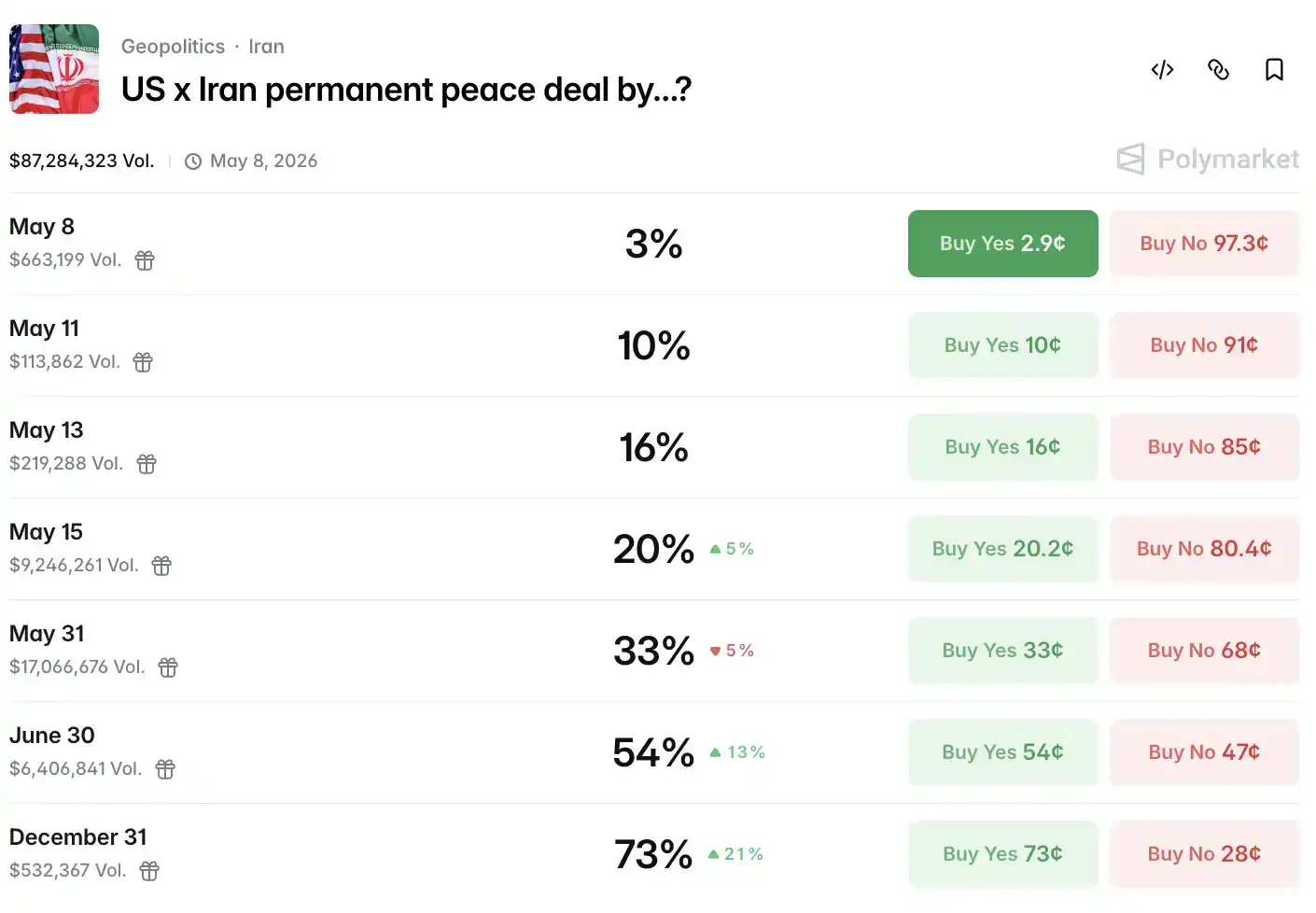
Polymarket data shows the probability of a peace deal being reached before May 15 has fallen to 15%, and was around 20% at the time of writing.
Consequently, oil prices traced a dramatic V-shape.
Intraday, Brent futures once fell to $96.73, a drop of over 12%. As the peace talk news gradually soured, bulls re-entered the market. Brent closed near $100, and WTI closed around $90.5, both barely holding key round-number levels.
Notably, Dated Brent (spot) has fallen below the Brent front-month futures contract, a reversal signal of the backwardation structure, hinting that physical crude oil supply is relatively ample at present, forming a structural divergence from the geopolitical risk priced into the futures market.
Outside the Strait, U.S. crude oil exports hit a record high last week, with global buyers accelerating their shift to U.S. supply sources to avoid Middle East transportation risks.
BNP Paribas' head of energy strategy, Aldo Spanjer, has simply abandoned trading the energy market: "The outcome is too binary, headlines are enough to trigger stop-losses, this has happened five times this week already, it's almost untradeable." TP ICAP energy analyst Scott Shelton called the current situation a "risk desert," with only hedging positions left in the market.
Can Bitcoin Hold the $80,000 Level?
Now, turning to the asset of most interest to crypto enthusiasts: Bitcoin.
Bitcoin continued to face pressure in this context, with spot Bitcoin falling about 1.56% on the day, finding support near the $80,000 level.
Unlike previous rounds of panic selling, this pullback structure is relatively healthy. On-chain data shows the proportion of long-term holder supply has risen to 78.3% of the circulating supply, exchange balances have fallen consecutively to a 7-year low, and whale addresses have net purchased about 270,000 BTC over the past 30 days. BlackRock's Bitcoin ETF holdings have grown to about $62 billion, indicating a stabilizing institutional holding structure.
Regarding Ethereum, sentiment this week overall benefited from rising expectations for U.S. crypto regulatory legislation to be enacted. ETH rose approximately 5.6% over five days, oscillating in the $2,360–$2,412 range, with its market cap maintaining around $2.33 trillion.
It's worth noting that April of this year was the strongest month for net inflows into U.S. spot Bitcoin ETFs since October 2025, with net inflows reaching $2.44 billion. The institutional pipeline continues to open, forming an internal echo with Bitcoin's relatively resilient performance amidst current macro turbulence.
From a narrative logic perspective, the impact of the Middle East situation on the crypto market is showing structural differentiation. Surging oil prices and rising inflation expectations lead to increased probability of Fed rate hikes, thus pressuring Bitcoin; but simultaneously, capital from some Middle Eastern regions is accelerating the transfer of assets into decentralized channels to evade potential sanction risks and liquidity constraints within the banking system. On the same day the U.S. Treasury added sanctions on Iranian-related oil networks, on-chain data showed slight abnormal movements in anonymous mixing transaction volumes. This is not a conclusion, but a signal worth continuous observation.
On the crypto legislation front, market expectations for the enactment of a U.S. regulatory framework are also supporting sentiment. Stablecoin and digital asset market structure bills are advancing in the U.S. Senate and House of Representatives. If passed within the year, they would provide compliance support for institutions to further expand allocations.
U.S. Stocks Fluctuate Near Highs, Semiconductors Catch Down
Thursday was the second directionless trading session of the week.
The S&P 500 closed down 0.38% at 7,337.11 points; the Dow fell 313.62 points (-0.63%) to 49,596.97 points; the Nasdaq's decline was relatively restrained, closing down just 0.13% at 25,806.20 points. The Russell 2000 small-cap index fell 1.63%, the largest decline among major indices for the day.
All sectors closed lower, with the energy sector suffering the heaviest losses and consumer staples showing relative resilience.
Divergence was evident within the tech sector. Tesla rose 3.28%, Nvidia rose 1.76%, Microsoft rose 1.68%, Meta rose 0.64%; Apple fell 0.03%, Alphabet fell 0.01%, Amazon fell 1.39%. The "Magnificent Seven" combined index rose a slight 0.69% overall, one of the few bright spots of the day.
Semiconductors were the hardest hit. The Philadelphia Semiconductor Index (SOX) closed down 2.72%, with AMD down 3.07% and TSMC's ADR down 1.28%. Stronger-than-expected earnings from Qualcomm and Fortinet, and Datadog's analyst day providing some support to the software sector—potentially marking a fourth consecutive weekly gain for the software index—could not conceal the systemic selling pressure in the chip sector.
Data from Goldman Sachs' trading desk provides a more telling dimension: their high-beta momentum basket fell a sharp 8% on the day, while the S&P 500 and Nasdaq 100 fell less than 0.5%. This spread is among the top ten extreme single-day values of the past five years, and this marks the fifth such occurrence so far in 2026.
Furthermore, the VIX fell 1.78% to 17.08, showing a rare divergence from the stock market decline. Typically, when stocks fall, the fear index rises; their concurrent downward movement suggests the market may already be waiting for tomorrow's (Friday) Non-Farm Payrolls data, unwilling to place directional bets in the short term.
Recent U.S. stock earnings reports are also highly representative. Arm Holdings reported its FY2026 Q4 earnings after the close on May 6th, with adjusted EPS of 60 cents and revenue of $1.49 billion, both slightly surpassing analyst expectations. Licensing revenue grew 29% year-over-year, royalty revenue grew 11%.
The report itself wasn't bad. But on the earnings call, management mentioned that the company's latest AGI CPU data center chips face supply bottlenecks, with an additional $1 billion in demand temporarily unable to convert into revenue. Raymond James analyst Simon Leopold wrote directly: "Supply constraints led management to temper revenue guidance increases."
The stock surged as much as 13% after hours, only to give back all gains and then some, falling over 10% after Thursday's open, becoming one of the heaviest decliners among tech giants for the day. This is the third time in the past year Arm has seen "better-than-expected earnings" followed by a "next-day plunge."
After Arm's performance, CoreWeave took the stage after hours. Its Q1 actual revenue beat expectations, its revenue backlog has ballooned to $99 billion, and Nvidia injected another $2 billion during the quarter. However, its Q2 revenue guidance fell short of market expectations, while its full-year 2026 capital expenditure guidance was raised to $31-35 billion, more than doubling the $14.9 billion in 2025. Its stock fell over 10% after hours.
CoreWeave's losses are real, its debt is real, but its orders are also real: a $99 billion revenue backlog, and Nvidia's continuous backing. But clearly, everyone is doubting whether this future money can outrun today's capital expenditures.
Fed Leans Hawkish, Friday's Non-Farm Payrolls Data
Finally, on the Federal Reserve front, slight hawkish shifts appeared in the short-term interest rate market that day, with the probability of an unexpected rate hike before year-end rising to about 20%. But the market largely viewed this as noise, as labor data remains strong. Weekly initial jobless claims only edged up to 200,000, showing no substantial cracks yet in the job market.
The 10-year U.S. Treasury yield rose about 4.8 basis points to 4.393%, moving higher in sync with the rebound in oil prices.
Offshore Chinese yuan briefly broke through 6.80 per dollar, hitting a four-year high, before retreating slightly, closing the New York session at 6.8078. The U.S. Dollar Index rose 0.08% to 98.10.
Regarding gold, spot gold touched above $4,700 per ounce intraday, a two-week high, closing up 0.22% at $4,701.61. The tug-of-war between inflation worries fueled by oil prices and safe-haven demand amid peace talk expectations found gold its place. Silver saw larger gains, with COMEX silver futures closing up 3.02% at $79.64 per ounce, and spot silver briefly breaking above $82 intraday.
In European markets, the pan-European STOXX 600 fell 1.02%, the UK's FTSE 100 fell 1.55%, France's CAC 40 fell 1.17%, and Germany's DAX fell 0.99%.
The variable of the Strait of Hormuz is not yet cleared. And the next market trigger is Friday's Non-Farm Payrolls data. This week's initial jobless claims slightly rose to 200,000 but remained below the market expectation of 206,000, indicating continued mild layoff pressure in the labor market. With the probability of a Fed rate hike this year rising to about 20%, this also means the jobs data will become the next coordinate for repricing.