The US estimated damage from cryptocurrency fraud at $80.7 billion

cryptonews.ruPublished on 2026-07-29Last updated on 2026-07-29

Abstract

According to a report by the Consumer Federation of America (CFA), U.S. citizens lost an estimated $80.7 billion to cryptocurrency fraud in 2025. This figure is derived from data reported to the FBI's Internet Crime Complaint Center (IC3), which received 181,565 crypto-related complaints with claimed losses of $11.37 billion—a 22% increase from 2024. The CFA applied a 7.1 multiplier to account for significant underreporting. Cryptocurrency fraud accounted for over half of all losses reported to IC3. The largest category of reported damage was investment fraud, totaling $8.6 billion (estimated $61.4 billion after the multiplier). The FBI specifically noted 61,559 crypto investment fraud complaints with losses of $7.23 billion. Individuals over 60 were disproportionately affected, reporting $4.43 billion in losses from 44,555 complaints. Overall, IC3 received over 1 million complaints across all internet crimes in 2025, with reported losses of $20.88 billion. The CFA estimates total losses at $148.2 billion, or $1,009 per U.S. household. For the first time, the FBI separately tracked AI-enabled crimes, logging 22,364 complaints with $893.3 million in reported losses (estimated $6.3 billion). The FBI also highlighted its "Operation Level Up" initiative, launched in 2024, which has prevented over $500 million in potential crypto fraud losses.

In 2025, US citizens lost $80.7 billion due to cryptocurrency fraud. These figures were cited by the Consumer Federation of America (CFA).

The calculation is based on data from the FBI's Internet Crime Complaint Center (IC3). Last year, IC3 recorded 181,565 reports with a cryptocurrency component. The reported damage amounted to $11.37 billion, which is 22% more than in 2024.

Cryptocurrencies accounted for more than half of all losses reported to IC3.

The CFA multiplied the center's reported damage figure by a factor of 7.1. The organization explained this is due to underreporting: according to 2017 data from the US Bureau of Justice Statistics, only about 14% of victims of financial fraud report the incident to the police.

For all types of internet crimes, IC3 received 1,008,597 complaints. The reported damage amounted to $20.88 billion. The CFA estimated the total losses of Americans from online fraud and internet crimes at $148.2 billion, or $1,009 per household.
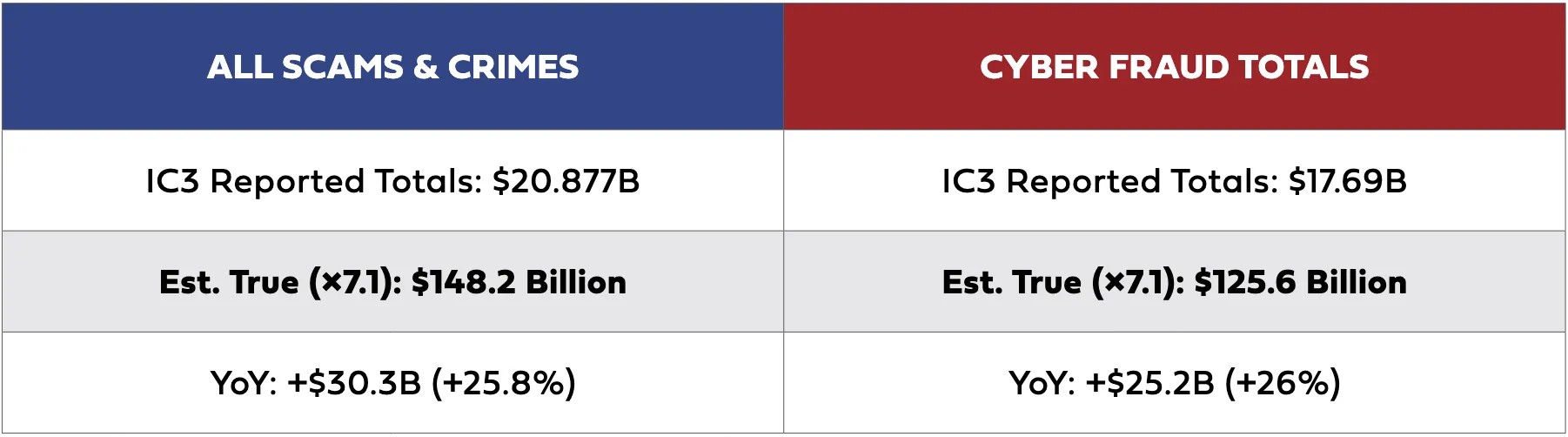
Source: Consumer Federation of America.

The largest category by reported damage in IC3 was investment fraud. In 2025, losses amounted to about $8.6 billion. The total figure was estimated at $61.4 billion after applying the coefficient of 7.1.
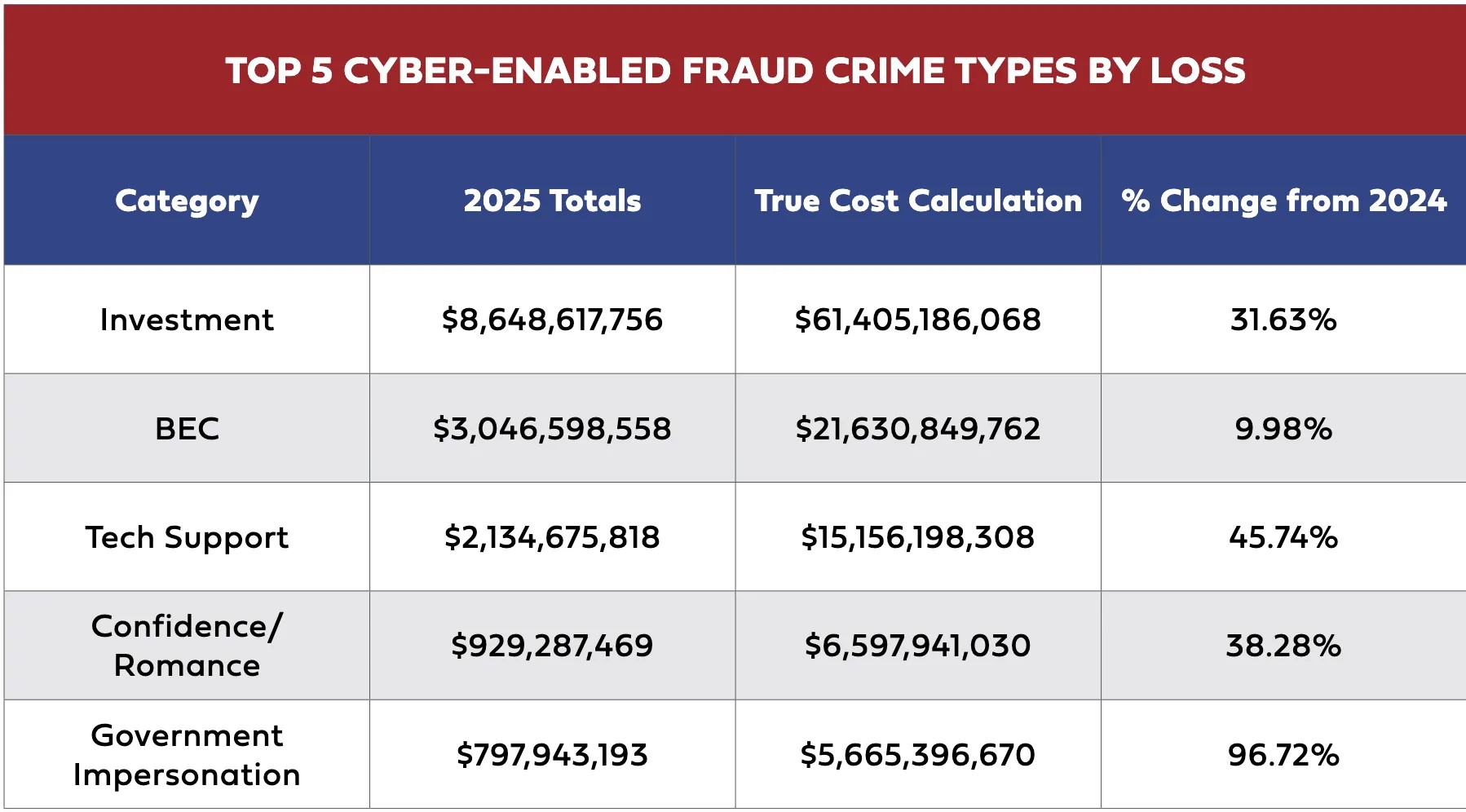
Source: Consumer Federation of America.

In a separate section on cryptocurrencies, the FBI listed 61,559 complaints about crypto investment fraud. The reported losses for them reached $7.23 billion. People over 60 years old filed 44,555 reports with a cryptocurrency component. Their reported losses are estimated at $4.43 billion, almost 39% of all crypto losses recorded by IC3.

For all types of internet crimes, this age group also suffered the largest damage — $7.75 billion. The average reported figure was $38,500 per complaint.
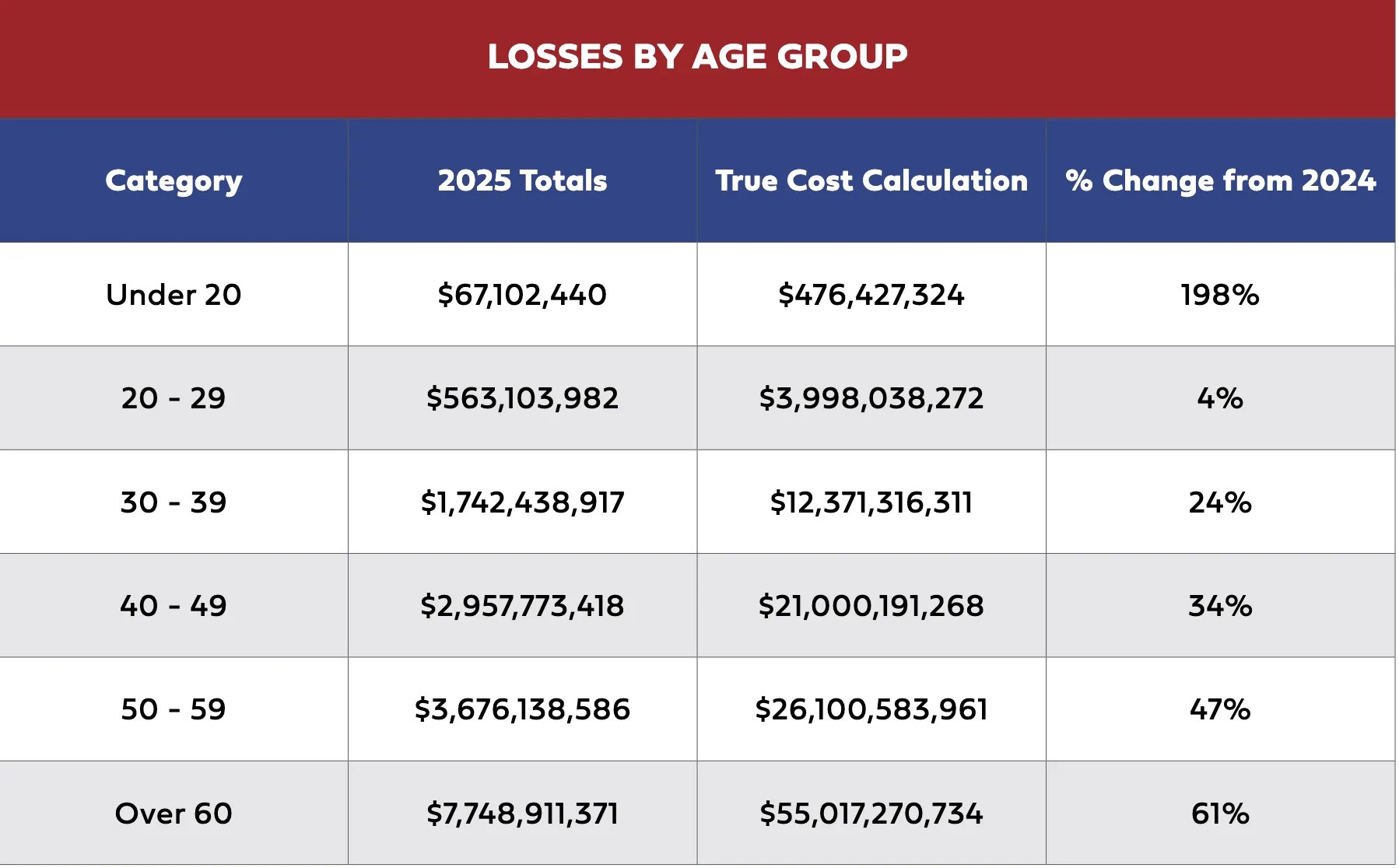
Source: Consumer Federation of America.

IC3 for the first time separately accounted for crimes involving the use of AI. In 2025, the FBI recorded 22,364 such complaints and $893.3 million in reported losses. The CFA recalculated this figure to $6.3 billion in estimated damage.

According to the FBI, criminals use artificial intelligence to create fake social media profiles, clone voices, forge documents and videos featuring public figures or victims' loved ones.

The IC3 report also described the FBI's initiative against crypto investment fraud, Operation Level Up, launched in early 2024. According to the bureau, since then, the operation has helped notify over 8,000 potential victims and prevent over $500 million in losses. In 2025, the figures were 3,780 people and $225.9 million in potential damage, respectively.

Digital Slavery in Myanmar: How a Network of Fraud Factories Operates in the Country

Recall that in May, the FBI announced the seizure of more than 127,000 BTC worth about $8 billion as part of an international operation, Operation Blackout, against scam centers and associated networks.


Related Questions

QWhat was the estimated total loss due to cryptocurrency fraud for U.S. citizens in 2025 according to the Consumer Federation of America (CFA)?

AThe Consumer Federation of America (CFA) estimated the total loss for U.S. citizens due to cryptocurrency fraud in 2025 to be $80.7 billion.

QHow did the CFA calculate its estimate of $80.7 billion in crypto fraud losses from the FBI's IC3 reported figure of $11.37 billion?

AThe CFA calculated its estimate by applying a multiplier of 7.1 to the FBI's IC3 reported loss of $11.37 billion. This adjustment is based on a U.S. Bureau of Justice Statistics report indicating that only about 14% of financial fraud victims report the crime to the police.

QWhich demographic group suffered the largest reported financial loss from all types of internet crimes according to the FBI's IC3 data?

AAccording to the FBI's IC3 data, people aged 60 and older suffered the largest reported financial loss from all types of internet crimes, totaling $7.75 billion.

QWhat was the total estimated damage from AI-related crimes in 2025 after CFA's calculation?

AAfter applying the 7.1 multiplier, the CFA estimated the total damage from AI-related internet crimes in 2025 to be $6.3 billion, based on the FBI's IC3 reported figure of $893.3 million.

QWhat is Operation Level Up, and what was its reported impact in 2025 according to the FBI?

AOperation Level Up is an FBI initiative launched in early 2024 to combat crypto investment fraud. In 2025, the operation helped notify 3,780 potential victims and prevent an estimated $225.9 million in potential losses.

Related Reads

Anthropogenic Artificial Intelligence Breaks HAWK-256 in 60 Hours, Sparking Concerns Over Bitcoin

An unpublished Anthropic AI model, Claude Mythos Preview, broke the post-quantum signature scheme HAWK-256 in about 60 hours at a cost of roughly $100,000. The AI uncovered a previously unknown symmetry in HAWK's design, reducing its security effectiveness by 50% and slashing the required work from ~2^64 to ~2^38 operations. The algorithm, a candidate in NIST's post-quantum cryptography evaluation, was subsequently withdrawn by its creators. This event does not pose an immediate threat to Bitcoin, as Bitcoin never used HAWK-256. Bitcoin currently relies on ECDSA and Schnorr signatures on the secp256k1 elliptic curve, which are unrelated. However, the incident significantly changes a key assumption in Bitcoin's post-quantum roadmap: AI is making the testing and potential breaking of complex cryptographic systems faster and more affordable. The development intensifies the debate on when Bitcoin should begin its transition to quantum-resistant cryptography. Proposals like BIP-360 (introducing P2QRH outputs using NIST-approved ML-DSA/SLH-DSA) and BIP-361 (phasing out ECDSA) are already in motion, having bypassed HAWK. The core challenge is whether AI-assisted cryptanalysis could compromise these intended replacement algorithms before the network completes its migration. Analysts warn that AI is accelerating cryptanalysis, compressing security timelines. Combined with quantum computing advances, this underscores the urgency for Bitcoin's transition. Reports estimate roughly 6.7 million BTC (worth nearly $600 billion) could be vulnerable to a sufficiently advanced quantum computer, with a non-trivial probability of such a machine existing by 2035. The primary issue is no longer solely hardware development but whether the network can execute a successful protocol upgrade in time.

cryptonews.ru20m ago

Anthropogenic Artificial Intelligence Breaks HAWK-256 in 60 Hours, Sparking Concerns Over Bitcoin

cryptonews.ru20m ago

Trading

Spot
活动图片